Executive Overview
In a landmark convergence of contemporary art, architectural intervention, and high-profile institutional collaboration, the Hayward Gallery’s iconic brutalist exterior is set to undergo a dramatic visual transformation. Swiss-based artist Renée Levi is preparing to unveil September, a sweeping large-scale outdoor public artwork that recontextualises one of London’s most recognisable modernist structures through the lens of vibrant, gestural abstraction. Opening to the public on September 23, the commission represents Levi’s very first large-scale public art project in the United Kingdom.
The project is the result of a high-profile curatorial partnership between the Hayward Gallery—a cornerstone of London’s Southbank Centre renowned for its fearless exhibition programming—and Audemars Piguet Contemporary, the dynamic art commissioning arm of the Swiss watchmaker known for supporting ambitious, experimental contemporary practices. By fusing Levi’s signature painterly approach with the heavy, textured concrete panels of the Hayward’s brutalist facade, the collaboration aims to challenge conventional perceptions of how public art interacts with architectural space.
In tandem with the physical unveiling of September, Dazed Club—the membership and cultural platform of Dazed—has announced an exclusive opportunity for an emerging arts writer within its community to interview Renée Levi. The resulting Q&A will be published globally on Dazed Digital, offering a vital platform for early-career arts journalism. This initiative forms a core pillar of a wider creative collaboration between Dazed Club and Audemars Piguet Contemporary, which will culminate in an exclusive live event for Dazed Club members and the broader London arts community at the Southbank Centre’s St Paul’s Pavilion on October 12.
This comprehensive report examines the genesis of the September commission, details the chronological rollout of the project, analyses the structural and philosophical implications of merging painting with brutalist architecture, evaluates the institutional metrics driving the collaboration, and explores the long-term outlook for public contemporary art interventions in the UK capital.
Detailed Chronology: From Concept to Public Unveiling
The realisation of September is the culmination of years of quiet dialogue, meticulous planning, and rigorous site-specific research. While the public debut is slated for late September, the project’s historical timeline reveals a deeply considered approach to institutional commissioning.
- Pre-2023: Long-Term Artistic Tracking: Audemars Piguet Contemporary spent several years following Renée Levi’s evolving practice. Known for her immersive installations, architectural interventions, and dynamic explorations of colour and line, Levi’s work caught the attention of the organisation’s curatorial team as a prime candidate for a monumental public scale-up.
- Late 2023 to Early 2024: The Hayward Partnership: Discussions began in earnest between Audemars Piguet Contemporary and the Hayward Gallery leadership team. Identifying the Hayward’s unapologetically brutalist architecture—with its raw concrete ribs, stairwells, and stark geometric planes—as a formidable yet fertile canvas, the two entities formalised their co-commissioning partnership.
- Mid-2024: Site-Specific Development: Renée Levi conducted intensive site visits to the Southbank Centre, studying the shifting light, pedestrian traffic patterns, spatial rhythm, and tactile materiality of the Hayward Gallery. Rather than treating the building as a passive exhibition wall, Levi developed a visual vocabulary tailored specifically to the concrete’s porous, textured surface.
- August 2024: Media and Community Partnerships: Planning commenced for community engagement, leading to the partnership with Dazed Club. Organisers structured an open call for an emerging arts writer to secure an exclusive interview with Levi, bridging the gap between high-level institutional commissioning and grassroots creative talent.
- September 23, 2024: Public Opening of September: The large-scale outdoor artwork officially debuts on the exterior of the Hayward Gallery, transforming the brutalist landmark into a living, breathing painting.
- October 12, 2024: Dazed Club Exclusive Event: The collaboration hits its milestone community phase with an intimate, high-impact gathering at the Southbank Centre’s St Paul’s Pavilion, bringing together Dazed Club members, artists, critics, and curators to dissect the themes underlying Levi’s intervention.
Supporting Context & Metrics: The Intersection of Brutalism and Abstraction
To fully appreciate the significance of September, one must examine the physical and ideological friction between Renée Levi’s artistic methodology and the architectural legacy of the Hayward Gallery.
Built in the late 1960s and opened in 1968, the Hayward Gallery is a prime exemplar of brutalist architecture—a style characterised by massive, unadorned concrete volumes (béton brut), severe geometries, and an unyielding structural honesty. While celebrated today as a masterpiece of post-war civic design, brutalism has historically divided public opinion, often perceived as cold, forbidding, or aggressively monolithic.
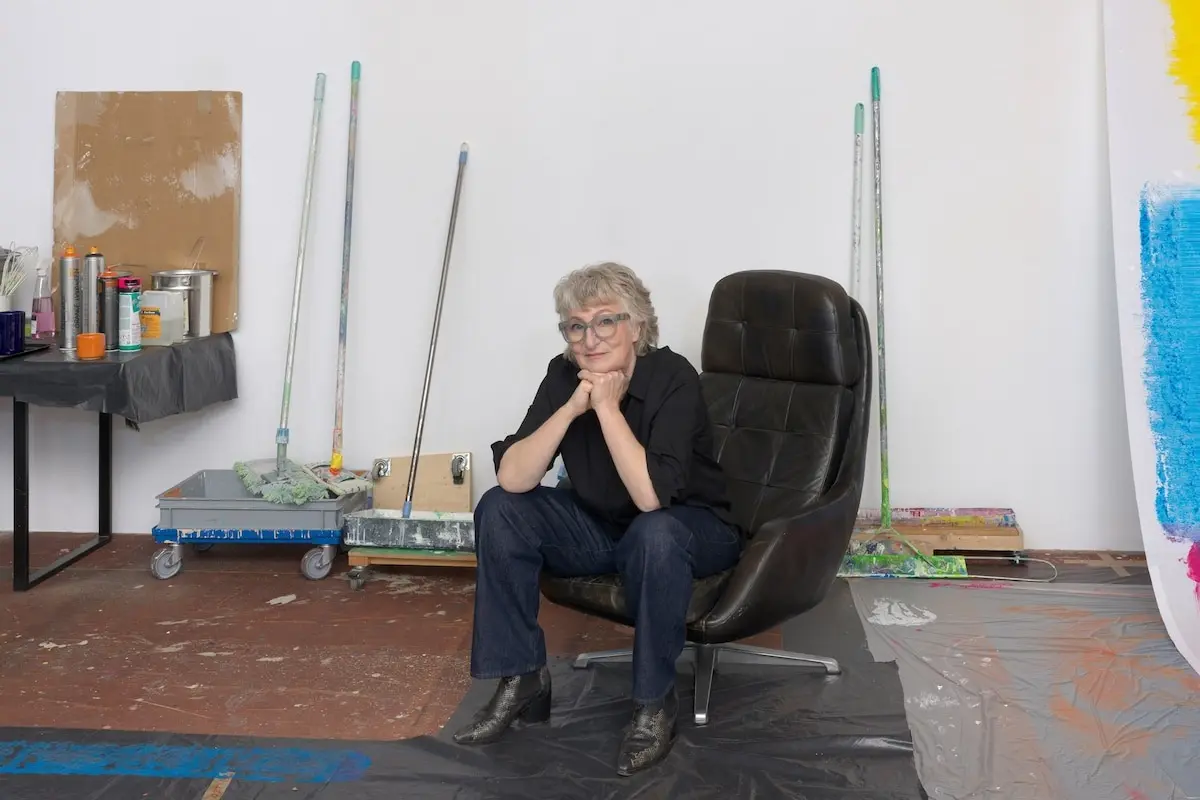
Renée Levi’s artistic practice offers a direct counter-narrative to this austerity. Working across painting, digital media, and spatial installations, Levi is celebrated for her gestural dynamism, vibrant chromatic palettes, and an intuitive understanding of scale. Her marks—often executed with speed, precision, and visceral energy—infuse static environments with a sense of rhythm, motion, and emotional resonance.
By applying her painterly ethos to the exterior of the Hayward Gallery, Levi performs an act of architectural alchemy. She does not mask the building; rather, she dialogues with it. The juxtaposition of fluid, expressive strokes against rigid, weathered concrete creates a dynamic tension that alters how viewers experience the Southbank public realm. Passersby are forced to look up, reconsidering the texture of the city around them through an explosion of colour and form.
The Curatorial Vision: Audemars Piguet Contemporary and the Hayward
The partnership between Audemars Piguet Contemporary and the Hayward Gallery represents a sophisticated model of private-public cultural funding. Founded to support living artists in creating projects outside their usual comfort zones, Audemars Piguet Contemporary provides artists with the financial backing, time, and curatorial freedom necessary to execute ambitious visions that might otherwise be unfeasible within standard institutional budgets.
Audemars Piguet Contemporary Curator Audrey Teichmann underscores the nuance of Levi’s approach: "Levi approaches the Hayward Gallery’s exterior as more than a backdrop, responding to its rhythm, materiality, and scale." This philosophy shifts the paradigm of public art from transient ornamentation to deeply integrated spatial critique. The building becomes an active participant in the artwork, its raw concrete ribs catching shadows, reflecting changing London weather, and framing Levi’s gestural interventions.
Empowering Emerging Voices: The Dazed Club Initiative
In parallel with the physical installation, the collaboration places heavy emphasis on critical discourse and youth engagement through Dazed Club. By opening up the opportunity for an emerging arts writer to interview Renée Levi for Dazed Digital, the initiative tackles a persistent barrier in the creative industries: access.
Arts journalism has faced significant economic and structural pressures in recent years, often making it difficult for early-career writers to secure high-profile commissioning credits with major international publications. By embedding an open call directly within the Dazed Club digital app, the project democratises the pathway to cultural criticism, ensuring that the discourse surrounding September is shaped by fresh perspectives rather than established orthodoxies.
Official Statements and Industry Insights
The collaborative nature of September has generated significant commentary from the key institutions and creative leaders driving the project.
Audrey Teichmann, Curator at Audemars Piguet Contemporary, elaborated on the multi-year journey of tracking Levi’s work and the conceptual framework underpinning the Hayward intervention:
"Having followed Renée Levi’s work for years, we knew her practice possessed a rare capacity to alter spatial psychology. The Hayward Gallery presents a unique challenge due to its uncompromising brutalist architecture. Levi does not view the exterior as a mere backdrop; instead, she reads its rhythm, materiality, and scale as musical or gestural cues. This commission gives her the canvas to push her practice into entirely unexpected territory, creating a dialogue between contemporary painting and post-war architectural history that London audiences have never experienced before."
Representatives from the Hayward Gallery highlighted the significance of welcoming Levi for her first major UK public commission, noting that the project aligns with the gallery’s long-standing tradition of presenting boundary-pushing art that spills out from traditional gallery walls and into the public square.
Meanwhile, editorial teams at Dazed expressed enthusiasm for the upcoming Dazed Club activation:
"Our mission with Dazed Club has always been to foster active participation rather than passive consumption. By pairing an emerging arts writer with an artist of Renée Levi’s stature, we are not only documenting a major moment in contemporary public art but also actively shaping the future of cultural criticism. The October 12 event at St Paul’s Pavilion will serve as a vital crucible for these ideas, bringing our community directly into the heart of London’s contemporary art conversation."
Future Outlook: The Legacy of September and Public Art in London
As London’s cultural landscape continues to navigate post-pandemic economic shifts, funding models for public art are undergoing profound transformation. The collaboration between the Hayward Gallery and Audemars Piguet Contemporary points toward a sustainable, ambitious future for institutional commissioning—one where private philanthropic vision aligns seamlessly with public gallery stewardship to execute projects that would otherwise remain financially or logistically out of reach.
Furthermore, the integration of community-driven platforms like Dazed Club signals a broader industry shift toward inclusivity and participatory culture. The old model of the ivory-tower art critic is steadily giving way to porous, community-engaged ecosystems where emerging writers, local residents, and international art enthusiasts all have a stake in interpreting major cultural moments.
When September opens to the public on September 23, its impact will extend far beyond its physical lifespan on the Hayward Gallery’s walls. It will serve as a case study in how contemporary artists can converse with the architectural ghosts of the twentieth century, transforming imposing civic structures into canvases for vibrant, human-scale expression.
For the emerging arts writer selected through the Dazed Club open call, the commission offers a career-defining platform, while the October 12 gathering at St Paul’s Pavilion will ensure that the conversations sparked by Levi’s intervention continue to ripple through London’s creative communities long after the paint has settled. Applications for the writing opportunity are currently open via the Dazed Club app, inviting the next generation of cultural commentators to make their mark on one of the most anticipated art events of the autumn season.