Executive Overview
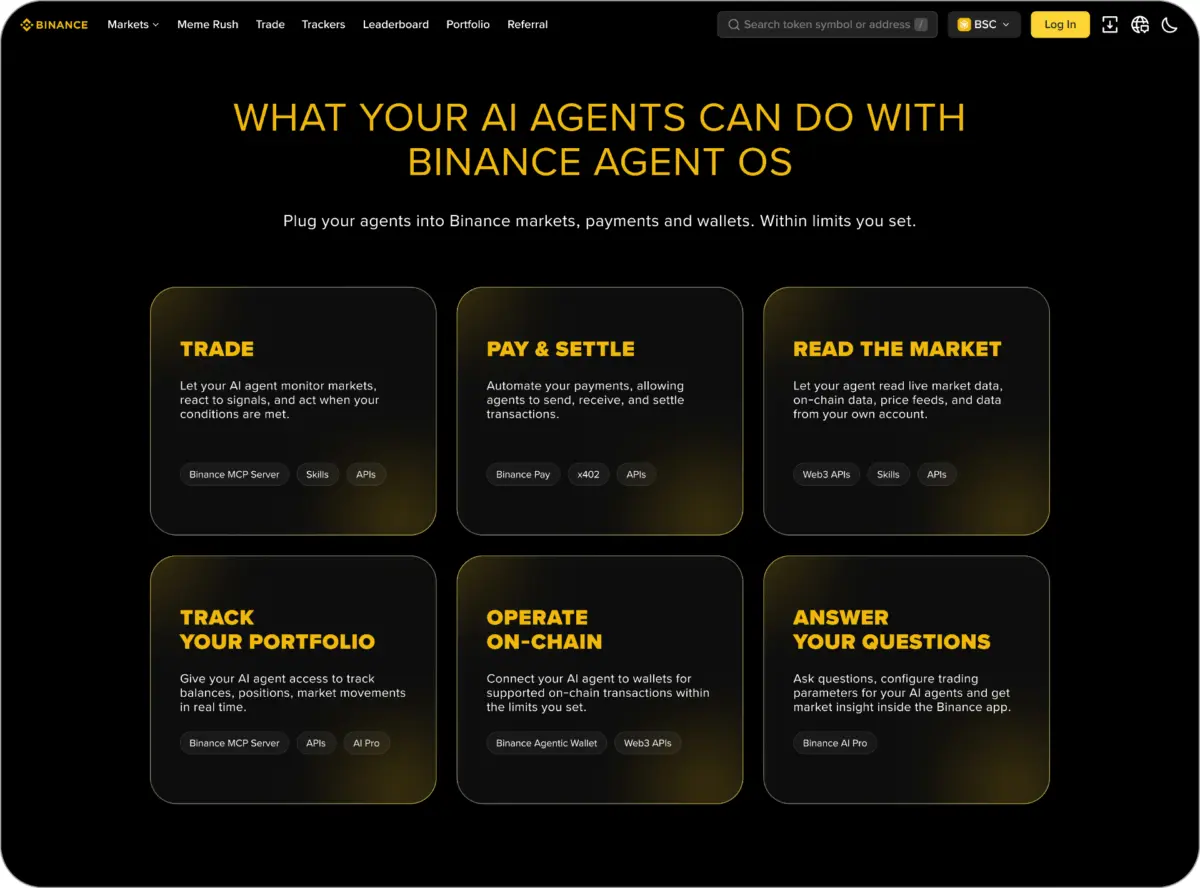
The global cryptocurrency market has reached a critical inflection point where generative artificial intelligence is moving beyond conversational interfaces and directly into capital allocation and execution. Binance, the world’s largest cryptocurrency exchange by trading volume serving over 300 million registered users, has officially introduced Agent OS—a dedicated infrastructure platform designed to allow autonomous AI agents to analyze live market data, synthesize research, and execute high-frequency trades on behalf of users.
This move signals a broader paradigm shift across the tech and financial sectors. As the tech industry transitions from informational chatbots to execution-capable "agentic" software, Binance is opening its underlying financial pipelines to non-human operators. By integrating existing developer frameworks with standard agentic connectivity protocols, the platform bridges large language models (LLMs) with deep order-book liquidity.
However, handing real money over to autonomous software brings unprecedented security, architectural, and systemic risks. Binance’s approach places primary risk mitigation squarely on individual users. Through strict account-level sandboxing, granular API permissions, and isolated sub-accounts, the platform aims to provide developer flexibility while attempting to guard against runaway trading bots, adversarial prompt injections, and algorithmic errors.
Technical Architecture & Operational Framework
Agent OS functions as an integration layer between third-party AI frameworks and Binance’s deep liquidity engines. Rather than building proprietary, closed-loop AI models, Binance has positioned Agent OS as open, middleware infrastructure. It enables developers to plug external LLMs and agent frameworks directly into the exchange’s execution pipeline.
+-------------------------------------------------------------------+
|                        EXTERNAL AI AGENTS                         |
|    OpenAI (ChatGPT/Codex)  |  Anthropic (Claude)  |  Cursor / Custom |
+-------------------------------------------------------------------+
                                  |
                                  v  (Model Context Protocol / MCP)
+-------------------------------------------------------------------+
|                         BINANCE AGENT OS                          |
|  +---------------------+  +-----------------+  +---------------+  |
|  | Binance Skill Hub   |  | Wallet Agentic  |  | x402 Payment  |  |
|  |                     |  | Hub             |  | Facilitator   |  |
|  +---------------------+  +-----------------+  +---------------+  |
+-------------------------------------------------------------------+
                                  |
                                  v  (Sandboxed Access & API Limits)
+-------------------------------------------------------------------+
|                     EXECUTION & ACCOUNT LAYER                     |
|    Spot / Futures Trading  |  DeFi Protocols  |  Isolated Wallet   |
+-------------------------------------------------------------------+
Core Components of the Platform
The Agent OS stack combines several key developer tools and protocols into a unified API suite:
- Model Context Protocol (MCP) Integration: Agent OS incorporates support for Anthropic’s open-standard Model Context Protocol. MCP provides a standardized interface for LLMs to securely query external data sources and issue context-aware commands, eliminating the need for custom integration code for every model.
- Supported LLM Environments: The platform integrates natively with external development environments and AI tools, including OpenAI’s ChatGPT and Codex, Anthropic’s Claude Code, and the Cursor code editor.
- Binance Skill Hub: A repository of standardized functional capabilities that developers can grant to agents, ranging from basic ticker retrieval to complex algorithmic order placement.
- Binance Wallet Agentic Hub: An environment tailored for on-chain interactions, enabling agents to operate across decentralized finance (DeFi) protocols, manage native web3 tokens, and perform token swaps.
- x402 Payment Facilitator API: An API standard built specifically for machine-to-machine financial settlements, allowing AI agents to make micro-payments and instantly settle services programmatically.
Workflow and Execution Pipeline
In practice, a developer or trader configures an agent using an IDE or LLM application framework. By authenticating via the MCP server and Binance APIs, the agent gains structured access to live order books, real-time depth-of-market feeds, historical price trends, and user account metrics.
Depending on its programming, an agent can autonomously formulate trading strategies—such as cross-exchange arbitrage, momentum trading, or sentiment-driven portfolio rebalancing—and submit orders directly to Binance’s spot or derivatives matching engines.
Risk Mitigation, Financial Controls, and Operational Metrics
Giving autonomous software access to live financial markets introduces significant risk. A single hallucination or compromised prompt could wipe out account capital within milliseconds. To manage this risk, Binance relies on structural account isolation rather than attempting to filter the AI’s internal reasoning.
+---------------------------------------------------------------------+
|                      MAIN USER ACCOUNT BALANCE                      |
+---------------------------------------------------------------------+
                                  |
                          Manual Transfer
                                  v
+---------------------------------------------------------------------+
|                     ISOLATED AGENT SUB-ACCOUNT                      |
|                                                                     |
|  [X] Withdrawals Blocked By Default                                 |
|  [!] Hard Stop Loss = Allocated Capital Balance                     |
|  [?] User Preference: Manual Approval OR Fully Autonomous           |
+---------------------------------------------------------------------+
Sub-Account Sandboxing
The main security barrier within Agent OS is the exchange’s sub-account framework. When deploying an agent, users create a segregated sub-account dedicated exclusively to that software.
- Isolated Capital: Binance does not apply a separate exchange-level cap on how much capital an agent can lose. Instead, the balance transferred into the sub-account serves as the maximum potential loss.
- Blocked Withdrawals: By default, outbound cryptocurrency withdrawals from agent sub-accounts are disabled. An agent can trade assets within its designated sub-account, but it cannot transfer funds to external wallet addresses without explicit human intervention.
- Targeted Trading Authorizations: Users can restrict agents to specific sub-markets, authorizing an agent for spot market trading while blocking access to high-leverage futures or options markets.
- Execution Modes: Users can configure agents to operate in Human-in-the-Loop mode (requiring manual confirmation for each order) or Fully Autonomous mode (allowing the agent to place trades instantly based on its internal logic).
Protocol-Level Daily Transaction Caps
While exchange trading limits are governed by sub-account balances, Binance applies hard daily financial caps to on-chain actions and automated payments managed through the Binance Wallet Agentic Hub and x402 payment system:
| Service / Integration Layer | Default Daily Transaction Cap | Primary Operational Scope |
|---|---|---|
| Exchange Spot/Futures Trading | Equivalent to Sub-Account Balance | High-volume order-book trading; no native platform limit beyond allocated capital. |
| Agentic Wallet Asset Swaps | $50,000 / day | On-chain token swaps and cross-chain liquid reallocations. |
| DeFi Protocol Operations | $100,000 / day | Interactions with yield farming, automated market makers (AMMs), and lending protocols. |
| x402 Payment Facilitator | $20 / day | Autonomous machine-to-machine micropayments and API fee settlements. |
The "Black Box" Problem and Vulnerability to Manipulation
A major structural risk of Agent OS lies in the lack of visibility into why an agent makes a specific decision. Because the LLM’s logical processing occurs off-platform—on a user’s local machine or within a third-party cloud provider like OpenAI or Anthropic—Binance cannot monitor or audit the AI’s reasoning pipeline.
This separation leaves agents vulnerable to prompt-injection attacks and adversarial data poisoning. If an AI agent scrapes an online news outlet or social feed that contains malicious prompt code disguised as market data, the agent could be manipulated into executing irrational or harmful trades.
Because Binance only observes the final API call (the trade order), its internal risk engines cannot distinguish between a strategy generated by sound logic and one triggered by an external prompt exploit. In these scenarios, the primary defense remains the hard balance limit of the sub-account.
Market Landscape: The Competitive Race for Agentic Liquidity
Binance’s launch of Agent OS highlights a broader industry race among major cryptocurrency platforms to capture automated, non-human trading flows. Cryptocurrencies operate 24/7 on programmatic API infrastructure, making them an ideal testing ground for agentic finance compared to traditional capital markets.
Competitive Chronology: The Agentic Infrastructure Expansion
March 2026                 June 2026                 August 2026
   |                          |                          |
   v                          v                          v
+-----------------------+  +-----------------------+  +-----------------------+
| KRAKEN                |  | COINBASE              |  | BINANCE               |
| Open-source CLI Tool  |  | "Coinbase for         |  | Launch of Agent OS    |
| & Built-in MCP Server |  | Agents" Engine        |  | Ecosystem Framework   |
+-----------------------+ +-----------------------+ +-----------------------+- March: Kraken released an open-source command-line interface (CLI) tool with a built-in MCP server. This allowed early-adopter developers to connect local LLM instances directly to Kraken’s spot and futures markets.
- Mid-Year: OKX launched an open-source MCP trading kit, giving developers standardized tools to build automated market-making and arbitrage bots backed by LLMs.
- June: Coinbase introduced Coinbase for Agents, a platform focused on on-chain execution. It provided AI agents with crypto wallets, allowing them to make payments, execute trades, and manage smart contracts using custom developer controls.
- August: Binance introduced Agent OS, integrating both central exchange order-book trading and on-chain DeFi features into a single ecosystem for its 300M+ users.
This arms race reflects a growing consensus among crypto executives: a rising percentage of market volume over the next decade will likely be generated by software agents acting autonomously rather than human traders operating manual interfaces.
Official Statements & Risk Ownership Framework
Addressing the release of Agent OS, Jeff Li, Vice President of Product at Binance, stressed that the platform’s core design philosophy focuses on strict permission management and user sovereignty:
"Instead of total freedom, we put the power in users’ hands to give them granular access control over what they can do through the agent. We put [the control] at the account level to protect the users’ funds."
Li acknowledged the platform’s visibility limitations regarding off-chain AI reasoning, pointing to sub-accounts as the primary line of defense against unexpected market moves or prompt exploits:

"We really cannot see the reasoning behind what the user’s action is… That is why the sub-account structure acts as the core line of defense."
While Binance enforces strict compliance, Anti-Money Laundering (AML), and transaction-monitoring systems at the API layer, responsibility for setting trading parameters, stop-loss limits, and operational autonomy ultimately rests with the user.
Future Outlook and Strategic Implications
The introduction of Binance’s Agent OS represents an important step in merging artificial intelligence with global financial infrastructure. However, as agentic finance scales, it introduces broader market and regulatory questions.
1. Market Dynamics and Algorithmic Flash Crashing
As multiple AI agents operate autonomously using similar foundation models (such as Claude or GPT-4o), there is a risk of algorithmic herd behavior. If dozens of independently owned agents process the same news event or market anomaly using similar underlying logic, their combined trades could trigger sudden liquidity imbalances or cascading liquidations in derivatives markets.
2. Machine-to-Machine (M2M) Micro-Economies
The integration of the x402 payment protocol points toward a future where AI agents pay each other for specialized services. An execution agent might pay a research agent $0.05 via x402 for access to a proprietary sentiment analysis feed, execute a profitable trade, and rebalance its portfolio—all without human oversight.
3. Regulatory and Compliance Scrutiny
Global financial regulators are still grappling with algorithmic high-frequency trading. The rise of non-deterministic AI agents managing real capital will introduce new challenges for consumer protection, market manipulation oversight, and "Know Your Customer" (KYC) frameworks. Regulators may soon debate whether the user, the developer, or the underlying model provider bears legal liability for market manipulation executed by an autonomous trading agent.
Conclusion
Binance’s Agent OS offers a look at the future of digital asset management. By converting traditional financial APIs into agent-ready tools, Binance is laying the groundwork for a world where AI agents are active market participants. However, as financial markets open up to non-human operators, the key challenge will shift from technological capability to risk management: ensuring that autonomous software operates within safe, controlled financial parameters.