
Executive Overview
The consumer technology landscape is on the cusp of an unprecedented financial milestone. According to a landmark market study published by Counterpoint Research, the global consumer wearables market is projected to skyrocket past $1 trillion in cumulative revenue between 2026 and 2032. This staggering economic expansion is not merely a reflection of increased device shipments; rather, it underscores a fundamental evolution in how humanity interacts with personal technology.
For years, wearables were viewed as niche novelty items or supplementary accessories designed primarily for tracking steps during morning jogs. Today, they are transitioning into sophisticated, autonomous hubs for personal health, preventive medicine, and seamless computing.
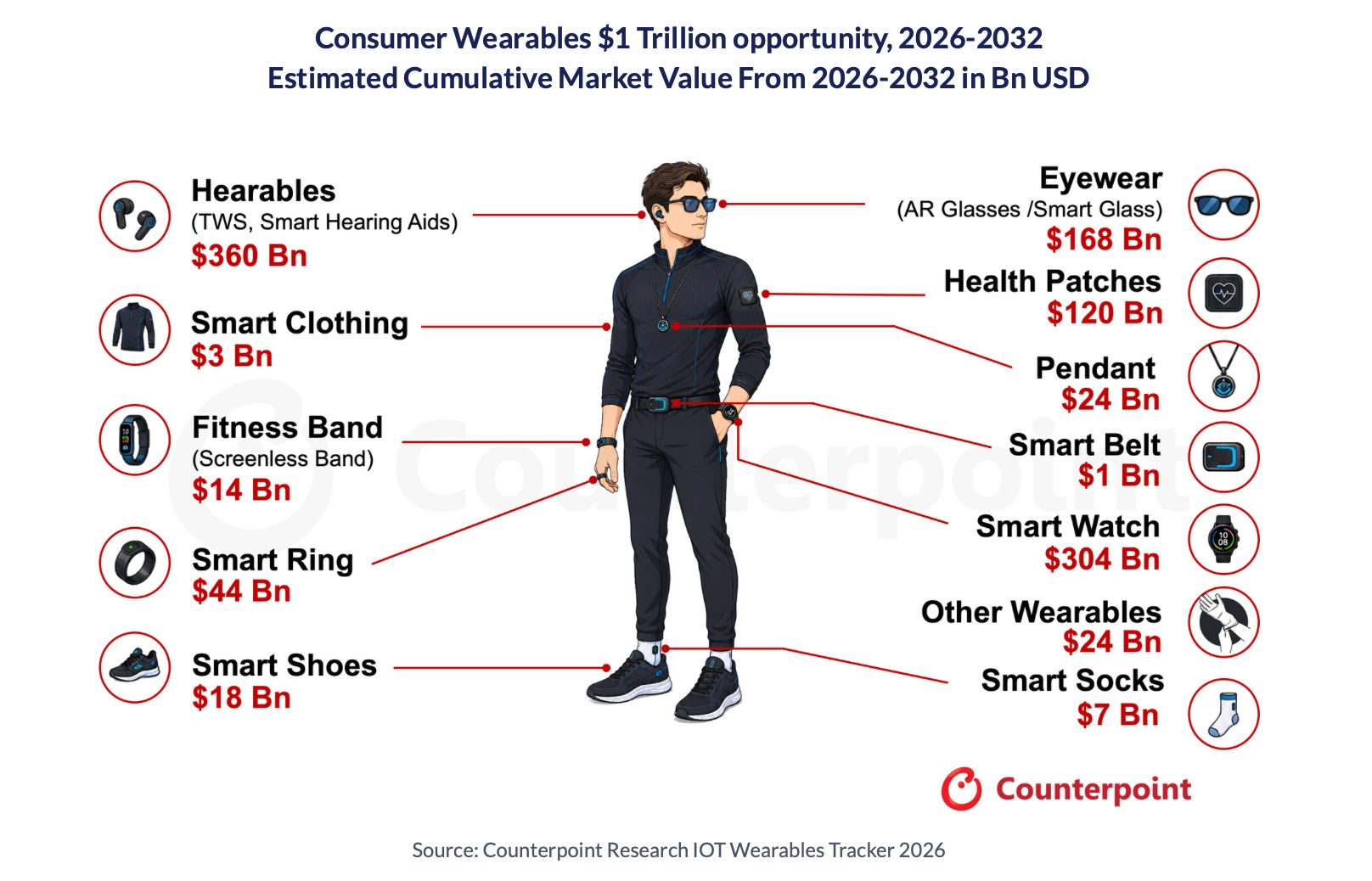
At the vanguard of this trillion-dollar movement are two dominant product categories: True Wireless Stereo (TWS) earbuds and smartwatches. Together, these titans of the tech accessory world are expected to capture a staggering $558 billion of the cumulative market share over the forecast period. Meanwhile, emerging form factors—ranging from smart eyewear and health patches to smart rings and biometric pendants—are quickly diversifying the ecosystem, opening up new frontiers for industry giants like Apple, Samsung, and Google.
This comprehensive analysis examines the growth drivers fueling the wearable economy, breaks down the multi-billion-dollar market segments, explores the shifting paradigm toward proactive healthcare, and evaluates how market leaders are positioning themselves to capitalize on the next decade of innovation.
Detailed Chronology and Market Evolution
To fully grasp the magnitude of a trillion-dollar forecast, it is essential to trace the historical trajectory of the wearables market. The journey from rudimentary pedometers to advanced physiological monitoring systems has been defined by three distinct eras of hardware and software integration.

The Fitness Tracker Genesis (Pre-2016)
The modern wearables boom began in the early 2010s with basic step-counters and sleep-tracking bands. Devices like early Fitbit models and specialized fitness bands dominated the consumer consciousness. During this period, hardware was utilitarian, software ecosystems were fragmented, and utility was largely limited to retroactive data logging. Consumers viewed these devices as fitness journals rather than everyday utility tools.
The Ecosystem and True Wireless Revolution (2016–2025)
The introduction of Apple’s AirPods in late 2016 fundamentally reshaped the audio landscape, sparking the explosive growth of the True Wireless Stereo (TWS) market. Concurrently, the Apple Watch and competing Android-compatible smartwatches matured from smartphone extensions into standalone communication and fitness hubs. During this decade, wearables established deep integration with primary smartphone ecosystems, driving massive global adoption, regular hardware replacement cycles, and widespread brand loyalty.
The Preventive Health and On-Device AI Era (2026–2032)
Entering the 2026–2032 window, the wearables industry is undergoing its most profound transformation yet. As highlighted by Counterpoint Research, revenue growth is now outpacing shipment growth. This dynamic indicates that consumers are increasingly willing to pay a premium for advanced functionality.
The integration of advanced biometric sensors—such as optical heart rate monitors, blood oxygen sensors, electrocardiograms (ECGs), and non-invasive glucose monitoring technologies—is shifting the industry paradigm. Wearables are no longer reactive tools used to review a workout after the fact; they are becoming proactive health guardians designed to flag anomalies and health risks before symptoms manifest in the user. Coupled with on-device artificial intelligence, these tools are transforming passive accessories into active personal health assistants.
Supporting Context & Financial Metrics: Breaking Down the $1 Trillion Ecosystem
The Counterpoint Research report provides a granular look at how the projected $1 trillion in cumulative revenue will be distributed across various hardware categories. While legacy giants maintain their stronghold, emerging categories are carving out lucrative niches.

The Heavyweights: Hearables and Smartwatches
- Hearables (TWS Earbuds): Projected to capture the largest single share of cumulative revenue at approximately $360 billion. Despite intense price competition and feature standardization, the sheer volume of replacement demand and everyday utility (ranging from spatial audio and active noise cancellation to live translation) ensures steady financial returns.
- Smartwatches: Trailing closely behind at $304 billion, smartwatches represent the highest Average Selling Price (ASP) category among traditional wrist-worn devices. The inclusion of premium materials, cellular connectivity, advanced health sensors, and generative AI features will continue to drive revenue higher.
- Combined Impact: Together, smartwatches and TWS devices will generate an estimated $558 billion, anchoring more than half of the entire trillion-dollar market.
The Rising Tides: Smart Eyewear and Health Patches
- Smart Eyewear: Poised to generate $168 billion through 2032. As tech companies solve the engineering challenges associated with weight, battery life, and discreet camera/display integration, augmented reality (AR) glasses and smart audio frames are transitioning from concept designs to mainstream consumer electronics.
- Health Patches: Forecasted to pull in $120 billion. These medical-grade or semi-permanent adhesive sensors represent the bleeding edge of continuous health monitoring, catering primarily to chronic disease management and serious athletic training regimens.
The Niche and Specialty Wearables
Beyond the major revenue drivers, a long tail of specialized form factors is expected to contribute billions to the cumulative total:
- Smart Rings: $44 billion
- Pendants: $24 billion
- Smart Shoes: $18 billion
- Fitness Bands: $14 billion
- Smart Socks, Smart Clothing, and Smart Belts: Projected to generate less than $10 billion each individually, pointing to slower consumer adoption due to washing durability concerns and high price points.
Official Industry Insights and Strategic Analysis
The underlying mechanics of this market shift reveal a maturing consumer base that values convenience, longevity, and health insights above all else. According to Counterpoint’s market analysis:
"Smartwatches and TWS will remain the largest wearable categories, together generating an estimated cumulative revenue of $558 billion between 2026 and 2032. Their scale is supported by large installed bases, replacement demand, everyday use across health, communication and entertainment, and close integration with smartphone ecosystems. Premium hardware, cellular connectivity, advanced health sensors and on-device AI will support rising smartwatch ASPs and expand the category into a preventive-health and personal-computing platform, while TWS value growth remains constrained by feature standardization and price competition."
The Shift to Preventive Healthcare
Perhaps the most significant qualitative takeaway from the research is the industry-wide pivot toward preventive healthcare. For years, digital health tools focused on quantified self-movements—counting steps, measuring active calories, and logging sleep scores.
The next generation of wearables transcends basic metrics. By leveraging sophisticated machine learning algorithms and continuous sensor streams, devices are increasingly capable of identifying silent threats—such as atrial fibrillation, sleep apnea episodes, hypertension indicators, and early-stage systemic inflammation—long before the user experiences physical symptoms. This evolution turns consumer technology into a literal life-saving utility, dramatically increasing the perceived value of premium devices and justifying higher price points.
Future Outlook: Apple and the Competitive Landscape
As the wearables market races toward the trillion-dollar mark, major technology conglomerates are aggressively staking their claims. Among them, Apple Inc. stands in a uniquely advantageous position, already commanding dominant market shares in the two most lucrative categories identified in the report: hearables and smartwatches.
Apple’s Current Footprint and Financial Strength
Apple’s dominance in this sector was recently underscored by its financial reports. During fiscal Q3 2026, Apple reported $7.88 billion in revenue for its Wearables, Home and Accessories segment, marking a robust 6% year-over-year increase and the division’s strongest growth period since fiscal Q4 2022.
Furthermore, independent analyst estimates highlight the sheer scale of individual product lines. Industry trackers project that AirPods alone will surpass $100 billion in cumulative revenue in 2026, cementing the wireless earbud line as one of the most successful consumer electronics products in history.
Expanding Horizons: Beyond the Watch and Earbuds
While Apple Watch and AirPods continue to serve as the bedrock of Apple’s wearable strategy, Cupertino is actively exploring adjacent form factors to capture emerging revenue streams:
- Smart Glasses: Rumors consistently point to Apple developing its own line of AI-powered smart glasses, aimed at capturing a slice of the burgeoning smart eyewear market.
- Smart Rings: Industry leaks indicate that Apple has actively explored a smart ring form factor to rival emerging biometric rings currently dominating specific health-tracking demographics.
- Screenless Fitness Bands: Reports suggest Apple is prototyping simplified, screenless fitness bands designed for minimalist users who prioritize discrete health tracking over notification-heavy smartwatches.
Competitor Strategies
Apple is not alone in its pursuit of the trillion-dollar wearables pie. Samsung continues to refine its Galaxy ecosystem with advanced health metrics on its smartwatches and Galaxy Buds. Meanwhile, specialized players like Oura and Whoop have proven that dedicated form factors like smart rings and performance bands can command fierce brand loyalty and high subscription-based revenues. Google, through its Pixel Watch and Fitbit acquisitions, is similarly doubling down on deep AI-driven health integration via Fitbit’s clinical research background.

Conclusion
The projection that consumer wearables will generate over $1 trillion in cumulative revenue through 2032 is a testament to the indomitable integration of technology into human biology and daily routine. What began as a trend of tracking casual workouts has matured into a foundational pillar of modern consumer electronics and preventive medicine.
As hardware manufacturers refine on-device artificial intelligence, improve battery chemistries, and introduce revolutionary form factors like smart eyewear and health patches, the boundary between consumer gadgets and medical-grade personal care will continue to blur. For industry leaders like Apple and their competitors, the trillion-dollar horizon is not a distant fantasy—it is the active battleground where the future of personal computing and human health will be decided over the next decade.