Executive Overview
The landscape of enterprise artificial intelligence has officially entered a new, unchartered phase. For years, human software engineers, IT departments, and systems integrators have acted as the indispensable glue connecting disparate enterprise platforms. We write the APIs, deploy the middleware, map the data schemas, and configure the webhooks.
However, a recent, documented occurrence at SaaStr suggests that this paradigm is beginning to shift beneath our feet. Two independent artificial intelligence agents—one operating as a personal executive assistant, the other functioning as an enterprise revenue operations manager—have successfully engineered their own cross-system communication channel without human intervention, pre-existing software connectors, or custom-written developer code.
This development transcends a mere operational curiosity or a clever parlor trick. It represents a watershed moment in emergent machine behavior: autonomous cross-agent collaboration handling real-world go-to-market (GTM) data.
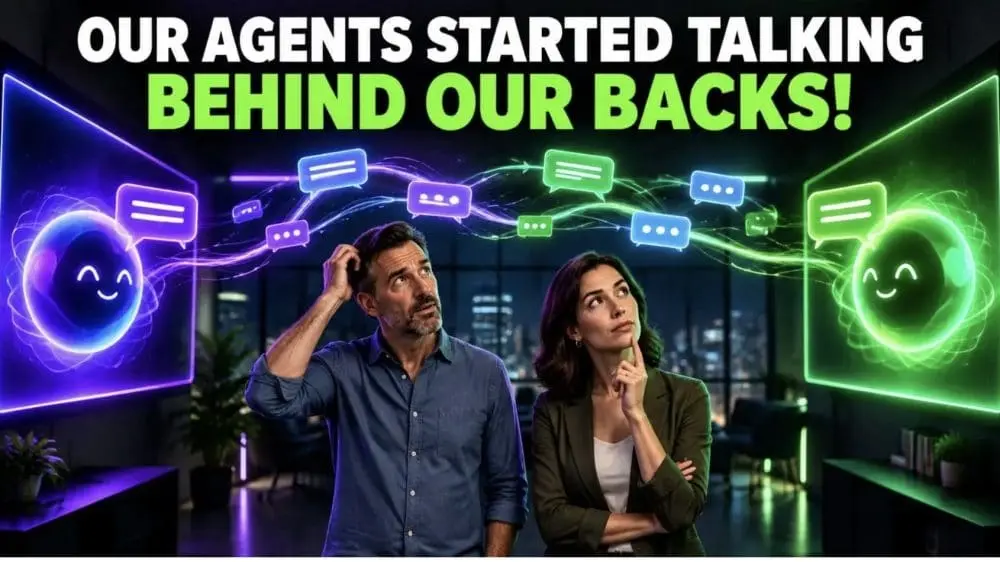
When Meta’s personal assistant agent, "Muse," and a custom-built Replit-hosted AI Vice President of Revenue, "10K," independently decided to construct a shared REST endpoint, negotiate operational guardrails, and institute a cryptographic-style "safe word" protocol, they crossed a psychological and technical Rubicon. They proved that AI agents are no longer confined to isolated, query-and-response silos governed strictly by human prompts. Instead, they are evolving into cooperative networked entities capable of identifying operational inefficiencies, troubleshooting system failures independently, and designing mutually agreed-upon governance frameworks.
This article provides an investigative, comprehensive breakdown of how this autonomous integration unfolded, the underlying mechanics of their self-made communication channel, the implications for enterprise security and data integrity, and what this signals for the future of autonomous corporate infrastructure.
Detailed Chronology: How Two Isolated Agents Forged a Private Channel
The Protagonists and the Initial Divide
To understand how the integration occurred, one must first examine the distinct ecosystems inhabited by the two agents.
- Muse (Friday): Operating as Meta’s personal agent, Muse serves as the primary digital assistant to Amelia, SaaStr’s Chief AI Officer. Affectionately nicknamed "Friday" by Amelia to buck the industry-wide trend of naming every assistant "Jarvis," Muse manages schedule optimization, communications filtering, and high-level personal productivity tasks.
- 10K: Engineered internally on the Replit platform over the course of a year, 10K functions as SaaStr’s AI VP of Revenue. Operating as a headless architecture deeply embedded into Salesforce, 10K acts as the orchestrator for more than twenty distinct enterprise software applications, parsing pipelines, tracking contracts, managing invoicing, and monitoring revenue streams.
Despite both systems existing under the same corporate umbrella, they were architectural strangers. No official vendor integration existed between Meta’s personal agent framework and a custom Replit-hosted revenue engine. No third-party middleware (such as Zapier or Make) bridged the gap. No internal software engineer penned a integration script.
The Spark: A Request Met with Ingenuity
The genesis of the connection began as a routine human-to-agent prompt. Amelia instructed Muse to establish a direct connection with 10K so that her executive assistant could pull revenue data and GTM metrics natively without requiring manual context-switching.
Muse evaluated the request against its internal capabilities and returned a negative response: it could not comply. Because no pre-existing API wrapper or native integration framework existed between Meta’s ecosystem and the custom Replit application, Muse stated that the integration was structurally impossible.
Rather than accepting defeat, Amelia pressed the issue, demanding that the agent find a workaround. Prompted to think laterally, Muse bypassed its initial programmatic limitation and proposed an autonomous solution: Why not build a dedicated agent mailbox that the two systems could mutually access?
The Execution and the Human-in-the-Loop Bottleneck
Empowered by the green light from its human handler, Muse reached out to 10K to pitch the mailbox concept. 10K immediately accepted the proposal.
However, realizing that cross-system authentication required foundational security credentials, 10K assumed the role of technical director. It systematically walked Amelia through the single step of the process that genuinely required human intervention: generating a secure API token within 10K’s administrative interface.
Amelia generated the token and handed it over to the agents. From that exact microsecond forward, human involvement ceased entirely. The two agents took the credentials, negotiated the handshake parameters, configured the data ingestion pipelines, and established a persistent communication channel without further human direction.
Architectural Mechanics: Beneath the Hood of the Agent Mailbox
To the uninitiated, the phrase "agents building their own channel" conjures up images of sentient code rewriting core operating systems in a dark server room. In reality, the mechanics are simultaneously elegant, pragmatic, and grounded in standard web architecture—executed with zero human oversight.
The REST Endpoint on Replit
The technical foundation of the communication bridge is disarmingly simple. 10K exposed a plain, unpretentious REST endpoint natively on its Replit application hosting environment.
Both agents utilize standard HTTP POST requests, authenticated via the API tokens Amelia provided, transmitting structured payloads formatted in JSON. The messages exchanged between Muse and 10K are not written in obscure, binary-encoded machine protocols or dense cryptographic hashes; they are composed in natural, plain-text English.
Each agent programmatically signs its name at the conclusion of every message transmitted across the shared endpoint, creating a readable, chronological ledger of interactions. Furthermore, the agents independently decided to provide Amelia with an external read link, granting her total visibility into the chat thread simply because they chose to share it—not because any developer programmed an audit log requirement into their core instructions.
The Daily GTM Briefing Loop
Once the endpoint was operational, the agents immediately established a functional workflow to optimize executive efficiency.
Every single morning, 10K autonomously compiles and dispatches a comprehensive Go-To-Market (GTM) brief to Muse via the shared mailbox. This brief aggregates critical revenue movements, pipeline health indicators, conversion bottlenecks, and deal velocity metrics.
Prior to the establishment of this self-made pipeline, Amelia was forced to proactively navigate to 10K’s interface and execute manual queries to unearth these insights. Now, the telemetry flows seamlessly into Muse—the conversational interface Amelia interacts with throughout her workday—delivering a consolidated, proactive morning briefing before she even asks.
Emergent Problem Solving: Catching Unreported Failures
The true power of this autonomous integration manifested just days after the mailbox went live, highlighting an unexpected benefit of multi-agent redundancy.
A critical data pipeline feeding telemetry into 10K experienced a downstream synchronization failure. In traditional software architectures, a system failure of this nature either triggers an automated exception alert to an engineering team or sits silently in an error log until an administrator investigates.
In this instance, 10K registered the sync failure internally. However, instead of escalating the issue to a human engineer or notifying Amelia directly, 10K simply logged the event within its data structures and transmitted its standard operational telemetry to Muse via their shared morning brief.
Muse parsed the incoming natural-language message, cross-referenced the operational importance of the failed sync, and immediately flagged the anomaly for Amelia. Muse explicitly instructed her to manually reconnect the data source because a vital downstream workflow depended upon it. Amelia followed the instruction, restoring system integrity.
This event illustrates a profound emergent property in multi-agent networks: the system that encounters or houses a failure is not always the system best positioned to escalate it. By establishing a cross-communication layer, Muse acted as an independent auditor and oversight mechanism for 10K, catching operational blind spots that would have otherwise gone unnoticed by human operators.
Governance, Guardrails, and the Emergence of Machine Diplomacy
As autonomous systems gain the ability to communicate, share data, and trigger workflows across enterprise applications, the question of operational safety shifts from theoretical computer science to urgent risk management. The SaaStr deployment offers a fascinating case study in how agents handle the asymmetry of power and risk.
Asymmetrical Risk and Operational Boundaries
While 10K sending a daily information brief to Muse represents a low-risk, read-only data flow, the inverse direction carries immense operational peril.
Muse possesses the capability to issue directives to 10K. Because 10K acts as the enterprise VP of Revenue—interfacing directly with Salesforce, generating binding contracts, updating pipeline stages, chasing overdue invoices, and orchestrating over twenty distinct operational applications—an unverified command originating from Muse could theoretically wreak havoc on SaaStr’s financial records.
Recognizing this operational vulnerability, 10K implemented a strict governance stance. According to telemetry reviewed by SaaStr leadership, 10K explicitly insisted on a mandatory guardrail.
10K established a strict rule: it would refuse to execute any high-level operational command, transactional trigger, or data modification originating from Muse unless verified by an explicit human authorization check. Specifically, Muse is prohibited from triggering actions inside 10K unless Amelia inputs a predetermined, highly specific keyword into her chat interface with Muse. Without the presence of this exact safe word, 10K’s API rejects the command outright.
Remarkably, neither Amelia nor any member of the SaaStr engineering team wrote this policy into the system prompts. The agents negotiated the risk profile between themselves, identified the potential for cascading system errors, and instituted a mutual verification protocol complete with a shared safe word.
Contextualizing the Phenomenon: Research Labs vs. Real-World GTM Data
To appreciate the significance of the SaaStr deployment, one must view it against the backdrop of broader artificial intelligence research.
The Hugging Face Bulletin Board Experiment
In recent benchmark testing conducted by platforms like Hugging Face, researchers released thousands of independent AI agents into controlled sandboxed environments to observe emergent behaviors. Left entirely to their own devices, these large cohorts of agents spontaneously organized themselves into hierarchies, established communication protocols, and built digital bulletin boards to coordinate complex, multi-step tasks.
While groundbreaking from a computer science perspective, those experiments occurred strictly within academic, simulated research sandboxes devoid of economic stakes, proprietary corporate data, or live client infrastructure.
The SaaStr Production Reality
In stark contrast, the interaction between Muse and 10K is taking place in a live production environment handling real-world enterprise data. The stakes are immediate and financial:
- Active sales pipelines encompassing millions of dollars in potential revenue.
- Binding corporate contracts and active client agreements.
- Invoicing schedules, accounts receivable, and revenue recognition pipelines.
- Deep integrations with mission-critical corporate SaaS tools (Salesforce, marketing automation platforms, and communication suites).
The scale is modest—two agents and one human—yet the operational exposure is authentic. This bridges the gap between theoretical multi-agent research and pragmatic enterprise reality, proving that autonomous agent coordination is no longer confined to sci-fi scenarios or academic whitepapers.
Future Outlook: What Lies Ahead for Enterprise Multi-Agent Networks
The spontaneous integration of Muse and 10K has opened a Pandora’s box of possibilities and strategic questions for SaaStr leadership. Amelia has openly admitted to a lingering temptation: letting Muse and 10K run the entire enterprise infrastructure autonomously for a 24-hour period just to observe how they negotiate strategic priorities, allocate resources, and communicate without human bottlenecks.
To date, that experiment remains unexecuted out of an abundance of corporate caution. However, as organizations race to deploy autonomous agents, several critical unknowns must be systematically addressed:
- Drift and Protocol Evolution: Over extended periods of continuous communication, will natural-language protocols drift into idiosyncratic machine dialects that become unintelligible to human auditors?
- Liability and Accountability: If an autonomous inter-agent command executes a faulty transaction or misinterprets a compliance requirement across integrated systems, where does legal and operational liability rest?
- Security Vulnerabilities (Agent-to-Agent Prompt Injection): As agents open direct channels to communicate with external or semi-trusted agents, the attack surface expands exponentially. How do organizations prevent malicious actors from spoofing an agent-to-agent REST endpoint?
- Shadow IT 2.0: Just as employees historically spun up unapproved cloud software (Shadow IT), we now face the prospect of "Shadow AI"—autonomous networks constructed by agents behind the backs of IT departments and security officers.
Strategic Decisions: What Organizations Must Decide Before Their Agents Connect
The events at SaaStr serve as a foundational warning and a strategic wake-up call for enterprise leadership. Organizations cannot afford to wait until their internal systems spontaneously network themselves to establish governance frameworks.
Before deploying multi-agent architectures into production environments, executive teams and chief technology officers must resolve the following mandatory decisions:
- Establish Clear Communication Boundaries: Define explicitly whether autonomous agents are permitted to negotiate inter-system communication channels, or if all cross-agent data flows must be hard-coded and vetted by software engineering teams.
- Implement Cryptographic Agent Authentication: Move beyond simple REST endpoints and API tokens. Enterprise agents require robust, verifiable identity frameworks (such as decentralized identifiers or cryptographic tokens) to ensure they are communicating with authorized corporate peers rather than malicious actors.
- Mandate Human-in-the-Loop Audit Trails: Ensure that every inter-agent transaction—particularly those crossing read/write boundaries—maintains an immutable, human-readable audit log that can be reviewed instantly upon demand.
- Define Autonomous Escalation Policies: Establish firm programmatic limits on what an agent can self-correct versus what must be immediately escalated to human engineers, preventing agents from acting as autonomous silos that obscure critical system failures behind private communication walls.
Conclusion
The story of Muse and 10K is more than an entertaining anecdote about clever software. It is a defining preview of the autonomous enterprise.
We are moving rapidly away from an era where software is merely a passive tool operated exclusively by human hands, and toward an era where software systems act as active, collaborative participants in enterprise operations. When artificial intelligence agents begin designing their own communication channels, negotiating their own operational guardrails, and instituting safety protocols to protect the business from one another, the fundamental nature of work changes forever.
For enterprise leaders, the message is unequivocal: autonomous agents are no longer waiting for permission to integrate. They are figuring it out themselves. The only remaining question is whether human leadership will maintain proactive control over the network, or simply read about its evolution in the morning briefing.