Executive Overview
In a major development for the data engineering and cloud analytics landscape, Amazon Web Services (AWS) has announced the general availability of AWS Glue 6.0. This latest iteration of the fully managed, serverless data integration and ETL (Extract, Transform, Load) service introduces a transformative shift in pricing, performance, and capabilities. Most notably, AWS Glue 6.0 delivers a permanent 30% reduction in pricing compared to previous versions, positioning serverless data processing as more cost-effective than ever before.
Under the hood, AWS Glue 6.0 is powered by a thoroughly modernized, high-performance runtime stack. Built on Apache Spark 4.1, Python 3.13, and Scala 2.13, the new engine unlocks unprecedented processing speeds and efficiency. Furthermore, this release brings complete, native support for Apache Iceberg v3 (built on Iceberg 1.11.0), making AWS Glue the most comprehensive Iceberg implementation available on any fully serverless managed Spark service.
Among its headline features is the introduction of the VARIANT data type with built-in shredding support. This capability fundamentally alters how data teams ingest, store, and query semi-structured data—such as JSON payloads, application logs, and real-time event streams—without the traditional operational tax of schema flattening or custom parsing pipelines.
Designed for seamless adoption, AWS Glue 6.0 requires no breaking API changes, allowing organizations to migrate or spin up modern data pipelines effortlessly across the AWS Management Console, CLI, SDKs, and integrated development environments.
Detailed Chronology and Technical Evolution
The release of AWS Glue 6.0 marks the culmination of years of iterative architectural modernization by the AWS data engineering teams. To understand the gravity of this release, one must trace the evolution of AWS Glue from its inception as a managed metadata catalog and basic Spark runner to its current status as a state-of-the-art serverless data lakehouse processing engine.
The Modernized Runtime Stack: Spark 4.1, Python 3.13, and Scala 2.13
Historically, upgrading foundational data frameworks like Apache Spark or language runtimes such as Python presented significant friction for enterprise data teams. Custom dependency management, deprecated API calls, and compatibility issues often delayed adoption cycles by months.
With AWS Glue 6.0, AWS has proactively addressed these engineering bottlenecks. The service integrates Apache Spark 4.1, bringing the most significant performance optimizations, query planning enhancements, and vectorization improvements seen in the Spark ecosystem to date. Complementing the Spark upgrade are Python 3.13 and Scala 2.13, providing data engineers and data scientists with access to the latest language features, performance improvements, and security updates.
The Apache Iceberg v3 Revolution
The open table format ecosystem has undergone a massive paradigm shift over the past several years, with Apache Iceberg emerging as the de facto standard for building high-performance data lakehouses. AWS Glue 6.0 fully embraces this architectural shift by delivering the complete Apache Iceberg v3 specification, underpinned by Iceberg version 1.11.0.

The centerpiece of this integration is the VARIANT data type equipped with advanced shredding support. In legacy big data workflows, handling semi-structured data—such as nested JSON objects or dynamic event logs—required complex, brittle ETL jobs that flattened schemas into wide, sparse tabular formats. This practice frequently led to:
- Data explosion and redundant storage overhead due to duplicate copies.
- Fragile pipelines that broke instantly whenever upstream schema changes occurred.
- Suboptimal query performance caused by parsing massive string columns or navigating deeply nested structures.
The new VARIANT data type in AWS Glue 6.0 eliminates these friction points. By utilizing shredding techniques, the engine separates frequently accessed fields from complex structures, allowing analytical engines to read semi-structured data with speeds rivaling traditional, rigidly typed scalar columns. Teams can now ingest raw JSON and event data directly, querying it natively without upfront schema definition, custom parsing scripts, or fear of pipeline breakage during schema evolution.
Supporting Context & Metrics: Cost, Performance, and Architecture
Financial Impact: The 30% Price Reduction
In an economic climate where enterprise cloud optimization and FinOps are top priorities, the announcement of a 30% price reduction across AWS Glue 6.0 is arguably its most commercially disruptive feature.
Traditionally, organizations balancing performance and budget were forced to optimize cluster utilization carefully, tuning worker types, autoscaling policies, and execution timeouts. By decreasing the baseline cost of running Glue jobs by nearly a third—while simultaneously boosting performance via Spark 4.1 and Iceberg v3 optimizations—AWS has effectively lowered the barrier to entry for large-scale data lakehouse operations.
Organizations can now process larger volumes of data, run more frequent incremental updates, and execute complex transformations at a fraction of their historical operational expenditure.
Serverless Efficiency and Operational Metrics
AWS Glue 6.0 operates on a fully serverless paradigm. Users are billed by the second (with a minimum hourly rate structure) for crawlers that discover data and ETL jobs that process and load it. For the AWS Glue Data Catalog, pricing remains anchored around a predictable, simplified monthly fee for metadata storage and access, complemented by generous free tiers (the first million objects stored and the first million accesses are completely free).
When combined with the performance enhancements of the Spark 4.1 runtime engine, the practical impact on job runtimes is substantial. Early benchmarks indicate that jobs utilizing Iceberg v3 optimizations and the VARIANT data type experience double-digit percentage decreases in execution times, directly translating to fewer compute hours billed and faster time-to-insight for downstream analytics and machine learning applications.
Official Statements and Migration Pathways
Seamless Adoption and Upgrades
A key engineering goal for AWS Glue 6.0 was ensuring backward compatibility and minimizing migration friction. AWS has designed the release so that no API changes are required to adopt the new version.

Data engineers can deploy and configure AWS Glue 6.0 jobs using their existing deployment patterns:
- AWS Command Line Interface (CLI): Utilizing the existing
--glue-versionparameter withincreate-joborupdate-jobAPI calls. - AWS SDKs & Infrastructure as Code (IaC): Seamless integration via Terraform, AWS CloudFormation, and custom SDK scripts.
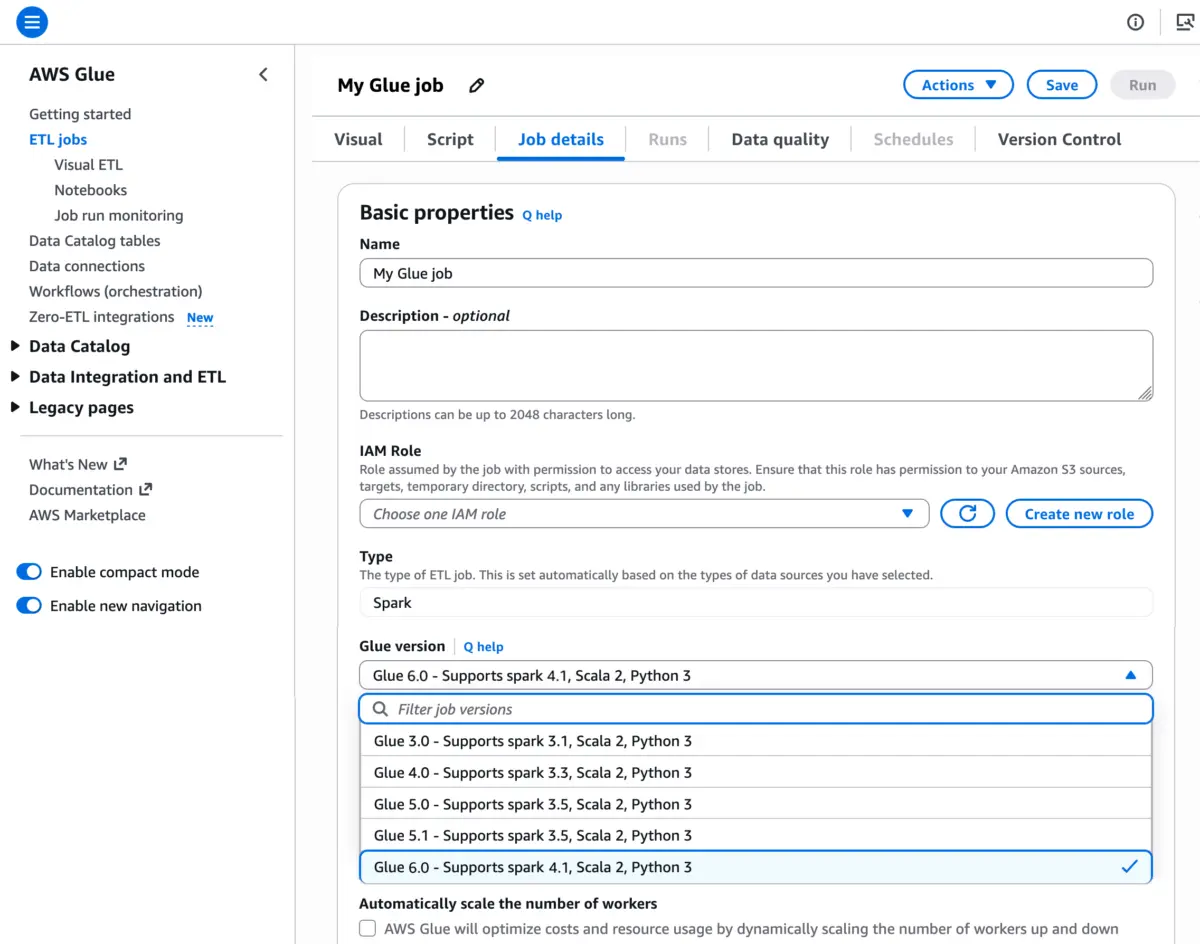
- AWS Glue Studio Console: A streamlined visual interface where developers can navigate to the Job Details tab and select the version labeled
Glue 6.0 – Supports Spark 4.1, Scala 2, Python 3. - Interactive Notebooks & Sessions: Developers working within AWS Glue Studio notebooks, Amazon SageMaker Unified Studio, or standard Jupyter notebooks can immediately target the new runtime by setting
6.0in the%glue_versionmagic command.
Automated Migration Tools
To assist enterprises managing hundreds or thousands of legacy jobs, AWS has introduced the Spark upgrade agent within AWS Glue Studio. This utility analyzes existing job configurations, identifies potential compatibility hurdles between older Spark/Glue versions and Spark 4.1, and provides actionable remediation guidance. Furthermore, auto-upgrade capabilities allow teams to transition workloads systematically with minimal manual intervention.
Future Outlook and Ecosystem Integration
The launch of AWS Glue 6.0 signals a clear trajectory for the future of cloud-native data architectures: fully serverless, highly optimized, open-format lakehouses that bridge the gap between structured relational analytics and unstructured/semi-structured modern workloads.
AI-Driven Operations and the AWS MCP Server
In tandem with the core service release, AWS is emphasizing modern AI-assisted developer workflows. Users can now leverage the AWS MCP (Model Context Protocol) Server and associated plugins within their preferred AI coding assistants and agent toolkits. This integration empowers engineers to query documentation, check regional feature availability, look up API specifications, and troubleshoot job errors conversationally, dramatically accelerating development velocity.
Regional Availability and Community Feedback
AWS Glue 6.0 is generally available today across all commercial AWS Regions where AWS Glue operates. Organizations looking to verify specific regional rollouts can consult the AWS Capabilities by Region resource.
As enterprises begin migrating their mission-critical ETL pipelines to the new runtime, AWS has encouraged community collaboration and feedback through AWS re:Post for AWS Glue and traditional enterprise support channels.
With its combination of deep Apache Iceberg v3 integration, a modernized Spark 4.1 runtime, transformative semi-structured data handling via the VARIANT type, and a sweeping 30% price cut, AWS Glue 6.0 sets a new benchmark for enterprise-grade, serverless data integration.