Executive Overview
For years, upgrading a Kubernetes control plane has been regarded as a classic "one-way door" in cloud architecture. Because open-source Kubernetes does not natively support control plane rollbacks, once an administrator initiated a minor version upgrade, turning back was virtually impossible without complex, high-risk workarounds. This architectural limitation forced organizations to design and maintain elaborate compensating mechanisms—such as extended bake periods, stagger groups, rigorous automated sign-off processes, and arduous, months-long upgrade cycles.
Given that the Kubernetes community releases three minor versions annually, organizations managing hundreds of clusters, particularly those operating in strictly regulated industries, often found themselves paralyzed. Fearing catastrophic failures with no straightforward path to recovery, IT and engineering teams routinely delayed upgrades entirely. Consequently, thousands of production environments remained stuck on aging Kubernetes versions, missing out on vital security patches and eventually running headfirst into the hazardous territory of extended support timelines.
To eliminate this industry-wide pain point, Amazon Web Services (AWS) has officially announced the launch of Kubernetes version rollbacks for Amazon Elastic Kubernetes Service (Amazon EKS). This landmark feature introduces a robust, native safety net for cluster administrators, empowering them to seamlessly reverse a Kubernetes version upgrade within a seven-day window if unforeseen compatibility issues arise. By reverting the cluster back to its previous, fully validated production state without requiring a total infrastructure rebuild, AWS is effectively delivering the ultimate "undo button" for Kubernetes management.
Available today at no additional cost across all commercial AWS regions where Amazon EKS operates, this new capability promises to fundamentally alter how enterprises approach cluster lifecycle management. Whether managing traditional self-provisioned worker nodes or leveraging the fully automated paradigm of EKS Auto Mode, platform engineers now possess the operational security required to embrace rapid, fearless innovation.
Detailed Chronology: The Evolution Toward Fearless Upgrades
The Historical Dilemma of the One-Way Door
To understand the magnitude of the EKS version rollback release, one must examine the historical friction of Kubernetes cluster administration. In standard, upstream Kubernetes implementations, control plane upgrades are inherently irreversible. When an administrator executes an upgrade, internal etcd database schemas, API definitions, and controller configurations undergo modifications that cannot be cleanly undone simply by reapplying older binaries.
While the open-source Kubernetes community has made commendable strides—such as the introduction of KEP-4330, which explores emulated versions to ease rollback friction—these theoretical fixes often leave clusters trapped in transitional, semi-emulated holding states. They rarely restore a cluster to the exact, pristine condition of a proven production environment.
Faced with this risk profile, enterprise platform teams adopted defensive engineering practices. Bake periods stretched from days to weeks. Staggered deployment groups ensured that only a fraction of the fleet was exposed at any given moment. Yet, despite these precautions, the sheer velocity of the Kubernetes release cadence meant that teams were perpetually firefighting upgrades, leading to widespread upgrade fatigue and accumulated technical debt.
The Engineering Breakthrough: EKS Version Rollbacks
Recognizing that fear of failure was driving customers toward dangerous security postures, AWS engineering teams developed a native rollback mechanism designed specifically for Amazon EKS. Rather than relying on fragile scripts or experimental emulations, the new EKS feature captures the precise state required to revert a control plane safely.
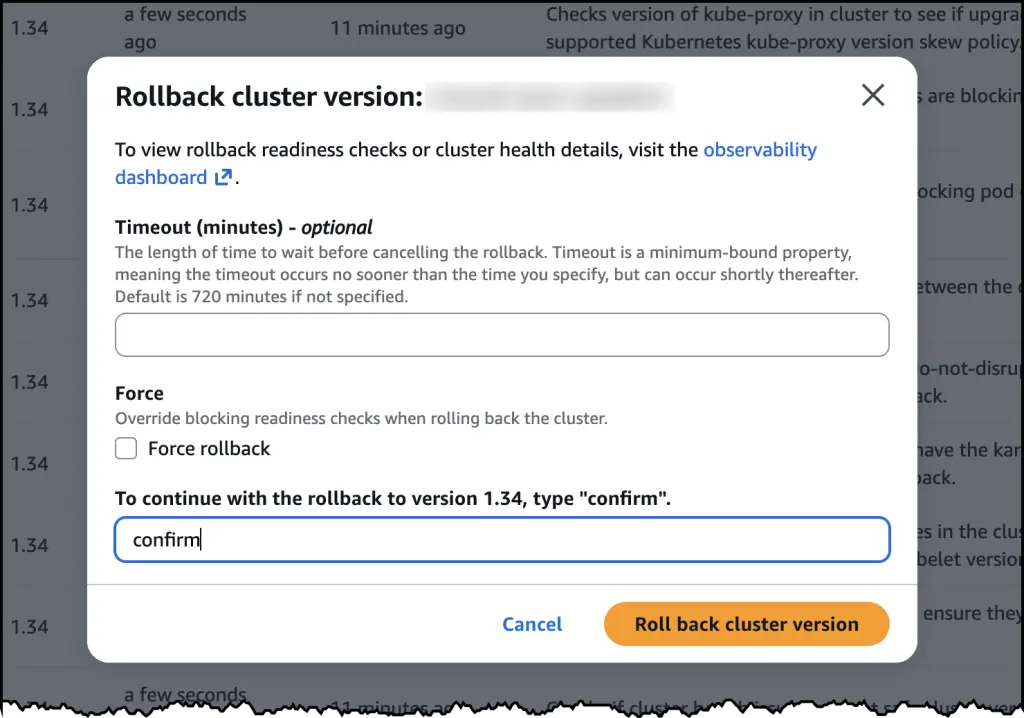
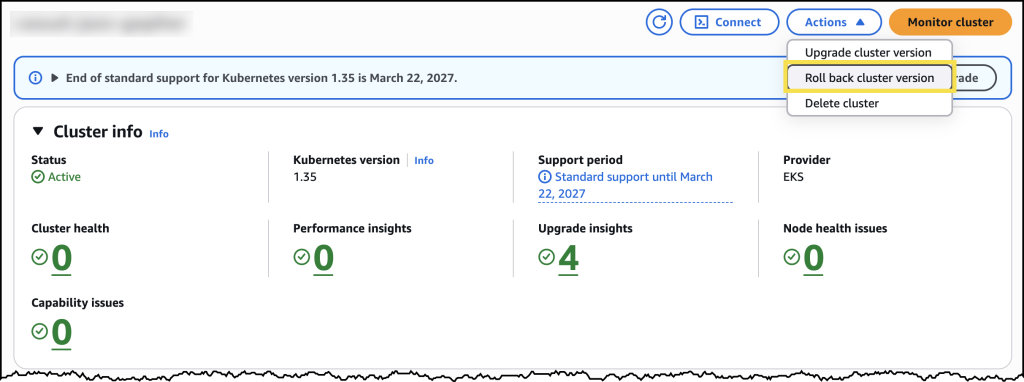
If an organization upgrades a cluster—for instance, transitioning from Kubernetes version 1.34 to 1.35—and subsequently discovers a critical third-party controller incompatibility or an application regression, administrators can initiate a rollback via the AWS Management Console, AWS CLI, or APIs. Within a seven-day window following the initial upgrade, EKS can revert the control plane to its exact previous minor version.
Crucially, this process restores the cluster to a fully validated configuration that has already proven its stability in production. There is no need to panic, scramble to debug complex error logs under executive pressure, or painstakingly rebuild clusters from scratch.

Granular Execution and EKS Auto Mode Integration
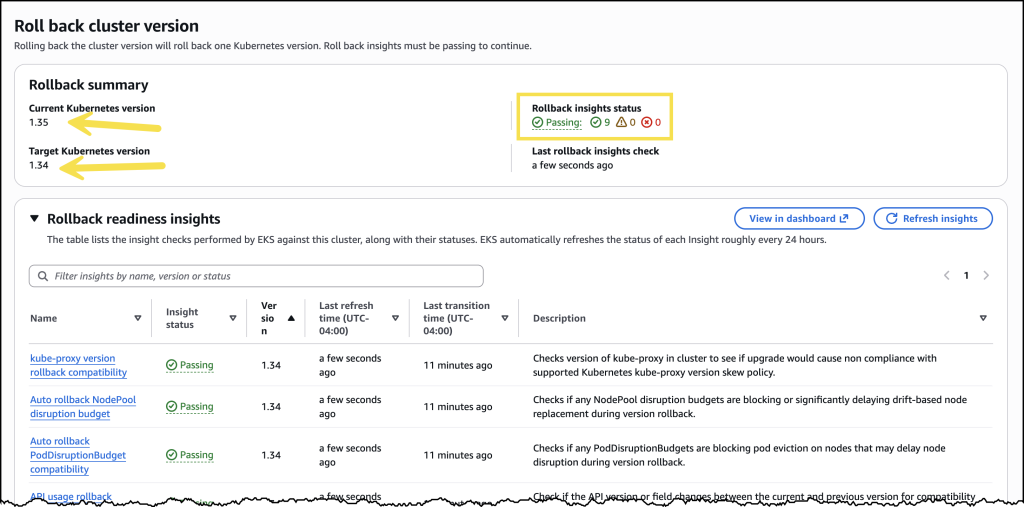
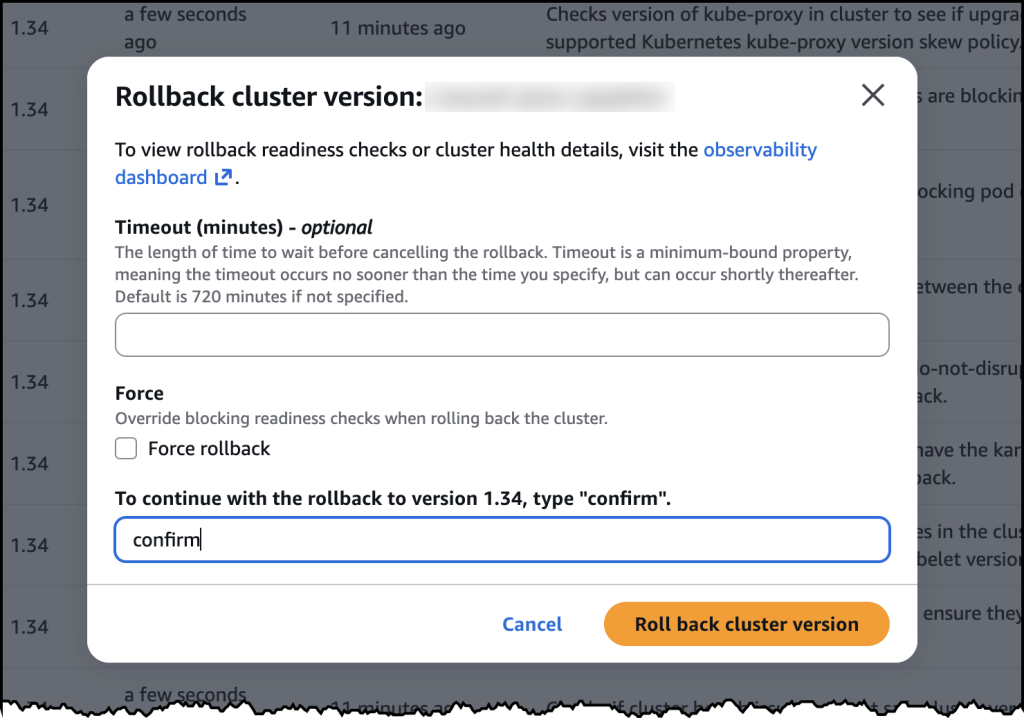
The rollout mechanism follows the same disciplined, incremental approach that EKS utilizes for standard upgrades, supporting rollbacks of one minor version at a time. To ensure maximum safety, EKS automatically evaluates rollback readiness using built-in Cluster Insights. Before an administrator executes a rollback, Cluster Insights scans the environment, proactively flagging potential friction points such as node version compatibility or incompatible add-on dependencies. For teams operating under tight emergency timelines who have already vetted their environment, an optional --force flag allows them to bypass these preliminary checks and execute the rollback immediately.
For organizations that have embraced EKS Auto Mode—the fully managed infrastructure experience that automates compute, networking, and storage management—version rollbacks require orchestrating both the control plane and managed worker nodes simultaneously. Because node rollbacks must strictly adhere to configured Pod Disruption Budgets (PDBs) to prevent application downtime, the overall duration of the rollback can vary depending on workload density and cluster configurations.
To address potential bottlenecks where a node rollback might take longer than desired, AWS introduced a dedicated Cancel API. If an administrator observes that a rollback is progressing slowly due to conservative PDB constraints, they can cancel the operation, modify or temporarily remove their disruption budgets to accelerate the node termination cadence, and restart the rollback with optimized parameters. By default, however, EKS prioritizes workload stability above all else, ensuring that disruption budgets are never automatically overridden unless explicitly requested by the operator.
Supporting Context & Metrics: Operational Impact and Use Cases
Mitigating Risk in Regulated Industries
Financial institutions, healthcare providers, and government agencies face stringent compliance mandates requiring high availability and predictable system behavior. In these sectors, an unexpected outage triggered by a minor software incompatibility can result in severe financial penalties and reputational damage.
Prior to the introduction of EKS version rollbacks, compliance officers frequently mandated months of testing before approving a single minor version upgrade. Metrics collected across enterprise cloud deployments indicate that a significant percentage of Kubernetes clusters worldwide run versions that are past their standard support window, primarily due to upgrade hesitancy.
By shrinking the recovery window from days or weeks of manual disaster recovery to a matter of minutes via a single command, Amazon EKS removes the primary deterrent to regular patching. Organizations can now upgrade with the comforting knowledge that an instantaneous safety net is always active for seven days post-upgrade.
Financial Predictability and Cost Efficiency
A vital element of the EKS version rollback announcement is its pricing model: it is entirely free of additional charges.
AWS has structured the feature so that customers pay only for the standard EKS control plane fees and underlying compute resources they already consume. There are no premium license tiers, data processing fees, or hidden transaction costs associated with executing a rollback. This democratization of enterprise-grade tooling ensures that startups, mid-market enterprises, and Fortune 500 corporations alike can leverage the exact same level of operational resilience.
Step-by-Step Practical Walkthrough
To demonstrate the frictionless nature of the feature, practitioners testing the capability in sandbox environments note the following operational workflow:
- Console Navigation: Administrators log into the Amazon EKS console and navigate to the configuration page of a recently upgraded cluster.
- Window Visibility: The interface clearly displays the active status of the version rollback option alongside the remaining duration of the seven-day rollback window.
- Insight Review: Before confirming, operators inspect the Rollback Insights tab, which details node health, add-on compatibility, and any flagged warnings.
- Execution and Monitoring: Upon initiating the rollback, the cluster remains accessible and functional. Control plane restoration typically completes within approximately 20 minutes—mirroring the timeline of a standard upgrade. In Auto Mode clusters, nodes gracefully cycle back to the previous AMI and Kubernetes version while respecting all active Pod Disruption Budgets.
Official Statements and Industry Perspectives
The release of EKS version rollbacks has drawn considerable praise from cloud-native architects, DevOps leaders, and enterprise security professionals worldwide.
In the official AWS announcement, principal engineering leadership emphasized the core philosophy driving the feature:
"Upgrading infrastructure should never feel like walking a tightrope without a safety net. By providing a true, production-validated undo button for Kubernetes versions, we are shifting the paradigm from defensive, fearful hesitation to confident, continuous innovation. Our goal is to empower every organization—from agile startups to heavily regulated global enterprises—to stay fully patched, secure, and modern without compromising uptime."
Independent cloud infrastructure analysts have similarly lauded the development, noting that control plane rollback capabilities represent one of the most glaring missing links in the broader cloud-native ecosystem. Industry experts point out that while managed Kubernetes services have dramatically simplified cluster provisioning, the lingering fear of upgrade-induced regressions remained the last major cultural hurdle for enterprise adoption. By solving this at the control plane and Auto Mode layers, AWS has effectively neutralized the justification for running outdated, vulnerable infrastructure.
Future Outlook: The Next Frontier of Kubernetes Management
As organizations increasingly standardize on Amazon EKS as the foundational control layer for their modern microservices architectures, features like version rollbacks lay the groundwork for even more advanced autonomous operations.
Looking ahead, industry watchers anticipate that AWS will continue to expand upon the telemetry provided by Cluster Insights, potentially integrating machine learning models that proactively predict compatibility issues before an upgrade is even initiated. Furthermore, as the open-source Kubernetes community evolves, tighter synchronization between upstream enhancements (such as KEP-4330) and AWS proprietary automations like EKS Auto Mode will likely yield even faster, more intelligent remediation workflows.
Ultimately, the introduction of EKS version rollbacks signals a mature turning point in the lifecycle of cloud-native computing. It acknowledges that while software bugs and integration friction are inevitable realities of complex distributed systems, catastrophic downtime resulting from routine maintenance should be a relic of the past. By turning a historically irreversible "one-way door" into a safe, traversable hallway, AWS has armed millions of developers and system administrators with the confidence to move faster, build securely, and innovate without looking back in fear.