Executive Overview
In a major development for cloud architecture, Amazon Web Services (AWS) has announced the general availability of AWS Lambda MicroVMs, introducing a transformative serverless compute primitive designed to run user- and AI-generated code within isolated, stateful execution environments. Powered by Firecracker—the ultra-lightweight open-source virtual machine monitor that has quietly propelled over 15 trillion monthly Lambda function invocations—this new service merges the robust hardware-level security of traditional virtual machines with the developer-friendly agility of serverless infrastructure.
For years, cloud architects and multi-tenant application developers have grappled with an intractable architectural trade-off. On one hand, traditional virtual machines offer uncompromised isolation and state preservation, yet suffer from sluggish boot times that can drag into minutes. On the other hand, container platforms and traditional Functions-as-a-Service (FaaS) models deliver rapid, event-driven scaling, but rely on shared-kernel architectures. These shared-kernel models require extensive, custom hardening to securely contain untrusted code, and they fundamentally fail to support long-running, interactive sessions that must retain memory and disk state across disjointed user interactions.
AWS Lambda MicroVMs bridges this structural gap. By providing dedicated, single-tenant micro-virtual machines that launch nearly instantaneously from pre-initialized snapshots, maintain persistent state, and intelligently scale down to zero during idle periods, AWS has solved a multi-faceted engineering challenge. Developers can now build secure environments for AI coding assistants, interactive code sandboxes, complex data analytics pipelines, and dynamic gaming servers without needing to architect, provision, and maintain heavy custom virtualization infrastructure.
Detailed Chronology: From Concept to Implementation
To understand the operational mechanics of AWS Lambda MicroVMs, it is instructive to examine the end-to-end workflow experienced by developers adopting the platform. The service introduces a streamlined, declarative pipeline that blends standard container tooling with advanced snapshotting technology.
1. Image Creation and Packaging
The journey begins within the AWS Lambda console or via the AWS Command Line Interface (CLI). Developers package their application code—such as a custom Python Flask web server—alongside its dependencies and a standard Dockerfile.

FROM public.ecr.aws/lambda/microvms:al2023-minimal
RUN dnf install -y python3 python3-pip && dnf clean all

WORKDIR /app

COPY requirements.txt .
RUN pip install --no-cache-dir -r requirements.txt

COPY app.py .

EXPOSE 5000

CMD ["gunicorn", "--bind", "0.0.0.0:5000", "app:app"]
Once bundled into a deployment zip archive and uploaded to an Amazon Simple Storage Service (Amazon S3) bucket, the developer initiates the image creation command via the CLI:
aws lambda-microvms create-microvm-image
--code-artifact uri=<path/to/s3/artifact.zip> --name <VM_image_name>
--base-image-arn arn:aws:lambda:us-east-1:aws:microvm-image:al2023-1
--build-role-arn <IAM role ARN>
Behind the scenes, AWS Lambda retrieves the artifact, executes the instructions outlined in the Dockerfile, initializes the application environment, and immediately captures a Firecracker snapshot of the running disk and memory state. Build logs are piped in real-time to Amazon CloudWatch under dedicated log groups, ensuring full visibility. Once compiled, the resulting MicroVM Image is assigned a unique Amazon Resource Name (ARN) and version number.
2. Deployment and Lifecycle Management
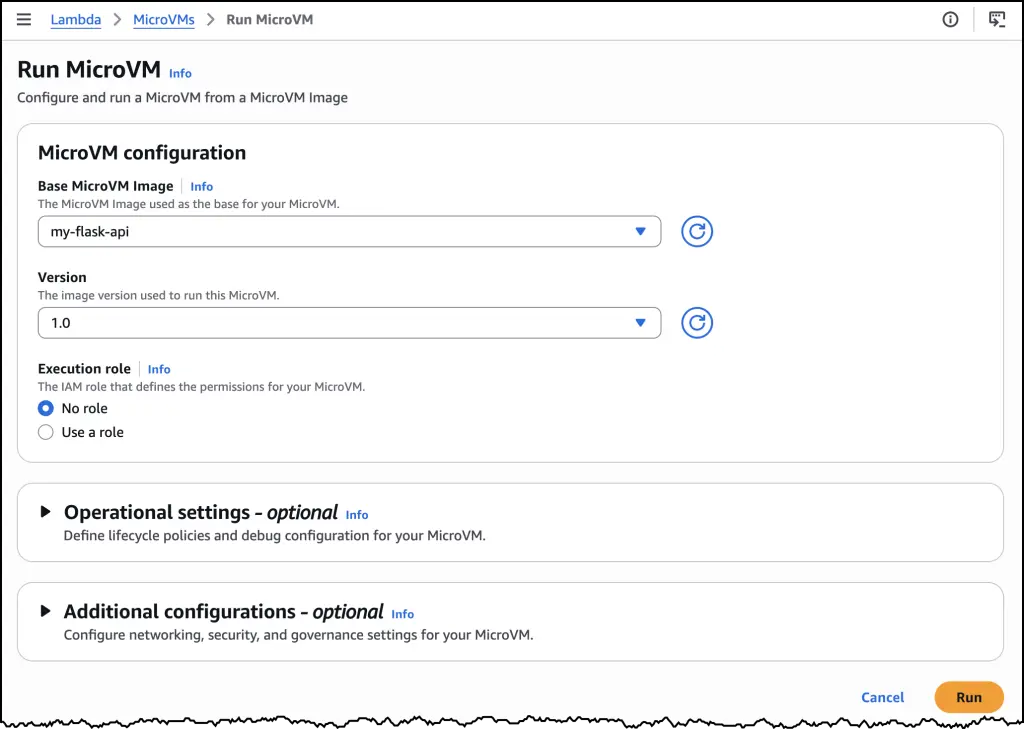
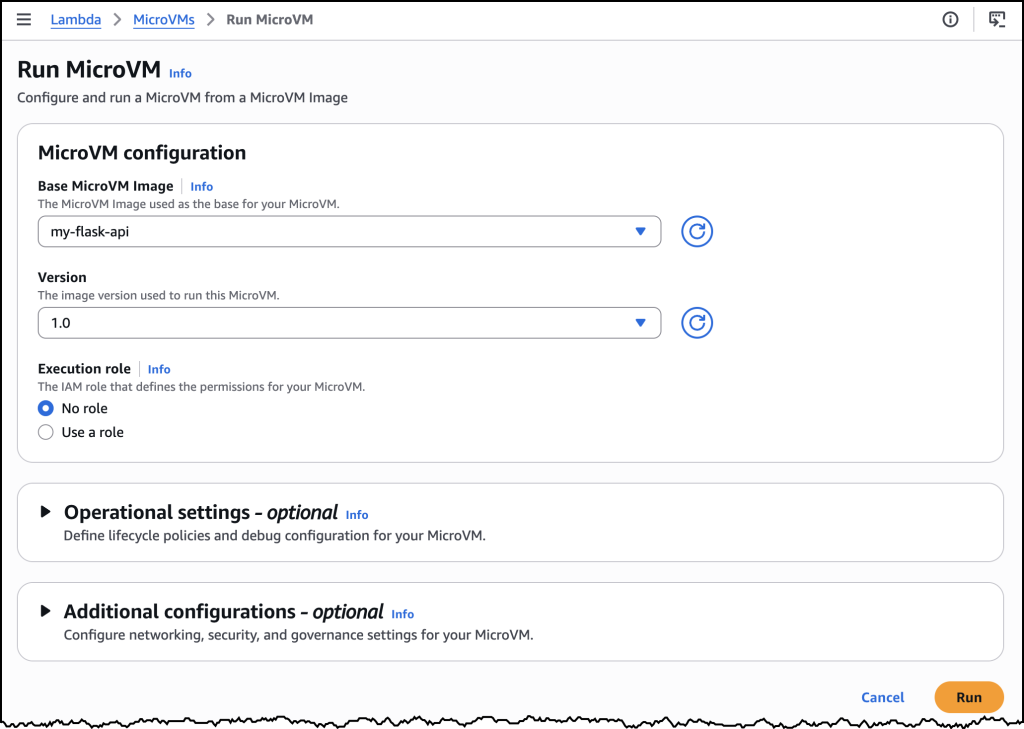
With a validated image ready, launching an instance requires a single API call or CLI execution. Developers pass the image ARN alongside a targeted execution role and a precise idle policy:
aws lambda-microvms run-microvm
--image-identifier arn:aws:lambda:<region>:<acct>:microvm-image:my-image
--execution-role-arn arn:aws:iam::<acct>:role/MicroVMExecutionRole
--idle-policy '"maxIdleDurationSeconds":900,"suspendedDurationSeconds":300,"autoResumeEnabled":true'
In this implementation, the idle policy is configured to automatically suspend the MicroVM after 15 minutes of inactivity while maintaining automatic resumption capabilities upon the arrival of subsequent traffic. Critically, no intricate networking setup or Virtual Private Cloud (VPC) configuration is required out of the box. AWS Lambda assigns the instance a unique identifier, provisions a dedicated endpoint URL, and instantiates the micro-virtual machine. Because the system resumes from the pre-computed Firecracker snapshot rather than executing a cold boot, the application is live and operational the moment the launch completes.
3. Traffic Routing, Suspension, and State Preservation
Communication with the running MicroVM occurs over authenticated HTTPS channels. By generating a short-lived authorization token via the CLI and passing it within the X-aws-proxy-auth header, client requests land directly on the running application (such as the Flask API endpoint).

import logging
from flask import Flask, jsonify

app = Flask(__name__)
logging.basicConfig(level=logging.INFO)

@app.route("/")
def hello():
    app.logger.info("Received request to hello world endpoint")
    return jsonify(message="Hello, World!")

if __name__ == "__main__":
    app.run(host="0.0.0.0", port=5000)
When user interaction ceases and the configured idle threshold is crossed, the Lambda MicroVMs platform transitions the environment into a suspended state. Crucially, the memory and disk states are carefully preserved and stored. When a new request arrives later, the environment thaws instantly. Installed packages, active working filesets, and loaded machine learning weights remain fully intact, creating a seamless, uninterrupted user experience where the underlying pause is completely invisible to the client.
Supporting Context & Metrics: The Architecture of Isolation
To fully appreciate the significance of AWS Lambda MicroVMs, one must examine the specific technical pillars that separate it from standard cloud computing paradigms: hardware-level security, snapshot-based virtualization, and flexible resource scaling.
Architectural Comparison of Compute Primitives
| Compute Primitive | Isolation Level | Cold Start Latency | State Retention | Primary Target Workload |
|---|---|---|---|---|
| Traditional EC2 VMs | Hardware-level (Strong) | Minutes | Stateful | Long-running servers, legacy apps |
| Standard Containers | Shared-kernel (Moderate) | Seconds | Stateless / Ephemeral | Microservices, CI/CD pipelines |
| Lambda Functions (FaaS) | Micro-isolation (High) | Milliseconds | Stateless | Event-driven, short APIs |
| Lambda MicroVMs | Hardware-level (Strong) | Near-Instant (Snapshot) | Stateful (Up to 8 hours) | Multi-tenant code execution, AI agents |
1. Firecracker-Powered Virtual Machine Isolation
Unlike containerized execution environments that share the host operating system’s kernel—exposing potential vectors for container breakout vulnerabilities—Lambda MicroVMs run each session inside its own dedicated micro-virtual machine. Utilizing the Linux Kernel-based Virtual Machine (KVM) subsystem via Firecracker, the service enforces robust hardware isolation. Untrusted code supplied by an end-user cannot access adjacent execution environments or compromise the underlying host infrastructure.
2. Snapshot-Based Rapid Bootstrapping
Cold starts have historically plagued serverless and virtualized architectures alike. Lambda MicroVMs eliminates this penalty through an "image-then-launch" model. By capturing the complete RAM and disk footprint of a fully initialized application via Firecracker snapshots, subsequent launches bypass the traditional boot sequence entirely. Even complex multi-gigabyte environments resume with sub-second responsiveness, matching the operational tempo required by modern real-time applications.
3. Extended Session Durations and Flexible Scaling
While traditional Lambda functions enforce strict execution time limits tailored for quick request-response cycles, Lambda MicroVMs are engineered for sustained workloads. Supporting continuous runtimes of up to 8 hours per session, they comfortably accommodate intensive tasks such as deep data analytics pipelines, automated software vulnerability scans, and multi-user collaborative platforms.

Furthermore, the hardware specifications available at launch provide substantial computing headroom. Deployed natively on AWS ARM64 architecture, individual MicroVMs can scale up to:
- 16 vCPUs
- 32 GB of RAM
- 32 GB of dedicated disk storage
Official Statements and Industry Implications
The introduction of AWS Lambda MicroVMs marks a fundamental shift in how cloud providers address the burgeoning demand for secure, AI-driven, and multi-tenant application architectures. Industry analysts and enterprise engineering leaders have closely monitored the convergence of generative AI and secure code execution, noting that applications leveraging LLMs to write and execute dynamic code on the fly have outgrown standard container infrastructure.
"Over the past few years, a new class of multi-tenant applications has emerged that all share a singular, complex requirement: handing each end user their own dedicated execution environment to safely execute code written neither by the developer nor the platform provider," notes AWS engineering documentation. "Building this capability previously forced engineering teams into making unacceptable compromises between strict security isolation and low-latency performance. Lambda MicroVMs eliminates this compromise by delivering enterprise-grade virtualization wrapped in a fully managed serverless developer experience."
By absorbing the operational overhead of managing virtualization clusters, hypervisors, and custom kernel security hardening, AWS allows development teams to refocus their intellectual capital entirely on core product features. Enterprises building AI coding copilots, interactive technical assessment platforms, and secure online IDEs no longer need to maintain dedicated DevOps squads just to manage fleet virtualization.
Future Outlook: The Complementary Future of Serverless
AWS has emphasized that Lambda MicroVMs is not intended to replace traditional AWS Lambda Functions, but rather to act as a powerful, complementary companion within the broader serverless ecosystem.
- Lambda Functions remain the gold standard for stateless, event-driven, high-concurrency microservices, webhooks, and rapid request-response APIs.
- Lambda MicroVMs occupy the specialized domain of stateful, multi-tenant, user-interactive sessions requiring deep hardware isolation and prolonged execution windows.
In future enterprise architectures, developers will likely orchestrate these services in tandem: utilizing standard Lambda functions as a lightweight, event-driven front-end backbone that dynamically provisions and calls into Lambda MicroVMs whenever untrusted, user-supplied, or AI-generated scripts require isolated execution.
Availability and Getting Started
AWS Lambda MicroVMs is available today across multiple key global infrastructure hubs, including:
- US East (N. Virginia, Ohio)
- US West (Oregon)
- Europe (Ireland)
- Asia Pacific (Tokyo)
Running exclusively on the energy-efficient and high-performance ARM64 architecture, the service features flexible pricing models tied to active execution time and automated idle suspension states, helping organizations optimize their cloud spend without sacrificing performance or state integrity.
Developers eager to explore the capabilities of this new primitive can access the management tooling directly through the AWS Lambda Console, consult the updated Lambda MicroVMs Developer Guide, or review the granular pricing tiers on the official AWS Lambda Pricing Page. As multi-tenant and AI-integrated applications continue to proliferate, AWS Lambda MicroVMs establishes a new baseline for secure, elastic, and developer-friendly cloud computing.