Executive Overview
The digital advertising landscape is undergoing its most profound structural shift since the advent of algorithmic bidding. Meta is systematically steering marketers away from granular manual control and toward a model of "guided supervision." In this new paradigm, advertisers act less like mechanics tuning an engine and more like directors guiding an automated system.
By offloading backend complexities—such as Facebook Pixel integration, dynamic campaign management, and creative variations—to artificial intelligence, platforms promise lower barriers to entry and accelerated performance. However, this automation trade-off introduces new risks. Advertisers must now balance the efficiency of machine learning with strategic oversight, discerning which algorithmic recommendations to trust and where human judgment remains non-negotiable.
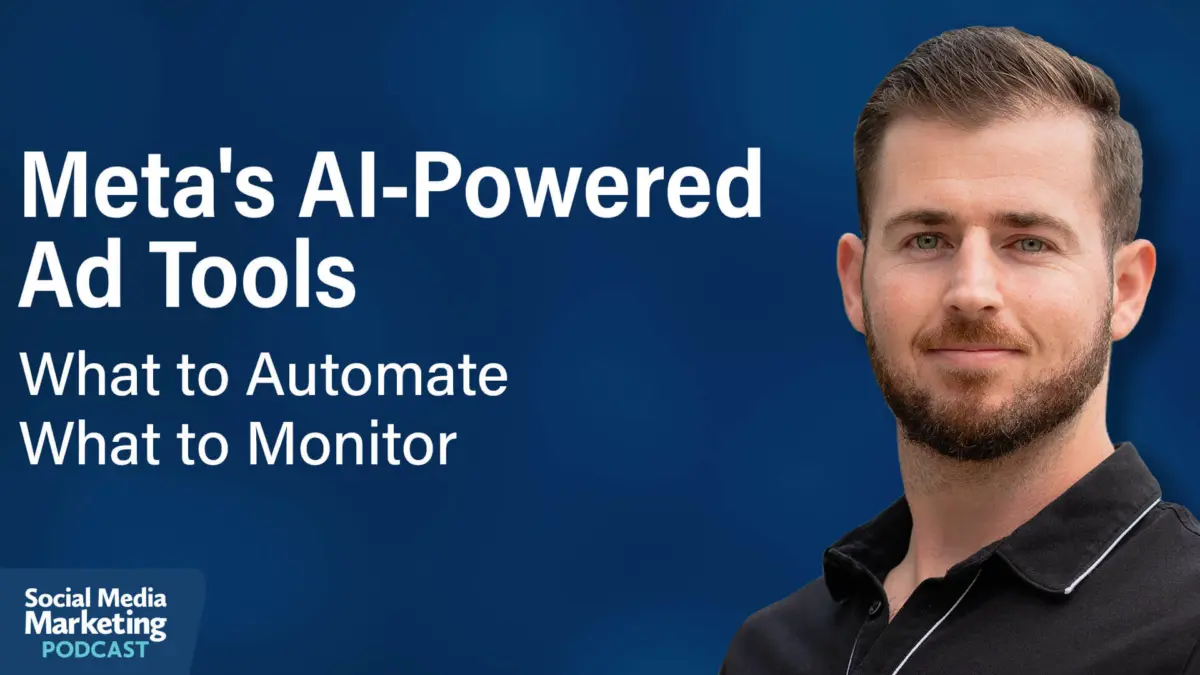
Drawing insights from e-commerce agency owner Nick Theriot alongside marketing authorities Michael Stelzner and Jerry Potter, this analysis explores how modern brands can harness Meta’s newest AI toolsets. We examine the evolution of tracking infrastructure, the hazards of third-party AI integrations, the double-edged sword of automated creative generation, and the psychological realities of frictionless, mid-funnel checkout mechanics.
Detailed Chronology: The Evolution of Meta’s AI Integration
To understand where Meta advertising stands today, it helps to examine how platform mechanics have evolved over the past decade.
- The Era of Manual Rigor (2018–2019): Success on Facebook and Instagram once hinged on complex account architectures. Media buyers meticulously built multi-layered campaigns, utilizing elaborate cost caps, bid caps, and meticulously segmented custom audiences to eke out profitable returns.
- The Shift to Creative Dominance (2020–2021): As algorithms grew more sophisticated, hyper-segmented account structures began to underperform. Advertisers realized that the creative asset itself—the image, video, and copy—was the primary lever for algorithmic success. Brands testing high volumes of unique creative variations began to outpace those relying on structural hacks.
- The Rise of Guided Control (Present Day): Today, Meta has condensed campaign architecture. Advertisers typically rely on a single, streamlined campaign containing a batch of creative assets. Meta’s AI handles the distribution, optimization, and audience matching. The human role has shifted from button-clicking micro-management to macro-level creative direction and strategic offer construction.
Pillar #1: Automated Infrastructure and the Smart Pixel
The traditional hurdle of launching paid social campaigns—technical tracking setup—has been largely dismantled by machine learning.
Modernizing the Facebook Pixel
The Facebook Pixel, the fundamental tracking code that maps user behavior on external websites, has received an intelligence upgrade. Meta’s AI now automatically connects and transmits data from web pages and product catalogs, capturing granular details like product names, inventory availability, and user actions with minimal manual configuration.
For many business owners, this eliminates the historic need to hire specialized web developers or configure complex Google Tag Manager containers just to verify that tracking fires correctly. Nick Theriot compares this to using generative code assistants to spin up an entire website in seconds: it is a black-and-white, highly technical task that AI is uniquely qualified to execute.
Strategic Setup and Business Model Nuances
While the AI setup can be toggled off or restricted regarding which data categories it pulls, the tactical advice for advertisers is clear: install the tracking infrastructure long before launching campaigns. By allowing the pixel to passively learn who interacts with and purchases from your site over time, you build a foundational dataset. When you eventually fund your first campaign, Meta’s algorithm has a head start, lowering your initial customer acquisition costs.
The utility of this automated tracking varies by business model:
- E-commerce Brands: Highly vital. Platforms like Shopify offer near-instant, one-click integrations that feed transaction data straight into Meta’s optimization engine.
- Publishers and Media Sites: These entities function similarly to social platforms, competing for the same attention spans, making standard e-commerce attribution less direct.
- Lead Generation Funnels: Highly complex setups involving multi-step landing pages and upsells benefit immensely from AI-driven data mapping to track drop-off points accurately.
Pillar #2: Third-Party AI Agents and the Risk of Account Bans
As the ecosystem expands, marketers are increasingly connecting external AI tools—such as Manus and Claude connectors—directly into Meta’s Business Manager and Ads Manager. These integrations allow systems to automatically generate performance dashboards, compile presentation decks, and ideate or publish content across Facebook and Instagram properties.
The Hidden Danger: Account Freezes
Despite the appeal of hands-off campaign management, caution is warranted. Over recent months, industry reports have highlighted a troubling correlation: advertisers connecting external AI tools to their ad accounts frequently experience sudden account bans or temporary freezes.
The root cause appears to be behavioral patterns rather than platform hostility. Automated systems often bombard ad accounts with high volumes of rapid-fire queries and adjustments. To Meta’s automated security protocols, this hyper-active API usage mimics malicious bot behavior, triggering an immediate safety lockdown. Consequently, seasoned operators advise disconnecting unverified third-party tools until API stability improves.
What AI Cannot Replace: Human Insight
Even as automation permeates campaign management, certain domains must remain human-centric. When asked to define target audiences, AI tools frequently default to generic demographic buckets.
True marketing conviction, however, stems from observing actual consumer behavior and marketplace demand firsthand. Understanding why a consumer chooses one product over another—and crafting messaging that speaks to those nuanced pain points—requires human empathy, creative intuition, and deep market research that algorithms cannot authentically replicate.
Looking toward the future, the traditional media buyer role is steadily evolving into a strategic marketing manager position. Success two years from now will rely less on executing tactical platform settings and more on constructing scalable offers, articulating clear product value, and capturing human attention while AI handles the execution.
Pillar #3: The AI Business Assistant and the Danger of Bad Math
Meta has aggressively rolled out its native AI Business Assistant, embedded directly inside Ads Manager to provide real-time recommendations and diagnostic insights.
Leveling the Learning Curve
For novice advertisers, this assistant can compress years of trial and error into weeks, surfacing structural optimizations that far exceed what a beginner might piece together from fragmented blog posts or video tutorials.
Caveats and Algorithmic Blind Spots
However, the assistant is trained exclusively on Meta’s internal rulebooks and incentives. This creates an echo chamber similar to advice historically given by platform ad reps—advice that frequently favors increased spending over structural efficiency.
- The "Spend More" Trap: AI recommendations to rapidly double or triple daily budgets based on a temporary dip in cost-per-result (CPR) are notoriously unreliable. Rapid budget scaling typically degrades audience efficiency, causing acquisition costs to spike.
- Mathematical Reliability: Different AI models handle numerical analysis with varying degrees of accuracy. When auditing complex spreadsheets, financial models, and multi-touch attribution metrics—especially for brands operating on tight margins or long-term customer lifetime value (LTV) payback windows—precision is paramount. Minor mathematical discrepancies at scale can critically impact a company’s financial health.
Pillar #4: Producing AI-Assisted Creative That Cuts Through
Because users never see backend campaign architectures, creative assets represent the single most important variable in modern advertising performance.
The Shift from Volume to Intent
A common piece of bad advice circulating in digital marketing circles is the mandate to test 100 to 200 distinct creative assets every week. Advertisers following this playbook often generate massive volumes of mediocre, low-effort material, leading to wasted ad spend and fatigue.
True creative excellence relies on intentionality. Just as viral organic content succeeds by presenting a genuinely unique perspective, paid ads perform best when they offer original angles. AI acts as an amplifier: if your foundational ideas are weak, AI simply helps you produce mediocre assets at scale. Conversely, skilled creators—photographers, copywriters, and video producers—can use AI tools to rapidly prototype and scale concepts that already possess strategic merit.

Workflow Acceleration
Modern creative teams utilize AI across several key vectors:
- Copywriting: AI tools routinely draft upwards of 90% of initial ad copy, leaving human "copy chiefs" to refine the final 10% for brand voice and emotional resonance.
- Visual Asset Generation: Advanced image and video tools allow teams to conceptualize and iterate product displays and graphical backgrounds in a fraction of traditional production timelines.
- Spokesperson Generation: Meta’s native tools now support AI-generated voiceovers, localized translations, and synthetic UGC-style video spokespersons. While using an AI persona to discuss product ingredients and benefits is permissible, fabricating false consumer claims (such as claiming a synthetic persona lost 30 pounds on a supplement) crosses ethical and legal boundaries, introducing severe liability risks.
Pillar #5: Frictionless Commerce and the Psychology of Checkout
Meta’s latest suite of tools extends directly into the mid- and bottom-funnel shopping experience through one-click checkouts and post-click AI shopping assistants. These features aim to surface reviews, pricing breakdowns, and immediate transaction options right inside the ecosystem.
The "Add to Cart" Psychological Buffer
While frictionless purchasing sounds ideal in theory, e-commerce veterans urge caution. Data indicates that replacing a traditional "Add to Cart" button with an immediate "Buy Now" or one-click checkout mechanism can inadvertently depress conversion rates for considered purchases.
There is a distinct psychological rhythm to online shopping. The "Add to Cart" action acts as a micro-commitment, providing consumers with a vital two-to-three-second pause to process their intent, review their cart, and feel secure in their purchasing decision. Stripping away this familiar step can disrupt the buying cadence, causing hesitation.
- Low-Ticket, Habitual Goods: One-click mechanics excel with low-consideration, habitual items (e.g., replacement kitchen utensils or basic apparel) where consumer deliberation is minimal.
- High-Consideration Purchases: Products requiring research, trust verification, and policy review benefit from multi-step landing pages where consumers can read reviews, check third-party forums, and validate brand credibility.
To navigate these evolving mechanics without risking capital on unproven features, successful brands typically employ an 80/20 resource allocation model: dedicating 80% of budget and energy to proven, revenue-generating funnels, and reserving 20% for exploratory testing of new platform features.
Future Outlook
As artificial intelligence continues to absorb the tactical burdens of campaign management, the definition of a successful digital marketer is evolving rapidly. The future belongs not to those who can master platform UI dashboards or manually adjust keyword bids, but to those who excel at:
- Strategic Offer Construction: Crafting irresistible product value propositions that naturally compel consumers to buy.
- Creative Direction: Directing AI tools to produce genuinely distinct, emotionally resonant visual and textual narratives.
- Financial Rigor: Auditing algorithmic recommendations and maintaining strict oversight over unit economics and multi-month customer acquisition payback windows.
By embracing guided automation while retaining strict human control over creative vision and financial governance, marketers can successfully harness Meta’s evolving toolset to drive sustainable, scalable growth.