Executive Overview
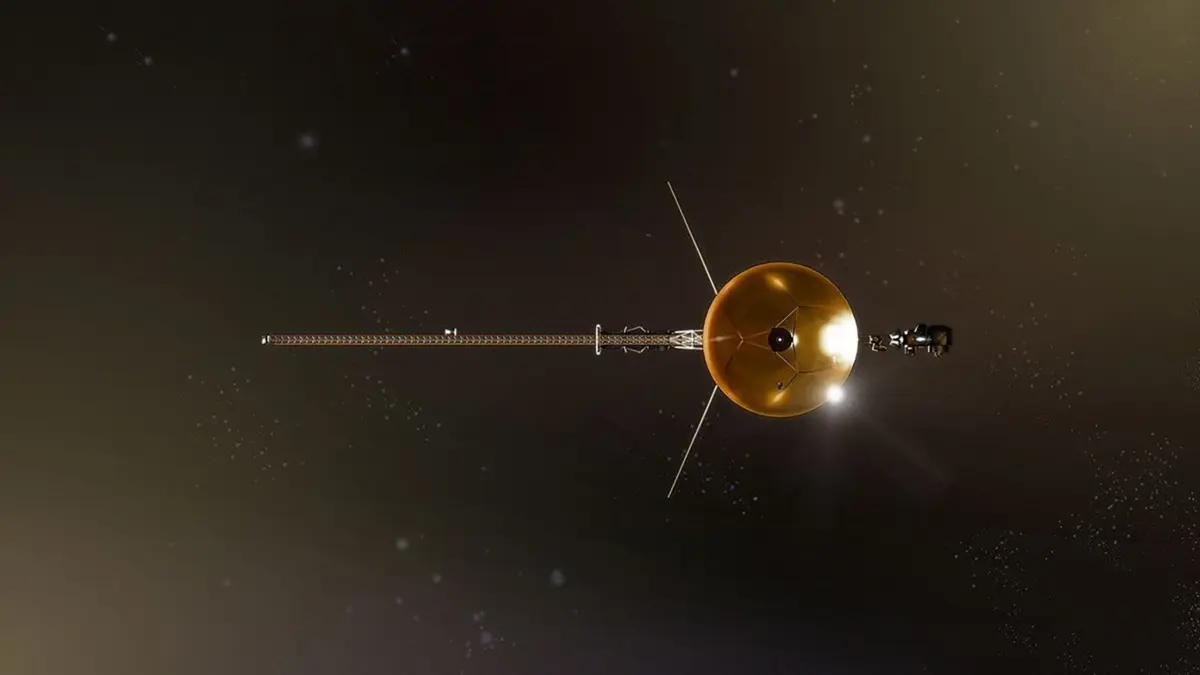
Launched into the inky abyss of space in September 1977, NASA’s Voyager 1 spacecraft has long since surpassed its initial mission parameters, evolving into humanity’s most distant ambassador. Today, this nuclear-powered marvel occupies a realm so remote that radio communications—traveling at the absolute speed limit of the universe—take a full 24 hours to make the round trip between the probe and mission control on Earth. It has officially entered the realm of the "light-day," a staggering milestone that stretches our very vocabulary of distance and challenges our understanding of celestial mechanics.
While the spacecraft’s hardware is a testament to late-20th-century engineering, its ongoing expedition provides a live physics laboratory at the very frontier of our solar system. As Voyager 1 ploughs through the interstellar medium, it forces scientists to confront deep questions regarding cosmic measurement, gravitational decay, stellar magnetic fields, and the ultimate destiny of objects hurled into the void. This report explores the mechanics of Voyager 1’s epic voyage, breaking down how we measure the cosmos, the unseen forces tugging at the spacecraft, and whether humanity’s pioneering emissary will truly travel forever.
Detailed Chronology: From the Inner Planets to the Interstellar Void
To comprehend the monumental current location of Voyager 1, one must trace the chronological steps of its nearly half-century trek through the solar system.
- September 1977: Voyager 1 lifts off from Cape Canaveral atop a Titan IIIE-Centaur rocket, closely following its twin, Voyager 2 (which launched a few weeks earlier on a different trajectory). Despite launching second, Voyager 1 was placed on a faster intercept trajectory designed to prioritize close-up observations of Jupiter and Saturn.
- March 1979: The spacecraft sweeps past Jupiter, providing humanity with unprecedented, high-definition imagery of the gas giant’s swirling storm systems, volcanic moons like Io, and complex ring structures. The encounter utilizes a gravitational slingshot maneuver, dramatically increasing the probe’s velocity and bending its trajectory outward toward Saturn.
- November 1980: Voyager 1 encounters Saturn and its magnificent ring system, capturing historic data on the moon Titan’s dense nitrogen atmosphere. Following this encounter, mission planners direct the spacecraft on a trajectory that takes it above the plane of the planets, effectively ending its planetary science mission and beginning its Interstellar Mission phase.
- February 1990: From a distance of roughly 4 billion miles, Voyager 1 turns its cameras back toward the inner solar system to snap the iconic "Pale Blue Dot" photograph, immortalized by astronomer Carl Sagan. Shortly thereafter, its cameras are powered down to conserve electrical energy for its long-term instruments.
- August 2012: Mission scientists confirm that Voyager 1 has officially crossed the heliopause—the boundary where the hot, pressurized solar wind of our sun meets the cold, dense gas of the interstellar medium. It becomes the first human-made object to enter interstellar space.
- The Present Day: Now operating more than 15 billion miles from Earth, Voyager 1 continues to transmit sparse scientific telemetry back to NASA, operating on decaying radioisotope thermoelectric generators (RTGs) as it navigates the uncharted territories between the stars.
Supporting Context & Metrics: Measuring the Unimaginable
The sheer expanse separating Voyager 1 from its creators breaks down conventional human scales. To make sense of distances that defy terrestrial intuition, astrophysicists rely on a ladder of specialized cosmic measurements, each tailored to progressively larger scales of the universe.
The Breakdown of Cosmic Scales
- The Meter and the Kilometer: While meters and kilometers are essential for measuring terrestrial distances or the altitude of the International Space Station, they quickly become unwieldy when applied to interplanetary travel. For instance, expressing the distance to Voyager 1 in kilometers yields a number exceeding 24 billion—a figure so large it loses conceptual meaning for the human brain.
- The Astronomical Unit (AU): Defined as the average distance from the center of the Sun to the center of the Earth (approximately 149.6 million kilometers, or $1.5 times 10^11$ meters), the AU serves as the standard yardstick for the solar system. Historically, this unit was derived by observing the transit of Venus across the face of the sun from various earthly vantage points. By applying triangulation and knowing the radius of Earth, scientists accurately calculated the Earth-Sun distance.
- The Parsec: When astronomers look beyond our solar system to neighboring stars, AUs similarly become cumbersome. Enter the parsec (derived from "parallax-second"), a unit equal to about 206,265 AUs or roughly 3.26 light-years. Despite its pop-culture misrepresentation by smugglers in science fiction, a parsec is strictly a unit of distance. It is calculated using parallax—the apparent shift in position of a nearby object against a distant background when viewed from two different vantage points (such as Earth’s position in its orbit six months apart).
- The Light-Year and Light-Day: Because nothing travels faster than the speed of light (roughly 300,000 kilometers per second), scientists often measure distance by how long it takes light to traverse it. A light-year is the distance light travels in one Earth year ($9.9 times 10^15$ meters). Applying this to shorter timeframes yields units like the light-hour or light-day. Voyager 1 currently sits at a distance of approximately one light-day—meaning a photon emitted from the sun takes 24 hours to reach the spacecraft, and a radio signal sent from Earth takes another 24 hours to elicit a response.
Velocity and Scale Comparison
To achieve this milestone, Voyager 1 has maintained an average velocity that defies everyday experience. If the spacecraft could travel in a perfectly straight line at a constant speed (though gravity has continuously modulated its path), its average velocity would sit at roughly 164 kilometers per second, or nearly 36,000 miles per hour. No other human-made artifact has ever ventured further or traveled faster into the deep cosmic sea.
Official Statements and Scientific Insights
The journey of Voyager 1 is not merely an exercise in distance; it is a profound testing ground for classical mechanics and astrophysical theory. NASA scientists and astrophysicists tracking the mission have continually published papers examining the forces acting upon the aging craft.
Dr. Suzanne Vance, a senior astrophysicist tracking deep-space telemetry, notes:
"Voyager 1 provides a singular, continuous dataset from a region of space we can otherwise only model theoretically. The transition from the heliosphere to the interstellar medium was not a sharp line, but a turbulent, highly dynamic boundary zone. Every bit of data that makes the 24-hour journey back to our Deep Space Network dishes refines our models of stellar wind interactions."
Furthermore, analyzing the physical forces operating on the spacecraft brings abstract physics laws into sharp focus. According to Newton’s universal law of gravitation, an attractive force exists between any two objects with mass. On Earth, the gravitational pull between a human and a nearby smartphone is infinitesimal—measured at roughly $4 times 10^-9$ newtons.

For Voyager 1, the gravitational landscape is dominated by the sun, which possesses a massive bulk of $2 times 10^30$ kilograms. Given Voyager 1’s current mass of roughly 722 kilograms, the gravitational pull exerted on it by the sun amounts to approximately $1.4 times 10^-4$ newtons—an invisible tether equivalent to the weight of just 78 grains of salt resting on Earth’s surface.
While the giant planets like Jupiter and Saturn provided critical gravitational slingshots decades ago, their local influence has long since faded into insignificance compared to the Sun’s persistent, distant tug. Additionally, the spacecraft encounters exotic, albeit weak, forces: the stream of charged particles known as solar wind, localized interstellar magnetic fields, and microscopic densities of interstellar dust.
Future Outlook: Will Voyager Go On Forever?
A common question asked by space enthusiasts is whether Voyager 1 will eventually slow down, stop, and reverse direction, or if it will coast through the cosmos for all eternity. The answer lies in the interplay between Newton’s second law of motion ($F = ma$) and the mechanics of orbital escape velocity.
As Voyager 1 travels away from the sun, the sun’s gravitational force works in the opposite direction of the spacecraft’s motion. This results in a continuous, albeit minuscule, deceleration. Calculations indicate that the sun’s gravitational pull slows Voyager 1 down by a mere 0.012 meters per second every single day.
To the untrained eye, this steady reduction in speed might suggest the craft will eventually grind to a halt. However, physics dictates otherwise. Because Voyager 1 is moving outward, it is simultaneously increasing its distance from the sun. As distance increases, the sun’s gravitational pull weakens exponentially.
This creates a scenario where an object constantly slows down, yet never quite reaches zero velocity. Provided its speed exceeds the local escape velocity of the region—which sits at roughly 3.2 kilometers per second where the spacecraft currently operates—Voyager 1 will permanently escape the sun’s gravitational dominion. Much like an object launched from Earth that exceeds escape velocity never falls back to the ground, Voyager 1 will never "fall back" to the sun. Instead, it is destined to wander the Milky Way galaxy indefinitely.
The Infinite Horizon
Of course, "indefinitely" comes with astronomical caveats. Over millions of years, the spacecraft could theoretically collide with interstellar dust grains, cosmic debris, or pass near other stellar systems. Its power sources, radioactive plutonium-238 heat sources, are projected to die out entirely sometime in the late 2020s, rendering its instruments permanently silent.
Yet, long after its electronics power down and its radio transmitters fall dark, the physical hull of Voyager 1 will endure. Bearing the Golden Record—a golden phonograph laden with sounds, images, and greetings from Earth—the spacecraft will continue its silent drift through the galaxy long after the solar system as we know it has evolved. Voyager 1 has transcended its status as a machine; it is now a permanent physical testament to human curiosity, echoing across the light-days and carrying our story into the infinite dark.