For generations, the post-trick-or-treat ritual has followed a familiar cadence: children pour their hard-earned pillowcases of loot onto bedroom floors, sorting the haul with microscopic precision. Smarties, Tootsie Rolls, and Dum Dums are cast into one corner; fun-size chocolates like Snickers and Reese’s Peanut Butter Cups form another; and the prized quarry—Skittles, Warheads, Starbursts, and Sour Patch Kids—are hoarded for a slow, strategic burn through November.
These idiosyncratic categorization systems are intensely personal, shaped by flavor preferences, texture tolerances, and childhood nostalgia. However, a sweeping national conversation spearheaded by Health and Human Services (HHS) Secretary Robert F. Kennedy Jr. threatens to superimpose a wholly new, geopolitical sorting mechanism onto America’s snack supply: Which candies are manufactured using petroleum-based synthetic dyes?
Kennedy’s crusade against synthetic food colorings is foundational to his broader "Make America Healthy Again" (MAHA) initiative. Last year, the administration formally announced aggressive federal goals to purge petroleum-based synthetic dyes from the American food supply, arguing that multi-billion-dollar corporations have no business feeding chemical concoctions to the public.
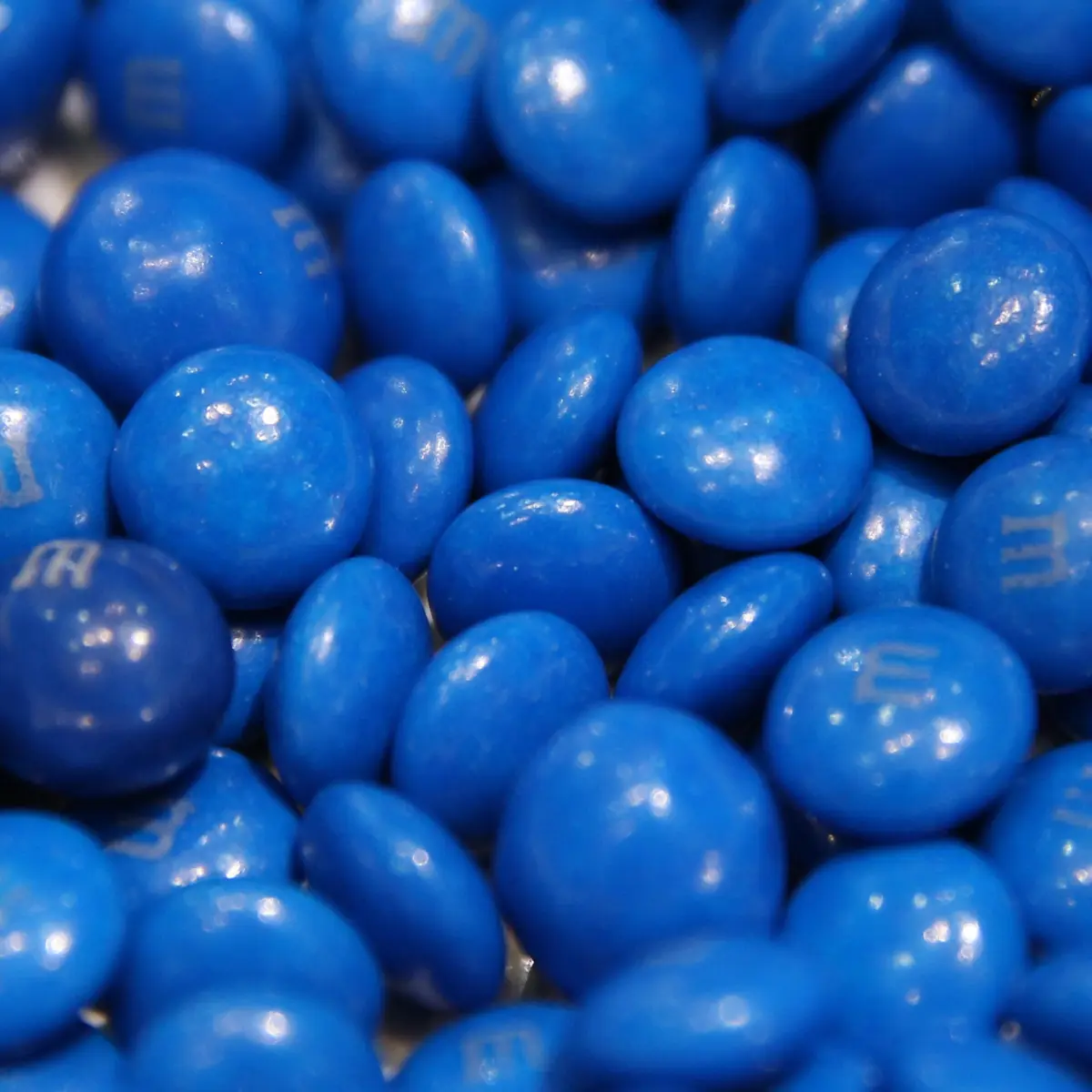
This regulatory pressure has triggered a multi-million-dollar operational crisis for confectionery giants, most notably Mars, the multi-national titan behind M&Ms. In response to mounting consumer anxiety and shifting federal priorities, Mars committed to engineering an all-natural version of its iconic chocolate treats. Yet, as a recent deep-dive investigation by the Wall Street Journal revealed, transitioning a legacy global manufacturing footprint away from synthetic agents is an engineering labyrinth. The premier casualty of this massive industrial pivot? The beloved, vibrant blue M&M.
This feature explores the high-stakes intersection of federal health policy, industrial food manufacturing, color theory, and consumer psychology. Drawing from investigative reporting inside Mars’s Topeka, Kansas production facility and interviews with leading food journalists, we examine why replacing a single synthetic shade requires millions of dollars, rewrites foundational chemistry, and ultimately changes very little about the nutritional reality of eating candy.
Detailed Chronology: The Road to the "MAHA Makeover"
To understand how a humble, candy-coated chocolate orb became a focal point of federal health reform, one must trace the timeline of Kennedy’s multi-year campaign and the corporate scramble that followed.
The Rise of the MAHA Movement
Long before ascending to the helm of Health and Human Services in the Trump administration, Robert F. Kennedy Jr. made synthetic chemical additives a central target of his public health advocacy. Denouncing popular processed snacks—including Doritos, Cheez-Its, Cap’n Crunch, and standard gummy bears—Kennedy publicly characterized these items not as food, but as "food-like substances" and "poisons," noting on national television that certain ingredients share lineage with petroleum refineries.
Kennedy’s primary indictments against artificial dyes center on purported neurological impacts, including childhood hyperactivity, attention deficits, and speculative links to carcinogenicity. While regulatory bodies have historically maintained a more nuanced view, the rhetorical momentum of the MAHA movement successfully shifted public perception, turning artificial food coloring from an invisible industry standard into a lightning rod for consumer distrust.
Mars and the All-Natural Pledge
Feeling the heat of shifting consumer demand and impending regulatory scrutiny, Mars announced a major corporate initiative last year: the development of all-natural alternatives for its flagship portfolio. The goal was to offer consumers a choice—maintaining traditional recipes while simultaneously engineering a clean-label product line free from petroleum-derived additives.
However, moving from corporate press releases to the factory floor proved exponentially more complex than executives anticipated. Mars quickly discovered that while substituting certain colors was relatively straightforward, others—specifically those relying on blue as a foundational base—defied easy replacement.
The Topeka Factory Revelation
Wall Street Journal reporter Jesse Newman went inside the massive Mars manufacturing facility in Topeka, Kansas, to observe the industrial reality of this transition. Inside the plant, millions of chocolate centers (referred to internally as "lentils") tumble through colossal, industrial-scale rotating drums—machinery resembling oversized commercial tumble dryers—while liquid coatings are sprayed onto the rolling surfaces.
The transition to natural alternatives immediately slammed into severe chemical and mechanical barriers, centering squarely on the industry’s chosen replacement for Blue 1: spirulina, a blue-green algae derivative.
Supporting Context & Metrics: The Chemistry and Economics of Color
The engineering hurdles faced by Mars highlight the profound gap between consumer desires for "clean" labels and the realities of mass food production.
The Science of Synthetic vs. Natural Dyes
For decades, the United States Food and Drug Administration (FDA) has maintained that nine synthetic artificial dyes are safe for human consumption when used within established regulatory thresholds. Global health bodies have historically echoed these safety assessments. However, state-level evaluations, such as those conducted by California agencies, have pointed to correlations between synthetic dyes and behavioral shifts, particularly hyperactivity in sensitive children.
The FDA acknowledges that while the vast majority of children tolerate synthetic colors without issue, a subset of the population experiences heightened sensitivity. Crucially, as food scientists note, artificial dyes serve a purely cosmetic purpose. They offer zero nutritional value. They exist solely to ensure visual uniformity and shelf appeal.
The Spirulina Bottleneck
Replacing synthetic Blue 1 with natural spirulina introduced a cascade of mechanical failures within the automated factory pipeline:
- State of Matter: Synthetic Blue 1 is delivered to factories as a liquid, blending effortlessly into liquid sugar syrups. Spirulina, by contrast, arrives as a fine powder. Incorporating a powder into a high-speed liquid coating recipe fundamentally alters the fluid dynamics of the mixture.
-
Viscosity and Clogging: Because spirulina is protein-rich, the resulting mixture exhibits significantly higher viscosity
(thickness). This thickened syrup quickly began clogging industrial piping, causing severe flow disruptions.
- Bio-Accumulation and Safety Hazards: The protein content in spirulina caused the mixture to coat and bake onto the interior surfaces of the manufacturing machinery. This internal buildup presents an immediate food safety and hygiene hazard, creating potential sites for microbial growth and mold.
Color Theory and the Missing Shades
Compounding the mechanical engineering challenge was elementary school color theory. To produce a wide spectrum of vibrant candy shells—including green and brown—food scientists rely on blue as a foundational primary color.
Without a stable, cost-effective, high-volume natural blue, producing true blue and rich brown M&Ms became chemically impossible. While Mars successfully isolated enough spirulina to formulate a natural green (utilizing a lower overall concentration of the algae), the sheer volume required for blue and brown remained unattainable at scale.
Consequently, Mars launched its naturally dyed M&M variant earlier this year featuring only red, orange, yellow, and green. Industry observers and consumers immediately noted the visual difference: lacking the bright, neon saturation of their synthetically dyed counterparts, the natural variants emerged with a muted, earthy palette that critics jokingly described as looking distinctly "autumnal" or mature.
Official Statements & Industry Perspectives
The fallout from the MAHA movement has forced food conglomerates into a delicate balancing act: appeasing health-conscious consumers without alienating the broader market that still demands affordable, brightly colored treats.
Mars has been careful to communicate that its traditional, synthetically dyed product lines are not disappearing from store shelves. The introduction of naturally dyed alternatives is strictly an expansion of consumer choice, not a wholesale replacement of legacy recipes.
"We are committed to providing consumers with options that align with their lifestyle and preferences," a Mars spokesperson noted during the rollout of the initiative. "However, scaling natural alternatives across global production volumes involves immense technical complexities that require careful navigation to ensure safety, quality, and affordability."
Food journalists and industry analysts emphasize that the financial investment required for these retrofits is staggering. Mars declined to disclose an official lump-sum expenditure figure, but corporate disclosures confirm that millions of dollars have been funneled into retrofitting approximately 300 distinct types of factory machinery across its production network.
Future Outlook: What the "MAHA Makeover" Means for Consumers
As the dust settles on the rollout of the muted, naturally dyed M&Ms, experts urge consumers to maintain a healthy perspective regarding the actual health impacts of these corporate pivots.
Food reporters examining the trend emphasize a fundamental truth: swapping artificial dyes for natural plant derivatives does not transform candy into health food.
When asked whether choosing naturally dyed snacks confers virtue or genuine wellness benefits, experts offer a blunt assessment: it means very little for physiological health. At its core, an M&M—whether colored with petroleum-derived Blue 1 or algae-derived spirulina—remains a confection composed primarily of sugar, fat, and calories.
While the MAHA movement has successfully galvanized corporate boardrooms to rethink ingredient decks, the ultimate consumer takeaway is sobering. Enjoying an afternoon pick-me-up or sorting through a Halloween haul is an indulgence best approached with clear eyes. Whether the candy shell is vibrant and synthetic or muted and autumnal, it remains a sweet treat, not a nutritional supplement. As federal regulators and food scientists continue their dance over the future of the American pantry, the ultimate responsibility for dietary choices continues to rest, as it always has, squarely in the hands of the consumer.