Executive Overview
In the high-stakes, shadowy ecosystem of global cybercrime, the Ransomware-as-a-Service (RaaS) group Qilin has risen to ruthless prominence. According to a comprehensive Q3 threat intelligence report released by cybersecurity firm NCC Group, Qilin has cemented its status as the world’s most industrious and active ransomware affiliate program, claiming at least 365 victim organizations in a mere three-month window.
Operating under a "double extortion" model—wherein sensitive corporate data is exfiltrated prior to the encryption of victim networks, followed by threats of public leaks—Qilin’s leadership has cultivated a vast, international web of affiliates. Unlike many Russian-speaking cybercrime syndicates that strictly isolate themselves from Western operatives, Qilin embraces English-speaking affiliates, partnering with notorious threat actors such as Scattered Spider and RansomHub.
Yet, as security researchers frequently demonstrate, even the most prolific and technically sophisticated cybercriminals are ultimately vulnerable to human error and digital forensics. Intelligence shared by specialized de-anonymization platforms, threat-hunting investigators, and extensive public data breaches has pierced the veil surrounding Qilin’s supreme administrator.
The mastermind who operates under the primary alias "Haise"—and who has directed millions of dollars in extortion schemes—is not a phantom. Digital breadcrumbs spanning over a decade connect the persona directly to Aleksey Mikhailovich Yakovtsev, a 36-year-old native of Murmansk living in St. Petersburg, Russia. This investigative feature traces the digital footprint, operational missteps, and multi-agency intelligence fusion that unmasked the man behind Qilin.
Detailed Chronology: From Low-Level Arbitrageur to Ransomware Kingpin
The journey of Aleksey Yakovtsev from a minor participant in online fraud to the head of a multi-million-dollar ransomware empire did not happen overnight. It represents a steady, calculated escalation in cybercriminal sophistication, punctuated by fatal operational security (opsec) missteps.
1. The Formative Years: Traffic, Logs, and Carding (2018–2020)
Before stepping into the elite circles of ransomware administration, Yakovtsev cut his teeth in the murkier corners of digital marketing fraud and financial crime. Cyber intelligence platforms including Flashpoint and Intel 471 indicate that between 2018 and 2019, the individual operated under early aliases, dabbling in credit card fraud, traffic arbitrage, and illicit digital assets.
By 2020, the profile evolved significantly. Operating under the moniker "Rjun" on prominent Russian-speaking cybercrime forums such as Exploit and XSS, the user maintained an active presence in Telegram channels using the handle Alexbigboss44. During this period, Rjun’s criminal portfolio focused heavily on the high-volume acquisition of Facebook logs, compromised credentials, and Google Ads accounts. These assets were leveraged to fuel fraudulent advertising networks, online gambling schemes, and widespread credential-stuffing operations.
2. Establishing Legacy Forum Roots
While utilizing the Rjun handle, Yakovtsev secured long-term memberships across several elite, heavily vetted Russian cybercrime forums, including Darkmarket, Verified, and Zloy. Crucially, when registering for these communities, he registered using a foundational email address: [email protected].
In the world of cybercrime, reusing an email address across multiple distinct operational phases is an unforgivable opsec sin. While threat actors frequently alter their public display names and forum nicknames to distance themselves from past mistakes, underlying infrastructure—such as email accounts, registration patterns, and cryptocurrency wallet handoffs—often persists.

3. The Genesis of Qilin and the Rise of "Haise" (2022)
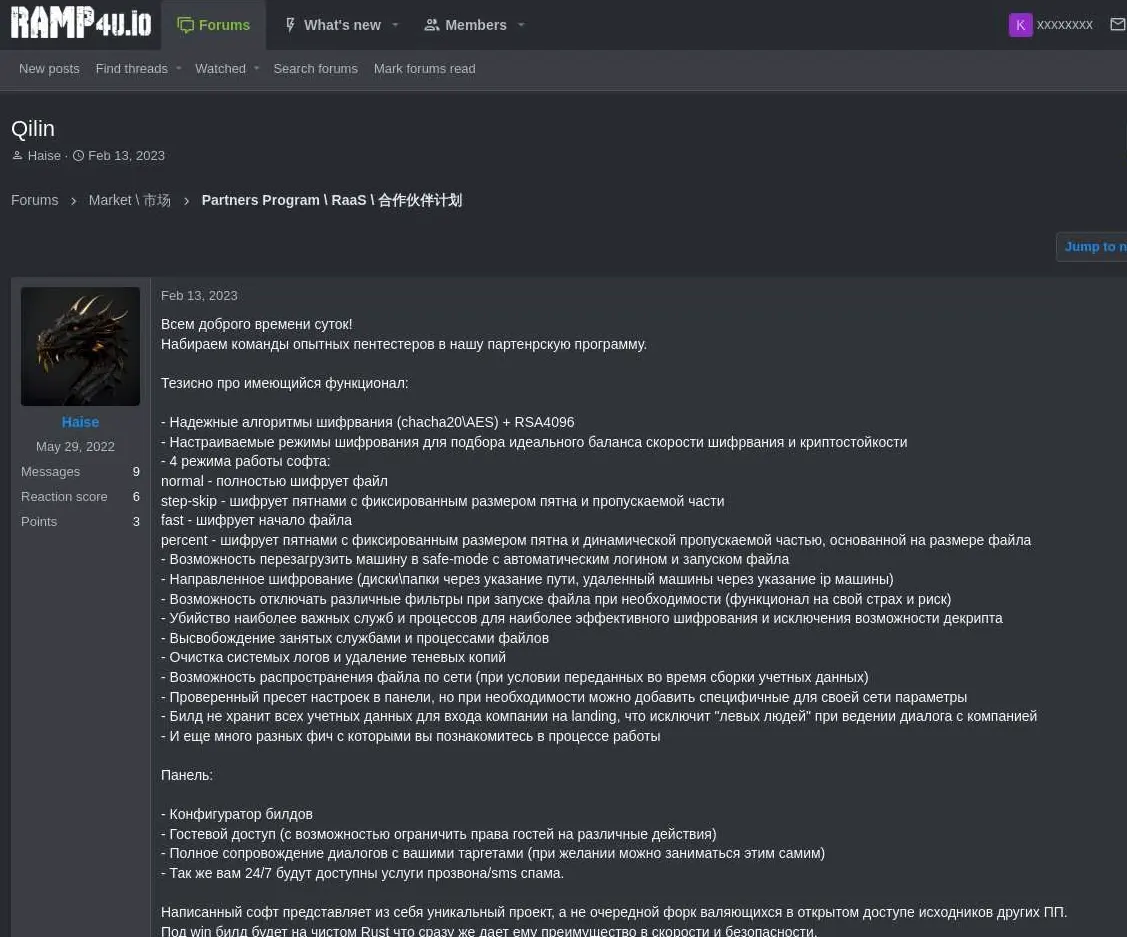
By September 2022, the digital landscape shifted with the formal emergence of the Russia-based ransomware group Qilin. Designed as an agile, highly lucrative RaaS program, Qilin enticed seasoned hackers by offering them an unprecedented 80 percent cut of any successful extortion payout.
To manage this rapidly expanding enterprise, the chief administrator adopted a fresh identity: "Haise." Recognizing the value of operational security, Haise initially operated under this clean break. However, cybercrime administration requires networking, vetting, and recruitment. In June 2022, when applying for membership to RAMP—a closely guarded, invitation-only Russian forum established specifically as a haven for ransomware syndicates—Haise was forced to bridge past worlds.
According to indexed direct messages captured by Intel 471 prior to the FBI’s seizure of the RAMP forum in January 2026, the RAMP administrator approved Haise’s application while explicitly cross-referencing him with his enduring Telegram username: Alexbigboss44. This single administrative crossover inadvertently welded Haise’s high-level ransomware operations directly to the historical footprint of Rjun.
Supporting Context & Metrics: De-Anonymization and the Breach Ecosystem
The formal connection between Haise, Rjun, and Yakovtsev was brought to light through advanced threat intelligence techniques, notably utilizing automated de-anonymization platforms, stylistic analysis (stylometry), and the fallout from massive data leaks within the Russian Federation.
The IntelHawk Breakthrough
Earlier this month, the AI-based de-anonymization platform IntelHawk shared internal findings detailing how historical usernames, behavioral telemetry, and stylometric indicators can link disparate online personas. Leo Bogod, founder and chief technology officer of IntelHawk, noted that a granular analysis of these accounts revealed a distinct behavioral progression:
- 2018–2019: A novice arbitrageur, fraudster, and credit card broker.
- 2020–2023: An increasingly experienced organizer of complex cybercriminal infrastructure, transitioning into malware deployment, botnets, and payment laundering.
Following IntelHawk’s disclosures, the independent OSINT tracking entity GangExposed—known for successfully unmasking high-profile ransomware figures—corroborated these conclusions. GangExposed released detailed investigative documents highlighting how Haise’s operational Telegram channels and recruitment posts on forums like RAMP mapped directly to Yakovtsev’s digital infrastructure.
The Smoking Gun: Russian Data Breaches
The cryptographic wall surrounding Haise ultimately crumbled due to real-world data leaks within Russian state infrastructure:
- The Forum Registration: Intelligence firm Intel 471 confirmed that Rjun registered across multiple forums using
[email protected]. - Credential Reuse: Identity threat protection firm SpyCloud discovered that this exact email address previously utilized the weak password
Rjun132. - The State Portal Leak: A query of the breach-tracking database Constella Intelligence revealed that
[email protected]appeared in records originating from gosuslugi.ru, the official digital portal for state and municipal services in the Russian Federation. Gosuslugi suffered a catastrophic data breach in late 2025, exposing over 20 million citizen records containing full legal names, dates of birth, and verified phone numbers. - The Identity Revealed: The leaked Gosuslugi registry tied
[email protected]directly to Aleksey Mikhailovich Yakovtsev, born August 18, 1990, residing in St. Petersburg.
Expanding the Digital Dossier
Further corroboration came from Flashpoint, which noted that Haise’s long-standing Telegram account—tied to internal User ID 118329521—had logged more than 5,000 active messages since 2018. Constella Intelligence cross-referenced this Telegram ID with the Russian mobile phone number +79602347275.
Pivoting on this telephone number uncovered a web of associated secondary email accounts, including [email protected] and [email protected]. According to IntelHawk’s analysis, the phone number formally belongs to Yakovtsev’s biological sister, an individual whose contact details Aleksey routinely utilized as a buffer when registering for various commercial and web services.

Physical records further anchored the profile. Data from Russia’s education watchdog, Rosobrnadzor, confirms that a person matching Yakovtsev’s identity completed grade school in Murmansk and subsequently earned a master’s degree in computing and information systems. Furthermore, internal flight manifests obtained from Russian travel agencies—compromised in recent cyber incidents—showed Aleksey Yakovtsev taking multiple domestic flights between St. Petersburg and Murmansk between 2013 and 2014, as well as frequent recent travel between St. Petersburg and Sochi, Russia’s premier Black Sea resort city.
Official Statements and Industry Impact
The revelation of Qilin’s administrative structure arrives at a critical juncture in international cybersecurity policy. Ransomware syndicates have increasingly transitioned into modular, business-like enterprises capable of evading traditional law enforcement parameters by operating safely within jurisdictions that lack extradition treaties with Western nations.
NCC Group’s Q3 threat intelligence report highlights the alarming efficiency of Qilin’s affiliate model. By offering an 80% payout split, the group has effectively incentivized external initial access brokers (IABs) to weaponize enterprise networks on a scale previously reserved for state-sponsored Advanced Persistent Threat (APT) groups.
Independent analysts point out that while exposing the real-world identity of a cybercriminal mastermind like Aleksey Yakovtsev rarely results in immediate physical arrest—given his residency inside the Russian Federation—it profoundly disrupts operations. The unmasking forces ransomware administrators to burn existing infrastructure, abandon trusted communication channels, cut ties with paranoid affiliates, and expend valuable resources rebuilding operational security from the ground up.
Attempts by investigative journalists to reach Mr. Yakovtsev via his known email addresses and telephone numbers were met with silence.
Future Outlook
The unmasking of Aleksey Yakovtsev as the man behind the Qilin ransomware administrator alias "Haise" serves as both a milestone in threat intelligence and a stark reminder of the limitations facing modern cyber investigations.
As artificial intelligence-driven analytics platforms like IntelHawk mature, the historical anonymity once granted by disjointed online handles, forum migrations, and encrypted chat apps is rapidly deteriorating. Stylometry, metadata correlation, and the compounding inevitability of massive data leaks within state and commercial databases mean that threat actors can no longer rely on superficial alias changes to protect their real-world identities.
For Qilin, the exposure of its primary architect introduces immediate friction. Affiliates demand trust, discretion, and financial security; public identification of a leader breeds internal paranoia and external scrutiny from international law enforcement agencies, including Interpol and the FBI.
Nevertheless, as long as geopolitical divides shield cybercriminals operating within Russian borders, kingpins like Yakovtsev will likely remain shielded from physical detention. Yet, their world has undeniably shrunk. The digital fortress built around Haise has been breached, proving that while code can be obfuscated and networks can be encrypted, human error will always leave an indelible paper trail.