By Investigative Desk
Executive Overview
The cultural reckoning sparked by the global #MeToo movement has fundamentally shifted how society confronts workplace misconduct, traditionally targeting the bastions of white-collar privilege—Hollywood studios, elite newsrooms, and high-stakes political corridors. However, a systemic blind spot has long persisted within blue-collar and corporate operational environments, such as call centers and regional dispatch hubs, where employees often labor far from the protective glare of media spotlights.
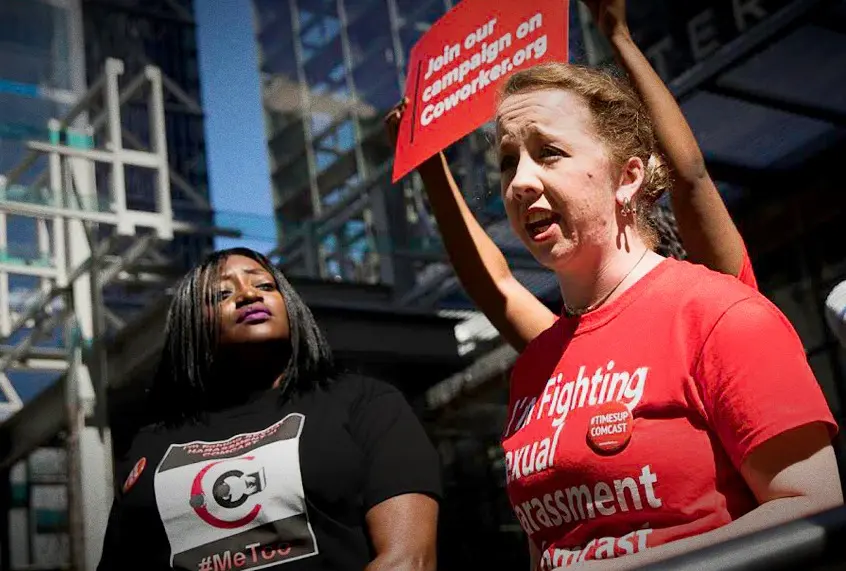
In May 2018, that hidden reality was thrust into the national conversation as former call center and dispatch employees of telecommunications giant Comcast banded together to demand sweeping institutional reform. Spearheaded by former sales representative Laterrica Perry and former dispatch representative Rylinda Rhodes, a coalition of current and former workers delivered a petition signed by over 4,000 individuals to Comcast’s corporate headquarters in Philadelphia.
The petition accuses the multinational conglomerate—which owns NBCUniversal—of fostering a pervasive culture of sexual harassment and systematically retaliating against employees who dare to report misconduct. Despite corporate pledges prioritizing integrity and respect, these women allege that reporting inappropriate behavior invites professional marginalization, psychological devastation, and ultimately, termination. This in-depth report examines the timeline of their allegations, the structural failures of corporate human resources departments, the broader context of blue-collar harassment in the telecommunications sector, and the enduring struggle for accountability.
Detailed Chronology: A Trajectory of Misconduct and Retaliation
The Ordeal of Laterrica Perry
Laterrica Perry’s journey from a dedicated sales representative to an activist fighting for systemic change at Comcast is marked by institutional apathy and alleged targeted retaliation. In July 2017, the then-30-year-old Memphis, Tennessee-based employee submitted an anonymous report to Comcast Human Resources. Armed with concrete evidence—including text message records and phone logs—Perry detailed a harrowing pattern of inappropriate behavior by her direct supervisor, which included unwanted sexual advances and explicit verbal comments.
According to Perry, her refusal to submit to her supervisor’s sexual advances triggered an immediate retaliatory campaign. She states that her boss deliberately obstructed her professional duties by denying legitimate requests for sick time and withholding critical letters of recommendation necessary for career advancement. Furthermore, she alleges that during the months it took HR to investigate and eventually terminate the supervisor in October 2017, the manager actively worked to tarnish her professional reputation within the company.
The psychological toll of the harassment and subsequent retaliation was severe. Perry was medically diagnosed with post-traumatic stress disorder (PTSD) and placed on disability leave until March 2018. The prolonged absence severely impacted her financial stability, forcing her to execute a hardship withdrawal from her 401(k) retirement account simply to cover basic living expenses.
While attempting to navigate her recovery through regular therapy sessions and medical management, Perry encountered yet another blow. On April 30, 2018, while awaiting formal paperwork regarding a separation package, she discovered via an unexpected email that Comcast had officially terminated her employment.
"The only information I got was via e-mail saying that they had proceeded with the actual separation, but I didn’t get the actual package that showed why I was separated," Perry recounted. "I received everything, as far as my COBRA coverage, my 401(k) information. The only thing that I had not received is the explanation for my termination. I kind of felt like that was something suspicious."
The Fight of Rylinda Rhodes
Perry’s experience mirrors that of Rylinda Rhodes, whose ordeal laid the foundational groundwork for the employee-led petition campaign. Rhodes worked across four different Comcast call centers between 2007 and 2012, serving as a dispatch representative. Shockingly, she reported experiencing sexual harassment in all but one of the facilities where she was employed.
The crisis point in Rhodes’s tenure arrived when a male colleague allegedly entered her office and physically groped her breasts. When Rhodes formally reported the incident, the internal response proved hostile to her continued employment. She was forced to take short-term medical leave to undergo talk therapy for trauma induced by the workplace environment. During her medical leave, while internal investigations were supposedly underway, Comcast management instructed her to apply for alternative positions within the company.
Ultimately, on August 1, 2012, Rhodes was terminated. While company records cited health reasons for her dismissal, Rhodes maintains that her firing was direct retaliation for her refusal to remain silent about sexual assault and harassment.
Inspired by the momentum of the burgeoning #MeToo movement in late 2017, Rhodes decided to break years of self-imposed silence, launching the Coworker.org petition that would eventually unite victims across corporate lines.
Supporting Context & Metrics: The Hidden Toll in Blue-Collar Sectors
While media coverage has heavily concentrated on executive-suite scandals—such as the high-profile terminations within Comcast subsidiary NBCUniversal, including former Today show host Matt Lauer and subsequent allegations against veteran anchor Tom Brokaw—the systemic nature of workplace harassment runs deep in operational and service-oriented sectors.
Data from the U.S. Equal Employment Opportunity Commission (EEOC) highlights a troubling historical trend. Between 2005 and 2015, approximately 1,200 charges of sexual harassment were filed within the information industry alone, a sector encompassing telecommunications giants like Comcast.
Analysts note that blue-collar and corporate support environments—such as call centers, customer service divisions, and field dispatch offices—present unique vulnerabilities for workers:
- Power Asymmetry: Call center employees and sales representatives often operate under rigid performance metrics managed by local supervisors who wield near-total control over scheduling, bonuses, and job security.
- Fear of Economic Instability: Workers in these environments are frequently living paycheck-to-paycheck, making the risk of speaking out—and facing potential termination or lost hours—financially catastrophic.
- Demographics of Vulnerability: A disproportionate percentage of frontline customer service and call center roles are occupied by women and women of color, who historically face compounded barriers when reporting misconduct by management.
For Perry and Rhodes, the shame and self-blame engineered by toxic management structures were initial hurdles to seeking justice. Rhodes noted that listening to supervisors minimize inappropriate behavior—frequently gaslighting victims by claiming they were "too sensitive" or "prudes"—caused her to question her own reality before realizing that institutional rules were intentionally being ignored.
Official Statements and Corporate Stance
In response to the mounting public pressure and media inquiries—initially brought to light by investigative reporting from Jezebel and Salon—Comcast corporate communications issued formal statements defending the company’s anti-harassment protocols.
Jenni Moyer, Senior Director of Corporate Communications at Comcast, stated in defense of the company’s record:
"Sexual harassment, or harassment of any kind, is not tolerated at Comcast. The company was founded on a foundation of respect, integrity, and trust. We have strong policies against sexual and other forms of harassment and encourage employees to report any harassing behavior. Any allegation of harassment is taken very seriously."
However, actions on the ground contrasted sharply with these corporate assurances. When Perry, Rhodes, and a third former employee traveled to Comcast’s corporate headquarters in Philadelphia to deliver their petition addressed to CEO Brian Roberts, executive leadership declined to meet with them.
Despite being turned away at the doors, the delegation viewed the demonstration as a symbolic victory. The petition, which surpassed 4,000 signatures, served notice to executive leadership that frontline employees were organizing across geographical boundaries to expose structural failures.
"It’s still a win. It lets them know people are watching and coming forth," Rhodes remarked following the delivery. "It’s also for the ones that are still suffering. To know they are not alone. We are just getting started. All women should have the freedom to be their authentic self and not a scared version because of sexual harassment."
Future Outlook: A Movement Beyond the Corporation
As the legal and public relations battles continue, the legacy of the Comcast employee protest extends far beyond the confines of a single telecommunications firm. It represents a decentralized evolution of the accountability movement, proving that grassroots worker organizing can challenge even the most deeply entrenched corporate hierarchies.
The outlook for systemic reform within companies like Comcast remains a subject of intense debate among advocates:
- Pessimism Regarding Internal Reform: Laterrica Perry remains deeply skeptical that corporate executives are genuinely open to self-examination or meaningful cultural overhaul. Her doubts stem directly from her personal experience of being terminated without clear justification while attempting to secure a separation package following her medical leave.
- Optimism Through Empowerment: Conversely, both Perry and Rhodes view their advocacy as an essential public service for the voiceless. By stepping forward, they aim to demystify the reporting process, educate workers on available legal and medical resources, and dismantle the stigma associated with reporting workplace misconduct.
Perry has signaled her intention to dedicate her future efforts toward supporting women navigating similar corporate crises, ensuring that victims understand they possess external avenues for recourse when internal human resources channels fail them.
Ultimately, the bravery of these former Comcast employees has permanently altered the discourse surrounding workplace safety in the telecommunications industry. By dragging institutional negligence out from behind the call center cubicles and into the public eye, they have ensured that corporate America can no longer ignore the human cost of unaddressed harassment on the front lines.