Executive Overview
On the morning of September 29, the global fashion capital held its breath as designers Ester Manas and Balthazar Delepierre officially stepped back onto the Paris Fashion Week calendar. Their return marked the end of a two-year hiatus—a period that, coincidentally or not, witnessed a catastrophic collapse in size diversity on the international runway.
According to data compiled in the Vogue Business Size Inclusivity Report, representation for plus-size models plummeted from an already abysmal 0.8 percent down to a virtually non-existent 0.3 percent across major fashion weeks. While industry analysts are quick to point out that the immense burden of body diversity should never fall squarely on the shoulders of just one or two independent labels, the mere presence of Ester Manas on the official schedule serves as both a vital anchor for inclusivity and a stark reminder of how fragile the industry’s tokenistic progress truly is.
For their long-awaited comeback, Manas and Delepierre chose a conceptual framework that was as unconventional as it was brilliant. Titled Somehow I Manage—a direct homage to the fictional, cringeworthy memoir penned by Michael Scott in the American television sitcom The Office—the collection was simultaneously a humorous nod to their own operational survival during their absence and a masterclass in high-fashion execution.
Partnering with the historic 161-year-old Belgian lingerie institution Primadonna, the design duo curated a runway collection that challenged conventional sartorial boundaries. They successfully merged delicate intimate wear with industrial outerwear, pastel sheers with aggressive cheetah prints, and corporate striped shirting with bouncy, light-catching beaded skirts.
The underlying thesis of the collection was simple yet revolutionary: sex appeal has no business being restricted by sizing matrices or rigid aesthetic categorizations. As the industry grapples with a sweeping regression in body representation, the return of Ester Manas offers both a critical design blueprint for the future and an urgent wake-up call to legacy luxury houses.
Detailed Chronology: The Road to the Somehow I Manage Comeback
The Two-Year Hiatus and Industry Vacuum
When Ester Manas and Balthazar Delepierre stepped away from the official Paris Fashion Week schedule two years ago, insiders whispered about the immense physical, financial, and emotional toll required for an independent, truly size-inclusive brand to survive within the rigid architecture of the global fashion system. Producing collections that cater to extended size ranges requires specialized pattern-making, increased yardage, robust testing, and casting budgets that far exceed industry standards for sample-size-only houses.
Their absence created an immediate, palpable void. Without Ester Manas regularly anchoring the Paris schedule with diverse casting, the already fragile ecosystem of runway representation began to crumble. Other labels that had tentatively experimented with mid-size and plus-size casting in the post-pandemic rush for performative inclusivity quietly reverted to old habits, shrinking their sample sizes down to the historical industry standard (typically a UK 6–8 / US 2–4).
The September 29 Return: Setting the Stage
The anticipation outside the venue on the morning of September 29 was electric. Editors, buyers, influencers, and activists packed the tight seating arrangement, acutely aware that this was not merely another runway show, but a litmus test for the commercial viability of radical inclusivity in a hostile market climate.
When the lights dimmed, the tone was immediately set by the collection’s Somehow I Manage. By invoking Michael Scott’s legendary, laughably misguided book from The Office, the designers infused their return with self-aware irony. Managing a fashion brand in today’s economic climate is an exercise in absurdity, and surviving as a champion of inclusivity without bowing to conglomerate pressures is nothing short of heroic. The title acknowledged the struggle with a wink, proving that the brand had lost none of its sharp cultural commentary during its time away.
Unpacking the Primadonna Collaboration
The creative engine behind the SS25/AW collection was an unprecedented partnership with Primadonna, a storied Belgian lingerie brand boasting 161 years of heritage. Traditionally known for crafting supportive, beautifully engineered foundation garments for fuller figures, Primadonna opened its extensive historical archives to Manas and Delepierre.
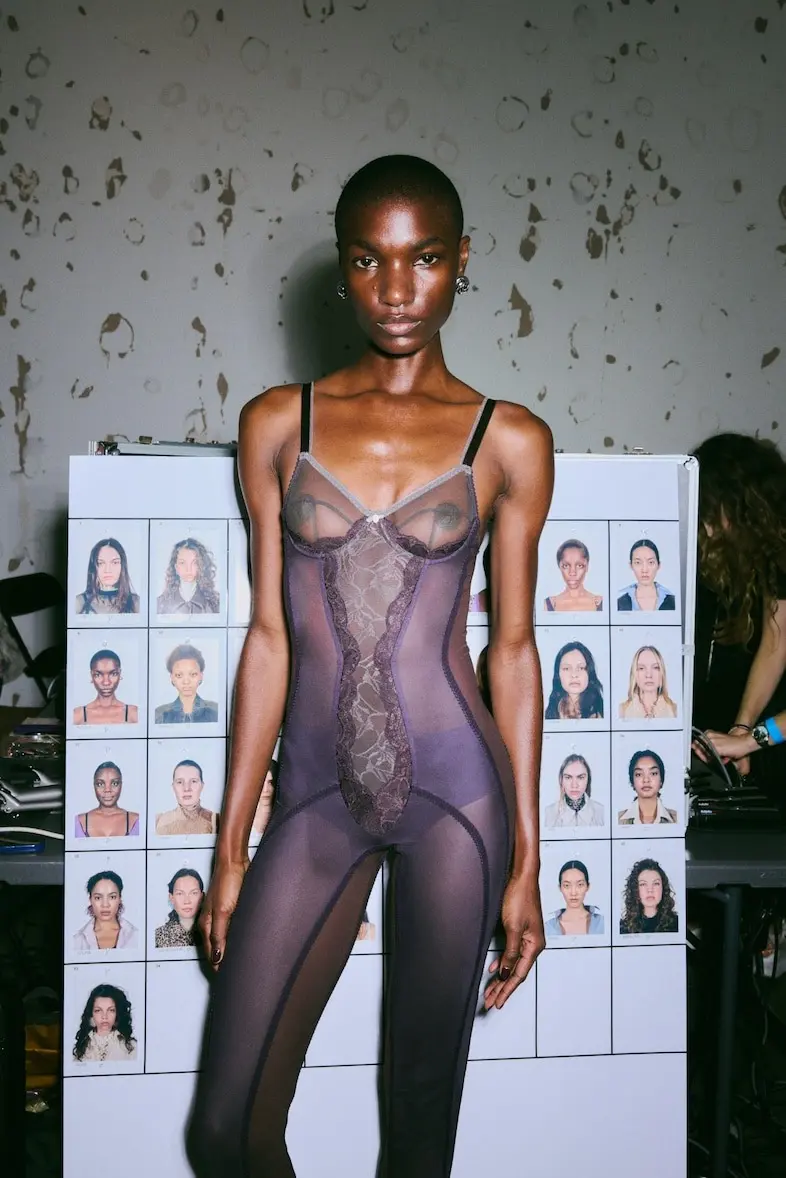
The collaboration allowed the designers to deconstruct the very notion of underwear versus outerwear. The runway saw the debut of exquisite sheer body stockings rendered in soft pastel hues—mint, lavender, and butter yellow—constructed with structural paneling outlined in intricate, vintage-inspired lace. Rather than hiding these foundation pieces beneath heavy garments, the designers elevated them to the status of primary attire. Underwear became outerwear, challenging the Puritanical gaze that has historically policed how larger bodies are allowed to display sensuality.
Material Clashes and Tailored Contrasts
The collection did not rely solely on softness and sheerness; it thrived on tension and contradiction. Cheetah prints aggressively clashed with cool-toned baby blues, subverting traditional notions of good taste and pushing into a realm of unapologetic maximalism.
Interspersed between the revealing lace garments were sharply tailored, striped corporate shirting items that riffed on traditional menswear, only to be abruptly paired with bouncy, kinetic beaded skirts that caught the light with every stride of the runway. Boxy, oversized technical jackets provided a heavy, architectural counterweight to the diaphanous sheer bodysuits underneath. This layering of disparate textures—industrial nylon against delicate lace, rigid stripes against fluid beads—created a visual vocabulary that spoke directly to the multifaceted nature of modern identity.
Supporting Context & Metrics: The State of Runways Today
The Hard Numbers: A Declining Landscape
To truly understand the weight of Ester Manas’s return, one must examine the grim statistical reality of the current fashion landscape. According to the Vogue Business Size Inclusivity Report—the industry’s gold standard for tracking runway diversity—plus-size representation has experienced a catastrophic decline over the past several seasons.
| Metric / Year | Plus-Size Representation (%) | Key Industry Trend |
|---|---|---|
| Peak Post-Pandemic Era | ~1.2% – 1.5% (Estimated) | Brief surge in performative diversity post-2020 |
| Previous Baseline | 0.8% | Widespread stagnation across major fashion weeks |
| Current Status | 0.3% | Steep regression; return to homogenous casting |
Dropping from an already dismal 0.8 percent to a microscopic 0.3 percent means that out of thousands of looks presented across New York, London, Milan, and Paris, genuinely plus-size models (defined broadly in the industry as UK size 16 / US 12 and above) were virtually erased.
Critics of the fashion system note that brands often use economic uncertainty as an excuse to retreat into homogeneity. Producing clothes in extended sizes costs more, requires a deeper supply chain overhaul, and forces luxury houses to confront their own institutionalized fatphobia. When brands pull back from inclusivity, they are not simply making a pragmatic financial choice; they are actively deciding which human beings are worthy of aesthetic visibility.
The Myth of the "One-Brand Burden"
Industry observers frequently debate the ethics of placing the weight of representation on independent pioneers like Ester Manas. It is fundamentally unfair that a small, independent house should bear the societal responsibility of rectifying an industry-wide crisis engineered by multi-billion-dollar luxury conglomerates.
However, fashion history proves that systemic change rarely trickles down from the top without grassroots pressure. Pioneer brands act as proof-of-concept. They demonstrate that inclusive clothing can be commercially viable, critically acclaimed, and culturally resonant. When labels like Ester Manas exit the schedule—even temporarily—the vacuum exposes just how hollow the commitments of mainstream luxury houses truly are.
Official Statements and Design Philosophy
Speaking backstage after the show, Ester Manas and Balthazar Delepierre articulated the core philosophy that has guided their brand since its inception:
"There is no reason why the sexy cannot mingle with what, we sometimes assume, does not belong to that category at all."
This simple declaration cuts to the heart of fashion’s historic prejudice. For decades, mainstream fashion has operated under the false assumption that sensuality, desirability, and high-fashion avant-garde design are the exclusive domain of a very narrow, youth-oriented, ultra-thin body type. Fuller figures have historically been relegated to either medicalized shapewear, shapeless muumuus, or completely ignored.
By merging the heritage corsetry and lingerie engineering of Primadonna with cutting-edge streetwear sensibilities, Manas and Delepierre dismantled this false dichotomy. They argued that a body does not need to conform to a specific size matrix to be adorned in sheer lace, dangerous cheetah prints, or playful beaded skirts.
Furthermore, the integration of the Somehow I Manage theme served as an official statement on the psychological endurance required to run an independent brand today. In an interview context, the designers noted that survival in the fashion industry often feels like a daily improvised comedy sketch—hence the nod to Michael Scott. Yet, beneath the humor lies a steely determination to institutionalize change rather than remain a passing trend.
Future Outlook: Where Does Fashion Go From Here?
The Imperative for Systemic Reform
As the dust settles on Paris Fashion Week, the return of Ester Manas serves as both a celebration and a warning. While the collection was universally praised for its technical brilliance and emotional resonance, a single triumphant comeback show cannot reverse a systemic drop to 0.3 percent size representation.
The future of fashion hangs in the balance. If major luxury houses—backed by immense capital and global supply chains—continue to abandon size inclusivity under the guise of "trend forecasting" or "aesthetic minimalism," the industry risks alienating an entire generation of consumers. Modern shoppers are increasingly sophisticated; they see through corporate greenwashing and body-diversity tokenism. They demand authenticity, representation, and garments that actually fit diverse human bodies.
What Needs to Happen Next
- Supply Chain Democratization: Luxury houses must invest in inclusive grading systems that treat extended sizing not as an afterthought or a "special collection," but as a core component of production.
- Casting Accountability: Casting directors must be held accountable for maintaining diverse rosters across all four major fashion capitals, rather than relegating plus-size models to a single token appearance per show.
- Financial Support for Independents: Investment firms and luxury conglomerates should provide structural and financial backing to independent size-inclusive brands like Ester Manas, ensuring they do not face crippling two-year hiatuses due to market pressures.
Conclusion
Ester Manas and Balthazar Delepierre have proven once again that they are among the most vital design voices of their generation. Through Somehow I Manage, they turned adversity into art, corporate irony into high-fashion triumph, and historical lingerie archives into a modern manifesto for body liberation. As the fashion world digests the sobering reality of the 0.3 percent statistic, the message from the Paris runway is clear: inclusivity is not a seasonal trend to be picked up and discarded—it is the absolute prerequisite for the future of style.