Executive Overview
In the fast-paced ecosystem of modern quantitative finance, algorithmic modeling and predictive forecasting have traditionally been restricted to institutional behemoths armed with proprietary technology stacks. However, open-source software initiatives continue to democratize access to advanced computational methodologies. The latest contribution to this landscape comes from software developer P. Jaiyuvan (operating under the community handle dragon_2007), who has released a new, lightweight Monte Carlo stock price simulator written entirely in C++ and powered by the CMake build system.
Designed primarily as an educational venture into systems programming and financial mathematics, this open-source project harnesses the power of stochastic differential equations to project future equity values based on current asset prices and simulated market volatility. While the project is currently in its active development phase, it highlights a growing trend among software engineers to bridge the gap between high-performance systems engineering and quantitative financial analytics.
This article provides an in-depth exploration of Jaiyuvan’s open-source Monte Carlo simulator. We will examine the core mechanics of Monte Carlo simulations in stock forecasting, analyze the technical architecture of the project—including its C++ implementation and custom-built CSV parser—and evaluate the broader implications of community-driven educational software in the computational finance sector.
Detailed Chronology: The Genesis and Evolution of the Project
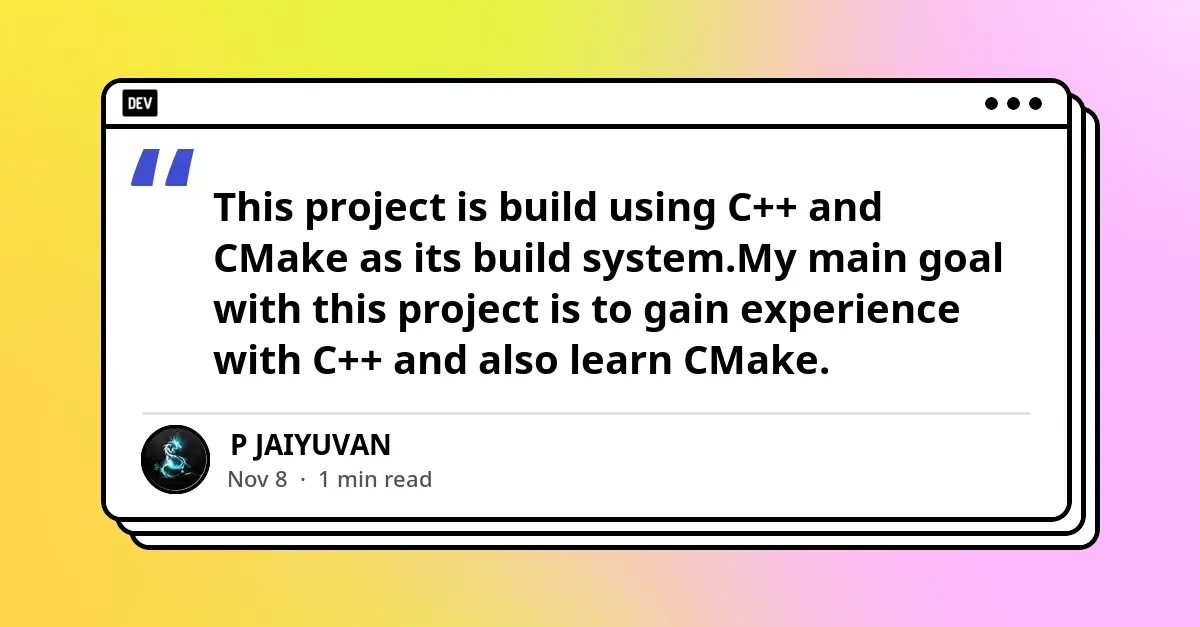
The journey of any open-source software project often mirrors the personal learning curve of its creator. For Jaiyuvan, the inception of the Monte Carlo simulator was born out of a dual objective: to deepen practical competency in modern C++ and to master CMake, a cross-platform family of tools designed to build, test, and package software.
Phase 1: Conceptualization and Core Mathematical Modeling
The initial phase of development focused on establishing a reliable predictive engine. In financial engineering, a Monte Carlo simulation is a mathematical technique used to model the probability of different outcomes in a process that cannot easily be predicted due to the intervention of random variables. In the context of equity markets, this involves simulating future stock prices by taking a current price point and introducing a "random shock"—a statistical deviation modeled using a normal (Gaussian) distribution.
By executing thousands of these simulations (often referred to as "paths"), developers and quantitative analysts can visualize a probability distribution of future price trajectories. Jaiyuvan prioritized a lean, highly performant core written in C++, leveraging the language’s speed and memory management capabilities to handle the heavy computational load inherent in running extensive simulations.
Phase 2: Build System Integration with CMake
As the codebase expanded beyond a single-file script, managing dependencies and compilation flags manually became untenable. To adhere to industry best practices, Jaiyuvan integrated CMake as the project’s build system.
Mastering CMake is a rite of passage for C++ developers moving past basic terminal commands (g++ main.cpp). By implementing a structured CMakeLists.txt file, the project gained cross-platform compatibility, making it easier for contributors on Linux, macOS, and Windows to compile and run the simulator without wrestling with platform-specific build configurations.
Phase 3: The Custom CSV Parser Pivot
A critical milestone in the project’s current timeline is the integration of historical market data. Initially, synthetic random walks provided the baseline for price shocks, but real-world testing requires empirical grounding. Financial historical data is predominantly distributed in Comma-Separated Values (CSV) format.
Rather than adopting established, highly optimized third-party parsing libraries—such as FastFormat, RapidCSV, or CSV parser headers—Jaiyuvan made the conscious decision to build a custom CSV parser from scratch. While acknowledging that specialized libraries exist and offer superior speed, Jaiyuvan framed the custom parser as an intentional pedagogical exercise. Writing a parser from the ground up provides deep insights into string manipulation, memory allocation, and data sanitization within C++.
Phase 4: Open-Source Publication and Community Engagement
With the core simulator functional and the foundational architecture established, the repository was published to GitHub for public access. The release marks a transition from a private sandbox project to a collaborative open-source initiative, inviting peer review, code contributions, and technical feedback from the global developer community.
Supporting Context & Metrics: Understanding Monte Carlo Simulations in C++
To fully appreciate the technical significance of Jaiyuvan’s project, it is essential to examine the underlying mechanics of Monte Carlo simulations and why C++ remains the gold standard for high-performance financial computing.
The Mathematics of Stock Price Simulation
In quantitative finance, stock prices are frequently modeled using Geometric Brownian Motion (GBM). The differential equation governing GBM incorporates two primary components:
- Deterministic Drift: The expected directional trend of the stock over time, often tied to the risk-free rate or historical returns.
- Stochastic Volatility (Random Shock): Unpredictable market fluctuations represented by a Wiener process (Brownian motion) scaled by the asset’s volatility and a normally distributed random variable.
The Monte Carlo method approximates the solution to this stochastic differential equation by generating numerous randomized paths. Mathematically, a future price $S(t+Delta t)$ can be simulated using the discrete approximation:
$$S_t+Delta t = S_t expleft( left(mu – fracsigma^22right)Delta t + sigma sqrtDelta t cdot Z right)$$
Where:

- $S_t$ = Current stock price
- $mu$ = Expected return (drift)
- $sigma$ = Stock volatility
- $Delta t$ = Time step
- $Z$ = Random variable drawn from a standard normal distribution $mathcalN(0,1)$
Generating thousands of these paths requires efficient pseudorandom number generation (PRNG). Modern C++ (specifically from C++11 onward via the <random> library) offers robust facilities like std::mt19937 (Mersenne Twister) and normal distribution wrappers (std::normal_distribution), which provide the statistical rigor necessary for accurate financial simulations.
Why C++ for Quantitative Modeling?
While languages like Python dominate data science and high-level prototyping due to libraries like NumPy and Pandas, C++ remains foundational for production-grade financial engineering.
| Metric / Attribute | Python (Interpreted / JIT) | C++ (Compiled) |
|---|---|---|
| Execution Speed | Moderate to Low (without C extensions) | Extremely High (Near bare-metal performance) |
| Memory Management | Automatic (Garbage Collected) | Manual / RAII (Resource Acquisition Is Initialization) |
| Concurrency | Limited by Global Interpreter Lock (GIL) | Highly efficient native multithreading |
| Ecosystem | Rich in data science libraries | Unmatched in high-frequency trading and systems programming |
By selecting C++ for this simulator, Jaiyuvan positions the project to handle large datasets and compute massive iteration matrices orders of magnitude faster than an equivalent unoptimized interpreted script.
Architectural Breakdown and Codebase Analysis
An inspection of the repository structure reveals several key architectural choices that reflect both learning milestones and software engineering best practices.
1. Separation of Concerns
The project structure cleanly separates the simulation logic from the input-output (I/O) operations. The mathematical engine responsible for executing the random walks operates independently of how data is ingested. This modularity is vital as the project transitions from synthetic data generation to processing historical CSV inputs.
2. Custom CSV Parser Engineering
Building a CSV parser from scratch presents several classic computer science challenges:
- Handling Delimiters and Escaped Characters: Ensuring that commas embedded within quoted strings do not incorrectly fragment data columns.
- Type Conversion: Safely parsing string tokens into numerical types (
doublefor prices, integers for volumes, andstd::stringorstd::chronofor dates) without triggering runtime exceptions due to malformed data. - Memory Efficiency: Avoiding excessive heap allocations when reading large multi-gigabyte historical datasets line by line.
While Jaiyuvan’s custom parser may not yet match the throughput of heavily optimized commercial libraries, the act of writing it provides invaluable experience in buffer management, pointer arithmetic, and stream processing in C++.
3. CMake Integration
The inclusion of CMake ensures that compilation is streamlined. A standard CMake workflow for the repository typically follows these steps:
# Clone the repository
git clone https://github.com/dragon_2007/monte-carlo-simulator-3i0n.git
cd monte-carlo-simulator-3i0n

# Create a build directory
mkdir build && cd build

# Configure the project with CMake
cmake ..

# Compile the executable
cmake --build .
This standardized build pipeline abstracts away compiler-specific flags, allowing developers to integrate the simulator into automated testing workflows or continuous integration (CI) pipelines effortlessly.
Future Outlook: The Road Ahead for the Open-Source Simulator
As Jaiyuvan continues active development on the Monte Carlo simulator, several strategic avenues lie ahead to elevate the project from an educational sandbox into a robust, feature-complete financial modeling tool.
Expanding Analytical Capabilities
- Multi-Asset Portfolio Simulation: Currently, the simulator focuses on single-stock trajectories. Expanding the engine to simulate correlated multi-asset portfolios using Cholesky decomposition would significantly increase its analytical utility.
- Advanced Statistical Output: Implementing comprehensive output metrics—such as Value at Risk (VaR), Conditional Value at Risk (CVaR), and confidence intervals—would transform raw simulation paths into actionable financial insights.
- Performance Optimization and Parallelization: Given that Monte Carlo simulations are inherently "embarrassingly parallel" tasks, integrating OpenMP or C++
std::async/std::jthreadwould allow developers to leverage multi-core CPU architectures, drastically reducing execution time for large-scale simulations.
Community Contribution and Peer Review
Open-source projects thrive on community feedback. Jaiyuvan’s explicit call for feedback on the repository opens the door for contributors with diverse skill sets—ranging from quantitative finance experts who can refine the stochastic models to seasoned C++ developers who can optimize memory footprints and streamline the custom CSV parser.
For students, hobbyists, and professional software engineers looking to understand the intersection of systems programming and financial mathematics, repositories like this serve as vital learning resources. They demonstrate that complex domain-specific software can be built incrementally, combining theoretical mathematics with practical systems engineering.
Conclusion
P. Jaiyuvan’s open-source C++ Monte Carlo simulator exemplifies the core ethos of software engineering: learning by building. By tackling a domain as mathematically rigorous as quantitative finance and implementing critical components—such as CMake build pipelines and custom CSV parsers—from scratch, the project serves as an inspiring case study for developers expanding their technical horizons.
As financial technology continues to evolve, tools that make quantitative modeling transparent, accessible, and open-source remain invaluable. Whether used as an educational stepping stone or a foundation for more advanced financial engines, this repository demonstrates the power of combining modern C++ with classic stochastic mathematics.
Developers interested in reviewing the codebase, contributing to the custom CSV parser, or offering technical feedback can access the project via its official GitHub Repository.