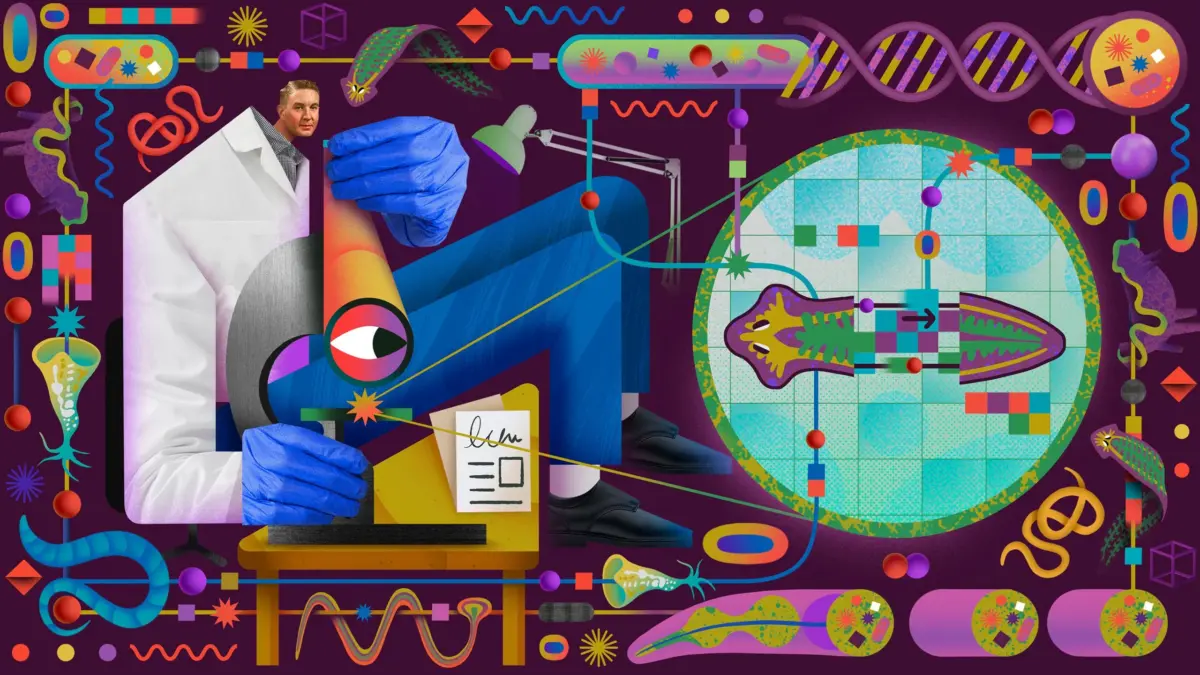
It was the dead of winter in Boston, and the surface of the Charles River was frozen solid. Braving a biting, bone-deep wind, Zachary Kelso, a research assistant in the Harvard neurobiology laboratory of Sam Gershman, hammered through the ice. His mission was simple yet bizarre: to capture wild arrow-headed flatworms known as planarians. This grueling fieldwork—which would later take Kelso across stream-hopping excursions in Eugene, Oregon, and thigh-high wading through Michigan lakes while bewildered families gawked from shore—was not merely an ecological expedition. It was an attempt to resurrect and finally put to rest one of the most polarizing mysteries in the history of neuroscience: Can memories be transferred, or even eaten, across generations?
More than half a century ago, an eccentric behavioral psychologist named James McConnell convinced the scientific establishment that planarians could be classically conditioned, and that these learned behaviors could be passed on to untrained peers through cannibalism. For a brief, sensational window in the 1950s and 1960s, McConnell captivated the public imagination with visions of "piano lesson
pills" and "professor burgers." Yet, as quickly as the planarian memory fad exploded, it collapsed under the weight of irreproducible results, relegating McConnell to the footnotes of scientific history as a cautionary tale.
Today, however, the concept of memory transfer is experiencing a striking renaissance. While modern neuroscientists are steering away from the inscrutable planarian—which stubbornly refuses to learn in contemporary laboratories—cutting-edge research involving sea slugs and microscopic roundworms suggests that McConnell may have been right all along. He just bet on the wrong worm.
Detailed Chronology: From McConnell’s Menagerie to Harvard’s Ice-Breakers
The 1950s–1960s: The Rise of "McCannibal"
The saga began in the early 1950s when James McConnell, then a psychology graduate student at the University of Texas, began questioning the emerging physical basis of memory. At a time when synaptic associations between neurons were just gaining currency, McConnell reasoned that planarians—among the simplest creatures with true neurons and bilateral symmetry—should possess the capacity to learn.
Substituting worms for rats in standard classical conditioning setups, McConnell repeatedly exposed planarians to a bright light paired with an electric shock. Before long, the worms learned to anticipate the shock, scrunching their bodies whenever the light flashed.
What made planarians uniquely fascinating, however, was their staggering regenerative capacity. A planarian chopped into pieces can regrow an entire organism from a fragment as small as 1/279th of the original body; early naturalists declared them effectively "immortal under the edge of the knife." Eager to test where memories resided, McConnell began beheading his trained worms. To his astonishment, the headless tails regenerated new heads and retained the conditioned response.
Pushing his unorthodox methods further, McConnell pureed trained worms and fed them to untrained, cannibalistic peers. The "cannibal" worms immediately picked up the light response, performing as if they remembered rather than learned the behavior. Convinced that memories were encoded in RNA structures, McConnell championed the chemical basis of memory.
Embracing media attention, he appeared on The Steve Allen Show, launched the half-satirical journal The Worm Runner’s Digest, and gleefully dubbed himself "McCannibal."
The 1965–1970s: The Backlash and Obscurity
The scientific honeymoon could not last. By the mid-1960s, attempts to replicate McConnell’s memory-transfer experiments yielded notoriously inconsistent results. In 1965, Nobel Prize-winning biochemist Melvin Calvin attempted to duplicate the worm experiments and failed, publishing a high-profile refutation that sparked bitter debates over experimental methodology.
As other researchers moved on to mammals and insects, interest in planarian memory evaporated. McConnell closed his lab in 1971, slipping into obscurity—interrupted only tragically in 1985 when he became a victim of the Unabomber, suffering temporary hearing loss. McConnell passed away in 1990, leaving behind a legacy viewed by mainstream neuroscientists as a cautionary fable about overzealous science.
2025–2026: The Harvard Replication Attempt
Decades later, Sam Gershman’s lab at Harvard decided to settle the matter once and for all. In the spring of 2025, Gershman and postdoctoral researcher Maddie Snyder meticulously reproduced the rigorous protocols of Alan Jacobson, one of McConnell’s most precise former students. Simultaneously, Kelso tracked down McConnell’s former collaborators, Daniel and Reeva Kimble, now in their nineties, discovering an entire print archive of The Worm Runner’s Digest in their basement.
Despite following historical protocols down to the letter—and even importing wild planarian strains directly from McConnell’s historical fishing grounds in Michigan—the Harvard team hit an absolute wall. None of their contemporary planarians could be conditioned to learn. In April 2026, they published their perplexing null results on bioRxiv, cementing a baffling scientific paradox: worms that supposedly learned effortlessly in the 1960s were now entirely uneducable.
Supporting Context & Metrics: The Science of Regeneration and Modern Revival
To understand the enduring friction surrounding planarian experiments, researchers must confront fundamental biological and sociological metrics:
Regenerative Power: A planarian fragment comprising just 0.36% (1/279th) of the original organism can regenerate into a fully functional adult within weeks.
Historical Reach: At its peak, The Worm Runner’s Digest boasted roughly 2,500 international subscribers, blending rigorous scholarship with satirical science fiction, poetry, and student comics.
Replication Failures: In the mid-1960s, at least 36 separate laboratories reported successful memory transfers, yet high-profile failures—most notably by Nobel laureate Melvin Calvin—ultimately stalled the field.
The Modern Paradigm Shift: Contemporary molecular biology has successfully demonstrated memory transfer mechanisms in other simple organisms, proving that McConnell’s core hypothesis—that memory possesses a transferable chemical substrate—was conceptually sound.
Official Statements and Perspectives
The friction between historical claims and modern empirical realities has forced researchers to reevaluate how scientific paradigms are constructed and abandoned.
On the impossibility of modern planarian learning:
"I was really scratching my head about this. We wanted a behavioral basis to be able to study the circuits that are driving memory in these extremely unstable animals… If you lose your head and all those circuits are gone, then what is the mechanism of storing memory?"
— Maddie Snyder, Postdoctoral Researcher, Harvard University
On confronting historical biases and modern assumptions:
"Throughout this entire project, I was like, ‘What are the things that I am taking for granted now in our models of neuroscience, and our assumptions of what is known and unknown, that I should really notice?’"
— Maddie Snyder
On the elusive nature of the phenomenon:
"What are the chances that a bunch of researchers just happened to do these studies at the particular time when this phenomenon happened? They just got extremely lucky, in the millions of years of planarian evolution? And then our luck ran out?"
— Dr. Sam Gershman, Neuroscientist, Harvard University
On the sociological legacy of James McConnell:
"Memory transfer was never quite disproved; it just ceased to occupy the scientific imagination."
— Science Historians Harry Collins and Trevor Pinch
Future Outlook: Beyond the Wormhole
While planarian learning appears to be a biological dead end—likely because their extraordinary regenerative capabilities render behavioral memory evolutionarily redundant—the broader quest for memory transfer has triumphantly returned to the scientific mainstream.
The Sea Slug Breakthrough (2018): UCLA neuroscientist David Glanzman successfully transferred sensitization memory between Aplysia californica sea slugs via direct injections of RNA, validating the concept that memory traces can be chemically housed outside traditional synaptic circuits.
The Roundworm Revelation (2021–2025): Princeton geneticist Coleen Murphy demonstrated that Caenorhabditis elegans—microscopic roundworms equipped with a mere 302 neurons—could acquire pathogen-avoidance behaviors by consuming trained peers. Her team identified retrotransposons like Cer1 acting as molecular couriers, while subsequent Indian Institute of Science studies highlighted extracellular vesicles transferring genetic training data.
At Harvard, Sam Gershman is officially shifting his laboratory’s focus from inscrutable planarians to the far more tractable C. elegans. While the journey from McConnell’s sensationalized "professor burgers" to precise molecular genetics has been fraught with controversy, the underlying premise endures. As modern neuroscientists map out retrotransposons, RNA carriers, and vesicular memory packets, they are discovering that James McConnell was merely plagued by premature enthusiasm. The ghost in the wormhole is real—we are simply learning how to read its true molecular language.