Executive Overview
In the silent, dark expanses of the Milky Way, roughly 1,600 light-years from Earth, astronomers have uncovered a profound glimpse into our own deep-time future. Utilizing the immense capabilities of the European Southern Observatory’s (ESO) Very Large Telescope (VLT), an international team of researchers has mapped a complex debris disk surrounding a white dwarf star cataloged as J1328–1450.
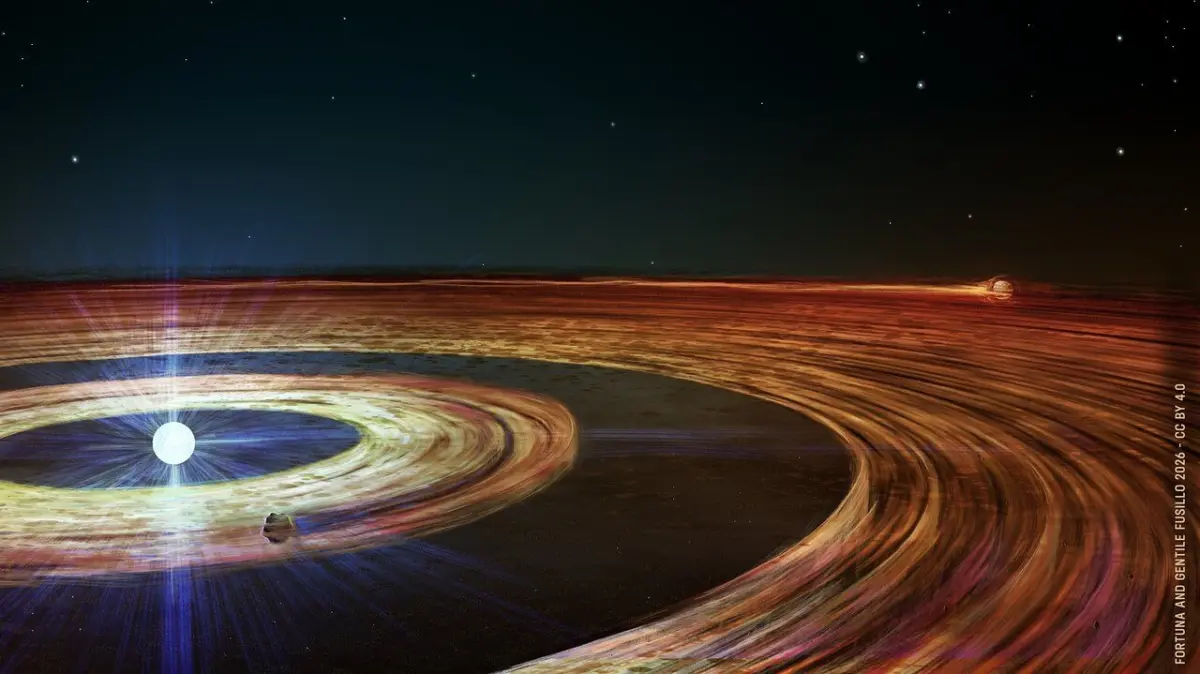
Unlike the uniform, chaotic rings of dust typically associated with stellar corpses, J1328–1450 features an astonishingly intricate architecture: two distinct, geometrically precise rings of gas separated by a pristine void. According to the latest astrophysical data, this system represents the pulverized remains of a planetary architecture that once mirrored our own.
As stars age, they undergo catastrophic transformations that test the structural integrity of everything orbiting them. When a star like our Sun exhausts its thermonuclear fuel, it swells into a bloated red giant, incinerating inner worlds and violently rearranging the gravitational dynamics of outer systems before shedding its outer layers to become a dense, Earth-sized white dwarf. The discovery of J1328–1450 provides direct empirical evidence of this violent transition.
Even more provocative than the dust and gas are the invisible sculptors shaping them. Mathematical models and spectroscopic analyses suggest that the dual-ring structure is being actively maintained by at least two surviving planetary or sub-planetary bodies hidden within the debris. If this hypothesis holds, it implies that small, resilient worlds can survive the death of their parent star, quietly orbiting the embers of their solar system for eons. For humanity, J1328–1450 is not merely an astronomical curiosity; it is a crystal ball reflecting the eventual fate of Earth, Mercury, Venus, and the outer planets some five billion years from now.
Detailed Chronology of the Discovery
The journey toward understanding J1328–1450 spans decades of progressive technological refinement in optical and infrared astronomy, transitioning from blind sky surveys to ultra-high-resolution spectroscopy.
Phase One: Cataloging the Corpse
Long before its planetary architecture was understood, J1328–1450 was registered in various astrometric and photometric star-mapping catalogs. As space-borne telescopes like Gaia and ground-based wide-field surveys mapped the positions and proper motions of billions of stars, J1328–1450 was flagged as a white dwarf—the stable, degenerate core of a dead, medium-mass star.
White dwarfs are fascinating laboratories for physicists because they pack roughly the mass of our Sun into a volume comparable to that of Earth. This creates extreme surface gravity and intense pressures, causing heavy elements like iron, calcium, and magnesium to sink rapidly into the stellar interior. Consequently, a pristine white dwarf’s atmosphere should consist almost entirely of hydrogen or helium.
However, over the last twenty years, astronomers realized that a significant percentage of white dwarfs display "polluted" atmospheres—chemical signatures of rocky planetary debris that has fallen onto the star. This realization shifted white dwarf research from stellar physics to planetary archaeology. J1328–1450 was identified as an intriguing candidate for atmospheric pollution, prompting targeted follow-up observations.
Phase Two: High-Resolution Observation with the VLT
To peer into the immediate environment of J1328–1450, researchers turned to the European Southern Observatory’s Very Large Telescope (VLT), situated at the Cerro Paranal Observatory in Chile’s Atacama Desert. The VLT, equipped with advanced adaptive optics and high-resolution spectrographs, allows astronomers to correct for atmospheric distortion and resolve structures at scales previously thought impossible from the ground.
When the VLT targeted J1328–1450, the data revealed something entirely unexpected. The star was not merely surrounded by a faint, diffuse halo of accreted dust. Instead, high-resolution imaging and spectroscopic mapping uncovered a structured circumstellar disk. The material had organized itself into two distinct, concentric rings of gas separated by a wide, well-defined gap.
Phase Three: Decoding the Geometry
The discovery of a segmented debris disk around a white dwarf immediately raised questions regarding its formation and maintenance. In dynamic astrophysical disks, particle collisions and viscous forces typically smear material into a continuous, smooth distribution over relatively short timescales. The persistence of a gap between two rings implied that external forces were at play.
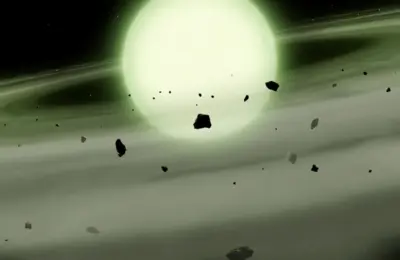
By running complex dynamical simulations, the research team began to reverse-engineer the history of J1328–1450. They concluded that the rings are the fossilized remains of a disrupted planetary system. When the central star evolved into a red giant, its expansion and subsequent mass loss destabilized the orbits of its planets. Asteroids, comets, and inner terrestrial worlds were torn apart by gravitational tidal forces, their pulverized remains settling into orbit around the newborn white dwarf.
Furthermore, the specific geometry of the gap and the rings strongly indicated the gravitational influence of unseen, surviving bodies—masses large enough to carve out pathways in the disk through gravitational resonances, much like shepherd moons maintain the structure of planetary rings in our outer solar system.
Supporting Context & Metrics
To fully appreciate the implications of the J1328–1450 discovery, it is essential to examine the physical scale, evolutionary mechanics, and comparative metrics of white dwarf systems and our own solar system.

The Anatomy of a White Dwarf System
White dwarfs represent the final evolutionary stage for over 97% of all stars in the universe. When a star with an initial mass of less than about 8 solar masses runs out of hydrogen fuel in its core, nuclear fusion ceases to generate outward pressure, causing the core to contract and heat up. This ignition triggers the burning of helium in a shell around the core, forcing the outer layers of the star to expand outward by millions of kilometers. The star becomes a red giant, swallowing any planetary bodies unfortunate enough to reside within its initial orbital radius.
| Metric / Parameter | J1328–1450 System | Our Solar System (Current) | Our Solar System (Future Projection) |
|---|---|---|---|
| Central Star Type | White Dwarf (Degenerate Core) | G-Type Main Sequence (Yellow Dwarf) | White Dwarf |
| Distance from Earth | ~1,600 light-years | 0 light-years (Local) | N/A |
| Age of Remnant | Several hundred million years (estimated) | 4.6 billion years | ~10 billion years |
| Circumstellar Architecture | Dual gas rings with central gap | Planets, asteroid belt, Kuiper belt | Debris disk / Surviving outer bodies |
| Dominant Composition | Carbon-oxygen core, silicate/metal debris | Hydrogen/Helium Sun, rocky/gas planets | Carbon-oxygen core, pulverized rock/ice |
The Mechanics of Tidal Disruption
When a rocky body—such as an asteroid, a dwarf planet, or an intact core—ventures too close to a white dwarf, it crosses what is known as the Roche limit. Inside this boundary, the gravitational tidal forces exerted by the dense white dwarf exceed the internal gravitational binding energy holding the rock together.
The result is catastrophic structural failure. The body is ripped apart, and its constituent material is sheared into a flat disk of dust and gas. Over time, friction circularizes this debris into an equatorial ring. In the case of J1328–1450, the presence of two separate rings suggests that multiple disruption events occurred at different orbital distances, or that a single massive body was fractionated and dynamically segregated by internal planetary perturbers.
Official Statements and Expert Analysis
The findings, published following extensive peer review and coordination through the European Southern Observatory, have sent ripples through the astronomical community. Researchers view J1328–1450 as a Rosetta Stone for stellar-planetary interactions.
Lead astrophysicists on the project emphasized the rarity and clarity of the structural data obtained via the VLT. In an official release from the observatory, members of the research team noted:
"What makes J1328–1450 exceptional is not merely the presence of a debris disk, but its hyper-structured nature. Finding distinct gas rings separated by a well-cleared gap gives us a direct window into the gravitational mechanics of dead star systems. We are essentially watching the aftermath of a cosmic car crash, where the skid marks are still visible in the dust."
Theoretical modelers tracking the long-term stability of multi-body systems have also weighed in on the implications of the invisible bodies maintaining the rings. Dr. Elena Vance, a prominent researcher in exoplanetary dynamics unconnected to the initial discovery team, highlighted the significance of the surviving mass estimates:
"If the gap in J1328–1450’s disk is indeed being carved by surviving planetary objects—one perhaps the size of a small asteroid and another scaling up to the dimensions of Pluto or our Moon—it fundamentally changes our understanding of system survivability. It proves that minor bodies, and potentially even some core remnants of terrestrial worlds, can weather the red giant phase and continue to sculpt their environment from beyond the grave."
Furthermore, planetary scientists modeling the deep-future timeline of our solar system have integrated the J1328–1450 metrics into their simulations. The consensus among astrobiologists and dynamicists is that while Mercury and Venus will almost certainly be devoured when the Sun expands, Earth’s ultimate fate remains delicately balanced on the edge of orbital migration models, while Mars and the outer gas giants stand a strong chance of surviving—albeit in a deeply altered, frozen state.
Future Outlook: What J1328–1450 Means for Earth
As humanity looks out across the cosmos, our understanding of our place in the universe is inextricably linked to our ability to model our own impermanence. The discovery of the J1328–1450 debris disk provides a concrete, empirical preview of the final chapter of our solar system.
The Five-Billion-Year Countdown
In approximately 5 billion years, the Sun will deplete the hydrogen reserves powering its core. As the core contracts and heats, thermonuclear fusion will ignite in shells closer to the surface, causing the Sun’s outer envelope to balloon outward.
- Phase 1 (The Red Giant Expansion): The Sun will expand to swallow the orbits of Mercury and Venus. Earth’s oceans will boil away, its atmosphere will be stripped away by intense stellar winds, and its surface will melt into a glowing sea of molten silicate. Whether Earth is completely engulfed or merely reduced to a charred, barren rock skimming the Sun’s outer chromosphere remains a subject of intense scientific debate.
- Phase 2 (The Planetary Purge): As the Sun loses significant mass through powerful stellar winds during its asymptotic giant branch phase, the gravitational grip it exerts on the remaining planets will weaken. Orbits will expand outward. Asteroids in the asteroid belt and icy bodies in the Kuiper belt will be perturbed into erratic, intersecting trajectories.
- Phase 3 (The White Dwarf Legacy): The Sun will cast off its outer atmosphere into space, leaving behind a glowing planetary nebula that will slowly dissipate over tens of thousands of years. At the center will remain a white dwarf—a dense, white-hot cinder roughly the size of Earth, radiating residual thermal energy for trillions of years.
Unanswered Questions and Next Steps
While J1328–1450 offers a breathtaking preview of this cosmic choreography, many mysteries remain. Astronomers are eager to confirm the direct presence of the suspected planetary bodies hidden within the disk’s gap. Because these objects are small, cold, and obscured by circumstellar gas and dust, they do not emit visible light of their own, making direct imaging extraordinarily difficult.
Future observations will leverage next-generation facilities, such as the European Southern Observatory’s upcoming Extremely Large Telescope (ELT) and space-based infrared observatories like the James Webb Space Telescope (JWST). These instruments possess the unprecedented light-gathering power and spatial resolution required to peer directly into the gaps of white dwarf debris disks, searching for the faint infrared glow of surviving planetary remnants.
Ultimately, J1328–1450 serves as a humbling reminder of the dynamic, cyclical nature of the universe. Solar systems are born from collapsing clouds of gas and dust, live through stable epochs of planetary nurturing, and die in fiery cataclysms that pulverize their children. Yet, as the intricate rings of J1328–1450 demonstrate, even in death, a solar system leaves behind a legacy—a complex, glowing monument written in gas and stone, whispering the history of worlds that once were.