EXECUTIVE SUMMARY
The tech industry’s prevailing narrative regarding artificial intelligence and workforce management has long been rooted in a single, frictionless hypothesis: AI makes companies leaner, allowing fewer workers to generate unprecedented revenue. But a groundbreaking, comprehensive dataset released by ICONIQ Capital covering performance metrics from 2022 through the first half of 2026 shatters this simplistic assumption.
While the headline takeaway from ICONIQ is that AI has not frozen headcount at hypergrowth companies, a deeper, more rigorous look into the data reveals a fractured, multi-speed tech economy. Rather than a universal shift toward radical leanness, the market is splitting into three distinct behavioral playbooks.
At the apex, AI-native B2B startups experiencing triple-digit revenue growth are hiring aggressively—outpacing even the dizzying recruitment rates seen at the peak of the 2021–2022 market boom. Meanwhile, stable mid-tier companies (growing between 50% and 100%) are quietly weaponizing AI efficiencies, slashing their headcount expansion rates by nearly half in a single year to achieve the same top-line gains. At the bottom, sub-25% growers have abandoned layoffs entirely, settling into a hyper-disciplined, structurally flat plateau.
For founders, executives, and investors, the data offers a clear warning: the future of tech scaling is not a monolithic march toward automation, but a strategic fork in the road requiring deliberate choices about leverage, burn rate, and organizational design.
Detailed Chronology: The Evolution of Tech Hiring from 2022 to H1 2026
To understand where tech talent acquisition stands today, one must trace the dramatic macroeconomic swings that have shaped the sector over the past four years. The ICONIQ dataset—incorporating quarterly financial and operating metrics from private venture-backed portfolios and select public software companies (totaling a sample size of 390 companies in 2022–2023, 200 in 2024, 195 in 2025, and 57 in the first half of 2026)—paints a vivid picture of market volatility followed by structural bifurcation.
2022–2023: The Great Correction and Post-Boom Hangover
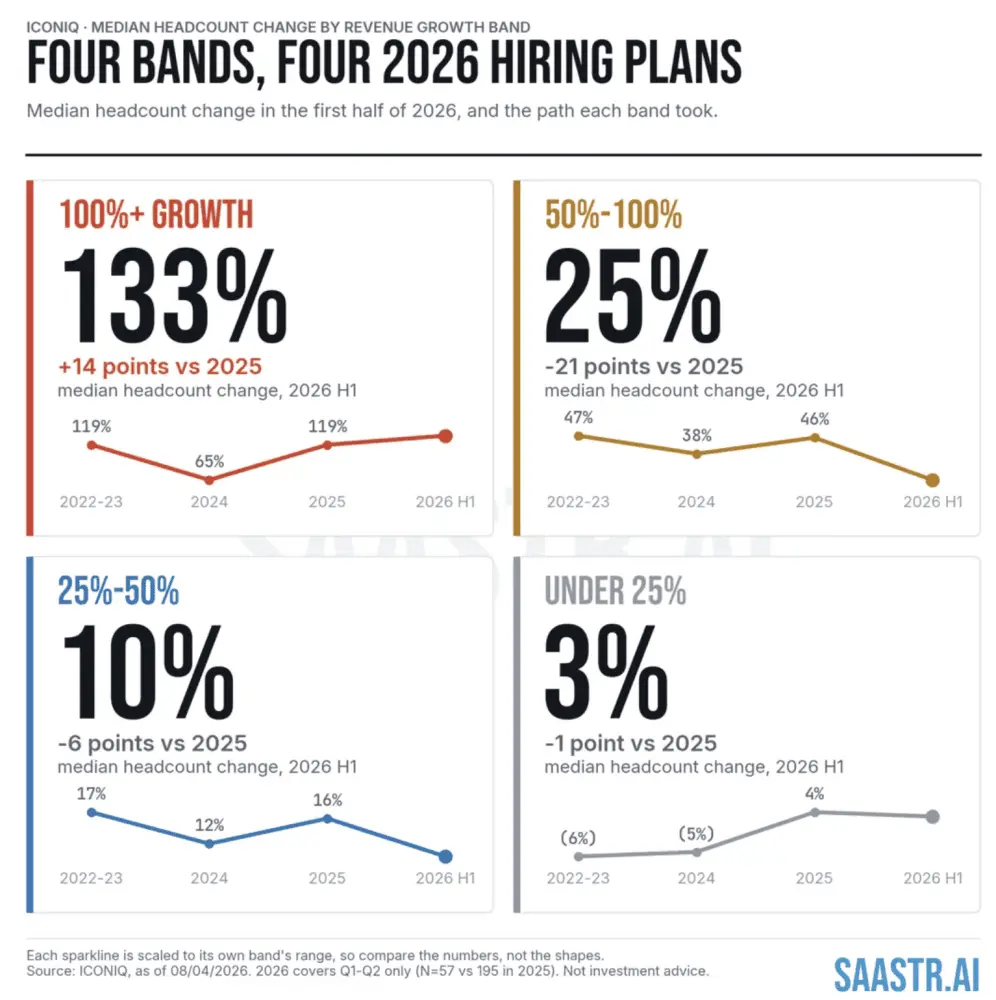
Following the hyper-inflated valuations of the pandemic era, 2022 and 2023 marked an era of painful recalibration. Companies across all growth bands faced sudden capital tightening. During this initial window, sub-25% growers experienced severe contraction, logging a median headcount change of -6%. Even the fastest-growing enterprises—those scaling at over 100% annually—saw their workforce expansion tethered to reality, though they still managed a hefty 119% median headcount growth to service exploding customer demand.
2024: The Discipline Year
If 2022–2023 was the hangover, 2024 was the year of corporate penance and operational discipline. Across the board, leadership teams pulled back sharply on hiring sprees. Most notably, the top-tier hypergrowth cohort (100%+ revenue growth) cut their headcount expansion rate nearly in half, dropping to 65%. It felt, at the time, like a permanent structural shift toward capital efficiency—the moment tech finally learned to scale responsibly.
However, as the subsequent data proves, this discipline was largely reactive rather than a permanent cultural transformation.
2025 to H1 2026: The Great Bifurcation
By 2025, the market snapback at the top was instantaneous. Hypergrowth companies surged back to a 119% headcount growth rate, which climbed even higher to an astonishing 133% in the first half of 2026.
At the exact same time, however, the middle tier of the market (companies growing between 50% and 100%) executed a quiet, permanent pivot. Rather than accelerating back to historical hiring norms, they decoupled revenue growth from headcount additions. The tech economy had officially split into two distinct realities: an AI-fueled land grab at the top that hires without abandon, and a highly efficient, automation-driven middle market quietly doing more with less.
Supporting Context & Metrics: Deconstructing the Four Growth Bands
A granular analysis of the ICONIQ dataset reveals four critical patterns that define the current enterprise software and B2B landscape.
[ICONIQ Data Summary: Median Headcount Change by Revenue Growth Band]
----------------------------------------------------------------------------------
Revenue Growth Band       2022-2023       2024        2025        H1 2026
----------------------------------------------------------------------------------
100%+ Growers             119%            65%         119%        133%
50% - 100% Growers         46%            37%         25%         (Decoupling)
25% - 50% Growers          16%            14%         10%         (Flattening)
Sub-25% Growers           (6%)            (5%)        +4%         +3%
----------------------------------------------------------------------------------
1. The 100%+ Growers Are Hiring Harder Than Ever
The top of the market is operating in a state of hyper-accelerated urgency. With median headcount growth hitting 133% in H1 2026—surpassing the 119% mark of 2022–2023—the fastest-growing companies are expanding their teams faster than they did at the height of the zero-interest-rate phenomenon.
Who populates this elite cohort? Overwhelmingly, they are AI-native B2B startups backed by massive venture capital war chests, locked in existential land grabs against three to four direct competitors. When a company is tripling its top-line revenue annually, internal operational efficiency exercises take a back seat. While these AI startups may utilize more powerful foundational tools than previous generations, their structural instinct upon securing capital is simple: deploy bodies to capture market share before the window closes.
2. The 50%–100% Band: Where AI Leverage Actually Lives
If you want to see where artificial intelligence is truly compressing workforce requirements, look no further than the 50%–100% revenue growth band. In a single year, these companies dramatically slashed their median headcount growth from 46% to 25%.

These are not struggling businesses; growing at 60% to 80% at scale represents an elite corporate performance. Yet, because they are not participating in the frantic, winner-take-all land grab of AI-native unicorns, they are leveraging software automation and generative tools to scale intelligently. They have figured out how to achieve massive revenue expansion without adding proportional layers of middle management, customer success reps, or administrative overhead.
3. Sub-25% Growers: The Flat Plateau
For companies in the lowest growth tier—typically mature B2B software firms that crossed the $50 million to $100 million ARR threshold during the 2021 boom and subsequently settled into stable 15% to 25% growth—the era of aggressive layoffs has officially concluded.
After logging negative headcount adjustments in 2022–2023 (-6%) and 2024 (-5%), this cohort shifted to a muted positive growth rate of +4% in 2025 and +3% in H1 2026. Practically speaking, a company growing revenue by 20% while adding only 3% more headcount is building a permanently flat organizational structure. For an organization of 200 employees, a 3% addition amounts to just six net new hires across the entire enterprise for an entire year. The "flat team" is no longer an interim survival phase; it is the permanent operating model.
4. The Diminishing Marginal Returns of Hypergrowth
The most provocative revelation within the ICONIQ data is that the absolute top of the market is becoming less efficient as it scales.
Using baseline estimates from the data, hypergrowth companies in 2024 added roughly 65% more headcount for every tier of high revenue growth, causing revenue-per-employee metrics to tick upward. By the first half of 2026, that same cohort is adding 133% more headcount. Unless these median companies are growing their top lines well in excess of 133%—a statistical improbability at scale—their revenue per employee is flatlining or declining.
This directly contradicts the prevailing Silicon Valley dogma that AI enables companies to scale infinitely with micro-workforces. Instead, hypergrowth AI companies are aggressively staffing up engineering talent, forward-deployed technical teams, and specialized customer integration units to manage complex enterprise deployments. They are trading raw capital for human muscle to maintain velocity.
Official Perspectives and Industry Insights
Market observers and venture capital analysts tracking the ICONIQ data have increasingly emphasized that organizational architecture is no longer dictated solely by macroeconomic conditions, but by strategic intent.
In public breakdowns of the data, industry leaders note that founders must stop viewing hiring benchmarks through a monolithic lens. The modern tech ecosystem does not reward a single operational model; rather, it penalizes companies that mismatch their hiring playbooks with their actual market velocity.
Furthermore, executive commentary highlights that while generative AI tools have successfully automated routine coding, customer support triage, and basic marketing operations, they have simultaneously increased the complexity of product integration. This structural paradox explains why hypergrowth AI firms are hiring specialized technical talent at historic rates: the tools reduce friction in some areas, but they create entirely new categories of high-skilled labor demand in others.
Future Outlook: Three Distinct Playbooks for Three Growth Realities
The ultimate value of the ICONIQ dataset lies not in providing a static benchmark to mimic, but in defining the operational ratios leadership teams implicitly select when designing their financial models.
By evaluating midpoints, companies growing between 50% and 100% deployed roughly 0.7 points of headcount growth for every point of revenue growth in 2025. By H1 2026, that ratio plummeted to roughly 0.4. This dramatic compression points toward a future defined by three distinct organizational playbooks:
- The Hypergrowth Land Grab (100%+ Growth): Characterized by triple-digit headcount expansion, heavy investments in technical talent, and prioritized market capture over immediate margin optimization. Efficiency is deliberately sacrificed for speed.
- The AI-Leveraged Scale-Up (50%–100% Growth): Defined by decoupled growth where revenue significantly outpaces headcount additions. This cohort represents the true realization of AI efficiency, utilizing smart automation to drive healthy, disciplined expansion.
- The Mature Plateau (Sub-25% Growth): Anchored by structurally flat teams, minimal net-new hiring, and a focus on profitability and cash-flow generation rather than headcount accumulation.
As the industry moves deeper into the latter half of the decade, executive leadership must make these strategic choices deliberately rather than by default. The era of one-size-fits-all tech scaling is over; in its place stands a discerning, highly fragmented market where operational design is the ultimate competitive advantage.
Data Source: ICONIQ Capital, incorporating quarterly financial and operating operating metrics from private venture-backed portfolios and select public software companies, 2022 through Q2 2026, as of August 4, 2026. Published for educational and analytical purposes; not financial or investment advice.