Executive Overview
For decades, modern astrophysics has operated under a profound paradox: the universe that we can see, measure, and interact with—stars, planets, glowing nebulae, and blazing galaxies—comprises a mere 15 percent of the actual cosmos. The remaining 85 percent is composed of an invisible, elusive substance known as dark matter, which acts as the gravitational scaffolding holding the universe together. Overseeing this grand, expanding architecture is an even more mysterious driver: dark energy, a ghostly force accelerating the expansion of the universe at an ever-increasing rate.
As the astronomical community grapples with unsettling contradictions in standard cosmological models—ranging from anomalous expansion rates to hints that dark energy itself might be weakening over time—NASA is preparing to launch a revolutionary instrument designed to rewrite the textbooks.
Scheduled to lift off as early as August 30 from the Kennedy Space Center in Florida, the Nancy Grace Roman Space Telescope represents a monumental leap forward in observational capability. Equipped with a field of view roughly 100 times larger than that of the Hubble Space Telescope while retaining its legendary optical resolution, Roman is built to serve as an ultimate "discovery machine." Over its primary five-year mission, the observatory will survey billions of galaxies, map the invisible web of dark matter, and cast a wide net across the Milky Way to discover up to 200,000 new exoplanets. Positioned nearly a million miles from Earth at Lagrange Point 2 (L2), Roman is poised to usher in a new century of understanding the very big.
Detailed Chronology: From Concept to Launch
The journey toward the Nancy Grace Roman Space Telescope has been decades in the making, tracing the evolution of spatial astronomy from targeted, deep-field investigations to expansive, statistical cartography of the cosmos.
- The Legacy of Cosmic Pioneers: Originally designated the Wide-Field Infrared Survey Telescope (WFIRST), the mission was officially renamed in honor of Nancy Grace Roman, NASA’s first chief astronomer and the visionary "Mother of Hubble" who laid the groundwork for space-based astrophysics.
- Architectural Evolution: Unlike older observatories engineered to stare deeply into isolated, narrow patches of the sky, Roman was conceived to address a critical blind spot in observational astronomy: the need for massive, high-resolution panoramic surveys.
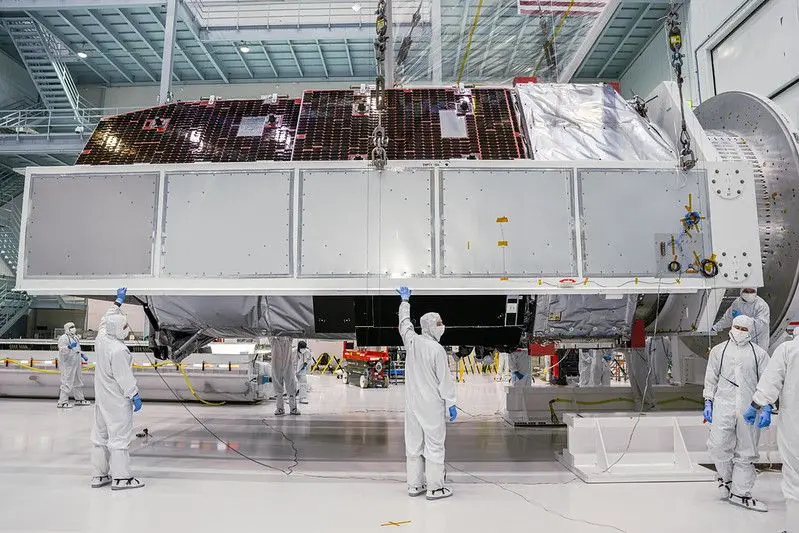
- Technological Integration: Over the past several years, aerospace technicians and engineers have meticulously assembled the spacecraft’s core segments. In cleanrooms across NASA facilities, teams successfully married the inner optical assemblies with the wide-field instrument payload, ensuring the telescope’s extreme sensitivity to infrared light.
- The Final Countdown: Following rigorous environmental, thermal-vacuum, and acoustic testing to simulate the brutal conditions of a rocket launch and the deep-space thermal environment, the observatory was readied for transport to Florida.
- The Launch Window: Targeting a liftoff as early as August 30 aboard a commercial launch vehicle from NASA’s Kennedy Space Center, the mission will embark on a roughly 30-day transit to Lagrange Point 2, setting the stage for science operations to commence after a period of instrument calibration and focusing.
Supporting Context & Metrics: The Mechanics of the Roman Mission
To understand why the astronomical community holds such high expectations for the Roman Space Telescope, one must examine the specific metrics and technological breakthroughs that separate it from its predecessors.
The Power of Panorama
Operating in the infrared spectrum much like the James Webb Space Telescope (JWST), Roman shares a cosmic neighborhood at Lagrange Point 2, where it can safely shield its optics from the thermal radiation and glare of the Sun, Earth, and Moon. However, while JWST is optimized as a microscopic scalpel—diving deep into the ancient, distant universe across tiny patches of sky—Roman operates as a macro-lens.
- Field of View: Roman possesses a primary mirror matching Hubble’s 2.4-meter diameter, but its instrument architecture grants it a field of view 100 times larger than Hubble’s infrared view.
- Galactic Census: Over its five-year lifetime, Roman will capture light from more than a billion galaxies, mapping cosmic structures across epochs ranging from 2 to 6 billion years after the Big Bang.
- Exoplanet Yield: By surveying hundreds of millions of stars, Roman is expected to confirm up to 200,000 new exoplanets, exponentially expanding humanity’s planetary catalog beyond the roughly 6,300 confirmed worlds discovered to date.
Dual-Method Exoplanet Discovery
Roman will utilize two primary techniques to find planets. First, it will employ the traditional transit method, spotting the minute dimming of starlight as a planet crosses in front of its host star. This is exceptional for finding close-in, large planets.
To find worlds that evade transit detection, Roman will rely on gravitational microlensing. When a foreground star passes directly in front of a background star, the gravitational field of the foreground object magnifies the light of the background star. If the foreground star hosts planets, those planets exert their own subtle gravitational enhancements on the starlight.

- This method allows Roman to detect planets located far from their host stars—well beyond the orbits where traditional transits occur.
- It does not require scientists to wait for a planet to complete a full multi-year orbit to confirm its existence.
- The telescope’s sensitivity is so acute that it can spot worlds with less mass than Mercury, as well as free-floating "rogue planets" cast adrift into the interstellar void.
Mapping the Invisible Web
To study dark matter and dark energy, Roman will utilize weak gravitational lensing. As light from distant galaxies travels across the universe toward Earth, its path is subtly bent and distorted by the gravitational influence of intervening cosmic structures, particularly massive halos of dark matter. By measuring these minute distortions across billions of galaxies, scientists can construct a three-dimensional map of the cosmic web, revealing how dark matter has clumped and evolved over billions of years.
Official Statements and Expert Perspectives
The profound ambitions of the mission are echoed by the leading scientists spearheading its development and scientific deployment.
-
Julie McEnery, NASA’s Senior Project Scientist:
"An observatory like Roman is intrinsically a discovery machine. We’re going to find rare things, unusual things, new things, surprising things. We’re not measuring the property of something in the universe; we’re understanding how the universe we’re in fundamentally works."
Addressing the unknown variables of the mission, McEnery adds:
"The most exciting science from Roman may well be something that we can’t even imagine now."
-
Rachel Mandelbaum, Carnegie Mellon University Astrophysicist:
"If we consider what the James Webb Space Telescope is doing, it’s optimized towards looking at the very distant universe—but just a tiny patch of the sky. In contrast, Roman is able to look at a large area of the sky at once."

Commenting on the investigation of cosmic structures, Mandelbaum notes:
"In the very early universe, the matter was almost uniformly distributed. But there were tiny perturbations or tiny regions that were just a fraction more dense or less dense… We’re trying to answer fundamental questions about the universe, and it turns out to be incredibly challenging to do that. We need really powerful observatories like Roman."
-
Matthew Penny, Exoplanet Researcher at Louisiana State University:
"This method [microlensing] can detect planets that are farther away from their stars than other methods. You don’t need the planet to complete an entire orbit before you see it. Our solar system is potentially quite unique, although we don’t really know at this point. There’s a lot of potentially lucky coincidences in the solar system that make life possible. Without a complete census of the whole range of possible planets, we don’t really know how common planets like Earth are, or planetary systems like our own."
Future Outlook: Resolving Cosmological Tensions
As humanity stands on the precipice of Roman’s launch, cosmology finds itself at a historical crossroads. Three major observational tensions have fractured the standard model of the universe:
- The Hubble Tension: The universe is expanding significantly faster today than predicted by models derived from the cosmic microwave background (the afterglow of the Big Bang).
- The Clumpiness Problem: Matter in the modern universe is distributed more smoothly and evenly than theoretical models suggest it should be.
- The Dark Energy Shift: Recent data from instruments like the Dark Energy Spectroscopic Instrument (DESI) in Arizona hint that dark energy may actually be weakening over time, defying the cosmological constant proposed by Einstein.
The Nancy Grace Roman Space Telescope is uniquely equipped to resolve these burning questions. By capturing tens of thousands of distant supernova explosions—several times more than all previous observations combined—Roman will provide an independent, high-precision measurement of the current expansion rate of the universe. Simultaneously, its massive weak-lensing surveys will map matter distribution and test whether dark energy’s properties are indeed shifting.
If the anomalies observed by DESI and other instruments are real, Roman is custom-built to verify them. As Julie McEnery observes: "We had a major breakthrough in the last century on the very small with the development of quantum mechanics and the discovery of elementary particles. Maybe this is the century of understanding the very big."
When the Nancy Grace Roman Space Telescope opens its eyes to the cosmos later this year, it will not merely look out into the dark—it will illuminate the hidden mechanics of space, time, and existence itself.