Executive Overview
In an era defined by sophisticated cyber threats, credential stuffing, and automated brute-force attacks, the static password has long ceased to be a reliable guardian of digital assets. Enter Two-Factor Authentication (2FA)—and its most resilient, ubiquitous standard: the Time-based One-Time Password (TOTP). Developed under the auspices of the Internet Engineering Task Force (IETF) as RFC 6238, TOTP has fundamentally reshaped digital security, transitioning the burden of verification from vulnerable, reusable text-message codes to mathematically synchronized, ephemeral passcodes.
Unlike its predecessor, the SMS-based verification code—which remains susceptible to SIM-swapping, interception, and cellular network latency—TOTP operates entirely offline. It requires no cellular coverage, no roaming data, and no direct communication between a user’s personal authenticator application and a remote authentication server. Instead, it relies on a triumph of modern cryptography and synchronized timekeeping: the independent generation of identical, short-lived numerical tokens by both client and server at the exact same microsecond.
This comprehensive technical breakdown explores the operational principles, cryptographic machinery, and logistical nuances of TOTP authenticator apps. By examining time discretization, HMAC-based message authentication codes (HMAC), and truncation algorithms, we illuminate how milliseconds and mathematics combine to protect billions of user accounts worldwide.
Detailed Chronology and Historical Context
To understand the architecture of TOTP, one must trace the evolution of authentication standards from static credentials to dynamic, algorithmic tokens.
The Era of Static Passwords and the Rise of Phishing
For decades, computer systems relied on username-and-password combinations. As computing power scaled and digital ecosystems expanded into consumer banking, enterprise networks, and cloud infrastructure, static passwords proved critically vulnerable. They could be leaked through database breaches, intercepted via man-in-the-middle attacks, or harvested through straightforward social engineering and phishing campaigns. Once compromised, a static password granted perpetual, unhindered access to an account.
The Hardware Token Revolution
Recognizing these vulnerabilities, security engineers in the late 1990s and early 2000s introduced hardware-based security tokens—most notably the RSA SecurID. These physical fobs displayed a new 6-digit passcode every 60 seconds, generated via a proprietary algorithm tied to a secure internal clock and a unique, factory-burned secret key. While highly secure, hardware tokens were expensive to manufacture, difficult to scale across consumer applications, and prone to being lost or damaged by users.
The Shift to Software and SMS
As smartphones proliferated, the industry sought software-based alternatives. Initially, telecommunications infrastructure was leveraged to deliver One-Time Passwords via SMS. While convenient, text messages travel across Signaling System 7 (SS7) networks that possess well-documented architectural vulnerabilities. Interception, packet sniffing, and social engineering attacks targeting mobile carrier support staff (known as SIM-swapping) exposed the fragility of SMS-based 2FA.
The Standardization of TOTP (RFC 6238)
To bridge the gap between the robust security of hardware tokens and the ubiquity of software, the IETF published RFC 6238 in May 2011, formally defining the Time-based One-Time Password algorithm. Building upon the HMAC-based One-Time Password (HOTP) standard (RFC 4226)—which relied on a counter incremented with each use—TOTP replaced the manual counter with a time-based variable. This innovation allowed any software application running on a smartphone, tablet, or desktop to function as a cryptographic authenticator, democratizing high-grade security for the global internet.
Operating Principle: How TOTP Works Without a Network
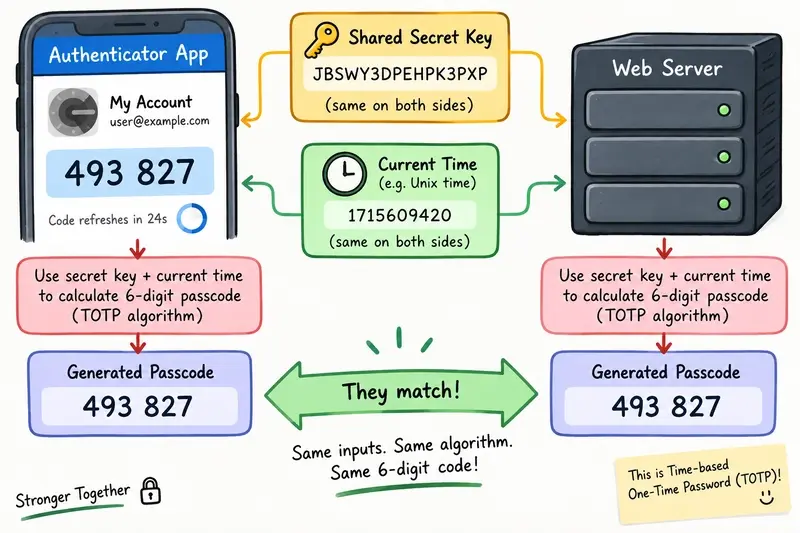
The foundational elegance of TOTP lies in its ability to generate matching codes without the client and server ever exchanging messages during the validation phase. This zero-communication model is made possible by two shared pieces of information established during an initial setup phase:

- A Shared Secret Key: A cryptographically secure, random byte string generated by the server and securely transmitted to the user’s device.
- A Reference Time Epoch: A mutually agreed-upon starting point (standardized as Unix time, or the number of seconds elapsed since January 1, 1970, 00:00:00 UTC) combined with a standardized time step interval (almost universally set to 30 seconds).
Because both the user’s mobile device and the remote login server possess the secret key and have access to synchronized system clocks, they can independently run the exact same mathematical formula and arrive at the exact same 6-digit code at any given second.
[User's Device: Secret Key + Current Time] ---> [Algorithm] ---> [6-Digit Code A]
                                                                        |
                                                                  (Compare Match)
                                                                        |
[Server's System: Secret Key + Synchronized Time] ---> [Algorithm] ---> [6-Digit Code B]
Setup and Key Exchange: Establishing the Trust Anchor
The secure provisioning of the shared secret key is the most critical juncture in the TOTP lifecycle. This exchange occurs only once, typically when a user enables 2FA on a web service.
- Generation: The server generates a high-entropy secret key (frequently represented as a 160-bit or 256-bit value).
- Encoding: To make this cryptographic material easily transferable to a human user or a mobile device, the key is typically encoded using Base32 encoding.
- Transmission via QR Code: The server renders the secret key—along with metadata such as the issuer’s name and the user’s account identifier—into a visual Quick Response (QR) code formatted as an
otpauth://URI scheme. - Capture and Storage: The user opens their authenticator app (e.g., Google Authenticator, Authy, Aegis, or Bitwarden) and uses the device’s camera to scan the QR code. The app decodes the URI, extracts the secret key, and securely stores it in local, encrypted device storage (such as the iOS Keychain or Android Keystore).
Once this initial handshake is completed, the authenticator app and the server are permanently synchronized in purpose, requiring no further internet connectivity or cellular data exchange to generate tokens.
Algorithm and Code Generation: A Step-by-Step Mathematical Breakdown
When a user opens an authenticator app, the software executes a rigorous three-step cryptographic pipeline to calculate the current passcode.
Step 1: Time Discretization (Splitting Time into Blocks)
Computers track time continuously down to the millisecond, but human users need a stable window of time to read and type a 6-digit code. To achieve this, the TOTP algorithm takes the current Unix timestamp and divides it by a predefined interval $X$ (standardized at 30 seconds):
$$textCounter = leftlfloor fractextCurrent Unix TimetextInterval (30) rightrfloor$$
Because computer integer division automatically truncates any fractional remainders, this resulting Counter value remains completely static for an entire 30-second window. It increments by exactly integer 1 the moment the next 30-second epoch begins.
Step 2: Cryptographic Hashing (Scrambling the Data)
Next, the algorithm combines the static Counter value with the shared secret key. This combined payload is processed through an HMAC (Hash-based Message Authentication Code) function—typically utilizing SHA-1, SHA-256, or SHA-512 algorithms.
$$textHash = textHMAC-SHA1(textSecret Key, textCounter)$$

The HMAC function acts as a one-way cryptographic mixer. It ingests the secret key and the time counter, scrambling them into a fixed-length digital fingerprint (e.g., a 160-bit output for SHA-1). This hash output is mathematically irreversible; an attacker cannot reverse-engineer the secret key even if they intercept multiple historical passcodes.
Step 3: Dynamic Truncation (Shortening to Human-Readable Digits)
A 160-bit hash is far too long for a human user to conveniently type into a login prompt. Therefore, the algorithm performs a process called Dynamic Truncation to distill the hash into a 6-digit or 8-digit decimal number:
- It examines the last four bits of the hash output to determine an offset index (from 0 to 15).
- It extracts a 4-byte chunk from the hash starting at that specific offset.
- It masks out the highest-order bit to prevent negative integer representations.
- Finally, it applies a modulo operation ($10^6$ for a 6-digit code) to isolate the final numerical value:
$$textPasscode = textExtracted 31-bit Integer pmod10^6$$
The resulting value is padded with leading zeros if necessary to ensure it always meets the required digit length (e.g., 042918).
Verification and Handling Clock Drift
When a user inputs their 6-digit TOTP code into a web application, the authentication server executes the identical mathematical sequence using its own internal system clock and the user’s stored secret key. If the server-generated token matches the user-provided token, authentication is approved.
However, real-world systems must account for an inevitable physical reality: Clock Drift.
Mobile devices rely on internal hardware clocks that can drift out of exact synchronization due to failing CMOS batteries, poor network time protocol (NTP) synchronization, or faulty system firmware. If a user’s phone is running three seconds ahead or behind the authentication server, their generated code might mismatch the server’s expected value, resulting in frustrating login failures.
To mitigate clock drift without compromising security, modern authentication servers implement a tolerance window (often parameterized as a $pm1$ or $pm2$ window). When a user submits a code, the server checks:
- The code for the current 30-second time block.
- The code for the previous 30-second time block.
- The code for the subsequent 30-second time block.
If the user’s code matches any of these three adjacent windows, authentication succeeds. This provides a robust 90-second operational safety margin while limiting replay attack vectors to a tightly controlled temporal band.

Supporting Context & Metrics
The adoption of TOTP as a primary multi-factor authentication mechanism has scaled dramatically over the past decade, driven by enterprise compliance mandates and consumer security awareness.
- Adoption Rates: Major technology providers—including Google, Microsoft, Apple, and GitHub—report that enabling 2FA reduces unauthorized account compromise by over 99%, even when primary passwords are leaked in third-party data breaches.
- Algorithmic Migration: While the original RFC 6238 standard heavily relied on HMAC-SHA-1, contemporary implementations increasingly adopt HMAC-SHA-256 and HMAC-SHA-512 to provide enhanced resistance against theoretical collision attacks and meet stringent government cryptographic guidelines (such as FIPS 140-3 compliance).
- Open Ecosystem Standards: Unlike proprietary hardware fobs, the open specification of TOTP has fostered an ecosystem of interoperable open-source applications (such as Aegis, Ente Auth, and KeePassXC), ensuring user data portability and freedom from vendor lock-in.
Official Statements and Industry Perspective
Security architects and standards organizations continue to champion TOTP as an essential baseline control in defense-in-depth strategies.
Dr. Stephen Farrell, a security researcher and former IETF participant, notes:
"The genius of TOTP is its decentralization. By marrying mathematical hash functions to the immutable march of time, we eliminated the single point of failure inherent in centralized telecommunications networks. It proves that robust security does not inherently require perpetual connectivity."
Enterprise security frameworks, including the National Institute of Standards and Technology (NIST) Special Publication 800-63B, formally recognize software-based authenticators utilizing out-of-band cryptographic generation as robust authenticators, though modern guidance increasingly encourages the parallel adoption of phishing-resistant hardware security keys (FIDO2/WebAuthn) for high-privilege environments.
Future Outlook: The Evolution of Authentication
While Time-based One-Time Passcodes remain a cornerstone of consumer and enterprise security, the digital landscape is actively evolving toward even more resilient paradigms.
- The Rise of Passkeys and FIDO2: Public-key cryptography standards spearheaded by the FIDO Alliance are gradually replacing passwords and TOTP codes altogether with biometric-bound passkeys. These credentials are fundamentally phishing-proof because they cryptographically bind authentication to the specific domain origin of the website being accessed.
- Encrypted Cloud Syncing: Early TOTP apps stored secrets strictly on a single local device, leading to catastrophic account lockouts if a phone was lost or broken. Modern authenticator implementations balance security and usability by offering end-to-end encrypted cloud synchronization, ensuring keys remain inaccessible to cloud providers while remaining recoverable for the user.
- Hardware-Backed Secure Enclaves: Modern smartphones utilize dedicated hardware security processors (such as Apple’s Secure Enclave or Android’s StrongBox) to execute cryptographic hashing operations and store TOTP secrets, insulating them from malware running in the device’s primary operating system.
Conclusion
The Time-based One-Time Password is a masterclass in elegant cryptographic engineering. By transforming universal time into a synchronized, rolling digital barrier, TOTP standards have protected countless user accounts from credential-based attacks. While the security horizon continues to expand toward biometric passkeys and hardware tokens, understanding the inner workings of TOTP apps provides invaluable insight into how modern systems establish trust in an untrusted digital world.
References
- Internet Engineering Task Force (IETF). RFC 6238: TOTP: Time-Based One-Time Password Algorithm. May 2011.
- Internet Engineering Task Force (IETF). RFC 4226: HOTP: An HMAC-Based One-Time Password Algorithm. December 2005.
- National Institute of Standards and Technology (NIST). Special Publication 800-63B: Digital Identity Guidelines – Authentication and Lifecycle Management.
- Open Web Application Security Project (OWASP). Authentication Cheat Sheet: Multi-Factor Authentication.