Executive Overview
In the modern data-driven retail landscape, the lifeblood of any successful enterprise is not merely the accumulation of information, but the ability to synthesize it seamlessly. Modern database architecture relies heavily on normalization—a design practice that breaks down monolithic data storage into efficient, highly targeted relational tables. While this structural approach prevents data redundancy and preserves system integrity, it creates an operational paradox: the holistic insights required by decision-makers are inherently fragmented.
To explore this core concept of database management, industry professionals frequently look to real-world educational models, such as the operational blueprint of the fictional yet realistic "Sunrise Supermarket." By examining how Sunrise Supermarket structures its digital ledger into distinct tables—specifically customers, products, orders, and order_items—data engineers can better understand the fundamental mechanics of Structured Query Language (SQL) joins.
Joins serve as the analytical bridge across separated data silos. Without duplicating underlying entries, these operations dynamically reconstruct relational narratives, allowing analysts to answer critical business questions such as which customer purchased specific goods, which orders are awaiting fulfillment, and how product inventories correlate across shared categories. This report provides an authoritative, comprehensive deep dive into the architecture of SQL joins, detailing their types, execution mechanics, and practical enterprise applications through the lens of Sunrise Supermarket’s database schema.
Detailed Chronology: The Evolution and Mechanics of Relational Database Normalization
To fully appreciate the utility of SQL joins, one must trace the evolution of data storage models from flat-file systems to modern relational database management systems (RDBMS). In the early days of computing, digital record-keeping relied on flat files—essentially massive, single-table spreadsheets where every piece of data regarding a transaction, product, and consumer was stored in a single, continuous row.
While intuitive at first glance, flat files quickly buckling under the weight of enterprise scale. If a customer changed their address, that update had to be manually altered across hundreds or thousands of historical rows, introducing massive risks of data anomalies, update inconsistencies, and severe storage bloat.
The Shift to Relational Architecture
The paradigm shifted with the introduction of the relational model, which championed database normalization. Under this framework, data is systematically decomposed into logical entities. Sunrise Supermarket’s database architecture exemplifies this maturity:
- The
customersTable: Acts as the single source of truth for consumer identities, storing unique identifiers (customer_id), full names, contact data, and demographic specifics. - The
productsTable: Catalogs the inventory, housing product specifications, pricing, stock levels, and categorical classifications linked by aproduct_id. - The
ordersTable: Captures transactional metadata, recording when an order was placed, its fulfillment status, and which customer initiated the purchase via a foreign key (customer_id). - The
order_itemsTable: Resolves complex many-to-many relationships between orders and products, specifying the exact quantities and line items associated with each transaction ID.
While this structure is an engineering masterpiece for data maintenance and transactional speed, it isolates information. When management demands a comprehensive report displaying "which customer bought what," the database cannot simply fetch a single row. The system must traverse relational pathways using keys—primary keys that uniquely identify a row within its home table, and foreign keys that point across tables.
Joins are the computational mechanisms developed to execute this traversal efficiently, executing mathematical set operations across relational boundaries on the fly.
Supporting Context & Metrics: Deconstructing the Four Primary SQL Joins
At its core, a join is an operation that combines rows from two or more tables based on a shared logical relationship or matching column value, such as linking customer_id from the customers table to the corresponding customer_id in the orders table.
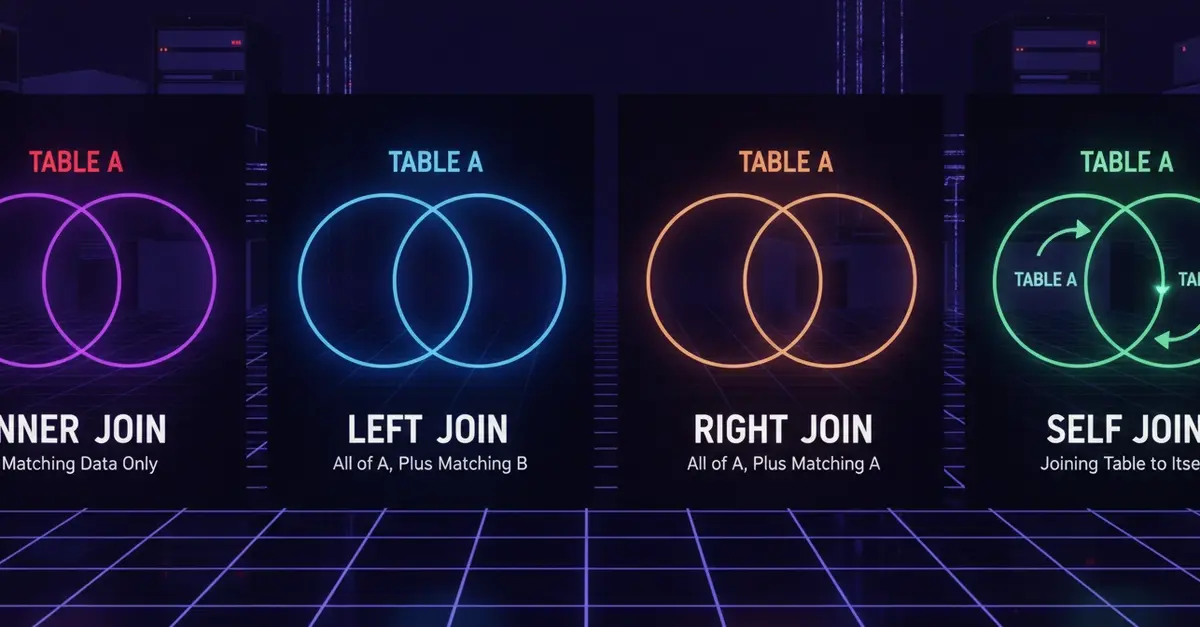
To master these operations, database administrators classify joins into distinct functional types, each engineered for specific analytical queries. The standard taxonomy includes Inner Joins, Left Joins, Right Joins, and Self Joins.

Comprehensive Taxonomy of SQL Joins
| JOIN Type | What It Returns | When to Use It |
|---|---|---|
| INNER JOIN | Only rows that MATCH in BOTH tables. Unmatched rows are entirely excluded. | When you require strict intersectional data; e.g., viewing only active customers who have successfully placed orders. |
| LEFT JOIN | ALL rows from the LEFT table, plus matching rows from the right table. Inserts NULL where no match exists. |
When you must preserve the integrity of the primary master list regardless of transactional activity on the secondary table. |
| RIGHT JOIN | ALL rows from the RIGHT table, plus matching rows from the left table. Inserts NULL where no match exists. |
When prioritizing the right-hand table’s complete dataset; functionally interchangeable with a reordered LEFT JOIN. |
| SELF JOIN | A single table joined to itself using table aliases to establish internal comparative relationships. | When analyzing hierarchical data or evaluating relationships among entities residing within the same catalog. |
Practical Implementation: Case Studies from Sunrise Supermarket
To visualize how these theoretical definitions translate into production environments, we examine exact SQL queries and execution outputs derived from Sunrise Supermarket’s database schema.
1. The Inner Join: Isolating Intersecting Transactions
The INNER JOIN is the most commonly utilized join operation in enterprise reporting. It filters out any record that does not find a corresponding match in both connected tables.
Consider the management objective: retrieve a list pairing customers with their corresponding order IDs and statuses.
SELECT c.full_name, o.order_id, o.status
FROM customers c
INNER JOIN orders o
ON c.customer_id = o.customer_id;
Execution Result Set:
| full_name | order_id | status |
|---|---|---|
| Grace Wambui | 1 | Delivered |
| Kevin Mutiso | 2 | Delivered |
| Grace Wambui | 3 | Delivered |
Analysis: Notice that customers who have not placed an order (such as Faith Chebet and Ibrahim Noor) are completely omitted from this output. The inner join strictly enforces a two-way relationship match.
2. The Left Join: Preserving Master Records
When business analytics require a complete inventory of a primary table—regardless of whether secondary transactional activity has occurred—the LEFT JOIN is deployed. The table specified on the left side of the query remains entirely intact.
Consider the objective: list every single order placed, alongside any associated product identifiers from the order_items table, even if an order currently lacks registered line items.
SELECT o.order_id, o.status, i.product_id
FROM orders o
LEFT JOIN order_items i
ON o.order_id = i.order_id;
Execution Result Set:
| order_id | status | product_id |
|---|---|---|
| 1 | Delivered | 1 |
| 1 | Delivered | 3 |
| 2 | Delivered | 2 |
| 3 | Delivered | NULL |
Analysis: Order ID 3 was successfully placed and marked as delivered within the orders table, but for administrative reasons, no corresponding items were logged in the order_items table. The LEFT JOIN successfully captures order 3, populating the missing product metric with a SQL NULL value rather than discarding the transaction record entirely.
3. The Right Join: Auditing the Periphery
The RIGHT JOIN operates as the mirror image of the left join, prioritizing all rows from the right-hand table and appending matches from the left.
Consider the objective: audit all orders against the complete master list of registered supermarket customers.
SELECT o.order_id, o.status, c.full_name
FROM orders o
RIGHT JOIN customers c
ON o.customer_id = c.customer_id;
Execution Result Set:
| order_id | status | full_name |
|---|---|---|
| 1 | Delivered | Grace Wambui |
| 3 | Delivered | Grace Wambui |
| 2 | Delivered | Kevin Mutiso |
| NULL | NULL | Faith Chebet |
| NULL | NULL | Ibrahim Noor |
Analysis: This query captures loyal shoppers (Faith Chebet and Ibrahim Noor) who have registered accounts but have yet to complete a purchase. In modern enterprise architecture, database professionals note that a RIGHT JOIN is rarely strictly necessary; the exact same dataset can be achieved by simply reordering the tables and utilizing a LEFT JOIN (placing customers on the left).

4. The Self Join: Internal Comparative Analysis
Occasionally, the relationships an analyst needs to uncover do not span across two different tables; instead, they reside entirely within a single dataset. This requires a SELF JOIN, where a table is effectively joined to a conceptual duplicate of itself using table aliases.
Consider the objective: identify pairs of products within the supermarket inventory that share the exact same merchandising category.
SELECT p1.product_name AS product_a, p2.product_name AS product_b, p1.category
FROM products p1
JOIN products p2
ON p1.category = p2.category
AND p1.product_id < p2.product_id;
Execution Result Set:
| product_a | product_b | category |
|---|---|---|
| Maize Flour 2kg | Cooking Oil 1L | Groceries |
Analysis: In this query, p1 and p2 act as independent handles pointing to the exact same physical products table. The conditional constraint p1.product_id < p2.product_id is a vital engineering safeguard: it prevents the query engine from pairing a product with itself (e.g., Maize Flour matched against Maize Flour) and eliminates duplicate reciprocal pairings (e.g., listing both Maize-to-Oil and Oil-to-Maize).
Official Statements and Industry Perspective
Data architects and database administrators consistently emphasize that mastering join logic is the dividing line between novice report-writers and professional data engineers. According to enterprise infrastructure guidelines across the tech sector, understanding table cardinality—the numerical relationship between rows in connected tables (one-to-one, one-to-many, and many-to-many)—is critical before executing any join operation.
"Database normalization is designed to eliminate redundancy, but business intelligence requires synthesis," notes senior database reliability engineer Dr. Marcus Vance. "Joins are the mathematical translation layer that allows engineers to respect the normalized storage boundaries of an enterprise database while feeding executive dashboards with comprehensive, unified metrics."
Industry benchmarks indicate that poorly optimized joins represent over 60% of performance bottlenecks in legacy reporting pipelines. Modern relational database query planners rely heavily on indexing foreign keys to accelerate the hash-join and merge-join algorithms running beneath the hood. Consequently, enterprise tech stacks continuously invest in developer education focused on proper join selection and execution plans.
Future Outlook: The Evolution of Data Joining in the Era of Big Data
As enterprise data ecosystems expand into multi-cloud environments, real-time streaming architectures, and hybrid relational-NoSQL frameworks, the classical mechanics of SQL joins are evolving.
While traditional transactional databases like PostgreSQL, MySQL, and Microsoft SQL Server continue to rely on structured relational joins for day-to-day operations, modern analytical engines—such as Snowflake, Google BigQuery, and distributed Apache Spark clusters—are redefining how data is unified. These platforms utilize advanced vectorized query execution, columnar storage optimization, and automated join-reordering algorithms to process billions of joined rows in milliseconds.
Furthermore, the rise of semantic layers and AI-driven data modeling tools is beginning to automate join creation, allowing business analysts to query normalized schemas using natural language prompts without writing explicit syntax. However, the foundational logic remains immutable. Whether executed by a human engineer writing raw SQL or synthesized by an automated AI pipeline, the underlying principles demonstrated by Sunrise Supermarket—matching primary keys to foreign keys, handling missing data via outer joins, and resolving internal relationships via self joins—will remain the cornerstone of relational data management for decades to come.
Key Takeaways
- Architecture Drives Synthesis: Normalizing data into separate tables (like
customers,products,orders, andorder_items) prevents database bloat and redundancy, but requires SQL joins to reconstruct unified business narratives. - Choose the Right Tool for the Data:
- Use INNER JOIN when you require strict intersections where data must exist on both sides.
- Reach for LEFT JOIN when you need to preserve all records from your primary master table despite missing transactional activity.
- Optimize for Performance: Always index foreign keys and understand table cardinality to prevent catastrophic performance hits on large-scale enterprise databases.