Executive Overview
In the heart of India’s culturally rich state of Odisha, traditional artisans create world-renowned masterpieces—from intricate Pipili applique wall hangings and Pattachitra paintings to masterfully woven Handloom textiles and Dhokra metal castings. For generations, these craftspeople have preserved techniques passed down through centuries. However, as global commerce shifts decisively toward digital marketplaces, a modern barrier has emerged between these rural creators and a worldwide audience: digital onboarding.
Writing compelling, search-optimized product listings for multiple e-commerce platforms and regional languages is a tedious, technical hurdle. Craft sellers and the micro-enterprises that support them frequently struggle with translating physical heritage into digital descriptions. Crucial details are often lost, misrepresented, or overly simplified, leading to lower visibility and missed sales.
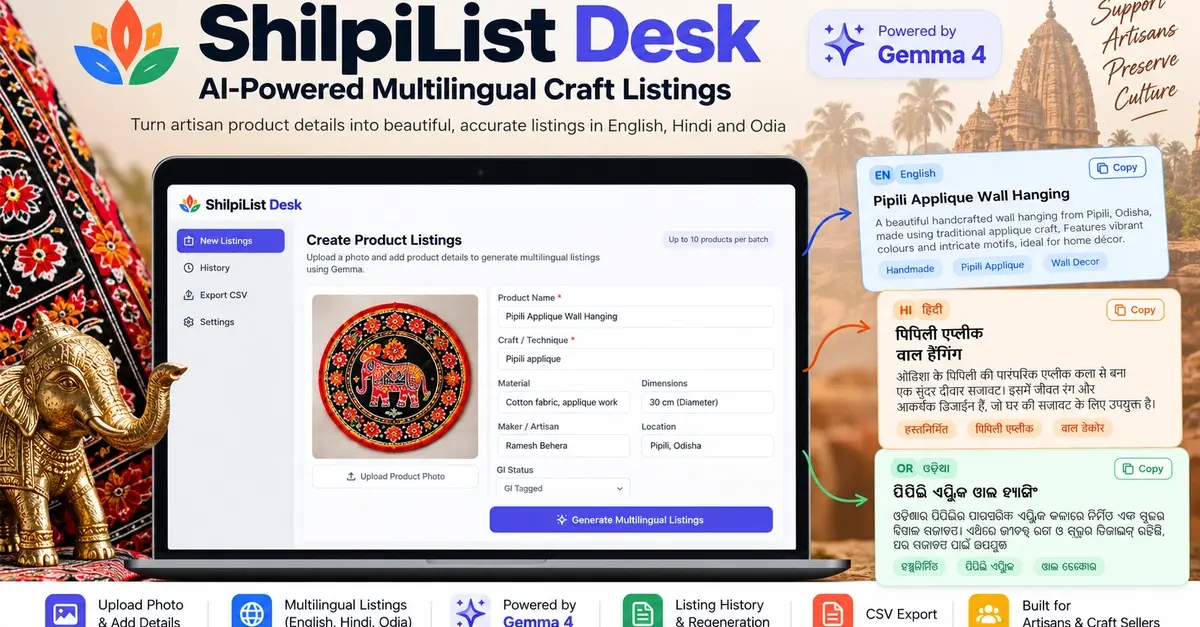
Enter ShilpiList Desk, an innovative, AI-assisted product listing application custom-built to bridge this digital divide. Developed as an open-innovation project leveraging the advanced capabilities of the Gemma open-weight multimodal model, ShilpiList Desk allows craftspeople to upload product photos and basic facts to automatically generate professional, accurate listings in English, Hindi, and Odia. By streamlining this workflow—and introducing features like CSV export, structured JSON validation, and meticulous separation between product identity and craft technique—the tool aims to transform how local artisans market their cultural heritage online.
Detailed Chronology: From Concept to Code
The development of ShilpiList Desk represents a deliberate, iterative engineering journey focused on solving a hyper-localized problem with global-scale technology.
Phase 1: Identifying the Friction Point
The initial conceptualization phase began by observing the daily operations of small craft sellers and artisan collectives. While these individuals possess deep domain expertise in crafting traditional goods, they often lack the technical resources or multilingual copywriting skills required to manage multi-channel catalogs. Listing a single item across various domestic and international marketplaces requires drafting descriptions, specifying materials, detailing dimensions, and highlighting geographical indications (GI status). Doing this manually for dozens or hundreds of items is practically prohibitive for individual artisans.

Phase 2: System Architecture and Technology Stack
To build a solution that is both lightweight and extensible, the developer selected a robust open-source stack. The application architecture relies on:
- Backend: Python and FastAPI for high-performance API routing and data validation.
- Frontend: A clean, responsive interface built with HTML, CSS, and JavaScript.
- Database & Storage: SQLite for managing local product records and generated catalog data.
- Core Intelligence: The Gemma open-weight multimodal model, accessed via an OpenAI-compatible inference endpoint.
Phase 3: Multimodal Integration and Structured Output
The core workflow of ShilpiList Desk is designed for simplicity. A user uploads a product photograph and inputs essential metadata: product name, craft/technique, material, dimensions, maker, location, and GI status.
This raw data, along with the image, is transmitted to the Gemma model. The system prompts the model to return a structured JSON response containing optimized titles and descriptions in three distinct languages: English, Hindi, and Odia. FastAPI immediately validates this output to ensure data integrity.
Phase 4: Refining Craft Taxonomy and Validation Heuristics
Early testing revealed a critical nuance in craft description: the distinction between a product’s identity and its underlying technique. For example, in the phrase “Pipili Applique Wall Hanging,” the product identity is a wall hanging, while the technique is Pipili applique. Conflating the two leads to inaccurate cataloging.
To resolve this, the developer updated the application’s database schema, intake forms, prompt engineering frameworks, and CSV export modules to cleanly separate identity from technique. Furthermore, to address the risk of AI hallucination, heuristic check routines were implemented to flag potentially unsupported claims and ensure standard craft terminology is appropriately integrated.

Supporting Context & Metrics
While ShilpiList Desk is currently in its prototype and validation stage, early testing provides a clear picture of its technical feasibility and areas for future growth.
Technical Validation and Testing
Initial benchmarking of the application relies on a curated test suite of six sample products representing diverse Odishancrafts. Key metrics tracked during development include:
- Glossary Hit Rates: Assessing whether specific, mandatory craft terminology successfully populates within the generated multilingual text blocks.
- JSON Compliance: Measuring how reliably the Gemma model returns well-formed, parseable JSON structures, including automated retry loops for malformed outputs.
- Multilingual Fidelity: While English and Hindi outputs have undergone baseline checks, Odia outputs are explicitly flagged as unreviewed drafts, requiring secondary validation by native speakers prior to publication.
Market Hypothesis and Business Model
The long-term viability of ShilpiList Desk hinges on solving a recurring operational cost for artisan groups and small-scale aggregators. The proposed business model explores a low-cost subscription tier or a pay-per-batch processing fee tailored for entities managing extensive, frequently updated product catalogs.
Although commercial monetization has not yet been launched—and validating whether resource-constrained sellers are willing to pay remains a task for future iterations—the structural foundation is built to scale gracefully alongside user demand.
Official Statements & Developer Insights
Reflecting on the philosophy driving the project, the creator emphasizes the vital role of open innovation in modern software engineering.

"Open-weight AI gives developers the flexibility to adapt a model to a specific problem instead of treating a hosted AI service as an unchangeable black box," the developer notes.
By utilizing an open-weight model like Gemma, the project avoids the rigid constraints of proprietary APIs. Developers retain the autonomy to fine-tune prompts, enforce strict structural constraints, integrate specialized domain glossaries, and experiment with alternative inference environments without rewriting the core application logic.
Addressing the broader implications for regional commerce, the developer explains:
"A tool for regional craft sellers needs to balance cost, latency, image understanding, factual accuracy, and multilingual quality. An open-weight approach creates room to experiment with these trade-offs and potentially explore local inference in the future."
While current iterations rely on a hosted inference endpoint—meaning fully offline execution and absolute client-side data privacy have not yet been fully realized in production—the open architecture ensures these capabilities remain within reach for subsequent development cycles.

Future Outlook
ShilpiList Desk stands as a compelling proof-of-concept for how generative AI can be democratized to support hyper-local economies and preserve cultural heritage. As the project moves beyond its initial six-product testing phase, several strategic milestones lie ahead:
- Native Speaker Verification: Expanding the validation pipeline for Hindi and Odia outputs through formal partnerships with regional linguists and artisan cooperatives to guarantee cultural and grammatical accuracy.
- Enhanced Factual Guardrails: Upgrading heuristic checks to more aggressively filter out unsupported marketing claims, ensuring absolute transparency for international buyers.
- Commercial Validation: Conducting pilot programs with artisan clusters in Odisha to test the subscription and pay-per-batch pricing models in real-world retail environments.
- Edge and Offline Deployment: Exploring local, on-device inference configurations using Gemma’s lightweight variants to ensure complete data sovereignty and seamless operation in areas with intermittent internet connectivity.
By keeping the innovation loop open, transparent, and closely aligned with the actual needs of traditional makers, ShilpiList Desk points toward a future where geographical isolation is no barrier to global market success.