Executive Overview
The B2B software ecosystem is undergoing its most aggressive structural realignment in a decade. Driven by the maturation of agentic artificial intelligence, an intensified focus on capital efficiency, and a growing consensus that smaller organizations often out-innovate bloated workforces, industry leaders are aggressively shedding headcount while simultaneously accelerating output.
This movement was underscored by Bending Spoons’ recent announcement of sweeping layoffs across the Airtable team. In a public statement justifying the cuts, leadership pointed to a fundamental operating thesis: small, hyper-focused teams ship faster and build better products. To prove the point, they highlighted a newly established "Core" team that successfully pushed over 30 top customer-requested features in just three weeks, bolstered by specialized Performance and Infrastructure teams.
Bending Spoons is far from an outlier. Across the tech sector, boards of directors and C-suite executives are asking a single, piercing question: How lean can we get while maintaining—or even accelerating—operational performance?
To answer this, we must examine the data emerging from major enterprises that executed deep restructurings. By dissecting the post-layoff trajectories of companies like Cloudflare, Atlassian, and Bending Spoons—alongside hyper-efficient outliers like SaaStr—this report provides an authoritative analysis of modern workforce optimization, departmental cut thresholds, and the rising benchmarks of revenue-per-employee in the age of intelligent automation.
Detailed Chronology: Three Major Restructurings and Their Aftermath
To understand the mechanics of modern corporate downsizing, we must look at how three distinct B2B giants executed deep cuts across different stages of maturity, functional areas, and market environments, and what their public metrics reveal about the aftermath.
1. Cloudflare: Trimming G&A to Fuel an Agentic Future
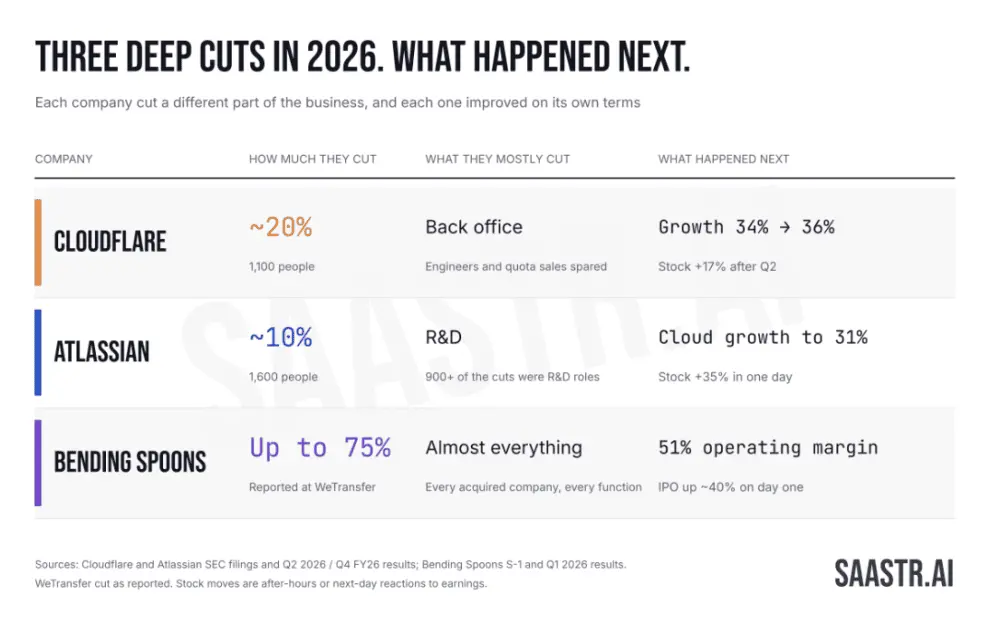
On May 7, Cloudflare announced a dramatic operational pivot toward an agentic, AI-first operating model. This shift involved eliminating roughly 20% of its workforce—representing over 1,000 positions—and incurring between $140 million and $150 million in restructuring charges. At the close of 2025, Cloudflare maintained a full-time staff of 5,156 employees.
Crucially, Cloudflare executed these cuts from a position of relative strength. The company had just posted stellar quarterly results, generating $639.8 million in revenue (a 34% year-over-year increase). Despite this revenue beat, Wall Street reacted with initial apprehension, sending the stock down more than 20% in after-hours trading.
However, the skepticism was short-lived. By the subsequent quarter, Cloudflare’s revenue hit $696.1 million—accelerating to 36% growth—and the stock rebounded by 17% after hours. Management subsequently raised its full-year guidance to a range of $2.86 billion to $2.87 billion, comfortably outpacing the $2.81 billion consensus, while maintaining a robust net dollar retention rate of 120%.
The Strategy: Cloudflare surgically targeted back-office operations while actively protecting engineering and sales. CEO Matthew Prince emphasized that cuts were concentrated in administrative and general (G&A) roles that had been streamlined by AI automation. Quota-carrying sales representatives and core engineering pipelines were deliberately shielded across all regions.
The growth was primarily fueled by underlying market demand, with management highlighting "Workers" and agentic workloads as key growth engines. By downsizing its G&A overhead while capturing the machine-to-machine traffic boom, Cloudflare drastically improved its unit economics.
- Financial Impact: Taking Q1 annualized revenue over the pre-cut workforce of 5,156 yields roughly $496,000 per employee. Following the reductions down to approximately 4,050 workers, annualized Q2 revenue soared to roughly $690,000 per employee—representing an astounding 40% efficiency jump in a single quarter. Prince has noted that the company plans to resume hiring in 2027, albeit for entirely different skill sets.
2. Atlassian: R&D Rationalization and Cloud Acceleration
In March, Atlassian parted ways with roughly 10% of its global workforce—about 1,600 employees—in a bid to reallocate capital toward AI development and enterprise sales expansion. More than 900 of these eliminated roles were concentrated within software R&D.
At the time, market sentiment surrounding Atlassian was gloomy. The company had suffered a market valuation drop of more than 50% since the beginning of the year, driven by investor anxiety over the threat of AI-native software alternatives. The initial layoff announcement was met with a modest 2% bump in after-hours trading.
The Post-Cut Results:
- Cloud revenue expanded by 31% year-over-year.
- Free cash flow reached historic highs, proving that the R&D reduction did not starve the core revenue engines.
- Concurrently, co-founder and CEO Mike Cannon-Brookes signaled strong internal confidence by announcing plans to personally purchase up to $250 million of Atlassian stock on the open market.
The Nuance: While overall growth guidance for fiscal 2027 was pegged at a more modest 13% (with annual recurring revenue growth projected at 18%), this deceleration was largely anticipated due to the structural wind-down of legacy Data Center revenue as clients migrate to the cloud.

Despite cutting over 900 engineers, Atlassian’s product velocity actually increased. Adoption metrics for its MCP server and Teamwork Graph CLI surged past one million monthly active users, more than doubling in a single quarter. This productivity spike coincided with an internal reorganization that split the Chief Technology Officer role into two distinct, AI-focused engineering divisions, demonstrating that structural design matters just as much as headcount.
3. Bending Spoons: Extreme Margin Optimization and Asset Consolidation
Bending Spoons represents the most aggressive end of the corporate efficiency spectrum. Known for its playbook of deep operational restructuring following acquisitions, the company has consistently trimmed fat from mature software assets.
Prominent examples abound: Eventbrite executed major layoffs weeks after closing a deal tied to Bending Spoons’ orbit, and the firm reportedly slashed 75% of WeTransfer’s staff post-acquisition. Similarly, video platform Vimeo underwent two rounds of deep workforce reductions following a $1.38 billion buyout.
The Results:
- Revenue Per Employee: Bending Spoons generates an astonishing $2.57 million in revenue per employee—roughly four times Cloudflare’s post-cut metrics.
- Operating Margins: The company routinely commands operating margins north of 50%.
- Net Revenue Retention: NRR hovered around 95% in 2025, indicating that its acquired customer bases contract slightly over time. Rather than driving hyper-growth organically, Bending Spoons scales by acquiring new software portfolios and running them with skeletal crews.
The trade-offs of this model are clear. Prior to its acquisition, Vimeo showcased an ambitious roadmap featuring a completely overhauled review suite integrated with Adobe Premiere Pro and advanced natural-language search capabilities. Those ambitious innovation pipelines were largely sidelined following the January layoffs. Bending Spoons proves that mature, slow-growth products can be operated with a fraction of their original headcount to maximize profitability; it does not prove that a company can organically scale top-line revenue by 30% under the same constraints.
Comparative Matrix: Functional Cut Targets
| Company | Primary Functional Cuts | Post-Cut Performance / Outcome | Strategic Intent |
|---|---|---|---|
| Cloudflare | Back-office, G&A, Operations | Growth accelerated from 34% to 36%; revenue per employee jumped ~40%. | Protect sales and engineering; leverage AI for administrative workflows. |
| Atlassian | Software R&D (~900+ engineers) | Cloud growth hit 31%; developer productivity metrics doubled. | Reallocate capital toward enterprise sales and AI-native feature delivery. |
| Bending Spoons | Across-the-board (up to 75%) | Achieved $2.57M revenue per employee and >50% operating margins. | Maximize profitability on mature, slow-growth software assets. |
Supporting Context & Metrics: The Rise of the Agent-Driven Enterprise
To contextualize how these tech giants are achieving unprecedented output with leaner headcounts, one must examine how smaller organizations are leveraging autonomous systems.
SaaStr offers an extreme case study in ultra-lean scalability. Operating at a scale of $15 million to $20 million in annual revenue, the organization functions with just three human staff members supported by approximately 20 production-grade AI agents—though active system usage is typically dominated by a core team of roughly six primary agents.
What Autonomous Agents Run End-to-End:
- Comprehensive data scraping, market research synthesis, and initial lead enrichment.
- First-draft content generation, editorial scheduling, and multi-channel syndication.
- Customer support triage, tier-one ticket resolution, and documentation indexing.
- Routine financial reconciliation, reporting pipelines, and internal data hygiene checks.
What Humans Still Do:
The illusion that AI agents can run entirely unsupervised is quickly dispelled by daily operations. Humans remain critical for executive judgment, high-stakes relationship management, and meticulous quality assurance. Management notes that intensive review cycles—such as spending grueling 13-hour days auditing, re-ranking, and troubleshooting agent outputs without writing a single line of new code—are the new normal.
Organizations that slash their workforces by 50% under the naive assumption that AI agents will operate autonomously without human oversight will face severe operational failure. Someone must ultimately own, govern, and verify the output.
Granular Functional Guidance: Where to Cut and Where to Protect
For B2B executives mapping out organizational blueprints for the coming fiscal year, different functional areas carry vastly different risk profiles when subjected to AI-driven streamlining:
- Back Office, G&A, and Operations (50%+ Cut Potential): This category formed the bedrock of Cloudflare’s restructuring. Because modern LLMs and workflow automation agents excel at administrative tasks, contract processing, and internal coordination, companies can safely reduce manual overhead here first.
- Marketing Operations & Demand Gen Execution (30% to 50% Cut Potential): AI tools now handle campaign assembly, audience list hygiene, multi-variant creative generation, and attribution reporting. However, foundational brand strategy and creative vision must remain human-led.
- Engineering at Mature, Enterprise Organizations (10% to 20% Cut Potential): Atlassian’s success proves that large R&D teams bloated during the 2020–2021 hiring boom often harbor inefficiencies. With AI-assisted pull requests (PRs) accelerating coding velocity, mature engineering orgs can often do more with fewer personnel.
- Engineering at Early-Stage, Hyper-Growth Companies (Protect): If a 25-person startup is generating $20 million ARR and growing at 60% year-over-year, its engineers are vital. Because each engineer is effectively 2x to 3x more productive today, these teams should be protected and selectively expanded.
- Quota-Carrying Sales (Protect in Growth Phases): Cloudflare explicitly protected its sales force, while Atlassian redirected capital to bolster enterprise sales. If a sales pipeline is verifiable and quota attainment is healthy, revenue-generating reps are the absolute last group to touch.
- Customer Success (ACV-Dependent): For low-average-contract-value (ACV) products, AI agents can successfully manage the vast majority of onboarding and retention workflows. For enterprise contracts exceeding $100K ARR—which drive the lion’s share of revenue for infrastructure giants—human-led relationship management remains non-negotiable.
Revenue-per-Employee Benchmarks for the Boardroom
The ultimate metric governing modern B2B governance is revenue per employee. Historical baselines are shifting rapidly:
- Traditional Baseline: Historical ICONIQ data pegged the typical B2B software company benchmark at roughly $237,000 in revenue per employee.
- The New Pacesetter Standard: ICONIQ’s Pacesetter Index reveals that median revenue per employee for top-tier growth companies exceeding $100 million ARR has surged to $655,000.
- The Enterprise Reality: Cloudflare’s strategic restructuring instantly vaulted its metrics from roughly 2x the legacy industry average to sit comfortably above the Pacesetter median in a single quarter.
For any B2B enterprise operating below $300,000 in revenue per employee while growing at less than 30% annually, board-level inquiries regarding headcount efficiency are no longer a possibility—they are an inevitability.
Future Outlook
The restructuring waves led by Bending Spoons, Cloudflare, and Atlassian signal the permanent arrival of the lean-scale era in enterprise software. The old paradigm—where headcount growth was treated as a direct proxy for corporate health and market valuation—has been replaced by a rigorous focus on unit economics, automated operational leverage, and capital efficiency.
As agentic AI capabilities continue to evolve from experimental novelties into core operational infrastructure, the executive mandate for the future is clear: organizations must uncouple top-line growth from linear headcount expansion. Those that successfully harness AI to shrink back-office overhead while empowering lean, high-velocity engineering and sales cores will define the next generation of enterprise dominance. Those that cling to bloated legacy structures risk being out-paced, out-innovated, and out-capitalized.