By Editorial Staff
Published: October 14, 2026
Executive Overview
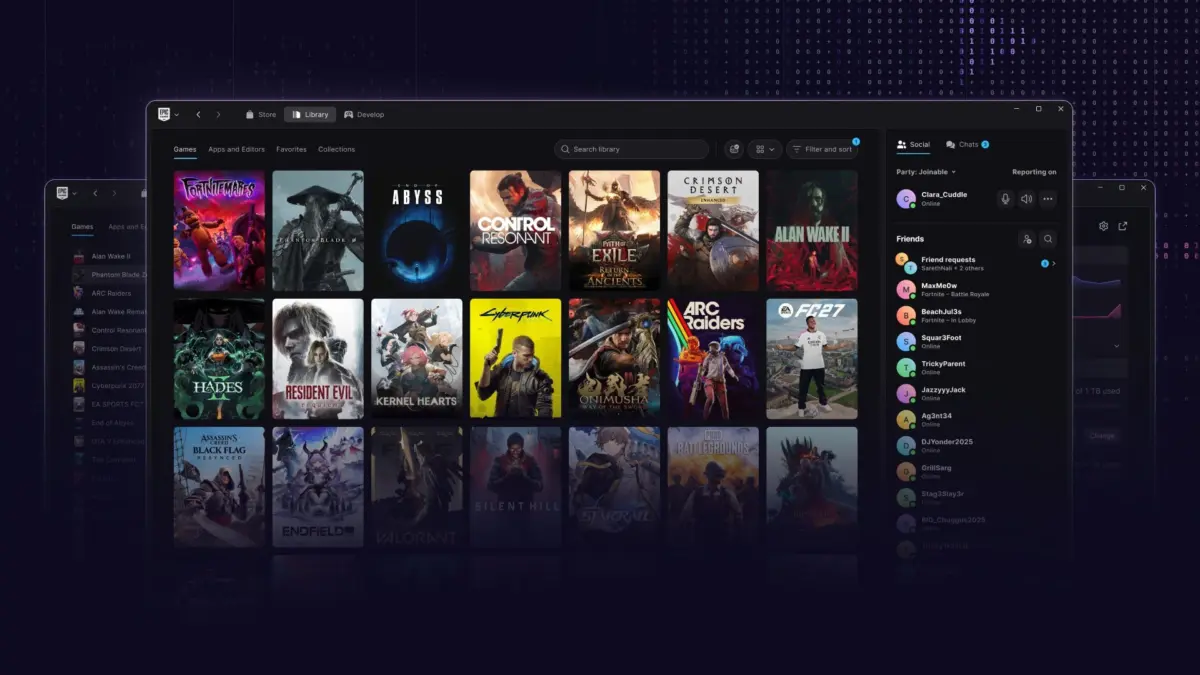
In a massive technological and strategic pivot, Epic Games has officially released a preview version of a completely overhauled Epic Games Launcher. Long criticized by consumers and power users alike for sluggish performance, bloated resource management, and a heavy-handed interface, the software has been rewritten from scratch. According to company executives, the newly deployed iteration leverages modern software architectures—including artificial intelligence and innovative development methodologies like "vibe coding"—to tackle the performance bottlenecks that have plagued the platform for years.
The preview build, available to download now, introduces a drastically pared-down installation footprint alongside monumental speed gains. Epic claims the new launcher boots from a cold start in just 5.47 seconds—outpacing Valve’s dominant Steam client by roughly 46% under identical conditions—and loads user game libraries up to 30 times faster than its predecessor. Furthermore, the application now spans Windows, macOS, and, for the first time natively, Linux.
While the preview build is currently "light on features" as it transitions into its early testing phases, the overarching ambition is unmistakable. Epic Games is positioning this rewrite not merely as a minor patch, but as a foundational cornerstone in its ongoing, uphill battle to capture meaningful market share from Valve and redefine the PC gaming storefront experience.
Detailed Chronology & Development Background
The journey toward a completely redesigned Epic Games Store (EGS) launcher has been a slow-burn realization for the company. Ever since its debut in December 2018, the Epic Games Launcher faced intense scrutiny. While consumers were routinely lured to the platform by aggressive exclusive deals and lucrative weekly free game giveaways, the underlying software application itself was frequently characterized as sluggish, unresponsive, and overly reliant on web-wrapper technologies that sapped system resources.
The Road to the Rewrite
Throughout the years, Epic implemented incremental updates to patch memory leaks and streamline navigation, but these bandaids failed to cure the fundamental architectural flaws embedded in the launcher’s original framework. Recognizing that superficial updates could no longer suffice, Epic leadership greenlit a comprehensive modernization strategy earlier this year.
During roadmap presentations released earlier in 2026, Epic teased ambitious targets, promising users up to a five-fold increase in boot speeds, deeply integrated user review systems, and a radically cleaner user interface. The culmination of those internal efforts is the newly launched preview build. Built entirely on a new tech stack, the rewrite encompasses both the core shell—managing downloads, app updates, and the user library—and the store architecture itself, reworking product detail pages and discovery feeds from the ground up.
The AI Factor and "Vibe Coding"
Perhaps one of the most intriguing disclosures surrounding the new launcher’s development is Epic’s reliance on cutting-edge software creation tools. In comments accompanying the release, the company confirmed that the application was constructed using advanced artificial intelligence assistance and agile development philosophies colloquially known as "vibe coding." By leveraging AI-assisted coding frameworks, Epic’s engineering teams were able to prototype, test, and discard legacy codebases at an unprecedented velocity, allowing them to construct a lightning-fast application framework in a fraction of the time traditional development cycles would demand.
Supporting Context & Performance Metrics
For years, performance comparisons between the Epic Games Launcher and Valve’s Steam heavily favored the latter. Steam, despite its own share of feature bloat, benefited from decades of refinement, robust caching algorithms, and a native client architecture that prioritized responsiveness. Epic’s new build aims to flip that narrative completely.
Breaking Down the Numbers
Epic Games has published a series of internal benchmarks highlighting the dramatic performance delta between the legacy launcher and the new preview build:
- Cold Boot Times: The new launcher boots from a cold state in 5.47 seconds, marking a staggering 46% improvement over Steam under testing conditions.
- System Tray Resumption: Waking the application from the system tray takes a mere 0.36 seconds, running roughly 14% faster than competing platforms.
- Library Loading Speeds: According to Epic Games Store Vice President and General Manager Martin Keely, the user game library loads 30 times faster than it did in the previous iteration of the software.
- Resource Footprint: Despite adding comprehensive multi-platform support, the new launcher maintains a tiny installation and operational footprint of just 300 megabytes, ensuring seamless operation across a diverse spectrum of PC hardware configurations, from high-end enthusiast rigs to budget laptops.
Platform Expansion: Entering the Linux Ecosystem
Beyond raw speed, the most profound structural shift in this update is platform availability. While the previous launcher was strictly confined to Windows and macOS, the new preview build officially expands support to Linux—a massive win for the open-source gaming community and growing cohorts of handheld PC users operating on Linux-based distributions like SteamOS.
However, this cross-platform rollout comes with a crucial caveat, particularly regarding Epic’s flagship title, Fortnite. While the launcher is functional on Linux, Fortnite is not yet playable on the operating system. Epic has clarified that bringing the battle royale juggernaut to Linux requires a fundamental structural rebuild of its Easy Anti-Cheat (EAC) system to ensure deep compatibility with various Linux kernel architectures and distribution standards.

"Once it’s working with a critical mass of distro maintainers, we’ll bring Fortnite to Linux via the Epic Games Launcher," Epic stated in an official blog post.
Official Statements and Industry Insights
In an exclusive interview following the preview launch, Martin Keely elaborated on the design philosophy driving the massive overhaul, emphasizing that speed and minimalism were the guiding principles.
"It’s been rebuilt entirely from the ground up," Keely told IGN. "So this is a completely new tech stack, a complete new rewrite of both the shell, which has the download manager, library, and the app itself, as well as the new store architecture. So features like discover and product detail pages, those have all been rewritten."
Addressing the lightweight nature of the current preview build, Keely noted that user feedback will dictate the integration of secondary tools. For now, the application focuses entirely on core necessities: a responsive storefront, an instantaneous user library, streamlined social panels, and dedicated developer pages optimized for creators utilizing the Unreal Engine.
"The library loads 30 times faster," Keely reiterated, highlighting the tangible user-facing benefits of the new codebase. "The startup is twice as fast. And it’s a small footprint, only 300MB. That was another thing that we wanted to continue to make as small as possible to support the wide range of hardware that players have."
Future Outlook: Can Epic Finally Win Over the Skeptics?
While the engineering achievements of the new Epic Games Launcher are undeniably impressive, the software faces a psychological hurdle that runs much deeper than mere millisecond optimizations: consumer perception.
Since its inception, the Epic Games Store has operated under a persistent cloud of skepticism. Despite giving away hundreds of millions of dollars worth of free games and securing high-profile PC exclusives, a vocal segment of the PC gaming community remains steadfast in its loyalty to Steam. Critics frequently point to Steam’s robust community features, integrated discussion boards, comprehensive user review ecosystems, and polished profile customization tools as benchmark standards that Epic has historically failed to match.
Epic is well aware of these shortcomings and has laid out a roadmap to address them systematically. Following the stabilization of this initial speed-focused phase, future updates will pivot heavily toward social integration and intelligent merchandising.
"The other piece that we’re going to be working on is how to improve game discovery in a way that is relevant to each player," Keely explained, outlining the platform’s medium-term trajectory. "We have a pretty large library and sometimes there’s great games that will be relevant for someone, so making sure that we continue to improve the merchandising components of how we make game discovery more possible and make that more social so that people can recommend games to each other and make that easy to share."
The Verdict So Far
The release of the preview launcher marks a turning point for Epic Games. By stripping away the bloated legacy framework and building a lightning-fast, resource-efficient client from scratch, Epic has eliminated its most glaring technical vulnerability.
Whether a faster boot time and a 300MB footprint will be enough to pry entrenched users away from their Steam libraries remains to be seen. However, by establishing a world-class technical foundation, Epic Games has finally armed its storefront with the performance engine it needs to compete on a truly level playing field.