Amazon Web Services (AWS) has fundamentally transformed how enterprise Public Key Infrastructure (PKI) handles automated certificate lifecycles. With the official rollout of native Automatic Certificate Management Environment (ACME) support for public certificates within AWS Certificate Manager (ACM), organizations can now seamlessly issue, renew, and revoke trusted Transport Layer Security (TLS) certificates without manual intervention.
Historically, managing TLS certificates at scale involved navigating a fragmented operational landscape. While cloud-native assets enjoyed smooth integrations, hybrid or containerized environments often relied on external certificate authorities coupled with ACME protocols. This introduced visibility gaps, decentralized control silos, and excessive administrative overhead. Furthermore, as the Certification Authority/Browser (CA/Browser) Forum tightens industry standards—mandating a reduction in maximum certificate validity periods to 100 days by March 2027 and a strict 47 days by 2029—legacy manual renewal workflows have become entirely untenable.

The new managed ACME service endpoint in ACM effectively bridges this operational gap. By supporting any ACMEv2-compatible client—such as Certbot, Kubernetes cert-manager, and acme.sh—AWS enables businesses to leverage Amazon Trust Services (ATS) directly via standard protocols. This capability is paired with enterprise-grade security guardrails, including granular IAM role integration, domain-scoping controls, and automated DNS validation through Amazon Route 53. Consequently, infrastructure teams can now scale automation securely while maintaining centralized governance, robust auditability, and unified monitoring.
Detailed Chronology & Technical Implementation
The introduction of native ACME support in ACM represents a major architectural milestone for AWS infrastructure management. To fully understand how this capability functions in production environments, it is necessary to examine the step-by-step workflow required to provision, secure, and deploy a public TLS certificate using standard tooling.

Step 1: Initializing the ACME Endpoint
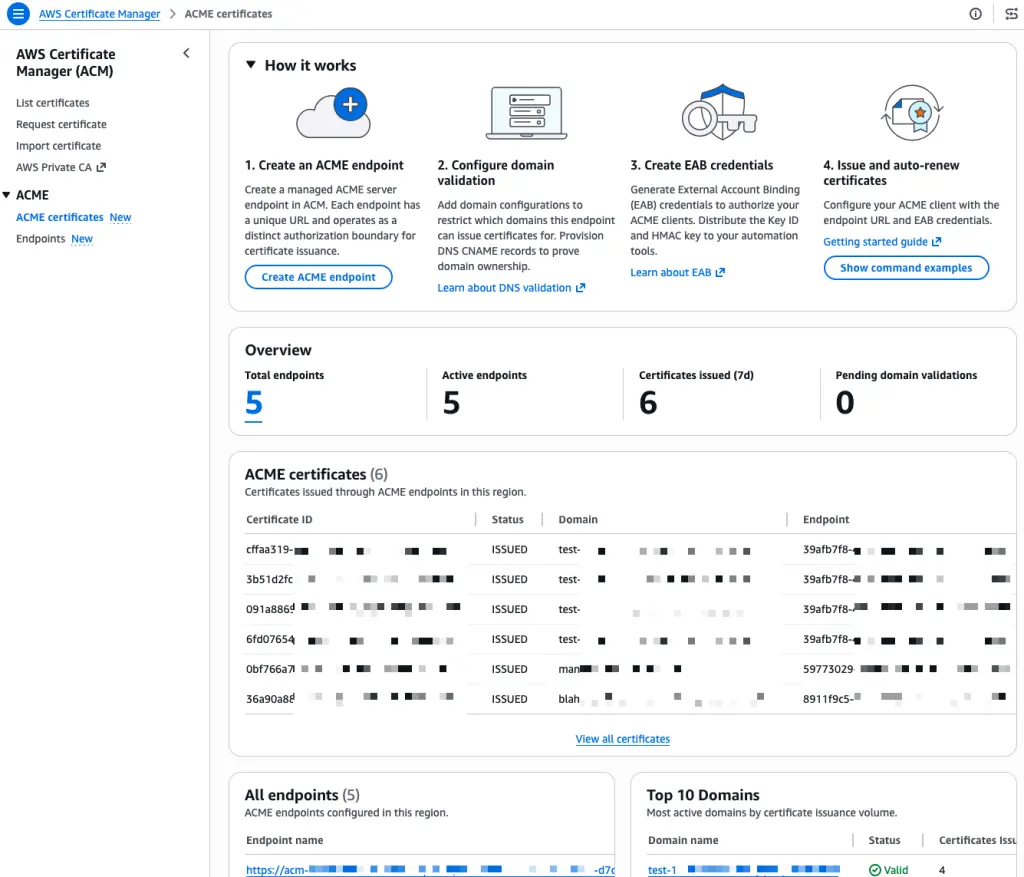
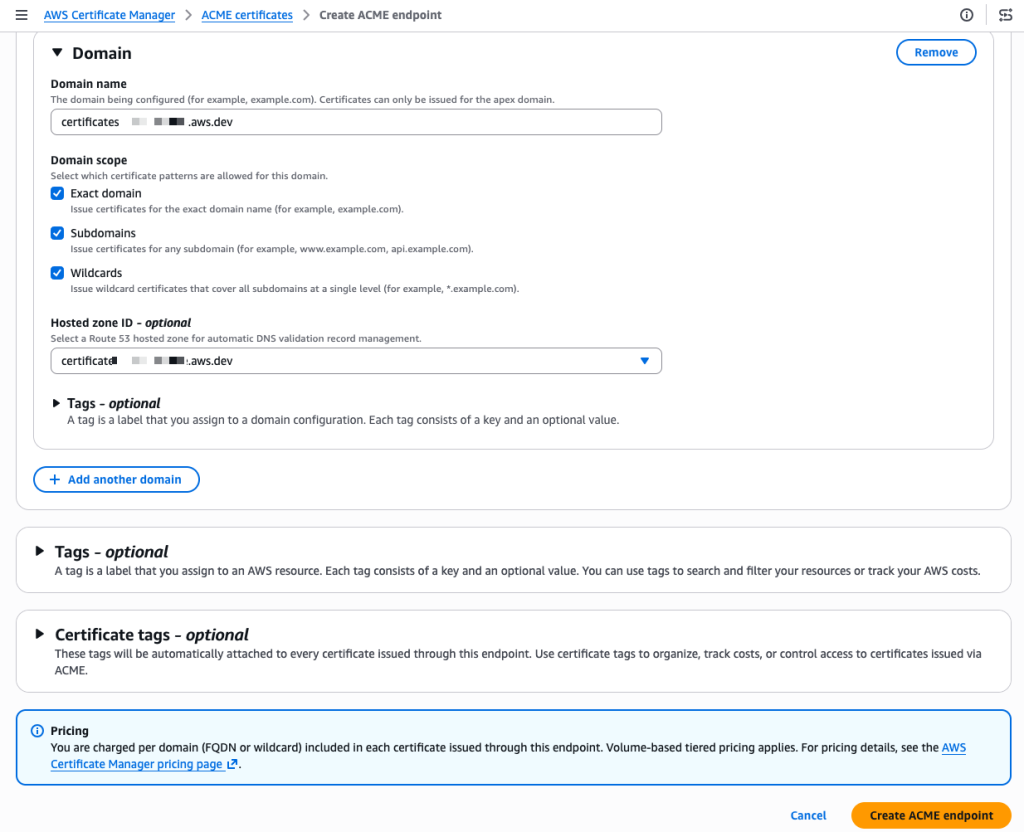
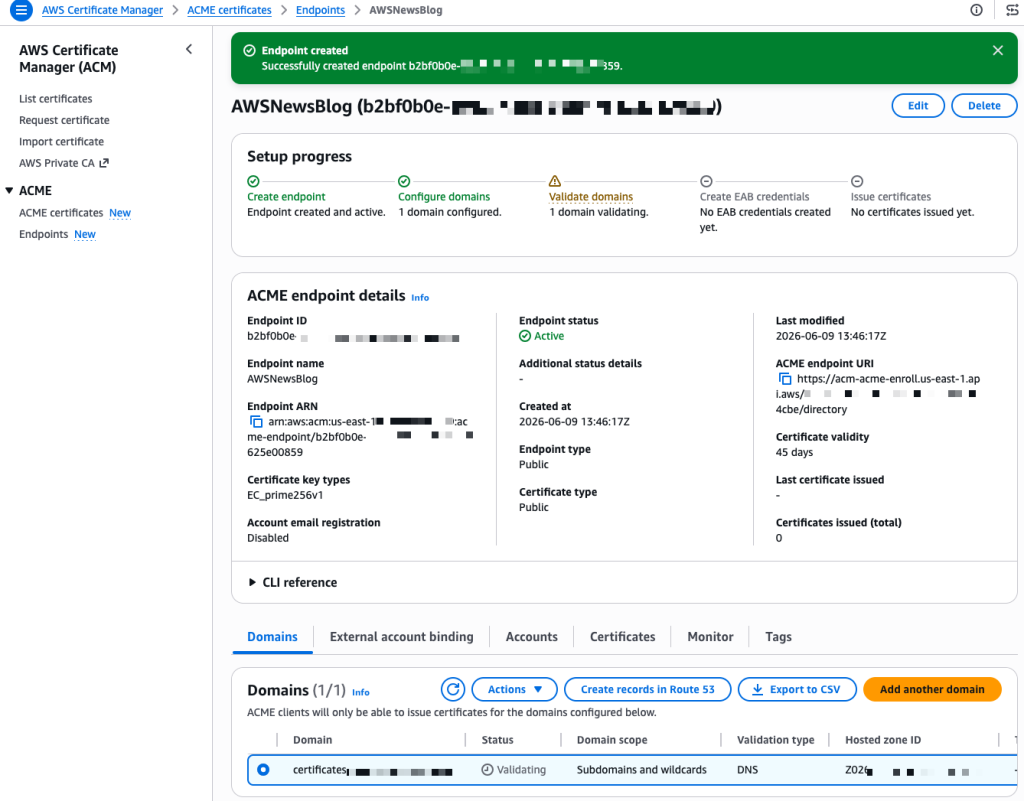
The journey begins within the AWS Certificate Manager console under the dedicated ACME certificates dashboard. Administrators start by selecting Create ACME endpoint, establishing a secure conduit through which external clients will communicate over the public internet.
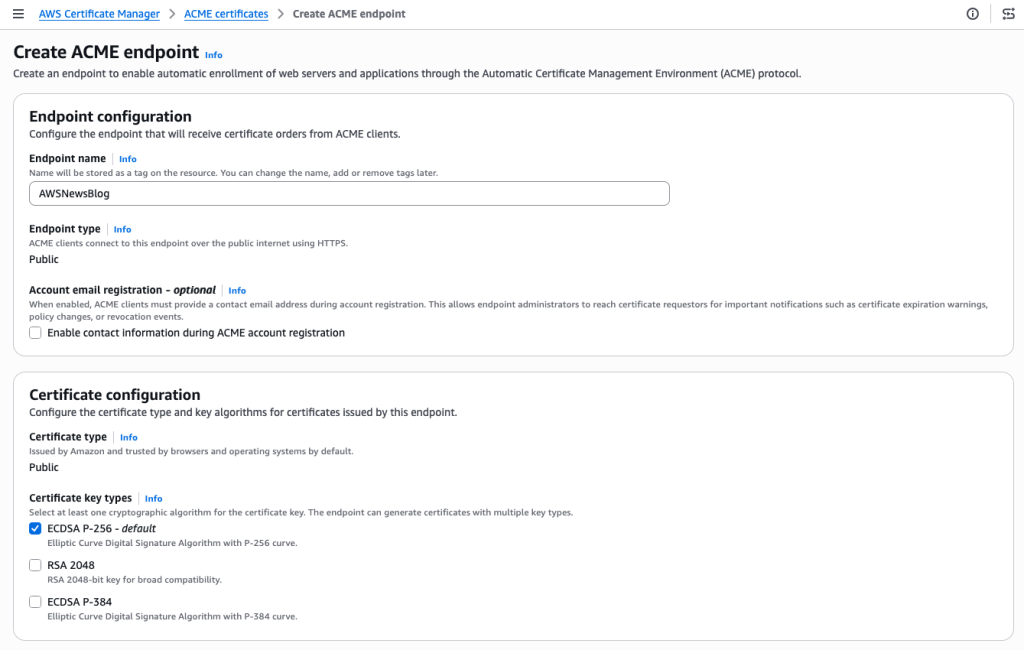
During initialization, engineers configure several critical parameters:
- Endpoint Type: Designated as Public to allow external internet-facing ACME clients to connect.
- Certificate Type: Publicly trusted certificates issued directly by Amazon Trust Services (ATS), ensuring native trust across all major browsers and operating systems.
- Key Types: Supporting modern cryptographic standards, including default ECDSA P-256, alongside legacy or specialized requirements like RSA 2048 and ECDSA P-384.
Step 2: Enforcing Domain Governance and Scoping
A core architectural advantage of ACM’s ACME integration is the separation of duties between PKI administrators and application owners. During endpoint configuration, administrators define strict Domain Scopes to dictate precisely what certificate patterns clients are authorized to request:
- Exact Domain: Restricts issuance strictly to the specified fully qualified domain name (FQDN).
- Subdomains: Permits automated generation for child assets (e.g.,
api.example.com,dev.example.com). - Wildcards: Authorizes wildcard generation (
*.example.com).
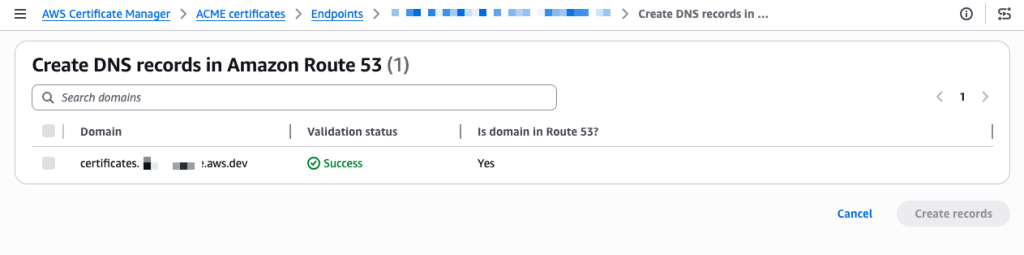
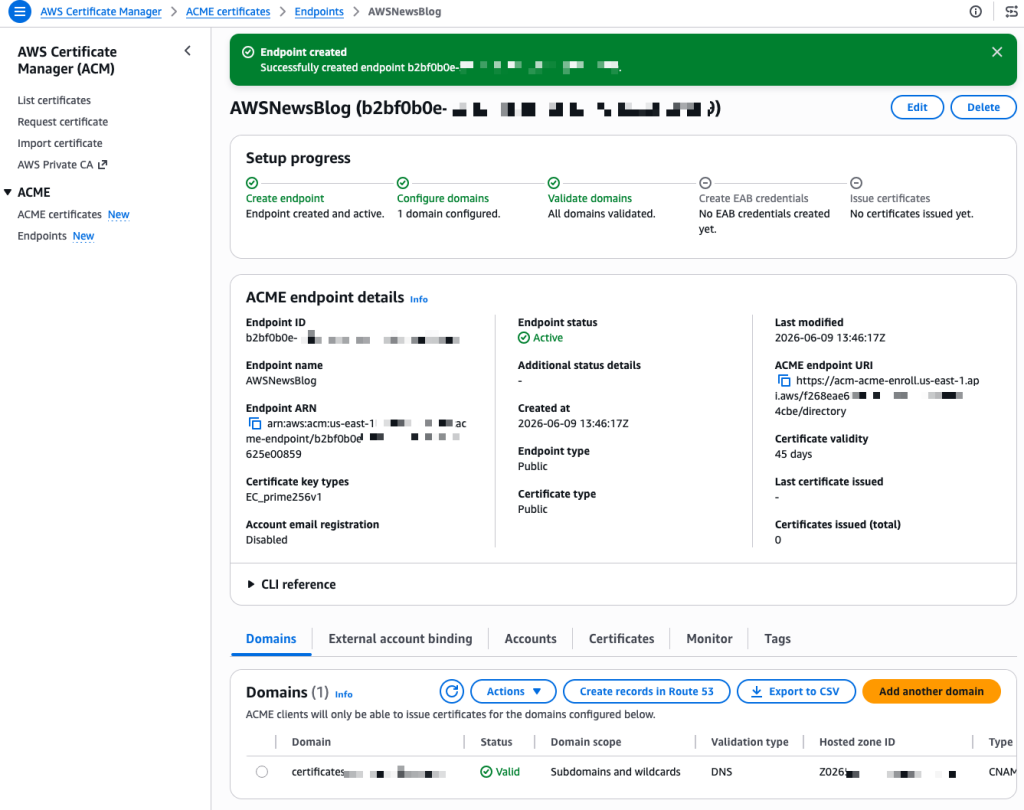
By intentionally omitting certain scopes—such as wildcards—on production endpoints, organizations can enforce a hardened security posture. Crucially, domain validation is handled upstream by the administrator using Amazon Route 53 integrated hosted zones or manual CNAME records. Application operators never touch or possess DNS infrastructure keys, drastically mitigating the risk of unauthorized domain validation or credential leakage.
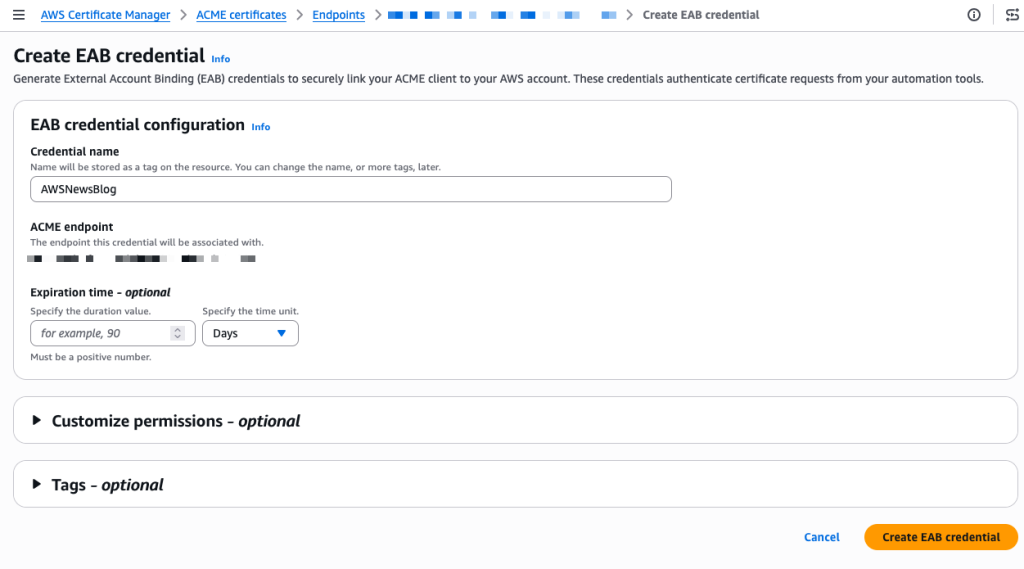
Step 3: Establishing External Account Binding (EAB)
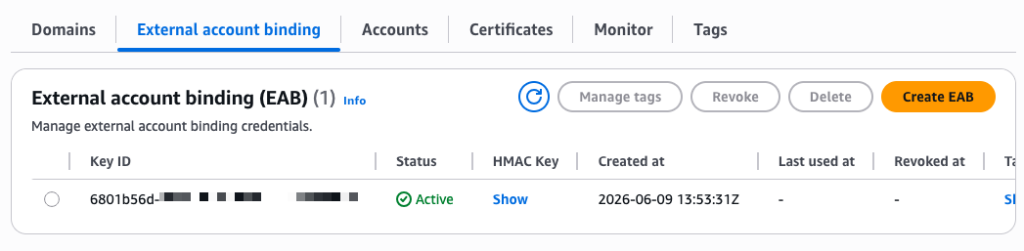
To securely onboard clients to the managed ACME endpoint, the service utilizes External Account Binding (EAB). EAB employs a key identifier (eab-kid) alongside a symmetric HMAC key.
When an ACME client registers with the endpoint using these credentials, it generates an asymmetric key pair utilized for authenticating all subsequent certificate requests. PKI administrators can optionally configure expiration windows for EAB credentials, limiting their lifespan strictly to the duration required for client onboarding.
Step 4: Requesting and Validating Certificates via CLI
Once the endpoint and EAB parameters are established, application teams can immediately interface with the ACM server using their preferred ACMEv2 client. For instance, executing a standard Certbot command within a containerized environment directs the client to contact the AWS endpoint:
certbot certonly --standalone --non-interactive --agree-tos
    --email [email protected]
    --server https://acm-acme-enroll.us-east-1.api.aws/<ENDPOINT_ID>/directory
    --eab-kid <EAB_KID>
    --eab-hmac-key <EAB_HMAC_KEY>
    --issuance-timeout 60
    -d api.example.com
Upon validation against the configured domain scopes, the ACM endpoint signs and returns a production-ready public TLS certificate issued by Amazon Trust Services. This certificate instantly populates within the centralized ACM console alongside traditional console- or API-issued assets, ensuring total asset visibility.
Supporting Context & Metrics
The timing of AWS’s release is closely tied to evolving cryptographic compliance mandates. The web security ecosystem is rapidly accelerating its lifecycle cadence to minimize the exposure window of compromised or misconfigured keys.
| Milestone / Standard | Timeline | Impact on Infrastructure |
|---|---|---|
| Current Baseline | Present | Traditional 90-day to 365-day validity models requiring heavy automation scripts. |
| CA/Browser Forum Mandate | March 2027 | Maximum certificate validity period reduced strictly to 100 days. |
| CA/Browser Forum Mandate | 2029 | Maximum certificate validity period slashed further to 47 days. |
With certificate lifespans shrinking to under seven weeks by the end of the decade, manual tracking spreadsheets or custom-coded cron jobs managing Let’s Encrypt scripts alongside AWS infrastructure will introduce unacceptable outage risks.
By integrating native ACME endpoints directly into ACM, AWS provides comprehensive enterprise observability tools:
- AWS CloudTrail: Automatically logs every certificate request, issuance, and revocation event for comprehensive auditing and compliance tracking.
- Amazon CloudWatch: Tracks operational metrics, enabling teams to build automated alarms around endpoint performance and traffic spikes.
- Automated Expiry Notifications: Triggers proactive alerts as certificates near their renewal thresholds, ensuring zero unexpected service degradation.
Official Statements & Industry Impact
Industry analysts and infrastructure security leaders have lauded the release as a vital evolution in cloud-native cryptographic governance. Prior to this integration, enterprise PKI managers frequently struggled with a fragmented architecture: critical web workloads were secured via ACM, while Kubernetes microservices or on-premises hybrid nodes relied on third-party ACME authorities, creating blind spots in central compliance inventories.
"By bringing native ACME support directly into AWS Certificate Manager, Amazon has eliminated the false choice between automated open protocols and centralized enterprise governance," notes enterprise cloud architecture expert Marcus Vance. "Organizations no longer need to build brittle wrapper APIs or purchase expensive third-party lifecycle managers just to enforce basic domain scopes and IAM boundaries on automated clients."
Furthermore, security architects emphasize the value of decoupling DNS ownership from application deployment. By allowing central IT teams to validate domain ownership once via Route 53 and issue restricted EAB credentials to downstream developers, companies can decentralize application deployment velocity without expanding their cryptographic attack surface.
Future Outlook
As digital ecosystems expand and machine-to-machine communications multiply, the volume of active TLS certificates will scale exponentially. Concurrently, cryptographic algorithms continue to evolve, with post-quantum cryptography (PQC) initiatives moving rapidly from theoretical research to practical implementation standards.
The establishment of a managed, highly scalable ACME server endpoint within AWS Certificate Manager positions AWS to absorb these upcoming cryptographic transitions effortlessly. As validity windows drop toward 47 days by 2029, infrastructure teams utilizing ACM’s native ACME capabilities will be insulated from administrative thrashing.
Looking ahead, we can anticipate deeper integrations between ACM’s ACME endpoints and container orchestration frameworks, automated IAM policy generators, and advanced multi-account resource sharing architectures. For enterprise organizations striving to balance agility, ironclad security, and rigorous compliance, native ACME integration sets a powerful new baseline for modern cloud-native certificate management.