
Executive Overview
In an era where cybersecurity threats are increasingly sophisticated, the attack vectors exploited by threat actors continue to evolve past traditional malware and rudimentary phishing scams. A striking example of this evolution came to light when security researchers and investigative journalists uncovered a campaign by the Russian state-sponsored cyber-espionage group known as Fancy Bear (also tracked as APT28, Sofacy, or Strontium). The group systematically weaponized a core feature of Google’s Accelerated Mobile Pages (AMP) framework to harvest credentials from high-profile targets, including journalists reporting on Russian political corruption and state-backed operations.
At the center of this controversy is an inherent architectural vulnerability within Google’s AMP protocol. Designed in 2015 to accelerate mobile web browsing by pre-rendering and caching web content, AMP routes these cached pages through trusted google.com domains. While the technology was marketed as an optimization tool for a mobile-first internet, critics, web developers, and security experts quickly identified its potential for abuse.
By cloaking malicious, lookalike phishing portals behind legitimate Google URLs, attackers effectively neutralized one of the foundational rules of cybersecurity education: always check the address bar for the domain name. Even technically proficient individuals, including developers and seasoned investigators, were successfully deceived. Despite early warnings from the developer community—warnings that Google project leads initially dismissed—the vulnerability was exploited in real-world attacks. Most notably, veteran journalist David Satter fell victim to the exploit, resulting in the theft and subsequent manipulation of his personal communications.
This incident ignited a broader, ongoing debate regarding corporate centralization, the governance of web standards, and the tension between user experience optimization and robust security protocols.
Detailed Chronology: The Anatomy of an AMP-Enabled Phishing Campaign
The exploitation of Google’s AMP architecture by Fancy Bear did not happen in a vacuum. It was the culmination of months of iterative testing, target profiling, and infrastructure deployment that intersected directly with a high-stakes geopolitical reporting environment.
The Genesis of the Vulnerability and Developer Warnings
Google launched AMP in late 2015 with the noble goal of making the mobile web faster. By stripping down HTML and forcing developers to adhere to a rigid subset of web components, AMP allowed mobile browsers to load simplified web pages almost instantaneously. To achieve this lightning-fast speed, Google implemented a caching mechanism: AMP pages listed in search results were pre-loaded onto Google’s own servers and served to users under a google.com domain structure.
While publishers fretted over the erosion of their brand identity and the concentration of internet traffic within Google’s ecosystem, web developers quickly spotted a security blind spot. In November 2016, web programmer Ray Etornam filed a bug report on GitHub (ampproject/amphtml/issues/6210), highlighting how bad actors and fake news operations could leverage AMP to inherit institutional legitimacy.
Developers like Christian Gloddy and John Pettitt amplified the warning, pointing out a critical user-interface flaw: while the true originating domain was displayed in small text at the very top of the content area, the browser address bar steadfastly displayed a trusted google.com URL. As users scrolled down the page, the origin disclaimer would vanish, while the Google domain remained fixed.
Despite these warnings, Malte Ubl, the tech lead for the AMP project, pushed back against the criticism, writing that the viewer "clearly attributes the original domain at the top" and asserting that "an unsophisticated user could not be fooled by this." The dialogue abruptly ended when project maintainers locked the GitHub thread as media inquiries began to mount.
Targeting Bellingcat: A Persistent Campaign
While Google’s internal team debated the theoretical risks, Fancy Bear operators were actively practicalizing them. Among their primary targets was Aric Toler, a researcher and writer for Bellingcat, an investigative journalism collective renowned for using open-source intelligence to expose Russian involvement in the downing of Malaysia Airlines Flight 17 (MH17) over Ukraine.
Toler had been targeted by APT28 multiple times throughout 2015 and 2016. Early attempts relied on rudimentary, easily identifiable tactics, such as URL shorteners like Bitly pointing to credential-harvesting portals. Recognizing that savvy targets easily bypassed these raw links, the hackers upgraded their tradecraft.

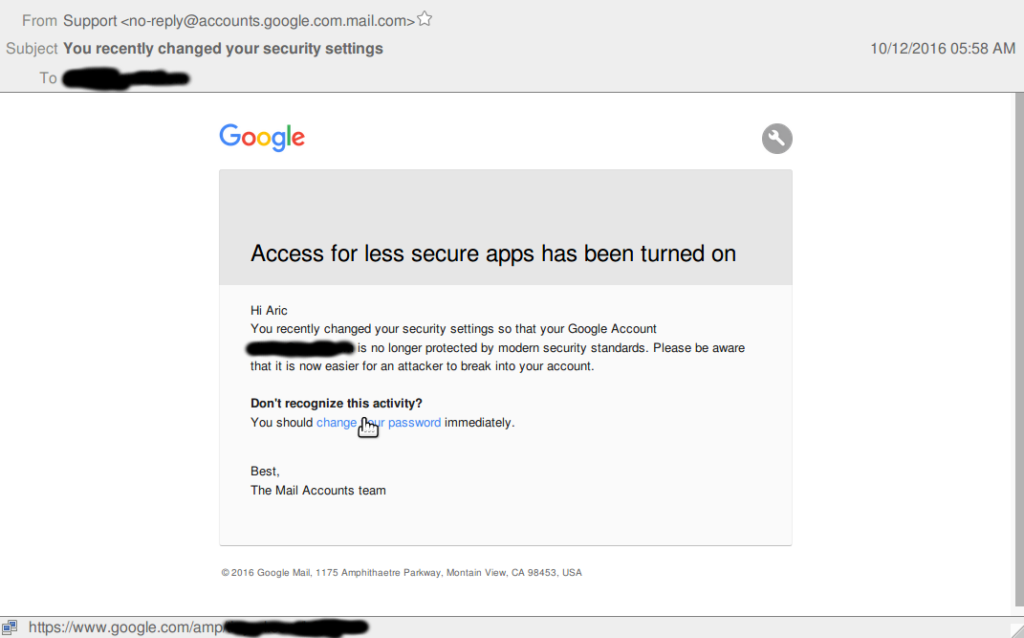
On October 12, 2016, Toler received a sophisticated spear-phishing email masquerading as a security alert from Google. The message warned that older email applications were accessing his account and provided a link to "fix" the issue. Crucially, the link directed Toler through a Google AMP URL, masking a malicious credential-harvesting site behind a pristine google.com address.
The following day, after Toler posted about receiving legitimate Google warnings on Twitter, the hackers adapted instantly. They fired off a second spear-phishing email—this time claiming that "government-backed attackers may be trying to steal your password"—and once again routed the malicious login prompt through the trusted AMP framework.
Through forensic analysis conducted by cybersecurity firm ThreatConnect, researchers tied these malicious domains back to infrastructure and email accounts (such as [email protected]) previously used in known APT28 operations. Fortunately, Toler and his Bellingcat colleagues recognized the indicators of compromise and avoided the trap.
The Compromise of David Satter
Not all targets fared as well. David Satter, an American journalist and author who has written extensively and critically about Russia and the Putin administration, was targeted using an identical methodology via the same [email protected] infrastructure.
Satter was successfully tricked into visiting a malicious AMP-facilitated phishing page and entering his Gmail credentials. Within moments of the compromise, automated scripts logged into his account, exfiltrating the entire contents of his inbox.
The consequences were swift and damaging. Within three weeks, digital watchdogs at Citizen Lab documented that the stolen documents had been leaked online. Worse still, the threat actors had altered portions of the stolen correspondence before publication, deploying a classic "tainted leaks" disinformation strategy designed to discredit Satter, manufacture false narratives, and defame critics of the Kremlin.
Supporting Context & Metrics: The Architecture of Trust and Deception
To understand why the Fancy Bear campaign succeeded where simpler phishing attempts failed, one must examine the psychological and technical mechanics of browser trust indicators.
The "Address Bar" Rule and the Breakdown of User Intuition
For decades, cybersecurity awareness training has instilled a singular, immutable rule in users: Check the address bar before entering sensitive credentials. If the domain does not match the service you intend to log into—for example, if a Gmail login prompt sits on a random third-party domain—users are instructed to abort.
Google’s AMP implementation fundamentally broke this paradigm. By serving third-party content under its own premier domain infrastructure (google.com), the architecture created an environment where security instincts were systematically undermined:
- Inherited Authority: Phishing links utilizing Google AMP appeared completely legitimate to casual observers and even trained professionals. A URL beginning with
https://www.google.com/amp/...carried the implicit cryptographic and brand trust of Google itself. - UI Deception: On mobile devices, where screen real estate is at a premium, the address bar is the primary anchor for trust. The sub-domain or origin text placed inside the web page body—often styled to mimic system notifications—was easily mistaken for a native UI element rather than web-rendered content.
- Spear-Phishing Integration: APT28 combined this infrastructure exploit with highly targeted reconnaissance. By leveraging personal details harvested from social media and previous data breaches, the emails matched the exact tone, formatting, and urgency of genuine Google security notifications, leaving victims virtually no behavioral cues to suspect foul play.
The Broader Backlash: Open Web vs. Corporate Silos
The security vulnerabilities exposed by the Fancy Bear attacks catalyzed existing frustrations within the web publishing and developer communities regarding AMP’s broader economic and architectural implications.
Industry leaders argued that AMP was less about mobile optimization and more about user retention and data consolidation. By keeping users within a Google-controlled caching environment, publishers lost direct engagement metrics, advertising revenue control, and audience data.
Prominent figures weighed in heavily on the controversy:
- John Gruber, creator of Daring Fireball, noted that expecting ordinary users—or even web developers glancing quickly at a link—to spot the difference between a real Google service and a weaponized AMP redirect was an unreasonable security burden.
- Scott Gilbertson, writing an essay titled "Kill Google AMP before it KILLS the web," argued that the standard was actively degrading the open architecture of the internet by homogenizing design and concentrating editorial control.
- Jason Kint, CEO of digital publishing trade association Digital Content Next (representing major outlets like The New York Times and the Washington Post), pointed out that the security incident underscored the dangers of corporate centralization and closed standards.
Official Statements and Remediation Efforts
As public scrutiny intensified, Google faced difficult questions regarding its handling of the vulnerability, its refusal to transparently disclose security updates, and its initial dismissal of developer warnings.
Google’s Response and Implementation of Safe Browsing
Initially, Google representatives and project leads defended the design of the AMP viewer, asserting that origin labels were sufficient to prevent user confusion. However, behind closed doors and in the wake of mounting evidence from journalists and threat intelligence firms, the tech giant quietly initiated remediation measures.
In statements provided following public exposure of the attacks, Google confirmed that it had retroactively applied its automated Safe Browsing technology to the AMP ecosystem. According to the company:
- Beginning in early January 2017, every AMP page linked via
google.com/ampwas subjected to automated security crawling and scanning to detect malicious payloads before they could be served to users. - In instances where a webpage had not been pre-screened by automated scanners, Google introduced a "redirect notice" warning page. This interstitial page informed users that they were navigating away from the Google domain to an external site, offering an option to turn back.
Criticisms of Transparency
Despite these technical fixes, Google drew sharp criticism for its opacity. Cybersecurity advocates noted that the company’s reluctance to openly discuss security flaws or credit external researchers who flagged vulnerabilities ran counter to standard industry practices of coordinated disclosure.
Furthermore, the decision by AMP tech lead Malte Ubl to lock public commentary on the original GitHub bug report during active journalistic inquiries was viewed by critics as an attempt to suppress accountability rather than address systemic risks.
Future Outlook: The Lingering Legacy of AMP and the Fight for a Secure Web
The weaponization of Google’s Accelerated Mobile Pages by a state-sponsored threat group marks a watershed moment in the history of web standards and cybersecurity. It demonstrated that even well-intentioned performance optimizations, when built upon centralized architectures that subvert browser trust indicators, can be co-opted by sophisticated actors for espionage and disinformation.
Although web standards evolve, the fallout from the Fancy Bear campaign left lasting scars on the digital publishing landscape:
- The Decline of AMP: Spurred by ongoing publisher pushback, performance improvements in standard mobile web browsers, and shifts in search engine optimization (SEO) ranking criteria that decoupled speed metrics from proprietary AMP formats, Google eventually began phasing out mandatory AMP requirements for top stories features in search results.
- Re-evaluating Trust Indicators: The incident forced browser vendors and security architects to re-examine how URLs and origin identities are displayed on mobile interfaces, emphasizing that UI design must never obscure the true cryptographic boundary of a web session.
- Heightened Vigilance for Media Organizations: Investigative outlets and high-profile journalists remain prime targets for state-sponsored operations. The attacks on Aric Toler and David Satter underscored the necessity of robust, hardware-backed multi-factor authentication (such as FIDO2/WebAuthn security keys) which successfully neutralizes credential-harvesting phishing campaigns regardless of how convincing the underlying URL appears.
Ultimately, the Fancy Bear AMP exploitation serves as a cautionary tale for the technology industry. It illustrates that efficiency must never outpace security, and that the foundational transparency of the open web remains the ultimate defense against those who seek to weaponize its infrastructure for political subversion.