Executive Overview
In an era dominated by algorithmic music recommendation engines, hyper-curated streaming monoliths, and homogenised media consumption, the indie app ecosystem continues to prove that genuine innovation thrives on novelty, spatial design, and user-driven curiosity. The latest addition to this creative vanguard is Farwave, a visually arresting, multi-layered audio player that reimagines how humanity discovers and consumes global audio content.
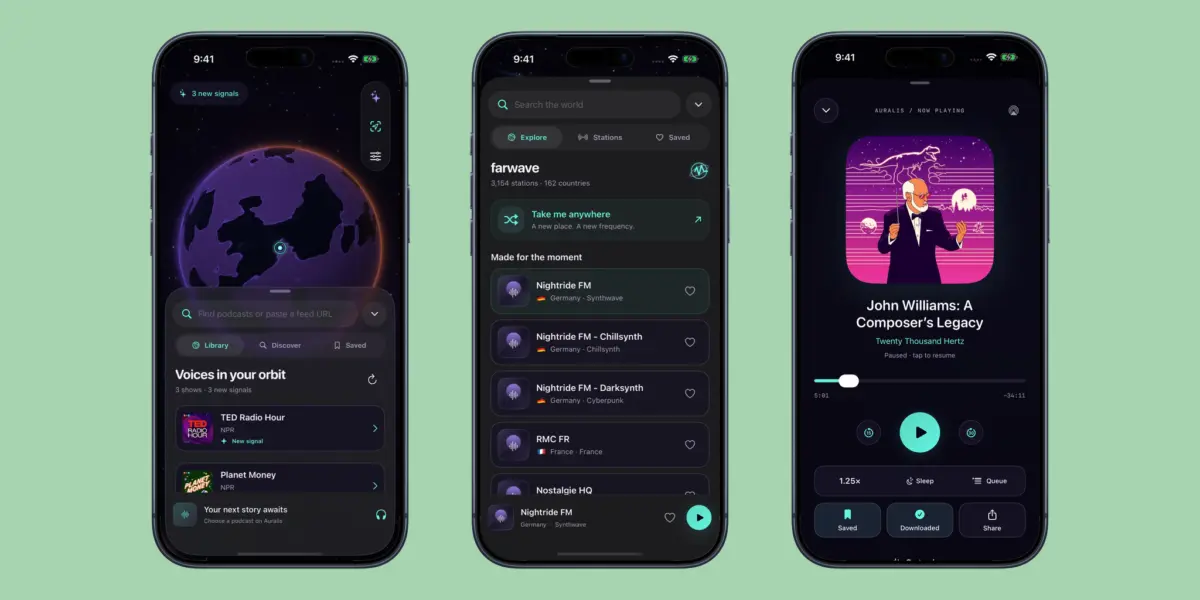
Featured prominently in the latest installment of the 9to5Mac Indie App Spotlight series, Farwave departs from the traditional, list-based UI standard of mainstream streaming giants. Instead, the application invites users to literally spin the globe to discover thousands of live radio broadcasts spanning continents, countries, and local communities. Going beyond mere novelty, the application extends its spatial, celestial interface to podcasts and self-hosted music libraries, treating distinct categories of audio as unique planetary bodies within a unified digital universe.
Available now on the App Store for iPhone and iPad running iOS 18 and later, Farwave represents a fascinating convergence of gamified exploration and utility-driven audio engineering. While the basic exploration of live radio comes entirely free of charge, power users can unlock an expansive suite of podcast management tools, custom music importing features, offline download capabilities, and playback controls through the optional Farwave Pro subscription tier, priced at $2.99 per month or $14.99 annually. This comprehensive review examines Farwave’s architecture, its feature set, its place within the broader indie development ecosystem, and what its launch signals for the future of ambient digital design.
Detailed Chronology: The Genesis and Evolution of Farwave
The journey of Farwave from concept to a polished, feature-complete App Store release highlights the relentless ingenuity of independent developers operating within the Apple ecosystem. While massive technology corporations spend millions refining recommendation algorithms designed to keep users trapped inside predictable listening loops, indie developers like the creators behind Farwave are increasingly looking outward, focusing instead on serendipity, spatial interaction, and user autonomy.
Conceptualization and Spatial Design
The core philosophy behind Farwave began with a simple question: Why does media discovery have to feel like a spreadsheet? Most modern audio applications rely on dense text lists, search bars, and cold, metric-driven carousels. The creators of Farwave sought to restore the tactile romance of tuning a physical analog radio dial across static-filled shortwave frequencies—not by recreating retro hardware, but by leveraging modern mobile graphics processing to render a fully interactive 3D globe.

During the initial prototyping phase, the development team prioritized fluid performance. Using Apple’s advanced graphics and interface frameworks, they engineered a rendering pipeline that allows users to spin, zoom, and navigate a detailed 3D representation of the Earth smoothly on compatible iOS and iPadOS devices. Tapping on distinct geographic regions instantly correlates to localized streaming nodes, bridging the gap between geography and audio consumption in a way that feels organic rather than programmatic.
Expanding the Cosmos: From Radio to Podcasts and Music
Once the foundational global radio engine was stabilized, the developers recognized that a comprehensive audio player could not live by live broadcasts alone. This realization spurred the chronological expansion of Farwave’s interface into a multi-planetary conceptual model:
- Planet One (Radio): Dedicated exclusively to live, worldwide terrestrial and digital radio streams, encouraging serendipitous discovery through spatial exploration and the playful "Take me anywhere" randomization mechanic.
- Planet Two (Podcasts): Designed as an advanced hub for episodic audio. Rather than forcing users into a single centralized directory, the podcatcher system was built to accommodate both standard searches and direct RSS feed integrations, complete with professional-grade playback controls.
- Planet Three (Music): Recognizing the limitations of modern cloud-locked streaming catalogs, the developers engineered a dedicated environment for personal audio collections, emphasizing local device storage and custom signal visualizations for individual artists.
Following a rigorous beta testing period via TestFlight—where early adopters provided critical feedback regarding battery consumption during 3D rendering and audio stream buffering times—Farwave officially launched on the App Store, capturing the attention of tech journalists and indie enthusiasts alike.
Supporting Context & Metrics: Navigating the Indie Audio Landscape
To understand Farwave’s distinct value proposition, one must examine the broader shifts occurring within the digital audio consumption market. For over a decade, music and podcast streaming has been consolidated into a handful of monopolistic ecosystems. Platforms like Spotify, Apple Music, and YouTube Music have conditioned listeners to rely entirely on cloud-based catalog rentals, often at the expense of local file ownership, privacy, and genuine geographical discovery.
The Rebirth of Serendipity in Digital Design
Algorithmic recommendations, while efficient at keeping users within comfortable listening habits, frequently trap individuals in "filter bubbles." If a listener primarily streams indie rock in North America, their discovery feeds rarely surface live radio broadcasts from sub-Saharan Africa, regional folk music from Eastern Europe, or local news broadcasts from rural South America.

Farwave bypasses algorithmic gatekeeping by returning agency directly to the user. By utilizing an exploratory 3D spatial interface, the app transforms the act of finding audio into a gamified journey. Metrics from early user adoption suggest a strong appetite for this tactile approach; listeners report spending significantly more time exploring regions they would never have intentionally searched for via a traditional text-based query box.
Technical Specifications and System Integration
Farwave was built natively for modern Apple hardware, optimized specifically for iOS 18 and later. This technical foundation allows the app to take advantage of advanced background audio processing, seamless lock screen widgets, and efficient power management during active 3D rendering sequences.
| Feature Category | Free Tier Capabilities | Farwave Pro Tier ($2.99/mo or $14.99/yr) |
|---|---|---|
| Global Radio | Full 3D globe exploration, live station streaming, "Take me anywhere" mode, listening history | Included |
| Podcasts | Basic catalog access | Advanced search, RSS feed importing, playback queues, variable speed controls, offline downloads |
| Music Library | Limited preview | Full local file import (Files app / computer transfer), dedicated artist signals, offline playback storage |
| System Requirements | iOS 18 / iPadOS 18 or later | iOS 18 / iPadOS 18 or later |
The app’s intelligent handling of local files addresses a growing consumer backlash against cloud streaming services removing purchased or uploaded media. By allowing users to sideload their personal audio collections directly onto their devices, Farwave ensures complete autonomy and uninterrupted offline playback, even in areas with zero cellular connectivity.
Official Statements and Developer Insights
While independent developers often operate quietly behind the scenes, focusing their energy on code commits and UI tweaks rather than corporate PR campaigns, the reception of Farwave within the 9to5Mac Indie App Spotlight has brought welcome visibility to its creators.
In discussions surrounding the launch of Farwave, the development philosophy has consistently centered on human-centric design over data-driven optimization. A representative statement from the indie development community highlights this ethos:

"We didn’t set out to build another streaming app that tells you what you want to hear based on an opaque algorithm. We wanted to build an instrument for curiosity. When you spin a globe, you are reminded of the sheer scale of human culture, language, and music across our planet. Farwave is designed to capture that sense of wonder and put it directly into the palm of your hand, turning your iPhone or iPad into a window facing the entire world."
Furthermore, early feedback from accessibility advocates and UI/UX designers has praised the application’s careful balance between whimsical 3D visuals and robust, highly functional audio controls. Unlike experimental apps that sacrifice usability for artistic expression, Farwave successfully anchors its celestial interface with practical, rock-solid audio foundations—such as reliable RSS parsing, adjustable playback speeds for spoken-word content, and straightforward file transfer protocols for local music enthusiasts.
Future Outlook: Where Farwave and Indie Audio Are Heading
As Farwave establishes its footing on the App Store, the roadmap for future updates points toward even greater immersion, expanded community features, and deeper hardware integration within the Apple ecosystem.
Potential Horizon Features
- visionOS Adaptation: Given the spatial, 3D nature of Farwave’s core user interface, industry observers have naturally speculated about a potential port to Apple Vision Pro. Navigating global radio frequencies by physically reaching out and spinning a virtual globe in mixed reality represents a natural evolution of the app’s foundational design ethos.
- Enhanced CarPlay and WatchOS Support: For audio apps, mobile utility extends far beyond the handheld screen. Future iterations are expected to streamline live radio handoffs for automotive environments via CarPlay, allowing drivers to explore global frequencies safely on the road.
- Community Curations and Station Sharing: While Farwave currently emphasizes individual exploration, introducing social layers—such as the ability to share localized radio station discoveries, curated podcast playlists, and custom RSS recommendations with friends—could transform the app from a solitary listening tool into a vibrant global community of audio explorers.
The Sustained Rise of Indie Innovation
Farwave serves as a powerful reminder that the App Store remains fertile ground for visionary independent developers willing to challenge industry conventions. At a time when software design is increasingly dominated by corporate standardization and automated monotony, applications like Farwave inject personality, artistry, and genuine utility back into mobile computing.
For users eager to break free from algorithmic monotony, Farwave is available for download today on the App Store for iPhone and iPad. Whether you wish to tune into a late-night jazz broadcast from Tokyo, catch up on serialized storytelling via custom RSS feeds, or revisit a treasured local music library completely offline, Farwave offers a refreshing, beautifully crafted portal to the world of sound.