Executive Overview
In the rapidly evolving landscape where consumer technology intersects with high-end professional artistry, few moments capture the imagination quite like a high-stakes, real-time creative experiment. Last week, multi-platinum singer-songwriter, producer, and composer Labrinth turned the historic Apple Tower Theatre in downtown Los Angeles into an ephemeral, nocturnal production suite. Over the course of a single evening, he crafted an entire song completely from scratch, culminating in a finished track titled “Surrender.”
What made this late-night session a watershed event for both audio engineers and technology enthusiasts alike was not merely the speed of creation, but the medium through which it was achieved. Labrinth served as the ultimate test pilot for Apple’s next-generation hardware: the touchscreen MacBook Pro equipped with the dazzling PROLED XDR Display and powered by Logic Pro 13.
The event, which was broadcast live to a global audience on YouTube, shattered traditional expectations of how producers interact with their digital audio workstations (DAWs). By leveraging the new hardware’s tactile interface, Labrinth demonstrated that the barrier between creator and software has fundamentally shifted. No longer bound exclusively to mouse clicks, physical MIDI controllers, and keyboard shortcuts, the artist was able to physically manipulate sound waves, sculpt equalization curves, and play virtual instruments directly on the glass.
Following the overwhelming response to the livestream, Apple has officially released "Surrender" on Apple Music, alongside an exclusive behind-the-scenes documentary short capturing the highlights of the Tower Theatre session. This report provides an exhaustive, multi-faceted analysis of the event, the underlying hardware innovations, the creative workflow that made it possible, and what this milestone signifies for the future of professional music production.
Detailed Chronology: A Night at
the Apple Tower Theatre
Setting the Stage: Midnight Alchemy
The historic Apple Tower Theatre—a magnificent architectural jewel in downtown Los Angeles known for its opulent French Renaissance Revival design—serves as an unorthodox backdrop for a high-tech audio engineering session. On a Wednesday evening last week, the grand interior was stripped of its typical retail presentation and transformed into a cavernous, ambient laboratory.
As the clock ticked toward midnight, Labrinth took his place at the center of the stage, flanked by cutting-edge studio monitors, acoustic treatment panels, and the centerpiece of the evening: the new touchscreen MacBook Pro. The stakes were high, and the parameters were uncompromising. The objective was simple yet daunting: conceive, write, arrange, mix, and record a fully realized, broadcast-quality song before the sun came up, all while streaming the entire process live to thousands of eager fans who chimed in with real-time questions, suggestions, and encouragement.
Phase One: Ideation and the First Touch
The session began with ambient exploration. Eschewing pre-recorded loops or heavy sample libraries, Labrinth opted to build the track’s foundation from organic and synthesized elements generated entirely on the fly.
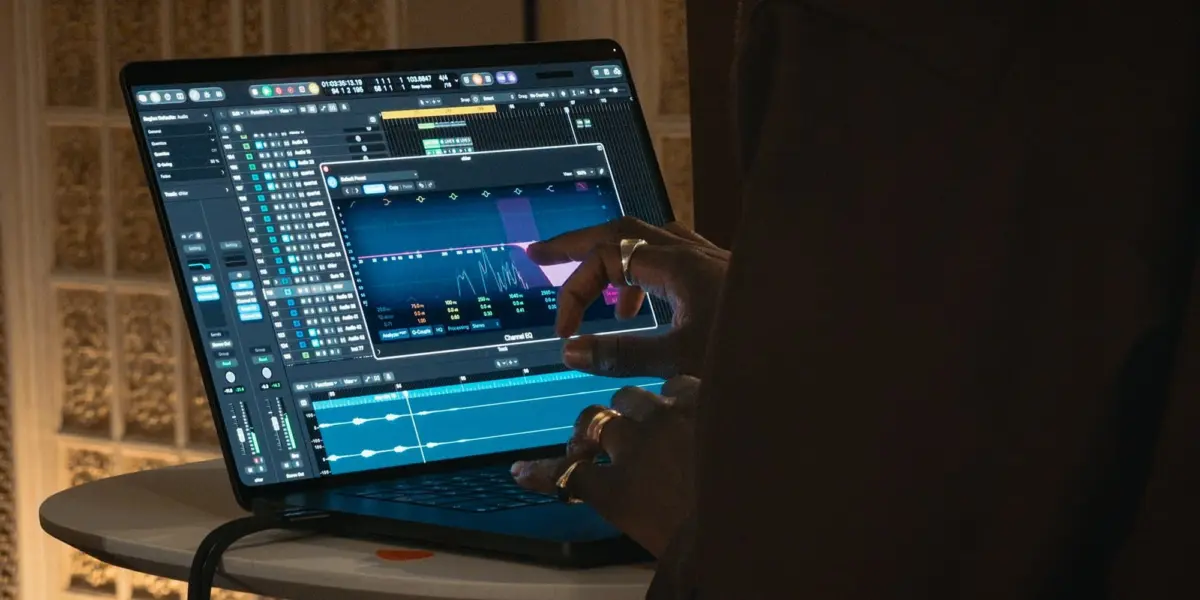
Viewers watching the YouTube livestream witnessed an immediate departure from traditional laptop-based music production. Instead of navigating menus with a trackpad, Labrinth’s hands hovered directly over the PROLED XDR Display. Utilizing the advanced touch capabilities integrated into Logic Pro 13, he began shaping EQ envelopes dynamically with his fingertips.

"I can literally touch my project now," Labrinth remarked during a brief pause in the creative flow, a sentiment that would quickly become the defining tagline of the experiment.
By mapping his fingers directly to the software interface, he was able to draw automation curves with a natural, fluid motion that mimics the feel of analog mixing consoles. The tactile feedback loop allowed him to carve out frequencies in real-time, sculpting the low-end rumble of a synthesized bass line while simultaneously tweaking filter cutoffs with his other hand—a maneuver that would historically require multiple passes or complex motorized control surfaces.
Phase Two: Sample Manipulation and Remix FX
As the clock pushed past 2:00 AM, the session shifted from foundational elements to textural experimentation. Labrinth began recording vocal snippets, ambient room noise, and percussive claps, dragging and dropping audio files directly across the touchscreen workspace.
The integration of Touch within Logic Pro 13 proved particularly potent during the manipulation of Remix FX. Traditionally controlled via a mouse or external hardware pads, Labrinth utilized the touchscreen to layer stutter effects, tape stops, and real-time filters simultaneously. His fingers danced across the glass, applying granular delays and sweeping filter modulations with an expressive precision that felt less like computer programming and more like playing an acoustic instrument.
The live chat exploded with questions as fans watched complex audio routing and spatial audio positioning executed with simple multi-touch gestures. Labrinth paused periodically to address the audience, explaining his creative choices, breaking down the mechanics of the new hardware, and maintaining an intimate, collaborative atmosphere despite the digital barrier of the livestream.
Phase Three: The Final Push and the Birth of “Surrender”
By the time the early morning hours rolled around, the sonic architecture of the track was firmly in place. What remained was the human element: the vocal performance and the final mixdown.
Standing before a studio microphone, Labrinth laid down soaring, emotive vocal takes that blended raw vulnerability with modern production aesthetics. Working at lightning speed, he comped the vocal tracks directly on the timeline using touch gestures to slice, crossfade, and align takes with seamless accuracy.
The final hours of the session were dedicated to polishing the mix. Utilizing the high-brightness, color-accurate PROLED XDR Display, Labrinth balanced levels, applied bus compression, and finalized the spatial audio parameters. As the first rays of morning light filtered through the ornate windows of the Tower Theatre, "Surrender" was officially complete—born in a single night from concept to master file.
Supporting Context & Metrics: The Hardware and Software Revolution
To fully understand the significance of Labrinth’s midnight session, one must examine the technological leap represented by the hardware and software used during the event. For decades, the professional music production community has maintained a strict division between hardware controllers (mixing boards, MIDI keyboards, pad controllers) and computing displays. The introduction of the new MacBook Pro with a PROLED XDR Display and native Touch capabilities bridges this historical divide.

The PROLED XDR Display and Touch Integration
Apple’s integration of touch technology into its flagship professional notebook line has been a subject of intense industry speculation for years. Critics and traditionalists often argued that vertical touchscreens caused ergonomic fatigue ("gorilla arm") and lacked the tactile precision required for fine-tuning professional audio and video timelines.
However, the hardware utilized in the Tower Theatre session introduces several critical advancements that neutralize these historical objections:
- Sub-Millisecond Latency: The touch interface operates with near-zero latency, ensuring that finger-drawn automation curves and instrument triggers translate instantly into the DAW without perceptible delay.
- Haptic Micro-Texturing: While the glass surface maintains its pristine clarity, advanced haptic actuators beneath the display provide subtle, physical feedback, simulating physical notches, sliders, and detents.
- PROLED XDR Brightness and Color Accuracy: Crucial for late-night studio sessions, the display offers unprecedented dynamic range and contrast, allowing producers working in dark environments to maintain visual clarity across complex multi-track timelines without eye strain.
Logic Pro 13: Tailored for Touch
Hardware is only as good as the software driving it. Logic Pro 13 was redesigned from the ground up to take full advantage of the touchscreen MacBook Pro architecture. Key features highlighted during Labrinth’s session include:
- Multi-Touch Virtual Instruments: Producers can now play complex chord voicings, drum racks, and synth leads directly on the screen, utilizing polyphonic aftertouch mapped directly to finger pressure.
- Gesture-Based Editing: Complex operations such as time-stretching, pitch correction, and crossfading can be executed using natural pinch-and-swipe gestures.
- Dynamic Mixer Views: The software intelligently adapts its UI when touch input is detected, enlarging fader caps and knobs to accommodate human fingers without sacrificing precision.
Official Statements and Industry Impact
The convergence of elite artistic talent and cutting-edge hardware generated immediate ripples across both the music and technology sectors. Apple’s official documentary short, released alongside the commercial availability of "Surrender," offers an inside look at the philosophy driving these innovations.
Apple’s Official Documentation
In the official video description accompanying the highlights reel, Apple emphasizes the liberating nature of the new workflow:
"One song. In one night. Created live on the new MacBook Pro with PROLED XDR Display and Touch.
Multiplatinum artist Labrinth transformed Apple Tower Theatre into his personal studio for the night, experimenting with new ways of making music on the new MacBook Pro.
See how Touch opens up a world of creative possibilities in Logic Pro 13: shaping EQ envelopes, manipulating samples, tweaking Remix FX, and even playing keys right onscreen."
Labrinth’s Perspective
Reflecting on the experience, Labrinth noted that the ability to physically interact with his DAW changes the emotional connection a producer has with their music. When working with a standard mouse and keyboard, the workflow is inherently analytical and abstract. By introducing touch to the production process, the barrier of abstraction is removed. Musicians can once again "play" their mixes the way a conductor guides an orchestra or a guitarist bends a string.

Industry analysts have pointed out that while traditional studio purists may take time to adapt to touchscreen workflows, the demographic of modern bedroom producers and touring artists will likely embrace the streamlined, highly portable nature of a touchscreen workstation that requires fewer peripheral devices to achieve professional results.
Future Outlook: What This Means for Producers and Consumers
The release of "Surrender" on Apple Music—now streaming for subscribers ($11.99 per month or via the Apple One bundle)—marks more than just a successful marketing campaign; it serves as a proof-of-concept for the future of creative software.
1. The Death of the Peripheral-Heavy Mobile Studio?
For touring musicians and producers who live out of suitcases, the prospect of shedding heavy MIDI controllers, external mixing pads, and specialized control surfaces in favor of an all-in-one touchscreen laptop is profoundly appealing. As developers follow Apple’s lead and optimize third-party plugins (such as synthesizers from Native Instruments, Serum, and FabFilter) for touch interfaces, the need for external gear on the road will dramatically decrease.
2. The Evolution of Live Performance and Streamed Production
Labrinth’s livestreamed creation process points toward a new era of interactive entertainment. Fans no longer want to just consume finished art; they crave access to the messy, vulnerable, and exhilarating process of creation. By broadcasting the birth of "Surrender" in real-time, Labrinth established a blueprint for artist-audience engagement that transforms product demonstrations into high art.
3. Software Development Roadmap
With Logic Pro 13 setting a new benchmark for DAW design, competitor digital audio workstations—such as Ableton Live, Pro Tools, and Steinberg Cubase—will inevitably face pressure to innovate their own touchscreen capabilities. The industry is moving inexorably toward spatial, multi-modal interfaces where sight, sound, and touch converge into a unified creative experience.
As "Surrender" climbs the streaming charts, it stands not only as a testament to Labrinth’s singular musical genius, but as a monument to a pivotal night in downtown Los Angeles when the boundary between artist and instrument dissolved forever.