Executive Overview
The digital landscape of the 21st century is littered with the ghosts of once-dominant tech brands. Among the most evocative is LimeWire—a name that, for millions of millennials, immediately evokes the chaotic, dial-up-adjacent peer-to-peer (P2P) file-sharing era of the early 2000s. Back then, LimeWire was synonymous with downloading compressed MP3s, navigating malware-laden installation wizards, and standing at the center of the fierce copyright battles that reshaped the modern music industry.
Today, however, the brand has completed one of the most improbable and radical pivots in technology history. Reborn as an advanced artificial intelligence (AI) content-publishing and monetization platform known as LimeWire Studio, the platform has entirely shed its contentious past. It has transformed into a sophisticated ecosystem designed for the generative AI age.
Rather than facilitating unauthorized music sharing, modern LimeWire empowers digital artists, musicians, designers, and everyday enthusiasts to conceptualize, generate, refine, and monetize original AI-driven media. By bridging the gap between cutting-edge generative AI models—such as Stable Diffusion and DALL-E—and decentralized Web3 infrastructure, LimeWire has carved out a distinct niche. It offers a hybrid model that combines creative tools, automated Non-Fungible Token (NFT) minting, ad-revenue sharing, and a native cryptocurrency token ecosystem ($LMWR).
This comprehensive report examines LimeWire’s technological evolution, its suite of generative features, its novel creator economy mechanics, and the strategic roadmap that aims to redefine how digital creators own and profit from their synthetic art.
Detailed Chronology: The Evolution of LimeWire
To understand the weight of LimeWire’s current positioning in the generative AI market, one must trace its trajectory from an outlaw file-sharing protocol to a legitimate Web3-enabled creator platform.
Phase 1: The P2P Pioneer (2000–2010)
Founded in 2000 by Mark Gorton, LimeWire was built on the Gnutella network, allowing users to share files directly across a decentralized peer-to-peer network. At its peak, it was one of the most popular software applications on the internet. However, its decentralized architecture made it a primary vehicle for copyright infringement, leading to a protracted and devastating legal battle with the Recording Industry Association of America (RIAA). In October 2010, a federal judge ordered LimeWire to shut down its file-sharing operations, effectively killing the original incarnation of the brand.
Phase 2: The Dormant Years & Brand Acquisition (2010–2021)
For over a decade, LimeWire remained a dormant cultural artifact. The intellectual property and domain name sat idle until the brand was acquired by Austrian entrepreneurs Julian and Paul Zehetmayr. Recognizing the immense equity and nostalgia attached to the LimeWire name, the new leadership team chose to re-envision the platform not as a relic of the past, but as a gateway to the next technological frontier: blockchain and digital collectibles.
Phase 3: The Web3 Collectibles Experiment (2022)
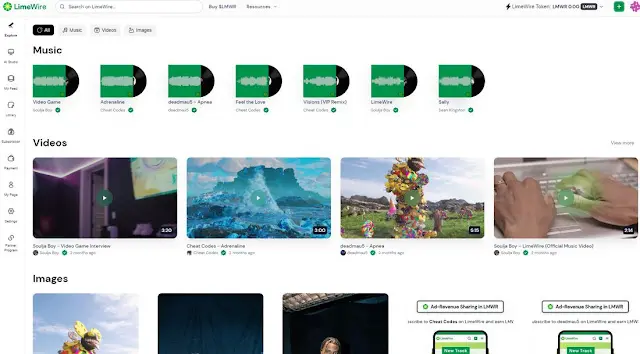
In early 2022, LimeWire re-emerged as an NFT marketplace specifically focused on music and digital art. The strategy initially targeted mainstream culture-makers, successfully onboarding high-profile musicians and artists like Deadmau5, Soulja Boy, and Sean Kingston. These creators utilized the platform to drop exclusive digital collectibles, audio tracks, and media files, establishing LimeWire’s early credibility within the Web3 community.
Phase 4: The Generative AI Transformation (2023–Present)
Recognizing that the broader creator economy was shifting rapidly toward artificial intelligence, LimeWire underwent its most profound reinvention yet. The platform integrated state-of-the-art generative image models, transitioned into an all-encompassing AI studio, launched its native utility token ($LMWR), and introduced comprehensive ad-revenue-sharing models. Today, LimeWire positions itself at the intersection of AI generation and digital asset ownership, democratizing tools that were once restricted to enterprise-level developers and specialized digital artists.
Supporting Context & Metrics: Inside the LimeWire AI Studio
At the heart of the modern platform is the LimeWire AI Studio, an intuitive workspace engineered to lower the barriers to entry for digital creation.
Advanced AI Image Generation Models
LimeWire does not rely on a single, proprietary engine; instead, it aggregates some of the industry’s most powerful open-source and commercial generative models under one unified interface. Users can seamlessly switch between:
- Stable Diffusion 2.1
- Stable Diffusion XL (SDXL)
- DALL-E 2
This multi-model approach grants creators unprecedented stylistic flexibility. Whether a user wants to generate photorealistic cinematic shots, stylized anime, intricate pixel art, retro analog film photography, or clean digital illustrations, the platform’s underlying architecture adapts instantly.
Furthermore, LimeWire incorporates advanced parameter controls—such as samplers, negative prompts, upscale tools, and prompt guidance sliders—allowing both novice hobbyists and professional graphic designers to fine-tune their outputs with surgical precision.
The Automated NFT Minting Pipeline
One of LimeWire’s most innovative features is its frictionless approach to blockchain integration. When a user generates an image or piece of media and decides to publish it, LimeWire automatically mints the creation as a Non-Fungible Token (NFT) on high-throughput, energy-efficient blockchains: Polygon or Algorand.
This automated minting process requires zero technical knowledge of smart contracts or gas fee optimization on the part of the creator. Once minted, the asset receives a permanent digital signature, guaranteeing authenticity, provenance, and verifiable ownership. Creators then have absolute autonomy over how their digital asset is distributed:
- Public Release: The content is published to the public feed, where it can be discovered, admired, and traded by the wider LimeWire community.
- Subscriber-Only Access: Creators can lock their content behind a paywall, offering exclusive media solely to their dedicated, paying subscribers.
Official Economic Models: Monetization and the $LMWR Token
Unlike traditional social media networks or static AI generators where platforms reap the vast majority of financial rewards, LimeWire has engineered a multi-tiered creator economy designed to put revenue directly back into the pockets of artists.
1. The Ad-Revenue Sharing Model
LimeWire shares advertising revenue generated from user views directly with the creators. When other platform members view a creator’s published images, music, or videos, 70% of the ad revenue generated from those views is funneled back to the creator. This creates a sustainable passive income stream for active designers and digital artists.
2. The $LMWR Utility Token
Financial transactions, rewards, and ecosystem incentives on LimeWire are powered by $LMWR, the platform’s native ERC-20 utility cryptocurrency.
- Monthly Payouts: Creator earnings—whether derived from ad revenue or secondary market trading royalties—are disbursed monthly in $LMWR tokens.
- Exchange Liquidity: These tokens can be easily withdrawn and traded on major global cryptocurrency exchanges, including Kraken, ByBit, and Uniswap.
- Platform Utility: Users can also utilize $LMWR tokens to purchase additional AI generation credits, pay for prompt generation, and access exclusive community features.
3. Secondary Market Royalties
When a user purchases or trades a creator’s NFT digital collectible on the LimeWire marketplace, the original creator automatically receives a 2.5% royalty fee on every subsequent transaction. This establishes a perpetual revenue mechanism reminiscent of high-end fine art markets.
4. Subscription Tiers and Pricing Structure
LimeWire operates on a freemium model that scales with user demand. The platform offers a free entry point alongside several robust subscription tiers:
- Free Tier:
- Cost: $0 / month
- Perks: 10 daily credits (approx. 20 image generations per day), 50% ad revenue share.
- Basic Tier:
- Cost: $9.99 / month
- Perks: 1,000 monthly credits (up to 2,000 image generations), early access to new AI models, 50% ad revenue share, Pro profile badge, faster processing, and an ad-free experience.
- Plus Tier:
- Cost: $29 / month
- Perks: 3,750 monthly credits (up to 7,500 image generations), early access to new models, 60% ad revenue share, Pro profile badge, full creation history, and faster generations.
- Advanced Tier:
- Cost: $49 / month
- Perks: 5,000 monthly credits (up to 10,000 image generations), early access, 70% ad revenue share, Pro profile badge, full history, and priority processing.
- Elite Tier:
- Cost: $99 / month
- Perks: 11,250 monthly credits (up to 22,500 image generations), early access, 70% ad revenue share, Pro profile badge, priority rendering queue, and complete ad-free functionality.
Future Outlook
LimeWire’s evolution from an illicit file-sharing protocol to a regulated, Web3-integrated generative AI studio is a masterclass in strategic rebranding and technological adaptation. By identifying the convergence of synthetic media generation and digital asset ownership early, the platform has positioned itself uniquely in a crowded marketplace dominated by standalone tools like Midjourney, OpenAI’s DALL-E 3, and Stability AI.
However, challenges remain. The generative AI market is hyper-competitive, and user loyalty is notoriously fickle. LimeWire must continually upgrade its underlying infrastructure to keep pace with rapid advancements in neural network capabilities.
Crucially, the platform’s future roadmap holds ambitious expansion plans that extend far beyond static 2D imagery. LimeWire is actively developing proprietary AI models alongside upcoming suites for AI music and video generation. The introduction of video and audio generation tools will transform LimeWire from an image-centric utility into a comprehensive multimedia powerhouse, enabling musicians and filmmakers to produce fully synthesized audiovisual assets under one roof.
As the lines between human creativity and machine generation continue to blur, LimeWire’s vision of a decentralized, democratized, and financially rewarding creator economy offers a compelling glimpse into the future of digital art. For creators looking to experiment with generative AI while retaining true ownership—and monetization potential—over their digital footprint, LimeWire Studio stands as a multifaceted platform well worth watching.