Executive Overview
It was not so long ago that the very mention of Victoria’s Secret and its globally broadcast, feather-plumed fashion show served as a cultural shorthand for institutionalized misogyny, punishing body standards, and tone-deaf exclusivity. For decades, the brand was a bastion of patriarchal objectification—a multi-billion-dollar machine built on the premise that female desirability was a narrow, unattainable formula.
However, the cultural reckoning of the late 2010s dealt a severe blow to the lingerie giant. Battered by a cascading series of catastrophic public relations scandals—most notably the profound and documented ties of its former leadership to convicted sex offender Jeffrey Epstein—the brand imploded. The iconic, glitter-soaked Victoria’s Secret Fashion Show was unceremoniously put on hiatus between 2019 and 2024, leaving an institutional vacuum while the company scrambled to orchestrate an aggressive, multi-year rehabilitation strategy.
Yet, as the brand re-emerges on the global stage, it has done so against a deeply paradoxical backdrop: the broader luxury and high-fashion industry has suffered a regressive, unashamed relapse into the worship of hyper-thinness. In an era dominated by GLP-1 weight-loss medications, algorithmic body-shaming, and a lean toward uncompromising aesthetic uniformity, high fashion has effectively discarded its half-hearted flirtations with body positivity. Recent data tracking runway representation confirms that contemporary catwalks are experiencing their leanest seasons on record.
In a cruel twist of cultural irony, the modern Victoria’s Secret—once the villain of body image discourse—now finds itself looking comparatively progressive. While far from a radical utopian space, the brand’s contemporary iterations offer a fascinating case study in corporate survival, strategic inclusivity, and the evolving psychology of modern consumer desire.
Detailed Chronology: The Fall and Rise of an Icon
The Peak and Peril (Pre-2019)
At its zenith, the Victoria’s Secret Fashion Show was a pop-culture juggernaut, drawing tens of millions of viewers worldwide. Yet, beneath the sparkling wings and pyrotechnics lay an increasingly toxic corporate culture.
The turning point for public tolerance came in late 2018. During a now-infamous interview with Vogue, Ed Razek, then-Chief Marketing Officer of parent company L Brands, bluntly defended the brand’s rigid casting criteria. Razek stated that the show was a "fantasy" and explicitly asserted that casting transgender or plus-size models would disrupt that illusion.
This overt gatekeeping, combined with toxic workplace allegations and the revelation of former CEO Les Wexner’s close financial and personal associations with Jeffrey Epstein, proved to be an insurmountable public relations crisis. Sales plummeted, cultural relevance evaporated, and in 2019, the plug was pulled on the fashion show.
The Wilderness Years and PR Rebuild (2019–2024)
During its five-year hiatus, Victoria’s Secret underwent a radical corporate restructuring and identity overhaul. The "Angels"—traditionally defined by towering heights and uniform, zero-waist proportions—were ostensibly retired. In their place, the company formed the "VS Collective," a rotating board of diverse, accomplished women spanning activism, sports, the arts, and varied body types, tasked with advising the brand on its new direction.
Crucially, the brand quietly began altering its casting blueprint. In 2019, Brazilian model Valentina Sampaio was hired as the brand’s first openly transgender campaign model. Simultaneously, the company expanded its size range, introduced mastectomy bras, and reframed its marketing language away from dictating what women should look like toward a softer, more generalized discourse of "support" and "empowerment."
The Triumphant, Complex Return (2025–2026)
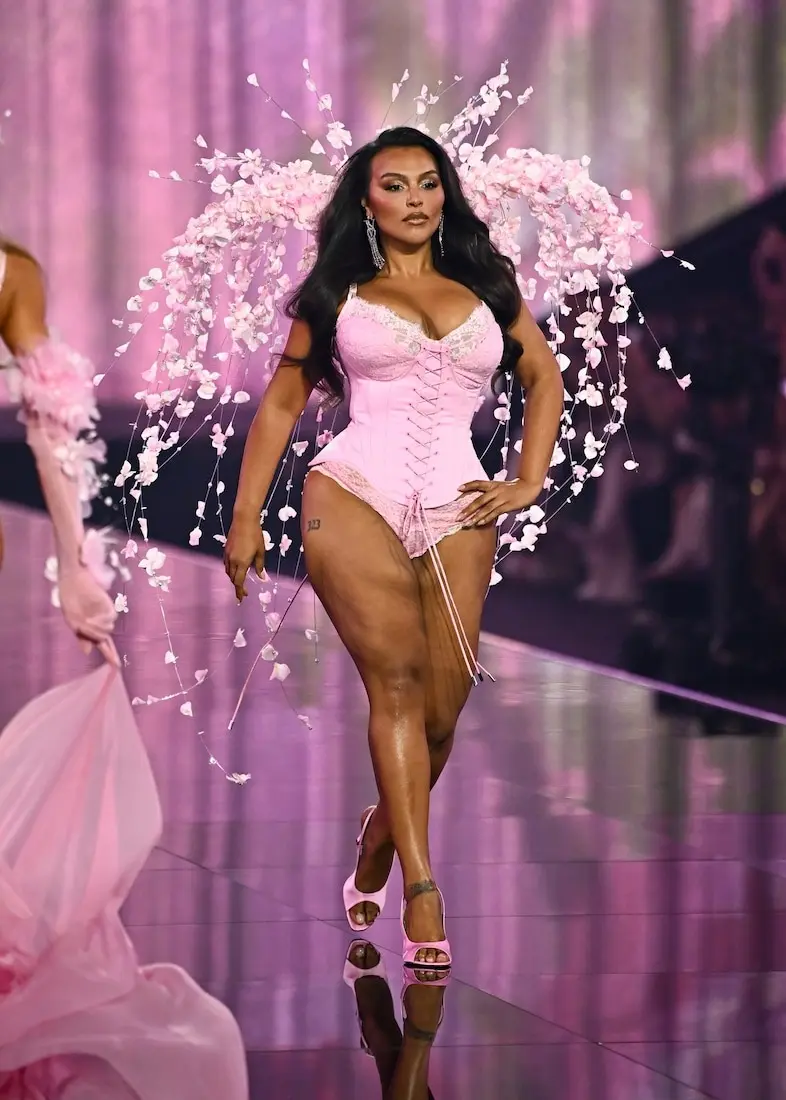
When the Victoria’s Secret Fashion Show officially returned, it was met with a mixture of cynicism, curiosity, and reluctant fascination. The runway featured pioneering trans model Alex Consani—making her third consecutive appearance—alongside high-profile plus-size icons like Ashley Graham, Precious Lee, and Devyn Garcia.
Yet, the brand could not completely divorce itself from its opulent heritage. The show made headlines globally with the return of the legendary multi-million-dollar Fantasy Bra, worn during a theatrical debut by cultural mega-influencer Kylie Jenner. It was a clear signal that while Victoria’s Secret wanted the moral glow of inclusivity, it was fundamentally still a purveyor of high-octane luxury and elite fantasy.
Supporting Context & Metrics: The High-Fashion Regression
To understand the cultural positioning of Victoria’s Secret in 2026, one must examine the broader landscape of the luxury fashion industry, which has undergone a chilling aesthetic conservative shift.
For a brief window following the body-positivity movements of the mid-to-late 2010s, high fashion made tentative strides toward demographic representation. Brands began casting mid-size and plus-size models, and runway diversity was celebrated as a progressive industry standard. However, this momentum has decisively shattered.
+--------------------------------------------------------------------------+
|             2026 RUNWAY REPRESENTATION METRICS (VOGUE BUSINESS)          |
+--------------------------------------------------------------------------+
|  High-Fashion Runways:                                                   |
|  - Plus-Size Representation: Historic lows (near zero across major       |
|    Paris/Milan houses).                                                  |
|  - Aesthetic Dominance: Complete resurgence of rigid, ultra-thin         |
|    standards, amplified by GLP-1 cultural saturation.                    |
+--------------------------------------------------------------------------+
|  Victoria's Secret Fashion Show:                                         |
|  - Plus-Size Representation: ~10% (Featuring Ashley Graham, Precious     |
|    Lee, Devyn Garcia, Paloma Elsesser).                                  |
|  - Trans Representation: Multi-year continuity (Alex Consani,            |
|    Valentina Sampaio).                                                   |
+--------------------------------------------------------------------------+
According to longitudinal tracking data published by Vogue Business, the international fashion weeks of the current cycle have recorded the lowest levels of plus-size representation since monitoring began in 2023. In an era saturated by the widespread cultural normalization of GLP-1 weight-loss drugs and a return to hyper-disciplined, "fascist" lean aesthetics, prestige fashion houses have effectively retreated into total exclusivity.
By comparison, the Victoria’s Secret Fashion Show—with its roughly 10% plus-size representation and intentional casting of racially diverse and trans trailblazers—appears almost revolutionary. Seeing figures like Alex Consani, Anok Yai, and Paloma Elsesser command the same stage is no longer just a clever casting trick; in the frostier climate of 2026 high fashion, it functions as a distinct moral beacon.
Official Statements & Industry Perspectives
The dichotomy between corporate intent and consumer reception has generated widespread debate among cultural critics, feminists, and industry insiders.
In corporate communications, Victoria’s Secret executives maintain that the brand’s transformation is absolute and permanent. Representatives emphasize that the modern customer demands authenticity, validation, and representation across every facet of the brand’s ecosystem—from digital storefronts to physical runways.
However, cultural analysts remain deeply divided.
“The VS show’s strategic rebrand has, perhaps, stumbled on something important. Many women have grown tired of watching women suffer, and of attaching themselves to brands that are bywords for that suffering.”
This sentiment underscores a growing weariness among female consumers. For decades, aspiration in fashion was inextricably linked to physical deprivation and emotional distress. The modern consumer, exhausted by the relentless demands of wellness culture and aesthetic perfection, is increasingly repelled by brands that market joy exclusively through the lens of suffering.
Conversely, skeptics argue that the rebrand is merely cosmetic capitalism at its finest. Critics note that the fundamental mechanics of the show remain unchanged: it continues to monetize an impossible, highly commercialized fantasy of femininity, backed by billionaire wealth and elite celebrity endorsements.
Future Outlook: Can Inclusion Survive the Fantasy?
As Victoria’s Secret navigates its second life in the cultural mainstream, the critical question remains: Is this new era of inclusivity a permanent evolution, or is it merely a temporary insurance policy against irrelevance?
The tension at the heart of the brand is emblematic of a broader cultural puzzle. On one hand, it is easy to dismiss Victoria’s Secret as corporate machinery designed to sell undergarments to young consumers. On the other hand, the brand’s calculated pivot proves a vital counter-intuitive marketing truth: inclusion can sell, even within spaces historically built on rigid exclusion.
The psychological appeal of the modern Victoria’s Secret show lies not necessarily in raw sex appeal, but in a strange kind of theatrical comfort. The feathers, the wings, and the soft-focus glamour present an alternative fantasy—one where vulnerability, rest, and intimacy are celebrated rather than punished. Crucially, this fairy-world fantasy only resonates today because it has expanded its gates. When trans women, plus-size models, and dark-skinned women are permitted to inhabit the dreamscape, the fantasy becomes accessible rather than exclusionary.
Meanness has long been a reliable engine for the fashion and beauty industries, generating sales through insecurity and longing. Yet, history demonstrates that meanness has a strict expiration date.
The lasting legacy of Victoria’s Secret’s 2026 renaissance may ultimately serve as a warning shot to the wider luxury fashion market: the public is growing fundamentally impatient with institutions that demand physical and emotional suffering as the price of admission. If high fashion wishes to survive the cultural fatigue of hyper-thinness, it may need to take a cue from its former adversary and remember that true aspiration must never come at the cost of humanity.