Executive Overview
In the wake of a cultural reckoning that has fundamentally reshaped powerful white-collar industries—from Hollywood boardrooms and Capitol Hill offices to high-profile newsrooms—a quieter, yet equally pervasive crisis of workplace misconduct has long persisted in blue-collar and corporate service environments. Telecommunications giant Comcast is currently facing intense scrutiny as former call center employees step forward to allege systemic sexual harassment, profound institutional failure, and calculated corporate retaliation.
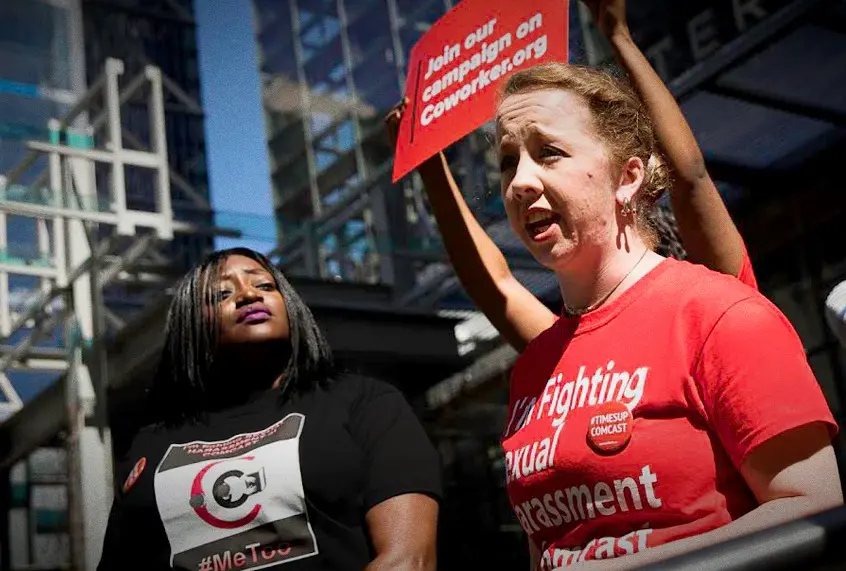
The movement reached a critical juncture when former Comcast sales representative Laterrica Perry, alongside fellow former dispatch representative Rylinda Rhodes, traveled to the company’s corporate headquarters in Philadelphia. There, they attempted to deliver a petition hosted on Coworker.org boasting more than 4,000 signatures. The petition demands that Comcast Chief Executive Officer Brian Roberts take decisive action to eradicate a culture of impunity surrounding sexual misconduct and to protect employees who report abuse.
For years, the national dialogue surrounding workplace harassment has spotlighted elite, high-profile figures. However, the unfolding situation at Comcast exposes a systemic vulnerability among front-line workers—disproportionately women of color—whose grievances are frequently obscured by corporate bureaucracy, stifled by unsupportive human resources departments, and met with swift, punitive retaliation. Despite encountering locked doors at corporate headquarters, these women are refusing to be silenced, aiming to dismantle a system that they argue failed to protect them and continues to endanger others.
Detailed Chronology: A Timeline of Allegations and Retaliation
The harrowing experiences recounted by former Comcast employees highlight a systemic pattern wherein victims of sexual harassment find themselves targeted by management rather than protected by it.
The Case of Laterrica Perry
In July 2017, Laterrica Perry, then a 30-year-old sales representative at a Comcast facility in Memphis, Tennessee, made the courageous decision to file an anonymous report with the company’s Human Resources department. Armed with concrete evidence—including inappropriate text messages and phone call logs—Perry detailed a persistent pattern of unwanted sexual advances, lewd comments, and predatory behavior exhibited by her direct supervisor.
Rather than experiencing immediate relief, Perry claims she was subjected to swift retaliation for rebuffing her boss’s advances. Her supervisor allegedly weaponized his authority, denying her essential sick leave and withholding a critical letter of recommendation necessary for career advancement.
Compounding the distress, Perry asserts that Comcast’s HR department dragged its feet, failing to terminate the offending supervisor until October 2017—months after the initial report. During this agonizing interim, she alleges that the supervisor actively worked to tarnish her professional reputation within the company.
The psychological toll of the harassment and subsequent retaliation proved devastating. Perry was diagnosed with post-traumatic stress disorder (PTSD) and was forced onto disability leave through March 2018. The prolonged absence triggered a precipitous drop in her income, compelling her to take a severe financial hardship withdrawal from her 401(k) retirement account merely to stay afloat.
"I’ve been having regular therapy sessions, my psychiatrist helps, and being medically regulated has helped me for the most part," Perry shared.
Her ordeal culminated in April 2018 when she learned, quite by accident, that Comcast had officially terminated her employment. Waiting for a standard separation package, Perry received an abrupt email on April 30 confirming her dismissal.
"The only information I got was via email saying that they had proceeded with the actual separation, but I didn’t get the actual package that showed why I was separated," Perry explained. "I received everything, as far as my COBRA coverage, my 401(k) information. The only thing that I had not received is the explanation for my termination. I kind of felt like that was something suspicious."
The Case of Rylinda Rhodes
Parallel to Perry’s struggle is the ongoing crusade of Rylinda Rhodes, a former dispatch representative who worked across four separate Comcast call centers between 2007 and 2012. Rhodes alleges she faced severe verbal and physical sexual harassment throughout her tenure, enduring toxic environments in nearly every facility she served.
The breaking point for Rhodes occurred when a co-worker allegedly entered her office and physically groped her breasts. When she formally reported the incident, the response from management was dismissive and hostile. Rhodes states that she was routinely gaslit by supervisors who labeled her "too sensitive" or a "prude," eroding her self-esteem and leading her to internalize the blame.
"The shame and embarrassment came from feeling powerless that this happened," Rhodes recalled. "I listened to what my supervisors and managers said, like, ‘Hey, you’re sensitive,’ and I started believing that I was the problem. That was one of the hardest things to go through. Then I realized, ‘No, you are not too sensitive,’ ‘No, you’re not a prude.’… There are rules set in place to prevent this, and they did not follow the rules."
During an investigation into her claims, Rhodes was instructed by management to apply for other jobs. She subsequently went on short-term medical leave to seek talk therapy for trauma induced by the workplace environment. On August 1, 2012, while still grappling with the fallout, Rhodes was terminated from Comcast under the official guise of health reasons. She has since filed a formal lawsuit against the telecommunications conglomerate.
Supporting Context & Metrics: Blue-Collar Vulnerability and the #MeToo Movement
The public reckoning sparked by the #MeToo movement has successfully dismantled the careers of numerous powerful men in elite sectors. Yet, labor experts and advocates emphasize that sexual harassment is equally, if not more, prevalent in lower-wage, blue-collar, and corporate service sectors—environments where employees often lack union representation or the financial cushion to withstand job loss.
Data from the U.S. Equal Employment Opportunity Commission (EEOC) highlights the scope of the issue. Between 2005 and 2015, approximately 1,200 formal charges of sexual harassment were filed within the information industry alone—a sector encompassing telecommunications titans like Comcast.
Unlike executive suites where perpetrators possess high public visibility, call center environments often feature isolated workspaces, intense performance metrics, and rigid hierarchies. These conditions give middle management disproportionate power over the livelihoods of customer service and sales representatives. For women of color, who make up a significant portion of the front-line workforce in these facilities, reporting misconduct frequently carries an amplified fear of reprisal, economic destabilization, and institutional alienation.
When Perry and Rhodes launched their petition campaign in November 2017—coinciding with the apex of national conversations surrounding workplace abuse—they tapped into a deeply suppressed well of frustration. Their online petition on Coworker.org rapidly accumulated over 4,000 signatures, drawing support from sympathetic customers, current employees, and more than 100 individuals identifying as former Comcast workers who shared similar tales of institutional indifference.
Official Statements and Corporate Response
Comcast, which also owns media giant NBCUniversal, has faced intense scrutiny regarding corporate culture across its various subsidiaries. Beyond the allegations within its call center divisions, the broader NBCUniversal family has weathered a series of high-profile #MeToo scandals. These include the firing of Today show host Matt Lauer following allegations of sexual misconduct, as well as subsequent accusations leveled against veteran news anchor Tom Brokaw.
In response to the mounting pressure from former call center employees, Comcast has maintained a strict stance emphasizing zero tolerance for misconduct. Addressing initial reports published by Jezebel and Salon, Jenni Moyer, Senior Director of Corporate Communications at Comcast, issued a definitive statement:
"Sexual harassment, or harassment of any kind, is not tolerated at Comcast. The company was founded on a foundation of respect, integrity and trust. We have strong policies against sexual and other forms of harassment and encourage employees to report any harassing behavior. Any allegation of harassment is taken very seriously."
Despite these assurances of strict protocols and thorough internal investigations, the lived experiences of employees like Perry and Rhodes paint a starkly contrasting picture. When the women, accompanied by supporters, arrived at Comcast’s Philadelphia corporate headquarters to hand-deliver their petition to CEO Brian Roberts, corporate executives declined to meet with them.
Rather than viewing the rebuff as a total defeat, Rhodes framed the action as a necessary milestone. "It’s still a win," she stated. "It lets them know people are watching and coming forth. It’s also for the ones that are still suffering. To know they are not alone. We are just getting started. All women should have the freedom to be their authentic self and not a scared version because of sexual harassment."
Future Outlook: Accountability, Advocacy, and the Road Ahead
As this high-stakes labor and civil rights issue continues to unfold, the long-term impact of Perry and Rhodes’ activism remains a point of divergence between the two women, though their commitment to empowering others is absolute.
Rhodes remains cautiously optimistic that public pressure and collective organizing can compel Comcast to reevaluate and overhaul its internal compliance and HR procedures. She recalls fondly the positive atmosphere of her very first Comcast location—proving, in her view, that a healthy corporate culture is achievable if leadership actively commits to structural reform.
Conversely, Perry harbors deep skepticism regarding Comcast’s willingness to voluntarily alter its internal mechanisms of accountability. "I have doubts that Comcast will be open to meeting with us and be open to resolving the issue that they have with sexual harassment," she remarked.
Nevertheless, neither woman regrets stepping forward. By breaking the silence, they view themselves as catalysts for a broader cultural shift that extends far beyond the telecommunications sector.
"What I’m doing is giving a voice to the voiceless. I’m also empowering people to step forward and say if something happens to them, whether it be at Comcast or any other corporation… That’s my silver lining," Perry stated, outlining her future plans to establish support networks and resource guides for victims of corporate retaliation.
For Rhodes, the ultimate victory lies in reaching even a single isolated worker trapped in a cycle of shame and self-blame. "The most important thing about this is sharing this to give hope to whoever is out there that feels lost, that feels like it was their fault, that feels shame and blame," Rhodes concluded. "I want them to know it is not their fault and that there are things that they could do to feel better and to be better. This does not have to define the rest of their lives."
As corporate America continues to grapple with the demands for true accountability, the courage of these former Comcast employees serves as a powerful reminder that the fight against workplace harassment and institutional retaliation must encompass every tier of the workforce—ensuring that front-line service workers enjoy the same protections, dignity, and justice as those in the nation’s most visible boardrooms.