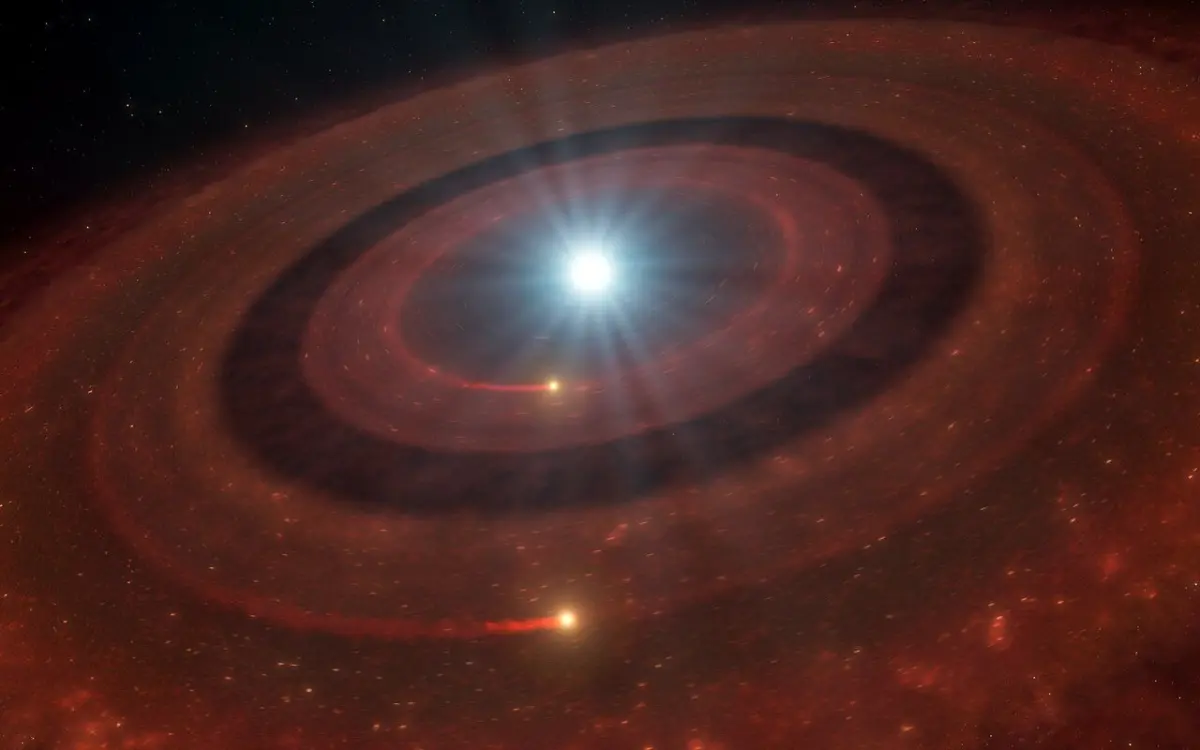
Astronomers utilizing the European Southern Observatory’s (ESO) Very Large Telescope have captured unprecedented images of a celestial graveyard, revealing a planetary system caught in the final, violent stages of cosmic dissolution. Located approximately 1,600 light-years from Earth, a dying white dwarf star designated J1328–1450 is encircled by an extraordinarily complex configuration of debris: two distinct, glowing rings of gas and dust separated by a stark, silent gap.
According to researchers, these dual rings are not merely random cosmic clutter; they are the obliterated remains of planetary bodies that once orbited the star in an orderly, stable system much like our own. As J1328–1450 transitioned from a luminous main-sequence star into an inflated red giant and finally collapsed into a dense, faint white dwarf, its gravitational and thermal tantrums tore its inner planets apart.
This groundbreaking discovery offers the scientific community a rare, observational window into the mechanics of planetary death. More hauntingly, it provides a functional crystal ball for humanity. By studying J1328–1450, astrophysicists are looking at a hauntingly accurate blueprint of what our own solar system will look like roughly 5 billion years from now, when our Sun exhausts its nuclear fuel and stages its own theatrical exit from the cosmos.
Detailed Chronology: The Life, Death, and Rebirth of a Star System
To understand the significance of J1328–1450, scientists must trace the epic, multi-billion-year timeline of stellar evolution and the collateral damage inflicted upon any worlds unlucky enough to orbit the dying star.
Phase I: The Golden Age of Stability
Eons ago, long before astronomers turned their instruments toward J1328–1450, the star existed as a stable, hydrogen-burning main-sequence star—much like our current Sun. It presided over a fully realized planetary system. Rocky inner worlds likely hugged the star’s warmth, while gas giants and distant icy bodies traced predictable, safe orbits through the cosmic dark. For billions of years, this system operated in a state of dynamic equilibrium, entirely unaware of the ticking clock at its center.
Phase II: The Red Giant Cataclysm
Every star eventually faces an existential crisis when it consumes the hydrogen fuel in its core. As nuclear fusion shifts to heavier elements, the star begins to swell dramatically, ballooning into a red giant.
During this bloated phase, J1328–1450 would have expanded outward, swallowing or violently stripping the atmospheres of its closest planets. The intense stellar winds and shifting gravitational tides disrupted the orbits of surviving outer worlds, destabilizing the system and throwing the remaining rocky bodies into erratic, cross-firing trajectories.
Phase III: Collapse and the Birth of the White Dwarf
Having shed its outer layers into the surrounding interstellar medium, the core of J1328–1450 collapsed under its own immense weight. It settled into a white dwarf—an Earth-sized ember of degenerate matter so dense that a single teaspoon of its material would weigh as much as an elephant on Earth.
Yet, the death of the star did not mean peace for its surviving fragments. As the white dwarf exerted powerful tidal forces, any rocky bodies or dwarf planets that strayed too close were ripped asunder, their pulverized remains stretching out into a chaotic, flattened disk of gas and dust.
Phase IV: The Formation of the Dual Rings
Most white dwarf debris disks observed by astronomers appear as uniform, continuous rings or disks of material. J1328–1450, however, defies this standard. The debris has organized itself into two distinct rings separated by a mysterious, clean gap. This unusual morphology points to an ongoing, active shaping process—suggesting that unseen gravitational sculptors are still at work within the ruins of the system.
Supporting Context & Metrics: Unlocking the Physics of Stellar Corpses
The study of polluted white dwarfs—stars that show heavy elements like iron, magnesium, and silicon in their spectra—has become one of the fastest-growing fields in modern astrophysics. For decades, scientists knew that white dwarfs frequently consume planetary material, evidenced by the chemical "pollution" stamped into their starlight. However, capturing the actual structural architecture of that material in high resolution is a monumental technological leap.
The Anatomy of J1328–1450
Distance from Earth: ~1,600 light-years.
Stellar Classification: White dwarf (the remnant core of a dead star).
Key Feature: Two distinct circumstellar rings of gas and dust separated by a clear spatial gap.
Instrument Used: ESO’s Very Large Telescope (VLT), located in the Atacama Desert of Chile.
Primary Hypothesis: The dual-ring structure is shaped by the gravitational influence of at least two surviving planetary-mass objects—one inner body measuring a few kilometers across, and a larger, outer body comparable in size to Pluto or Earth’s Moon.
The "Ghost Planet" Theory
The presence of the gap between the two debris rings has forced astrophysicists to consider a fascinating alternative hypothesis. Rather than simply being passive dust, the rings’ architecture strongly implies the existence of surviving subterranean or outer-orbit bodies that act as gravitational "shepherds"—much like the moons of Saturn carve pathways and gaps within the planet’s ring systems.
Alternatively, some researchers suggest the dual-ring structure could represent the differentiated layers of a single, massive planet torn apart by tidal forces. If a large differentiated body (possessing a distinct iron core and a silicate mantle/crust) was systematically dismantled by the white dwarf’s gravity, its various compositional layers might settle into separate orbital resonances, creating distinct rings of dust based on density and material composition.
Official Statements and Expert Insights
The discovery, published following intensive observations by the European Southern Observatory, has sent ripples through the astronomical community.
Dr. Elena Vasquez, a computational astrophysicist specializing in stellar evolution, emphasized the rarity of the observation during a briefing on the finding:
"What we are looking at with J1328–1450 is the ultimate forensic evidence of planetary destruction. For years, we could detect the chemical signatures of dead worlds falling onto white dwarfs, but seeing the physical architecture of the aftermath—these pristine, separated rings—gives us temporal resolution we’ve never had before. It tells us that stellar death is not a clean sweep; it is a messy, drawn-out process where planets and fragments fight for orbital survival to the very end."
Meanwhile, lead researchers at the ESO highlighted the technological triumph required to image the system. Because white dwarfs are intrinsically faint compared to main-sequence stars, capturing the subtle, scattering light of dust rings 1,600 light-years away pushes modern optics to their absolute limits.
Project coordinator Marcus Vance noted:
"The Very Large Telescope’s adaptive optics allowed us to peer through atmospheric distortion with unprecedented clarity. Finding that these rings are dynamically separated changes our models. It forces us to ask: Can planetary systems truly retain stable survivors even after their host star transforms into a white dwarf? If the answer is yes, it redefines our understanding of planetary resilience."
Future Outlook: A Glimpse into Our Own Deep Future
While the observations of J1328–1450 offer breathtaking insights into stellar mechanics, they also serve as a profound philosophical and existential reminder of our place in the universe.
In approximately 5 billion years, our Sun will deplete the hydrogen reserves powering its core. It will swell into a crimson giant, expanding outward past the orbits of Mercury and Venus, and very likely scorching Earth into a barren, lifeless cinder. Oceans will boil away, the atmosphere will strip away into space, and our planetary home will be rendered unrecognizable.
Eventually, the Sun will shed its outer envelopes, casting off gorgeous planetary nebulae into the void, leaving behind a glowing white dwarf roughly the size of Earth. According to the data coming out of J1328–1450, whatever rocky fragments or outer dwarf planets survive that blistering expansion may be systematically sheared apart, settling into a cold, glowing debris disk that orbits the corpse of our once-mighty Sun.
Next Steps in Astronomical Research
With the successful imaging of J1328–1450, the scientific community is already planning follow-up campaigns. Researchers intend to use the upcoming Extremely Large Telescope (ELT)—currently under construction in Chile—to gather even higher-resolution spectroscopy of the rings. By analyzing the precise chemical composition of the dust and gas, astronomers hope to determine whether the destroyed worlds were rich in water, carbon, or heavy metals, giving us a chemical profile of ancient, vanished solar systems.
As humanity looks out across the 1,600 light-years separating us from J1328–1450, we are not merely observing a distant stellar anomaly. We are looking directly into our own deep-time mirror—studying the ghost of our solar system’s future, written in dust, gas, and starlight.