Executive Overview
The landscape of international cybercrime has been jolted by a series of high-profile law enforcement actions, internal digital betrayals, and unprecedented escalations in extortion targets. At the epicenter of this tectonic shift is a teenager from Amman, Jordan, suspected of leading the prolific data theft and extortion syndicate known as ShinyHunters. Identified in security research circles by the hacker handle “Rey,” the suspect—legally named Saif Al-din Khader—has reportedly been detained by Jordanian authorities and is actively cooperating with the Federal Bureau of Investigation (FBI).
The dragnet closing in on Khader coincides with a period of extreme volatility for the ShinyHunters brand. The syndicate recently attempted to extort a navigation and digital aviation business unit divested by global aerospace titan Boeing. This aggressive move triggered immediate, high-priority intervention from U.S. federal law enforcement.
Compounding the chaos, parallel investigations in Europe have led to the dramatic arrest of a Dutch national previously hailed as a reformed hacker, with explosive new allegations tying him to international murder-for-hire plots. As the modern iterations of ShinyHunters splinter under the weight of coordinated global policing, leaking internal chats, and the weaponization of zero-day exploits, the mythos of the untouchable cybercriminal collective is rapidly collapsing.
Detailed Chronology of Events
The Fall of "Rey" and the Boeing Connection
The unravelling of Saif Al-din Khader accelerated in late September and early October 2026. On October 3, Reuters cited three intelligence and law enforcement sources confirming that Khader had been detained in Amman and was assisting the FBI. Investigative reporting by KrebsOnSecurity had previously unmasked Rey in November 2025, revealing his administrative role within various ransomware and data-theft ecosystems, including past affiliations with factions colloquially tracked as "Scattered Lapsus Hunters."
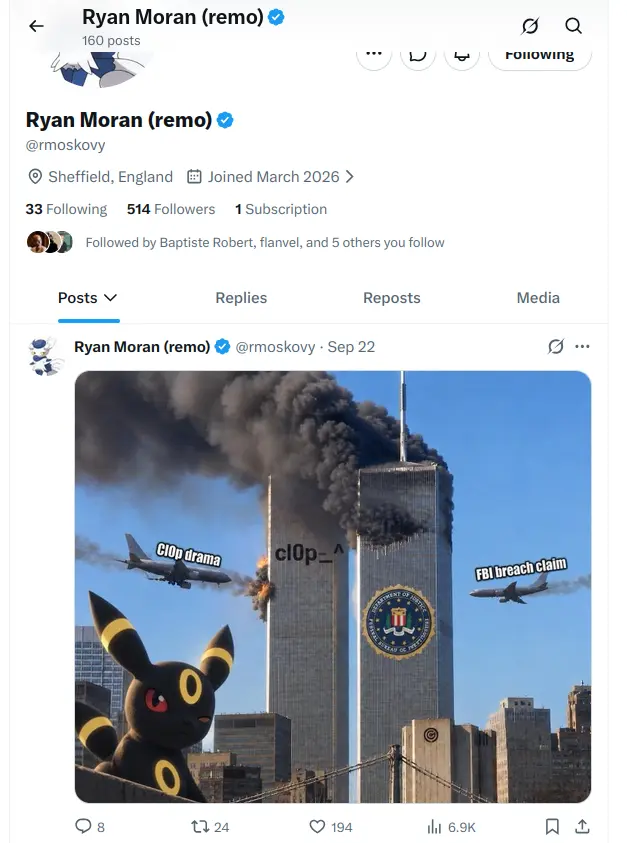
Khader’s downfall was catalyzed by his hubris. Following the September 15 arrest of 24-year-old Dutch cybercriminal Pepijn van der Stap by Dutch police forces using flash-bang grenades in Amsterdam, Rey brazenly seized control of the ShinyHunters brand assets. Attempting to capitalize on the vacuum, Rey publicly claimed responsibility for compromising sensitive FBI databases and extorting the notorious Cl0p ransomware syndicate. He even manufactured taunting memes uploaded to Twitter/X, embedding the digital avatar of Van der Stap’s former alias, “Umbreon,” in a clumsy false-flag operation designed to frame the Dutchman for simultaneous breaches.

However, Rey overextended his reach. Investigators revealed that his final, fatal error involved targeting Jeppesen ForeFlight, a digital aviation and navigation subsidiary that Boeing sold to private equity firm Thoma Bravo for $10.55 billion in November 2025. The extortion attempt—which involved stealing sensitive operational data—raised alarms across global defense and aerospace security frameworks.
Intriguingly, forensic analysis revealed deep irony in Rey’s operational footprint: cybersecurity investigations showed that Khader’s family computer had previously been compromised by information-stealing malware. Data harvested from that infection indicated that Rey’s father—an employee of Royal Jordanian Airlines, a carrier heavily reliant on Boeing fleets—had inadvertently reused corporate credentials across multiple airline portals. Following inquiries sent to his family regarding his son’s illicit activities, Rey hastily purged his social media presence, though his GitHub security blog, which had previously doxed core developers of the Cl0p ransomware, survived the digital scrub.
The Oracle PeopleSoft Zero-Day Campaign
The technical foundation enabling ShinyHunters’ aggressive mid-2026 campaign was the mass exploitation of a critical vulnerability (CVE-2026-35273) affecting Oracle PeopleSoft, a ubiquitous software-as-a-service (SaaS) platform utilized globally for human resources, payroll, and recruitment management.
Discovered as a zero-day in June 2026, the vulnerability allowed the group to harvest data from dozens of organizations spanning higher education, healthcare, technology, agriculture, transportation, and government sectors. While Oracle rapidly issued patches and security researchers at Mandiant and the Google Threat Intelligence Group (GTIG) published web application firewall (WAF) mitigation rules, ShinyHunters bypassed defenses using sophisticated URL-encoding tricks.
Among the casualties of this campaign was the FBI’s own recruitment portal. Reuters reported that the bureau was forced to remove an Accenture contractor following a devastating breach that exposed sensitive dossier data on over 5,000 FBI personnel, including specialized unit assignments, medical records, and psychiatric evaluations.

In subsequent interviews with trade publications like The Register, representatives for ShinyHunters claimed the FBI breach was executed as a calculated public relations maneuver to counter a May 2026 FBI flash notice warning victims against paying ransoms to the group. The hackers argued that the FBI’s advisory had undermined their business model, prompting a direct technical retaliation.
Supporting Context & Metrics
| Metric / Detail | Description & Impact |
|---|---|
| Primary Suspect | Saif Al-din Khader (“Rey”), a teenager from Amman, Jordan, currently detained and cooperating with the FBI. |
| Key Co-Conspirator | Pepijn van der Stap (“Umbreon”), a 24-year-old Dutch citizen arrested in Amsterdam on September 15, 2026. |
| Exploited Software | Oracle PeopleSoft (CVE-2026-35273), utilized for widespread data theft across diverse industrial sectors. |
| High-Profile Target | Jeppesen ForeFlight (a former Boeing digital aviation subsidiary sold for $10.55 billion). |
| FBI Exposure | Compromise of recruitment databases exposed sensitive records of over 5,000 personnel. |
| Financial Scale | Historical ShinyHunters campaigns have impacted billions of records globally since 2019; Van der Stap’s past convictions involved illicit proceeds estimated between €1.5 million and €2.7 million. |
Official Statements and Industry Reactions
The fallout from the dual arrests of Khader and Van der Stap has triggered extensive commentary from corporate entities and security researchers alike.
Boeing issued a measured statement acknowledging the threats:
"We are aware of claims by a threat actor regarding data allegedly associated with Boeing and our former subsidiary Jeppesen ForeFlight. We are actively reviewing the matter with the Jeppesen ForeFlight team."
Representatives for Jeppesen ForeFlight maintained that operations remained insulated:

"Based on our investigation to date into this claim and proactive security posture, there was no impact to our operations or products."
Meanwhile, the narrative surrounding Pepijn van der Stap took a sinister turn. Beyond his cybercrime convictions, Dutch daily newspaper RTL reported on September 29 that investigators suspect Van der Stap attempted to orchestrate at least two contract murders abroad. Prior to his dramatic arrest—which involved tactical police units deploying flash-bang grenades—Van der Stap had cultivated an image as a reformed hacker, recently securing employment as an "offensive security lead" at Dutch cybersecurity firm Neo Security.
Benjamin Korper, owner of Neo Security, confirmed that forensic investigators searched his offices on the night of the raid but stated that independent audits revealed no evidence of malicious activity directed against Neo Security or its clients.
Future Outlook: The Franchising of Cybercrime
The modern incarnation of ShinyHunters bears little resemblance to the original French-led collective that emerged in 2019. Security analysts characterize the current ecosystem as a franchised criminal enterprise, operating much like the fictional "Dread Pirate Roberts" from The Princess Bride. When one leadership cell is dismantled by law enforcement, opportunistic freelancers—such as the teenage Khader—step into the vacuum, purchasing legacy PGP keys, hijacking old communication channels, and renting out brand prestige to execute opportunistic extortions.
This decentralized franchising model has created intense friction within underground forums. Anonymous rival actors on Telegram channels such as “The Battle” have relentlessly doxed and ridiculed Khader, accusing him of inflating his technical capabilities and cheapening the group’s ruthless reputation for a meager 25% to 30% cut of negotiated ransoms.

As international law enforcement closes the net on these proxy operators, the "ShinyHunters" brand is effectively burning out. The convergence of zero-day patch deployments, swift cross-border intelligence sharing between the FBI, Jordanian authorities, and European cyber units, and internal digital infighting signals a difficult road ahead for freelance extortionists attempting to ride the coattails of legacy hacker syndicates.