Executive Overview
In a stunning escalation of an already unprecedented federal cybercrime investigation, Federal Bureau of Investigation (FBI) agents arrested a prominent Canadian cybersecurity executive in Pennsylvania on charges connected to the notorious ShinyHunters hacking collective. The arrest comes on the heels of a massive, humiliating data breach that saw the cybercrime syndicate infiltrate FBI systems and exfiltrate sensitive personal, medical, and psychiatric records belonging to thousands of federal agents.
The suspect, identified in federal court records as Edward Dubrovsky—a seasoned incident response professional, author, and executive associated with Canadian cybersecurity firms—was taken into custody while visiting Philadelphia for a high-profile industry event. Federal documents indicate Dubrovsky is facing severe federal charges, including conspiracy to commit cyber extortion and interference with commerce by threats.
This development marks a seismic shift in how law enforcement views the gray-market ecosystem of ransomware incident response and negotiation. Historically, cybersecurity firms specializing in ransomware negotiations have operated as trusted intermediaries between victimized enterprises and digital extortionists. However, the arrest of a high-ranking industry veteran suggests that federal prosecutors are casting a wider net, investigating whether certain advisory entities crossed the legal line from mediation into complicity, material support, or direct collaboration with cybercriminal cartels.
Detailed Chronology: From the Cyber Summit to Federal Custody
The Philadelphia Conference and the Trap Closing In
The sequence of events leading to Dubrovsky’s arrest began in early October 2026. According to industry sources and conference manifests, the annual Cyber Risk Summit—hosted by NetDiligence—took place at the Loews Philadelphia Hotel between October 5 and October 7. The multi-day summit drew hundreds of cybersecurity professionals, risk managers, and insurance executives from across North America.
Among the major financial backers of the event was Cypfer, a Canadian cybersecurity firm specializing in ransomware advisory and negotiation. Online professional registries and social media posts prior to the conference noted that Dubrovsky—who had previously served in leadership roles at Cypfer before transitioning to another Canadian security firm and conference sponsor, CyberSteward—was scheduled to attend the Philadelphia summit to participate in panel discussions regarding global extortion strategies and regulatory-compliant settlement services.
Instead of returning to Canada following the conclusion of the summit, Dubrovsky was intercepted and detained by federal law enforcement.
Court Filings and Jurisdictional Shifts
On October 8, 2026, federal court records materialized in the U.S. District Court for the Eastern District of Pennsylvania, detailing the arrest of an individual named Edward Dobrovsky—noting a minor typographical discrepancy in the surname. The initial filings charged the defendant with conspiring to threaten the confidentiality of proprietary information with the intent to extort money, alongside charges of interference with commerce via threats.
While the core criminal complaint and foundational affidavits were swiftly placed under seal by the court, a docket summary was indexed via open-source court platforms such as CourtListener. The U.S. Bureau of Prisons inmate locator confirmed that a 54-year-old individual matching Dubrovsky’s credentials was being held at a federal detention facility in Philadelphia.
However, the case did not remain in Pennsylvania for long. On October 9, a judicial notice was filed transferring the legal proceedings to the Eastern District of Texas. Multiple investigative sources indicate that the Eastern District of Texas has been designated as the centralized command hub and primary judicial district for the overarching, multi-jurisdictional ShinyHunters federal probe.

As of press time, Dubrovsky has not retained private counsel, nor has a public defender been officially appointed by the court. Representatives for Cypfer formally clarified that while Dubrovsky’s historical LinkedIn profile claimed co-founder status, he merely served as a managing director prior to his resignation in November 2025.
The ShinyHunters Syndicate: Escalation, Extortion, and Enterprise Heists
To understand the gravity of the arrest, one must examine the operational trajectory of ShinyHunters throughout 2026. Known primarily for sophisticated phishing operations, credential harvesting, and the mass theft of proprietary data from software-as-a-service (SaaS) providers, the group has established itself as one of the most prolific and aggressive cyber extortion rings operating today.
The Financial Scale of the Threat
According to official intelligence shared by federal law enforcement, the ShinyHunters collective has successfully targeted dozens of major corporate entities this year alone, extracting an estimated $70 million in ransom payments. Their MO typically involves penetrating cloud environments, downloading vast repositories of sensitive customer and corporate data, and threatening public publication on dark web data-leak sites unless exorbitant digital asset demands are satisfied.
The Humiliating Breach of the FBI
The urgency of the federal response intensified dramatically following a targeted cyberattack against the Bureau itself. In an unprecedented breach, ShinyHunters managed to penetrate online recruitment and administrative portals belonging to the FBI, making off with sensitive dossiers on thousands of active agents.
The compromised data reportedly included granular professional details—such as operational units, specialized skill sets—as well as highly confidential medical and psychiatric evaluations. This security failure delivered a profound psychological blow to the federal law enforcement apparatus, prompting an all-hands-on-response directed from the highest levels of the Department of Justice.
The International Web of Arrests
Dubrovsky’s apprehension is far from an isolated incident; it represents the latest domino to fall in an aggressive, coordinated international dragnet targeting the infrastructure supporting ShinyHunters and allied cybercrime networks:
- The Dutch Raid: Late last month, international pressure culminated when Dutch law enforcement agencies executed raids and arrested Pepijn van der Stap, a reformed hacker turned cybercriminal, suspected of playing a foundational role in supporting the ShinyHunters network. Federal investigators have spent weeks combing through digital media and hardware seized during the Dutch operation.
- The Rise and Fall of "Rey": Following Van der Stap’s arrest, leadership within the volatile hacking collective fractured. A young operative known by the handle "Rey" assumed operational control of ShinyHunters. Operating with reckless audacity, Rey began taunting FBI leadership publicly on social media regarding the stolen agency personnel data.
- The Detainment of Saif Al-din Khader: Investigative reporting by Reuters and subsequent disclosures revealed that "Rey" was actually a teenager named Saif Al-din Khader. Khader was tracked down and detained by authorities as the group attempted a high-stakes extortion plot against a digital navigation and aviation unit recently divested by aerospace giant Boeing. Following his detention, Khader reportedly began cooperating with federal investigators, providing vital intelligence that has accelerated the pace of secondary indictments.
Supporting Context & Metrics: The Murky Ethics of Ransomware Intermediaries
The arrest of a prominent negotiation executive casts a harsh spotlight on the controversial multi-million-dollar industry of cyber extortion mediation.
The Negotiator’s Dilemma
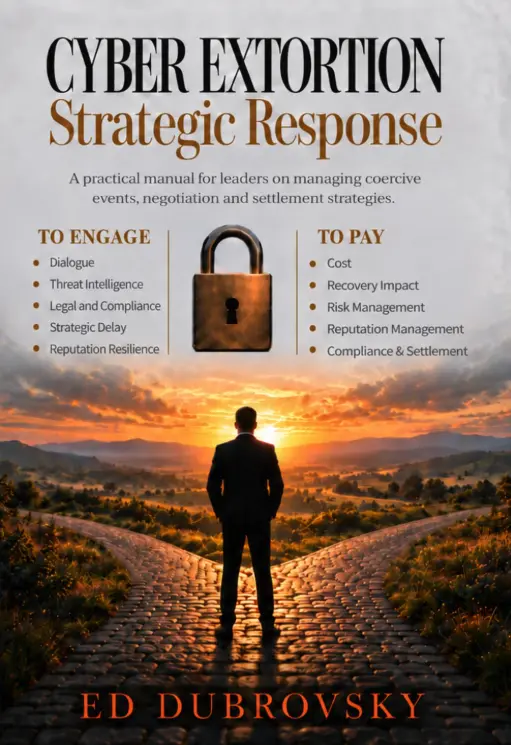
In his 252-page professional text, Cyber Extortion Strategic Response, Edward Dubrovsky expounded at length upon the nuanced mechanics of communicating with malicious actors. The book’s jacket copy highlights a core thesis: “Communicating with a criminal is not the same as negotiating a payment, and negotiating is not a commitment to pay.” Dubrovsky’s work argued that structured dialogue could serve legitimate defensive objectives—such as verifying the veracity of stolen data claims, buying time for forensic remediation, and preserving strategic options for victimized organizations.
However, federal prosecutors appear increasingly skeptical of these philosophical distinctions. In the eyes of law enforcement, the boundary separating a legitimate incident responder acting in the best interest of a corporate victim, and an illicit facilitator who greases the wheels of international money laundering and extortion syndicates, is razor-thin.

Industry Convergence and Legal Scrutiny
For years, the cyber insurance and incident response sectors have operated in a regulatory gray zone. When multi-national corporations are hit with debilitating ransomware attacks, boards of directors often face an agonizing calculus: pay a multi-million-dollar ransom to resume operations, or face catastrophic enterprise collapse. Cybersecurity brokerages and specialized negotiation firms stepped into this vacuum, charging massive retainers to manage communications, vet wallet addresses to avoid Office of Foreign Assets Control (OFAC) sanctions violations, and deliver cryptocurrency payouts.
Legal scholars note that federal investigators are now examining whether certain advisory firms went beyond advisory roles. Investigators are reportedly scrutinizing whether intermediaries knowingly facilitated communications that violated federal anti-extortion statutes, or if financial channels managed by advisory firms inadvertently served as laundering conduits for criminal syndicates like ShinyHunters.
Sources close to the ongoing grand jury proceedings indicate that Dubrovsky may not be the last corporate executive targeted. Federal subpoenas and investigative focus are reportedly expanding toward principals at other specialized ransomware mitigation firms, suggesting that a sweeping regulatory and criminal reckoning is underway for the incident response sector.
Official Statements and Institutional Silence
Reflecting the sensitivity of ongoing grand jury proceedings and the embarrassment of the initial agency breach, official channels have maintained a tightly controlled posture.
- The FBI: Leadership has largely declined to comment on the specifics of the Dubrovsky indictment or the status of the ongoing investigation. However, a brief statement published to X (formerly Twitter) by FBI Director Kash Patel acknowledged the general apprehension of suspects linked to the ShinyHunters conspiracy, praising the cross-jurisdictional cooperation of federal field offices.
- The Department of Justice: Prosecutors in the Eastern District of Texas—now serving as the central docket for the prosecution—have sealed numerous core evidentiary documents to protect ongoing intelligence operations and prevent co-conspirators from destroying digital evidence or liquidating illicit cryptocurrency assets.
- Industry Stakeholders: Corporate entities tied to the peripheral ecosystem, including CyberSteward and Cypfer, have issued carefully worded clarifications regarding executive rosters and corporate independence, seeking to distance their broader enterprise operations from individual legal actions.
Future Outlook: A Turning Point in Cyber Law Enforcement
The arrest of Edward Dubrovsky serves as a watershed moment for the global cybersecurity community. It signals an aggressive evolution in prosecutorial strategy: federal authorities are no longer content with pursuing isolated, overseas hackers who hide behind VPNs and cryptographic anonymity. Instead, law enforcement is aggressively inspecting the domestic and allied professional ecosystem—the consultants, negotiators, insurance brokers, and advisory firms that interact daily with cybercrime syndicates.
As the case migrates to the Eastern District of Texas and federal prosecutors begin unsealing additional indictments, the broader incident response industry faces an existential reckoning. Firms that once operated with impunity in the shadows of high-stakes corporate negotiations must now reckon with the very real possibility that federal investigators view their mediation strategies not as corporate defense, but as criminal conspiracy.
This is a rapidly evolving, developing news story. Further updates, legal filings, and institutional responses will be appended with timestamps as verified information becomes available.