Executive Overview
The landscape of mobile computing and high-performance portable gaming has fundamentally shifted. Modern devices—ranging from heavy-duty workstation laptops like the 2026 Apple MacBook Pro 16" M5 to cutting-edge gaming handhelds such as the Xbox Ally X20 and Lenovo Legion Go—demand unprecedented amounts of electrical energy. For years, finding a portable battery bank capable of delivering true workstation-class power output without requiring a heavy, cumbersome brick has been a challenge for digital nomads, mobile gamers, and remote professionals alike.
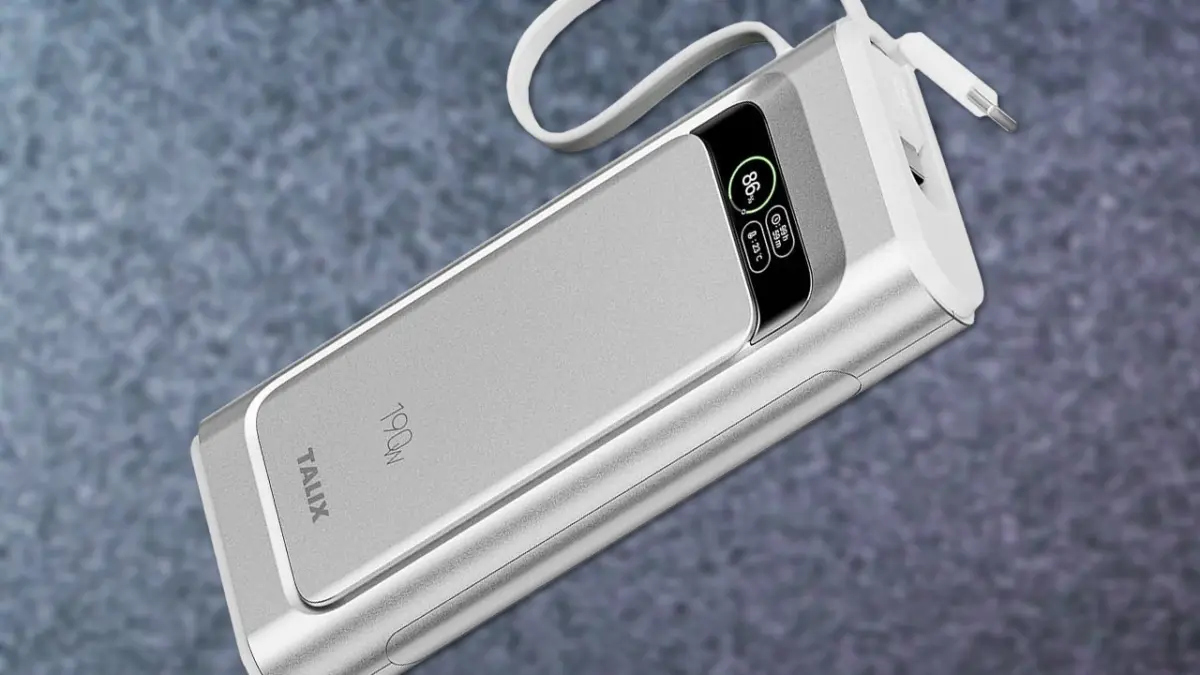
Enter the Talix 20,000mAh 140W Power Bank, a high-density lithium-ion peripheral that punches well above its weight class. Featuring a total maximum output of 190W distributed across multiple high-speed ports, this unit is engineered to eliminate battery anxiety for the most demanding power users.
In a notable retail development, Amazon has slashed the price of the Talix 20,000mAh 140W Power Bank down to just $29.99 with free shipping for a limited time. To secure this steep discount, buyers must apply the exclusive promotional code "KCPDDRBM" at checkout. With a robust build, airline-compliant capacity, and rapid-charge capabilities that rival dedicated wall chargers, this deal represents a significant inflection point in the accessibility of high-output mobile power solutions.
Detailed Chronology: The Evolution of High-Output Portable Charging
To understand the significance of the Talix 140W power bank deal, it is essential to examine the rapid evolution of power delivery standards over the past several years.
The Shift to USB-PD 3.1 and 140W Standards
For over a decade, the universal ceiling for USB power delivery hovered around 65W to 100W via the USB Power Delivery (USB-PD) 3.0 specification. While sufficient for ultraportable laptops, mainstream smartphones, and tablets, this threshold fell short for high-performance mobile workstations, creator laptops, and modern external graphics enclosures.
The introduction of the USB-PD 3.1 Extended Power Range (EPR) specification revolutionized the market by pushing maximum voltage profiles up to 28V at 5A, unlocking a baseline 140W threshold. Hardware manufacturers quickly capitalized on this shift. By 2024 and 2025, premium laptops—most notably Apple’s MacBook Pro lines and high-end enterprise notebooks from Lenovo, Dell, and HP—began adopting 140W fast-charging protocols as a baseline for rapid top-ups.
The Rise of the Power-Hungry Handheld Ecosystem
Concurrently, the portable gaming handheld market experienced an unprecedented renaissance. Devices that began as low-power emulation boxes evolved into full-fledged Windows and custom-OS gaming machines capable of running AAA titles at high refresh rates. Hardware ecosystems like the Asus ROG-backed Xbox Ally series and Lenovo’s Legion Go family pushed thermal design power (TDP) limits upward. Consequently, these handhelds required specialized power delivery systems capable of supplying high amperage without triggering thermal throttling or slow-charging states.
The Launch of High-Density Power Banks
As device power consumption increased, accessory manufacturers raced to miniaturize high-capacity energy storage. Early high-wattage power banks were bulky, expensive, and frequently suffered from thermal management issues.
The launch of advanced multi-port power banks featuring integrated USB-C cables and dynamic power allocation algorithms marked a turning point. The Talix 20,000mAh 140W model represents the maturation of this engineering cycle. By packaging enterprise-grade power output into a one-pound footprint and introducing aggressive promotional pricing, manufacturers are democratizing access to ultra-fast charging technology, making workstation-tier power accessible to casual consumers and enthusiasts alike.

Supporting Context, Specifications, and Performance Metrics
A closer technical examination of the Talix 20,000mAh 140W Power Bank reveals a device designed with versatility and raw performance in mind. Below is an exhaustive breakdown of its physical attributes, port architecture, power distribution logic, and real-world compatibility.
Physical Design and Port Architecture
Weighing in at roughly one pound, the Talix power bank strikes an impressive balance between energy density and portability. Its sleek chassis houses a 20,000mAh battery pack—translating to a total energy storage capacity of 74Whr (Watt-hours).
The device features a modern, user-centric interface that includes:
- Built-in USB Type-C Cable: Engineered to support up to 140W of Power Delivery, eliminating the need to carry loose cables for primary device charging.
- Dedicated USB Type-C Port: A secondary standalone port also capable of delivering up to 140W of Power Delivery.
- USB Type-A Port: An 18W legacy port designed for lower-draw accessories such as wireless earbuds, smartwatches, or older peripherals.
Intelligent Power Distribution (190W Total Output)
While individual ports can hit a ceiling of 140W, the power bank boasts a 190W total maximum power output rating. This is managed via an intelligent internal power management IC (Integrated Circuit) that dynamically distributes wattage depending on port utilization:
- Single-Port Mode (One USB-C port active): Delivers the full 140W output, perfect for charging high-draw laptops at their maximum rated speed.
- Dual-Port Mode (Two USB-C ports active): Splits the output dynamically, providing a robust 125W + 65W split. This allows users to fast-charge a demanding laptop at 125W while simultaneously fast-charging a secondary device (such as a gaming handheld or tablet) at 65W.
Real-World Device Compatibility
1. Next-Generation Laptops and Workstations
The 140W single-port output is specifically calibrated to meet the power profiles of modern heavy-duty portables. This includes:
- 2026 Apple MacBook Pro 16" M5: Fully capable of accepting its maximum fast-charging input, replenishing battery levels from zero to fifty percent in under thirty minutes.
- Lenovo ThinkPad and Legion Series: Fully compatible with modern Lenovo enterprise and gaming notebooks that utilize 140W (7A @ 20V) charging inputs, bypassing the need for bulky proprietary power bricks.
2. High-Performance Gaming Handhelds
Mobile PC gamers stand to benefit immensely from the unit’s high amperage output. The Talix power bank effortlessly powers devices like the Asus ROG Xbox Ally X and Lenovo Legion Go S at their absolute maximum manufacturer-specified charging rates. This ensures that users can maintain peak performance modes even when gaming far away from a traditional wall outlet.
Battery Capacity and Efficiency Calculations
With a 20,000mAh (74Whr) capacity, the Talix power bank provides ample reserve energy. Factoring in an industry-standard power conversion efficiency rate of approximately 80% (accounting for thermal loss and voltage conversion overhead), here is how the capacity translates into practical full recharges for popular electronics:
- High-End Gaming Handhelds (e.g., Xbox Ally X, Legion Go S): Approximately 1.5 to 1.8 full recharges, depending on the internal battery capacity of the specific handheld model.
- Modern Smartphones (e.g., iPhone series, modern Android flagships): Roughly 3.5 to 4.5 full recharges, making it an ideal companion for multi-day trips where grid access is limited.
- Tablets and Mid-Range Laptops: Capable of delivering a significant single-session boost, often restoring a depleted tablet to 100% capacity at least 1.5 times.
Airline Compliance and Travel Safety
One of the most common pain points for frequent flyers is navigating TSA and international aviation regulations regarding lithium-ion batteries. Under international air safety standards (enforced by the TSA, FAA, and IATA), power banks with a capacity exceeding 100Whr require special airline approval and are frequently banned from checked luggage.
The Talix power bank operates comfortably below these regulatory thresholds:

- Capacity Rating: 20,000mAh / 74Whr.
- Regulatory Limit: 27,000mAh / 100Whr (Carry-on limit).
Because its 74Whr capacity sits well underneath the 100Whr limit, travelers can pack the Talix unit in their carry-on baggage with complete peace of mind, avoiding confiscation or security delays at airport checkpoints.
Official Statements and Industry Perspective
While third-party consumer electronics accessories rarely command formal corporate press releases from major OEM giants like Apple or Microsoft, industry analysts and product managers view the proliferation of affordable 140W power solutions as a vital step forward for the mobile ecosystem.
Eric Song, Commerce Manager at IGN and a veteran technology deal analyst, emphasizes the value proposition of high-output portable batteries in contemporary hardware circles:
"Need a power bank that can handle the demands of more power-hungry electronics like an Xbox Ally X20, Lenovo ThinkPad, or Apple MacBook Pro? For a limited time, Amazon is offering high-density power solutions at a fraction of their historical cost. This battery has both the capacity and output to handle the demands of your more power-hungry portable electronic devices without compromising on safety or travel convenience."
Industry observers note that as laptops and handheld gaming PCs push toward higher thermal envelopes and faster charging standards, the accessory market must adapt by driving down the cost of entry. Historically, a power bank capable of sustaining a true 140W output commanded retail prices upwards of $100 to $150. By introducing models like the Talix 140W unit at a sub-$30 price point via targeted promotional codes, manufacturers are signaling a broader market trend: high-wattage power delivery is transitioning from a luxury enthusiast niche into an affordable commodity for the everyday consumer.
Future Outlook: The Next Wave of Mobile Power
Looking ahead, the intersection of semiconductor efficiency, battery chemistry, and charging protocols points toward an even more integrated and power-dense future.
Solid-State and Advanced Lithium Silicon Chemistries
While traditional lithium-ion cells remain the cost-effective standard for devices like the Talix power bank, the horizon is dominated by research into silicon-carbon anode and solid-state battery chemistries. These emerging technologies promise to increase energy density by 30% to 50% while simultaneously reducing physical volume and mitigating thermal risks. Within the next three to five years, consumers can expect 20,000mAh capacities to shrink down to the physical footprint of today’s ultra-slim 10,000mAh pocket chargers.
The Expansion of USB-PD 3.1 and Higher Standard Profiles
As computing hardware continues to evolve—exemplified by next-generation silicon architectures in the 2026 Apple MacBook Pro 16" M5 and iterative updates to handheld gaming ecosystems—the demand for even higher wattage tiers will inevitably follow. The USB Implementers Forum (USB-IF) is already looking past the 140W EPR ceiling, exploring profiles that push toward 240W. This will eventually enable full-power charging for desktop-replacement gaming laptops entirely through standard USB-C infrastructure.
The Democratization of Tech Accessories
Deals like the current Amazon promotion for the Talix 20,000mAh 140W Power Bank (accessible via code KCPDDRBM) act as a bellwether for where the market is heading. As manufacturing efficiencies scale up, premium features once locked behind expensive brand-name flagships are rapidly trickling down to accessible price points. For mobile professionals, remote workers, and mobile gamers, the era of carrying multiple proprietary chargers is rapidly drawing to a close, replaced by universal, high-output portable energy solutions that fit in the palm of a hand.