As the artificial intelligence landscape hurtles toward unprecedented industrial scale, few filings have offered as transparent—and staggering—a look into the economics of a leading AI lab as Anthropic’s newly amended S-1. Replacing the leaked investor day estimates from October, Anthropic’s audited Q3 figures lay bare a company operating at a velocity that defies traditional tech history.
With quarterly revenue touching nearly $17 billion, a net revenue retention (NRR) rate hovering around an astonishing 900%, and nearly $900 billion in long-term infrastructure commitments, Anthropic is simultaneously rewriting the playbook for enterprise software growth and shouldering financial risks of historic proportions. Yet, this hypergrowth comes with a price: a sudden quarterly operating loss driven by billions spent on short-term spot compute to avoid rate-limiting its explosive customer base.
Below is an exhaustive, deep-dive analysis of Anthropic’s amended S-1 filing, breaking down the numbers, the strategic gambits, and what they signal for the future of the generative AI market.
Executive Overview: The Scale of Anthropic’s Ascent
To understand Anthropic’s current trajectory, one must first grasp the sheer magnitude of its financial acceleration. In the third quarter, Anthropic posted revenue of $16.96 billion. To put this in perspective, that represents a 1,127% year-over-year explosion from the $1.38 billion recorded in the same period a year prior, and a 47% sequential bump from the $11.56 billion reported in the second quarter.
For the first nine months of the year, cumulative revenue reached $33.24 billion—dwarfing the $4.59 billion generated across the entirety of calendar year 2025. Annualizing the Q3 result pushes Anthropic toward an estimated $68 billion run rate. Wall Street expectations, however, are even more aggressive, with analysts tracking towards an anticipated $110 billion in annualized revenue by year-end, as reported by The Wall Street Journal.
Yet, this blistering pace of expansion introduces complex structural tensions. Anthropic posted an operating loss of $567 million in Q3, a sharp reversal from the $974 million operating income achieved in Q2. This red ink was not a sign of slowing demand, but rather the direct result of a calculated decision: rather than rationing access or capping usage to artificially secure back-to-back GAAP-profitable quarters ahead of its imminent IPO, management opted to pay a massive premium for short-term spot compute to keep pace with enterprise demand.
As the company marches toward the public markets, its financials present a dual narrative of unmatched technological adoption paired with astronomical capital requirements.
Detailed Chronology and Financial Breakdown
1. Revenue Progression and the Realities of Dollar Adds
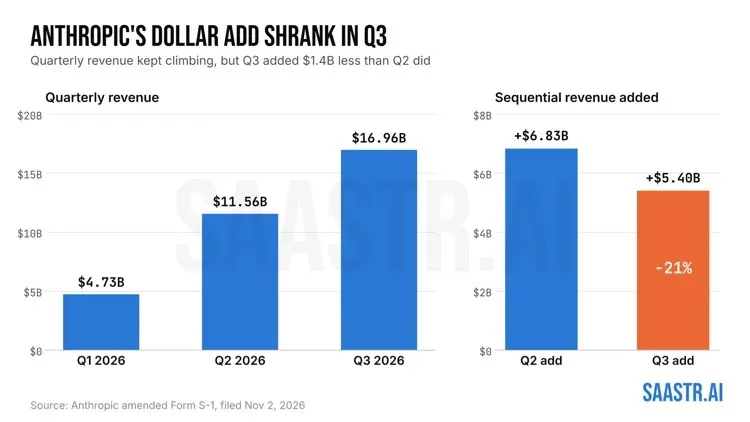
While percentage growth rates naturally decelerate as a company scales into the tens of billions, the absolute dollar adds tell the true story of market penetration.
- Q1: $4.73 billion
- Q2: $11.56 billion (a massive 140% sequential jump, adding $6.83 billion in absolute revenue over Q1)
- Q3: $16.96 billion (a 47% sequential jump, adding $5.40 billion over Q2)
Though the Q3 absolute dollar add dipped roughly 21% compared to the record-breaking Q2 add, the scale remains utterly unprecedented. The $5.4 billion added in a single quarter is roughly equivalent to the entire full-year revenue guidance of established enterprise software giants like Snowflake.
Looking ahead to Q4, the percentage growth rate will inevitably continue its downward slope. Consequently, market watchers and institutional investors will laser-focus on the absolute dollar add. To bridge the gap between a Q3 annualized run rate of $68 billion and the targeted $110 billion year-end exit run rate, Anthropic’s Q4 dollar add will need to be more than double its Q3 performance.
2. The $5 Billion Compute Bill and the Cost of Uncapped Demand
The primary driver behind Anthropic’s Q3 operating loss was an explosion in total operating expenses, which reached $17.5 billion for the quarter. At the center of this spending surge was a $5 billion expenditure on short-term compute and infrastructure commitments.
Because spot-market and short-term compute capacity commands a severe price premium compared to multi-year infrastructure contracts, Anthropic’s compute and infrastructure expenses jumped 78% sequentially to $9.86 billion. Compute costs escalated from roughly 48% of revenue in Q2 to 58% in Q3. This equates to generating about $1.72 of revenue for every dollar spent on computing power—nearly matching the $1.70 ratio communicated to investors during October’s briefings.
Management faced a fork in the road: throttle user growth to present a clean, GAAP-profitable balance sheet right before the IPO, or absorb the short-term compute penalty to fully capture surging enterprise demand. They chose the latter. On an adjusted basis, operating income actually rose to $2.5 billion in Q3, though the adjusted operating margin compressed from 19% in Q2 to 15%.
Supporting Context & Metrics: Customers, Commitments, and Compounding Usage
Enterprise Adoption and the 900% NRR Phenomenon
Anthropic’s top-line growth is overwhelmingly driven by its existing installed base rather than a reliance on raw logo acquisition. This dynamic is underscored by a staggering Net Revenue Retention (NRR) rate of approximately 900% at the close of the third quarter.
The enterprise customer breakdown reveals deep vertical penetration:
- $100,000+ Customers: Surged to more than 11,900, up an extraordinary 12.5x from the 950 customers recorded just a year prior.
- $1,000,000+ Customers: Climbed to more than 1,900 organizations.
- $10,000,000+ Customers: Reached an elite tier of roughly 250 enterprise accounts spending upwards of $10 million annually.
This expansion is heavily propelled by multi-product adoption. Over half of customers spending $100k+ annually now utilize both the core Claude platform and a specialized first-party application—such as Claude Code or Cowork—compared to just 30% at the end of the previous year. Claude Code, in particular, has emerged as a powerful monetization engine. While Claude Enterprise users who bypassed Claude Code averaged less than $75 a month in incremental spend, the top 5% of users who integrated Claude Code spent roughly 20 times that amount.
Despite these figures, massive headroom remains. Fortune 500 companies within the $100k+ tier spent, on average, less than 0.1% of their total corporate budgets with Anthropic during the third quarter. Conversely, this introduces a notable concentration risk; any macroeconomic pullback or shifting enterprise priorities among this elite cohort could disproportionately impact future results.
The $895 Billion Infrastructure Bet
To ensure it never again faces the crunch that forced a $5 billion spot-compute penalty in Q3, Anthropic has aggressively locked down future capacity. The S-1 reveals an aggregate committed spend of approximately $895.4 billion in purchase commitments and lease agreements, with the vast majority tied directly to compute and infrastructure.
According to analyses of the filing, the company layered on an additional $100 billion in commitments during the five weeks immediately following the close of the quarter—even while marketing its IPO and running an operating loss.
Against these nearly $900 billion in long-term liabilities, Anthropic sits on a formidable liquidity cushion: $95.6 billion in cash and cash equivalents coupled with $36.3 billion in short-term investments, totaling $131.8 billion. Roughly $69.8 billion of the total commitments will come due within the 12 months following September 30—an amount roughly equivalent to the company’s entire Q3 revenue run rate.
Official Statements and Industry Implications
The Deflationary Pressures of AI: Price Cuts vs. Volume
Beyond infrastructure and customer counts, the S-1 highlights a crucial trend defining the broader AI economy: the rapid deflation of compute and model costs.
ZeroHedge’s analysis of the filing points to roughly $600 million in Q3 revenue offset by price cuts, driven by the rollout of new model versions and contractual volume discounts. This accounts for about 3.5% of total quarterly revenue. For instance, the introduction of Claude Opus 5.5 reduced customer cost-per-task by approximately 40% compared to its predecessor, Claude Opus 5.
This dynamic reflects intense competitive pressures from both open-weight models originating globally and rival US labs. Anthropic’s business model is explicitly anchored on a foundational bet: that total usage volume will compound at a rate far exceeding the rate at which price-per-task declines. This volume-driven elasticity is the underlying engine powering their 900% NRR.
For the broader B2B software-plus-AI ecosystem, the math is unforgiving. As model generation costs drop by roughly 40%, software applications whose gross margins remain static are effectively passing those savings directly to end-users or redirecting capital into product expansion.
Future Outlook: Walking the Tightrope to the Public Markets
As Anthropic hurtles toward its public market debut, the amended S-1 paints a picture of a company operating in a league of its own, characterized by hyper-acceleration, immense capital intensity, and calculated risk-taking.
The path forward hinges on three critical variables:
- The Q4 Dollar Add: Whether Anthropic can sustain the absolute revenue dollar growth required to meet or exceed Wall Street’s lofty $110 billion annualized exit-rate expectations.
- Infrastructure Execution: Managing nearly $900 billion in long-term compute commitments against a $131.8 billion liquid war chest, ensuring that long-term capacity agreements replace expensive short-term spot purchases.
- Enterprise Expansion & Monetization: Maintaining extreme NRR figures by deepening the adoption of high-value tools like Claude Code within the Fortune 500, while navigating ongoing model price compression.
For investors, policymakers, and industry observers alike, Anthropic’s S-1 is more than a pre-IPO regulatory document—it is a clear window into the financial realities of the generative AI era, where staggering revenues are matched only by the titanic scale required to build the future of intelligence.