Executive Overview
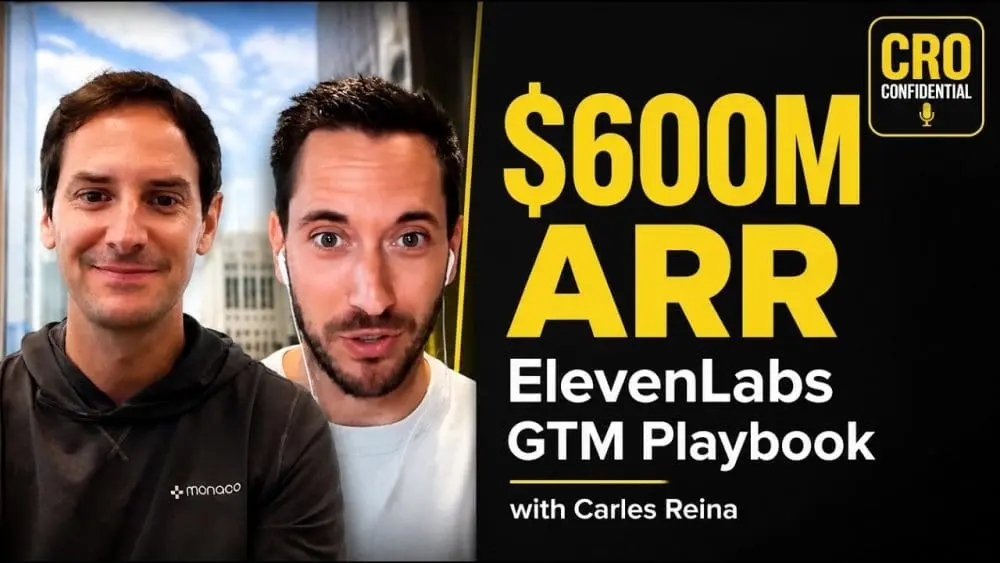
In the hyper-accelerated landscape of artificial intelligence startups, few trajectories match the meteoric rise of ElevenLabs. Scaling from a nascent idea to an enterprise behemoth generating upwards of $600 million in Annual Recurring Revenue (ARR) in just 41 months is a feat that defies traditional SaaS playbooks.
Behind this unprecedented expansion is Carles Reina, ElevenLabs’ employee #4, its inaugural go-to-market (GTM) hire, and its first investor. Having spent the critical foundational months navigating enterprise sales solo before architecting the company’s entire commercial organization, Reina recently stepped back to helm Baobab Ventures, a $15 million solo GP fund.
In a candid, masterclass-level appearance on SaaStrAI’s CRO Confidential hosted by Sam Blond—founder and CEO of Monaco and former CRO of Brex and Zenefits—Reina pulled back the curtain on the mechanics of hyper-growth. Rather than a polished, retrospective case study, the conversation served as a living blueprint for modern B2B scaling.
This deep dive unpacks the strategic pivots, counter-intuitive compensation models, and aggressive experimental plays that transformed ElevenLabs from a developer-focused voice AI model into a global enterprise titan.
Detailed Chronology: The Journey from Employee #4 to Global Enterprise
To understand ElevenLabs’ growth rate—which notably accelerated as the baseline numbers grew larger—one must examine the phased evolution of its go-to-market strategy.
Phase 1: The Solo Soldier and the Grants Gamble (Months 1–9)
For the first nine months following the company’s public debut, Reina was the sole commercial engine. Operating in a crowded landscape of early-stage voice and audio model companies, Reina needed a mechanism to instantly capture market share from competitors who were surviving on small-scale developer and startup adoption.
During a holiday with his wife—guided by his personal maxim to "figure out how to kill the current set of competitors"—Reina formulated the ElevenLabs Grants Program.
- The Mechanism: Any startup with fewer than 25 employees received free access to ElevenLabs’ technology for three months.
- The Execution: They marketed the initiative aggressively, distributing tens of thousands of grants in a compressed window.
- The Return: Though a massive gamble with zero guaranteed return at inception, the cohort became a self-sustaining enterprise pipeline. For long stretches subsequently, over 10% of ElevenLabs’ enterprise revenue originated directly from this grants cohort, as fledgling startups matured into paying enterprise accounts. By dropping a three-month free barrier, Reina effectively locked competitors out of the startup ecosystem.
Phase 2: International Expansion and Structured Hypotheses
As the product gained traction, ElevenLabs expanded its footprint into the US, Europe, Japan, India, Korea, Brazil, Mexico, Colombia, and the Middle East. Eschewing a haphazard "spray and pray" approach, every international launch required a rigorous written thesis answering three mandatory questions:
- Why this market?
- What is the channel mix?
- What is the expected result within 3 to 6 months?
The execution varied significantly by region based on financial constraints. While core markets favored direct sales, tax laws, withholding regulations, and local invoicing constraints in other regions made reseller-first models significantly more profitable. By writing down expected results prior to launch, the leadership team established an objective timeline for success or failure, eliminating ambiguous, eighteen-month debates over market viability.
Phase 3: Integrating AI into the GTM Org
Roughly two and a half years ago, at a company offsite in Switzerland when the team numbered under 30, Reina pitched the founders on an audacious idea: building an entirely automated AI GTM organization comprising an AI SDR, an AI Account Executive, and an AI Customer Success Manager.
Initially met with skepticism—the founders argued the technology was immature—Reina persisted, eventually securing a single dedicated developer. The internal pushback was immediate: human reps feared obsolescence. Two distinct operational decisions resolved this friction:
- Demonstrated Superiority: An AI SDR responding instantly to inbound queries converted significantly faster than a human operating within a 30-minute window. Furthermore, AI customer success managers unlocked dormant upsell revenue across the SMB and mid-market longtail that human reps simply lacked the bandwidth to pursue.
- The Compensation Guarantee: Crucially, when an AI agent closed or unlocked revenue on an assigned account, ElevenLabs still paid full commission to the human rep owning that account. This eliminated internal sabotage. Reps learned to lean into the automation rather than working against it.
Supporting Context & Metrics: The Anatomy of a High-Performance Commercial Engine
Reina and Blond’s discussion offered rare, granular transparency into the unit economics of an AI rocket ship.
The 20x Quota Model and Fair Compensation
The traditional B2B benchmark for sales compensation has long hovered around a 5x multiple (e.g., a $200K OTE expecting $1M in ARR). Reina shattered this convention by setting quotas at 20x base salary. A $100K base carried a $2M new ARR annual expectation, with uncapped commissions designed to double a rep’s base at plan.
While initial hires balked, Reina offered a solemn contract of fairness:
"I don’t know if you’re going to get there or not. What I can promise you is that we will make it fair. If in the next 3 to 6 months we see that you’re not getting there, I will lower the commission, I will lower the targets… If market fundamentals change, we will reevaluate and drop it."
The results were staggering: account executives regularly ran at 600% of quota, with many hitting 300%, and average quarterly attainment across the commercial organization sitting at 167%. Crucially, management honored its promise, granting up to 50% quota relief in markets where macroeconomic or regional fundamentals shifted.
The Proof Is in the Recurring Revenue: Zero Commission on POCs
ElevenLabs enforced a rigid rule: zero commission on Proof of Concepts (POCs), regardless of size or duration. Whether a trial was worth $20K or $20M, reps earned nothing until a true recurring revenue contract was signed.
Reina’s argument was rooted in enterprise valuation: $1M in ARR translates to approximately $33M in enterprise value at their multiple. A POC does not register on investor balance sheets or valuation multiples. Aligning compensation strictly with reported ARR ensured that reps focused entirely on high-value, long-term commercial commitments.
Official Insights: Lessons, Mistakes, and AI Reality Checks
The Two Biggest Regrets
When asked what structural changes could have pushed ElevenLabs past the $1 billion threshold even faster, Reina pointed directly to two hiring decisions:
- Sales Enablement and GTM Operations Too Late: Retrofitting onboarding and operational infrastructure onto a rapidly scaling sales team creates structural friction. Sam Blond echoed this from his time at Zenefits, noting that sales leaders—who are inherently execution-oriented—chronically under-hire for RevOps early on.
- Senior Reps Too Late: Relying exclusively on young, hungry, and inexpensive talent forces companies to reinvent the wheel on complex enterprise deals. Bringing in seasoned enterprise veterans with pre-existing procurement relationships earlier accelerates market penetration.
What AI Agents Are Good At (And What They Are Not)
Drawing from real-world scaling experience, Reina and Blond separated AI hype from operational reality:
- Where AI Excels Today: Analyzing vast datasets, researching accounts, building Total Addressable Markets (TAMs), scoring leads, monitoring buying signals, drafting outreach, and operating 24/7.
- Where AI Falls Short: Relationship-building. Because LLMs operate within median statistical distributions, they struggle with high-end enterprise selling, which often requires operating entirely outside conventional norms to forge deep human trust.
Future Outlook: The 100 Experiments Framework
As ElevenLabs continues its ascent, the underlying philosophy of its commercial growth remains anchored in relentless iteration. Reina’s guiding mantra to his team encapsulates the modern startup ethos:
"You need to test 100 things, but I only need one of those 100 things to actually work to give me another hundred million in ARR. I only need one. I don’t need five. I don’t need 20."
In an environment where market conditions fluctuate and customer churn is an inevitability, relying on a single, rigid strategy is a recipe for stagnation. By building an organizational culture that embraces high-velocity experimentation—evidenced by the wild success of the startup grants program—ElevenLabs has engineered a repeatable, antifragile framework for hyper-growth that will serve as a textbook case study for the B2B tech sector for decades to come.