Executive Overview
In a decisive move to reclaim the security and integrity of its connected ecosystem, home appliance giant LG Electronics USA has announced plans to purge its webOS app store of any applications that turn user televisions into "always-on" residential proxy nodes. This policy shift follows explosive findings from cybersecurity researchers at Spur, which revealed that more than 42 percent of applications available on LG’s smart TV platform harbored software development kits (SDKs) capable of routing third-party internet traffic through unsuspecting consumer living rooms.
The proliferation of residential proxy networks within the Internet of Things (IoT) has rapidly evolved into a major cybersecurity gray area. App developers, hunting for monetization strategies outside of traditional advertising models, have increasingly turned to proxy networks that pay per installation. By embedding these SDKs into seemingly benign software—ranging from casual arcade games like Pac-Man to screensavers and file utility tools—developers monetize their user bases by leasing their home internet connections to external entities.
While proxy providers defend the practice as a consent-driven, highly audited form of digital infrastructure sharing, security experts argue that smart TVs are uniquely ill-suited for such deployments. Unlike traditional desktop computers or mobile devices, consumers rarely audit their televisions for malicious background activity. Furthermore, single-screen consent prompts are frequently bypassed or misunderstood by minors within a household, raising severe questions about informed consent and home network security. LG’s new stance—coupled with the threat of sweeping app suspensions—signals a growing recognition among major hardware manufacturers that platform governance must extend far deeper than simple app-store curation.
Detailed Chronology: From Discovery to Policy Shift
The unfolding controversy and subsequent corporate turnaround can be traced across a rapid succession of industry revelations and regulatory maneuvers:
- Early July 2026 (The Spark): Security firm Spur published an exhaustive investigative report highlighting the rampant embedding of residential proxy SDKs across modern smart television operating systems. The report sent shockwaves through the cybersecurity community by demonstrating that nearly half of LG’s webOS catalog and over a quarter of Samsung’s Tizen OS apps contained proxy capabilities.
- July 2, 2026: Industry publication KrebsOnSecurity spotlighted Spur’s findings, drawing widespread attention to how casual applications—such as ad-supported versions of classic games—were quietly repurposing residential IP addresses to route external data traffic.
- Mid-July 2026: Facing mounting public scrutiny and direct inquiries from investigative journalists, LG Electronics USA initiated an internal audit of its webOS application catalog. The company recognized that these utilities violated the intended scope and safe operational parameters of its consumer hardware.
- Late July 2026: LG Senior Vice President John Taylor issued an official statement declaring that residential proxy networks are entirely incompatible with the intended use of LG smart TVs. The corporation announced an immediate enforcement mechanism: developers caught utilizing proxy SDKs would be given a strict ultimatum to remove the functionality or face immediate app suspension.
- July 22, 2026: Major residential proxy provider Bright Data issued a formal defense of its operations, emphasizing its strict adherence to user consent screens, know-your-customer (KYC) protocols, and independent auditing by PricewaterhouseCoopers (PwC).
- Simultaneous Developments (Late July 2026): Just as LG earned praise for its aggressive stance on smart TV security, the hardware manufacturer found itself facing separate public relations headwinds. Prominent hardware review channel Gamers Nexus revealed that certain high-end LG LCD monitors were covertly pushing promotional McAfee antivirus applications through Windows Update without explicit user authorization, complicating the narrative surrounding LG’s commitment to user-centric software transparency.
Supporting Context & Metrics: The Scale of the Proxy Economy
To understand the weight of LG’s decision, one must examine the mechanics of the residential proxy economy. Residential proxies differ fundamentally from traditional data-center proxies. Because they originate from residential Internet Service Providers (ISPs)—such as Comcast, Verizon, or AT&T—traffic routed through them appears as regular, human-driven web browsing. This makes residential IPs immensely valuable for legitimate enterprise tasks, such as web scraping, ad verification, search engine optimization (SEO) monitoring, and regional content testing.
However, the same characteristics that make residential proxies valuable to enterprises also make them attractive to malicious actors who wish to mask botnet traffic, conduct credential-stuffing attacks, or evade fraud detection systems.
The Spur.us Findings: A Quantitative Breakdown
The investigation conducted by Spur evaluated the prevalence of these SDKs across leading smart TV ecosystems and revealed stark figures:
- LG webOS Ecosystem: More than 42 percent of tested games and applications featured embedded proxy SDKs designed to turn the television into an indefinite proxy node.
- Samsung Tizen OS Ecosystem: Over 25 percent of applications analyzed on Samsung’s competing platform contained similar residential proxy components.
- Dominant Players: The research highlighted that specific commercial proxy networks—most notably Bright Data—accounted for the lion’s share of SDK implementations across both hardware ecosystems.
The Monetization Trade-Off
For app developers working on resource-constrained platforms like smart TVs, monetization options are historically limited. Subscription models rarely succeed for casual utility apps, and ad-supported models can clutter the user interface of a living room display.
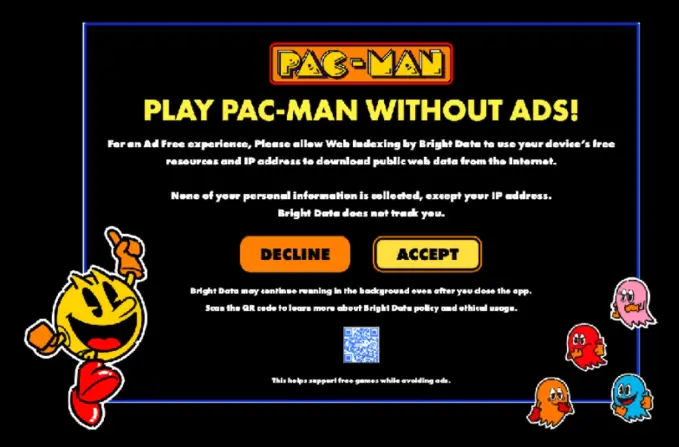
Residential proxy SDKs presented developers with a seductive alternative: monetize user bandwidth instead of attention. As illustrated by Spur’s analysis of a smart TV port of Pac-Man, users were frequently presented with a binary choice during setup: endure repetitive video advertisements or opt into a terms-of-service agreement that allowed the application to utilize their idle internet connection as a commercial proxy node.
Official Statements and Industry Perspectives
The clash between network monetization firms, hardware manufacturers, and cybersecurity researchers has brought conflicting philosophies of digital ownership into sharp relief.
LG Electronics USA: Redrawing the Boundaries
John Taylor, Senior Vice President at LG Electronics USA, articulated the manufacturer’s uncompromising stance in an emailed statement to industry media:
"A residential proxy network is not an intended use for LG smart TVs, and LG Electronics is working with developers to remove the residential proxy option from their apps on the webOS platform. If this option is not removed, these apps will be suspended."
Taylor emphasized that the company’s internal review of its application store is already "well underway now." He added that LG is taking structural steps to permanently prevent such code from infiltrating future firmware updates:

"As part of our ongoing efforts to enhance platform quality and the user experience, LG will continue to strengthen our evaluation process for developer-submitted apps, including those that incorporate residential proxy SDKs."
Bright Data: Defending the "Consent-Driven" Model
In response to the growing regulatory and corporate backlash, Bright Data defended its operational framework, emphasizing transparency and rigorous self-regulation. A company statement provided to security researchers noted:
"Every peer opts in through a dedicated screen and receives value in return; every customer is vetted, and our practices have now undergone a second independent audit by PwC. We remain committed to an open, transparent internet where legitimate businesses, researchers, and institutions can responsibly access data that lives in the public domain."
Proxy providers routinely emphasize that they deploy sophisticated technological safeguards. These countermeasures are designed to prevent proxy network clients from leveraging a residential node to scan, interact with, or compromise other devices residing on the same local area network (LAN).
The Security Community Counter-Argument
Despite the technical assurances offered by proxy networks regarding LAN isolation and KYC compliance, independent researchers remain deeply skeptical. Trevor Sutter of Spur argued that the core issue is not necessarily malicious intent, but rather the systemic mismatch between complex data-sharing agreements and consumer hardware expectations.
"A one-time consent prompt buried in a TV app is not a substitute for meaningful transparency, ongoing control, and platform oversight," Sutter wrote. "The risk is amplified when consent comes from individuals within the household who use the device but shouldn’t give consent, such as minors."
Unlike enterprise servers managed by dedicated IT staff, a family television is a shared household appliance. A child or guest clicking "Accept" on a wall of legal legalese to bypass a game’s advertisement screen has fundamentally compromised the security posture of the entire home network without the primary homeowner’s knowledge or informed consent.
Broader Implications and Platform Governance
LG’s intervention in the webOS app ecosystem serves as a bellwether for the broader Internet of Things (IoT) landscape. For over a decade, consumer hardware has prioritized feature expansion, third-party app integration, and rapid time-to-market over stringent runtime auditing. As smart TVs evolve into fully fledged computing nodes running complex operating systems, they inherit the exact security vulnerabilities historically associated with personal computers and servers.
The Dual Nature of Consumer Trust
Even as LG earns plaudits for cracking down on unauthorized proxy networks, the tech giant’s simultaneous missteps highlight the fragile nature of corporate consumer trust. The recent discovery by YouTube hardware channel Gamers Nexus—which demonstrated that high-end LG LCD monitors silently push promotional McAfee antivirus software through Windows Update without explicit user permission—illustrates a pervasive industry habit: treating user hardware as an advertising billboard or software distribution channel.
When hardware manufacturers engage in aggressive software bundling on one front while combatting rogue monetization schemes on another, it underscores a systemic tension within consumer electronics. Consumers purchase physical hardware expecting it to perform a dedicated function, only to find that the underlying economic model relies on continuous monetization of their data, attention, or network bandwidth.
Future Outlook: What Lies Ahead for Smart TV Security
LG’s crackdown is expected to trigger a domino effect across the consumer electronics industry.
- Stricter App Store Vetting: Competitors like Samsung, Roku, and Google (Android TV) will face mounting public and regulatory pressure to audit their own application storefronts for embedded residential proxy SDKs. Platforms that fail to proactively police their ecosystems risk reputational damage and potential regulatory scrutiny from privacy watchdogs.
- Developer Adaptation: App developers who relied on proxy SDK revenue will be forced to pivot back toward traditional monetization strategies, such as microtransactions, subscription tiers, or standard video advertisements. This may result in the disappearance or paid conversion of several free utility apps currently populating smart TV app stores.
- Enhanced Firmware-Level Controls: In the long term, major manufacturers may implement native runtime permissions or network monitoring tools within smart TV operating systems. These controls would alert users when an application attempts to establish persistent external connections or route traffic outside standard content-delivery networks.
- Regulatory Scrutiny on IoT Monetization: As lawmakers and privacy regulators increasingly target deceptive consent mechanisms and shadow data collection, the practice of turning consumer appliances into commercial proxies may soon face formal legislative restrictions, transforming an unregulated gray market into a legally hazardous endeavor.
Ultimately, LG’s decision marks a critical turning point. By establishing that smart TVs are entertainment and display devices—not commercial proxy nodes—the company has drawn a necessary boundary in the sand, prioritizing user privacy and network integrity over dubious app-store revenue streams.