Executive Overview
The landscape of the consumer electronics market is perpetually shifting, but few annual rituals command the global financial scrutiny of an Apple product launch cycle. In a comprehensive investor note reviewed by industry publication 9to5Mac, GF Securities analyst Jeff Pu has offered a nuanced, highly calculated perspective on Apple’s newly unveiled product lineup. According to Pu, while the tech giant’s latest generation of smartphones brings unwelcome price adjustments, the reality of these hikes is significantly less severe than Wall Street initially feared.
Yet, beneath the surface of relief regarding pricing restraint lies a more complicated narrative. Pu’s analysis highlights looming margin pressures, a distinct lack of substantial hardware innovations within the standard iPhone 18 Pro tier, and a general aura of market uncertainty surrounding the broader product cycle.
Amid this conservative outlook, however, lies a powerful catalyst: the iPhone Duo. Representing Apple’s boldest form-factor evolution in years, this newly minted $1,999 device is proving to be a surprising bright spot. Coming in just below the aggressive $2,000 to $2,500 estimations predicted by cautious onlookers, the iPhone Duo is rapidly emerging as the definitive demand driver for the entire iPhone 18 family. With initial consumer interest surging and a forecasted 7 million units slated for shipment by the close of the year, the Duo is carrying the weight of a generation that might otherwise struggle to captivate consumers.
Consequently, GF Securities has maintained a "Hold" rating on Apple stock, predicting a modest upgrade cycle tempered by hardware limitations but buoyed substantially by the novelty of Apple’s latest large-screen paradigm. This report delves into the intricate details of Pu’s investor note, examining the financial metrics, consumer reactions, and supply chain indicators that will define Apple’s performance through the remainder of 2026.
Detailed Chronology: Expectations vs. Reality of the iPhone 18 Launch
To fully understand the weight of Jeff Pu’s latest projections, one must retrace the expectations leading up to this autumn’s release. For months, financial analysts and supply chain insiders had been bracing for a brutal pricing landscape. Amid persistent inflationary pressures, rising component costs—particularly advanced 2-nanometer processors and complex camera arrays—and escalating global tariffs, market consensus heavily leaned toward steep price adjustments.

The Pricing Mitigation
Wall Street prognosticators had widely circulated forecasts suggesting that Apple would increase the price of its flagship iPhone 18 Pro models by anywhere from $200 to $250. For consumers already grappling with economic headwinds, such a jump threatened to severely dampen upgrade enthusiasm.
However, when Apple officially revealed the iPhone 18 Pro lineup, the reality proved more merciful than anticipated. The company implemented a modest $100 price hike. While any increase is inherently unpopular among consumers, the $100 adjustment was viewed by financial institutions as a strategic, consumer-friendly cushion. It effectively averted the catastrophic demand destruction that a $250 surge might have caused.
The Birth of the iPhone Duo
Simultaneously, Apple introduced the long-rumored "iPhone Duo," a device that has instantly polarized and fascinated the tech community. Early prognostications had pegged this radical new offering at an eye-watering $2,000 to $2,500 bracket, threatening to relegate the device to an ultra-niche luxury status.
To the pleasant surprise of analysts, the iPhone Duo debuted at a starting price of $1,999—sitting comfortably at the absolute floor of predicted expectations. By trimming the anticipated price ceiling, Apple managed to position the Duo as an attainable yet premium paradigm shift. According to Pu’s observations, this strategic pricing directly contributed to an immediate surge in early consumer interest, setting the stage for robust initial adoption rates.
Supporting Context & Metrics: Decoding the 4Q26 Forecast
While consumer fascination with the iPhone Duo is palpable, the overarching financial health of the iPhone 18 cycle requires a hard look at the cold numbers provided by GF Securities. Pu’s breakdown of Apple’s production schedules and stock valuation paints a picture of a transitional, somewhat subdued market cycle.
Financial Health and Stock Rating
GF Securities currently maintains a "Hold" recommendation for Apple’s stock. Within the firm’s specific equity rating framework, a "Hold" designation implies that the stock is expected to perform within a relative range of -10% to +10% over the evaluation period.
This neutral stance is rooted in a balancing act. On one hand, the iPhone 18 series is constrained by anticipated margin compression and a perceived stagnation in baseline hardware upgrades. On the other hand, these vulnerabilities are partially offset and cushioned by the unexpected sales volume and market enthusiasm surrounding the iPhone Duo.
Production and Build Forecasts
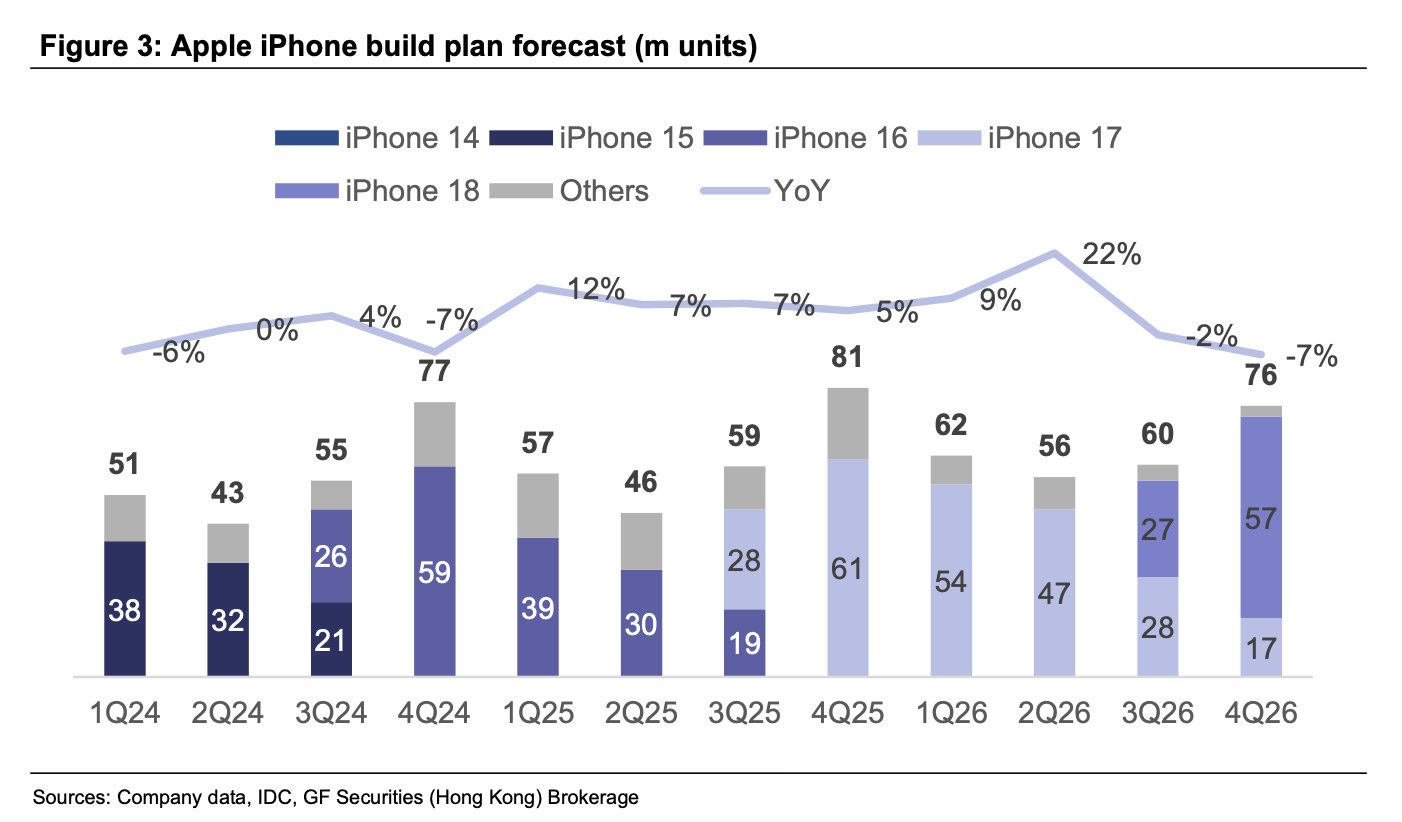
A critical component of Pu’s investor note is the fourth-quarter (4Q26) iPhone build forecast. The numbers reveal a contraction in overall production compared to the previous year, highlighting the transitional nature of this specific product cycle:
- iPhone 18-Series Units (4Q26): 57 million units.
- Total iPhone Shipments (4Q26): 76 million units across all active generations.
- Year-over-Year Comparison: The total anticipated shipment volume of 76 million units represents a 7% decline compared to the corresponding quarter in the previous year.
This downward adjustment in overall build volume aligns with the narrative of a "modest cycle." Consumers are retaining their current devices longer, and the incremental upgrades found in the standard iPhone 18 and 18 Pro models may not provide a compelling enough reason for a massive, widespread refresh cycle.
Official Statements & Analytical Insights
Jeff Pu’s investor note offers rare, unfiltered insight into how institutional analysts are interpreting Apple’s current market positioning. By contextualizing the supply chain data alongside shifting consumer behavior, Pu underscores the dichotomy between the traditional Pro models and the revolutionary Duo.

In his assessment of the product family, Pu explicitly highlighted the underlying anxieties facing the standard flagship models:
"For 2H26, we expect the iPhone 18 family to be supported by iPhone Duo (~7m units), while we see uncertainty around demand for iPhone 18 Pro/Pro Max and the impact on margin. Consumer interest in iPhone Duo appears strong, driven by Apple’s first major form-factor innovation in years and a differentiated large-screen experience, thus we view iPhone Duo as a key demand driver for the iPhone 18 family and see post-launch order lead time and supply-chain build revisions as key indicators to watch."
The Form-Factor Factor
The core thesis of Pu’s analysis rests on the concept of form-factor innovation. For several generations, incremental updates—such as minor camera improvements, subtle titanium chassis refinements, and nominal chip speed boosts—have defined the iPhone lineup. While these features appeal to tech enthusiasts, they have historically struggled to spark massive, industry-wide super-cycles.
The iPhone Duo, however, shatters this incremental mold. By introducing Apple’s first major structural and visual redesign in years, coupled with an immersive, highly differentiated large-screen experience, the device successfully captures the public imagination. It transcends the traditional "spec-sheet" upgrade race, offering something genuinely novel that users can physically and visually appreciate from the moment they unbox it.
Future Outlook: What to Watch in the Coming Months
As the dust settles on the initial launch weeks of the iPhone 18 lineup, market watchers and investors alike must shift their focus to forward-looking indicators. The success of Apple’s fiscal fourth quarter and the trajectory of its stock price will hinge on several critical variables identified by GF Securities.

1. Supply Chain Build Revisions
The initial forecast of 7 million iPhone Duo units through the end of the year is an ambitious baseline, but the true test will lie in how Apple adjusts its manufacturing orders. If consumer demand continues to outpace expectations, supply chain partners will likely see component orders increase. Conversely, any softening of demand will trigger rapid build revisions. Monitoring component procurement will provide the earliest warning signals of the Duo’s staying power.
2. Post-Launch Order Lead Times
In the world of consumer technology retail, lead times are the ultimate barometer of real-world demand. Observers should closely track shipping estimates on Apple’s official online store. If delivery windows for the iPhone Duo stretch out into weeks or months, it will confirm that early consumer interest is translating into sustained, high-volume commercial success. Short or immediate shipping windows, however, could suggest that supply is comfortably meeting a more modest demand level.
3. Margin Pressures on Pro Models
Apple’s ability to protect its profit margins amidst rising global supply costs remains a critical focal point. With the iPhone 18 Pro models experiencing a lower-than-expected price increase ($100 instead of $250), the financial burden of component inflation falls more heavily on Apple’s balance sheet. Investors will be scrutinizing the upcoming quarterly earnings reports to gauge how effectively the company can offset these margin pressures through software services, operational efficiencies, and the higher average selling price (ASP) commanded by the $1,999 iPhone Duo.
Ultimately, the iPhone 18 cycle is shaping up to be a story of two distinct realities. While the standard and Pro tiers navigate a cautious path marked by limited hardware leaps and protective pricing strategies, the iPhone Duo stands ready to carry the torch. By delivering a long-awaited form-factor evolution, the Duo has proven that innovation—when bold enough—can still pierce through market uncertainty and reignite consumer desire.