Executive Overview
In the crowded, ever-expanding landscape of cooperative horde shooters, 2026 has proven to be a particularly saturated battleground. Games in this genre occupy a very specific, beloved niche in modern gaming culture: they double as casual hangouts where players can chat about daily life over comms while simultaneously unleashing absolute carnage on digital waves of enemies. Simple, clear objectives allow for this cognitive multitasking. However, this ubiquity comes with a severe downside for newcomers.
Enter Exterminauts, a third-person, cooperative co-op shooter that drops players into the blood-stained boots of exploited blue-collar laborers working for a merciless MegaCorp. Armed with a bizarre arsenal of mad-science tools, players are tasked with defending and maintaining company assets against an aggressive, native insectoid threat.
Following an extensive hands-on preview session with the game, a central tension emerges: while Exterminauts features a polished aesthetic and is capable of generating moments of chaotic, systemic fun, it constantly invites comparisons to the titans of the genre that clearly inspired it. The ultimate question facing developer and player alike is whether this blue-collar bug-squasher has enough intrinsic juice to convince players to clock in for a long-term shift, or if it will ultimately be abandoned on the loading dock.
Detailed Chronology: Experiencing the Frontlines
The Satirical Setup and the Tone Problem
The gameplay loop of Exterminauts is anchored by a distinctly dystopian premise: you and up to three squadmates are indentured servants to a ruthless corporate entity that views both employee safety and native wildlife as disposable line items. The "evil corporate master versus exploited labor" dynamic is a tried-and-true sci-fi satirical starting point, but in practice, the game struggles to anchor its tone securely.
Throughout missions, players are subjected to constant audio banter between a beleaguered dispatcher and a detached Planetary Director. Unfortunately, the writing largely misses the mark. While it attempts a lighthearted, slapstick aura reminiscent of a chaotic workplace comedy, many of the field barks and character hollers frequently drift into the territory of uninspired, "Deadpool-esque" quipping. It lacks the razor-sharp, genuinely biting institutional satire found in genre peers like Helldivers II, leaving the narrative framing feeling more like white noise than an engaging world-building tool.
Dynamic Objectives and Collaborative Chores
Where Exterminauts begins to carve out its own identity is in its approach to mission objectives. Rather than merely forcing players to stand in a designated zone or press a single interaction button—as is standard for the genre—the game frequently demands tactile, multi-step problem-solving.
During the preview build, repairing damaged infrastructure brought players face-to-face with engaging mechanics like high-pressure welding. Players must guide a flaming torch precisely along jagged structural cracks on the side of a massive petroleum pump. The patterns are deliberately asymmetrical, requiring constant micro-adjustments that demand just enough attention to keep things tense while under active assault from the swarming local fauna, yet intuitive enough not to induce pure frustration.
Another standout cooperative mechanic involved a heavy mechanical winch requiring two players to work in tandem. One operator had to ratchet the device upward incrementally, holding their position while the second player applied their weight to lock the mechanism into place. While technically feasible to brute-force solo, these integrated chores organically encourage cooperative coordination. Although the limited preview maps featured only a handful of these tasks, expanding this design philosophy could become one of Exterminauts’ strongest differentiating pillars.
Side Jobs, Abandoned Mechs, and the Fauna
Exploration of the planetary biomes yields optional side objectives that spontaneously ping on the player’s HUD. These range from minor diversionary tasks—such as hunting down a localized elite monster for a single-run modifier—to high-value discoveries like abandoned corporate mechs.
The smaller side tasks offered little emotional resonance, feeling largely like checklist busywork. Conversely, stumbling upon a decommissioned heavy mech was uniformly exhilarating. These mechanical powerhouses pack an incredible punch, though they come with strict limitations: only a single squadmate can pilot one at a time, and once their ammunition reserves are depleted, the chassis is permanently spent. This stark dichotomy highlights a need for consistency in the game’s supplementary content as development progresses.
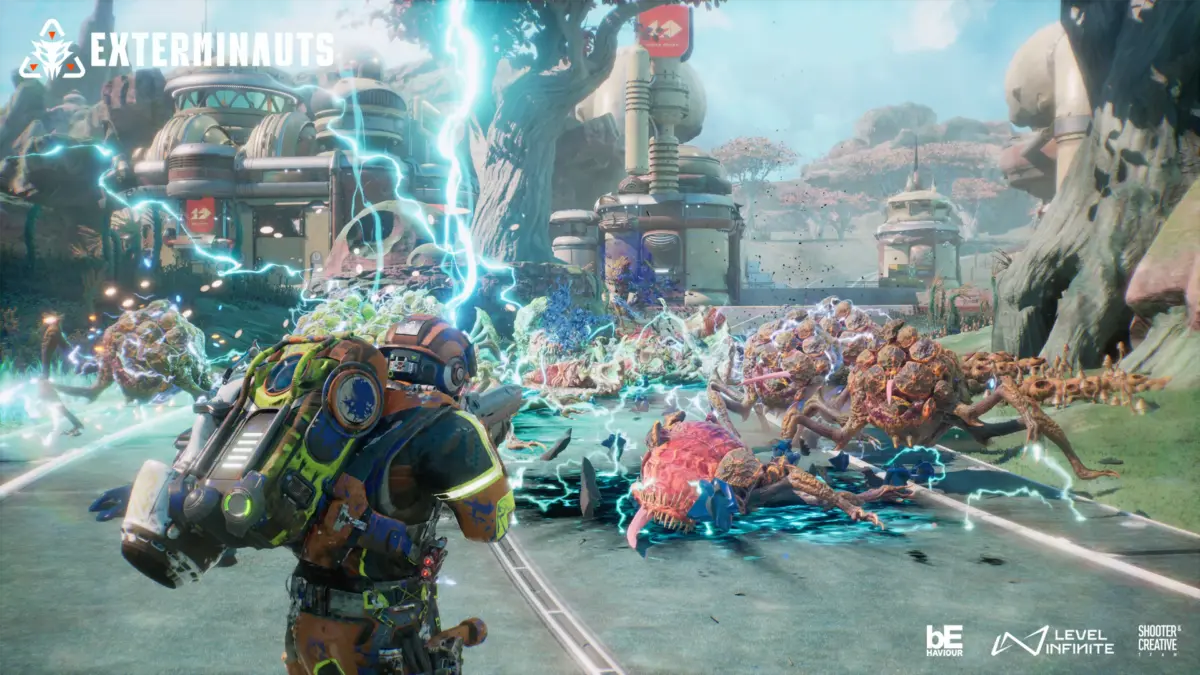
Meanwhile, the local ecosystem provides a memorable gauntlet of opposition. The insectoid fauna are wonderfully, grotesquely imaginative:
- Leaping Jaws: Horrific specimens that are roughly 80% mouth, capable of leaping vast distances to swallow players whole.
- Laser-Eyed Spitters: Creatures featuring long, fanning neck frills reminiscent of cinematic dinosaurs, substituting poison with concentrated beams of energy from a singular central eye.
- Parade-Float Parasites: Bizarre, floating, balloon-like entities that drift above the battlefield, spawning smaller, bioelectric flyers capable of delivering debilitating shock attacks.
Supporting Context & Metrics
Mission Scaling and Difficulty Tiers
During the preview sessions, squads typically operated between difficulty levels 2 and 8 out of a possible 8-tier progression system. At these moderate settings, the onslaught of bugs—while visually overwhelming when coagulating into a dense wave of teeth and chitin—remained manageable as teams mastered basic weapon kits.
However, scaling the difficulty up drastically shifts the mathematical reality of the game. Solo play, in particular, transforms Exterminauts into a punishing meat grinder. Higher tiers introduce:
- Significantly larger and more aggressive pest variants.
- An increased frequency of mandatory mid-mission infrastructure repairs.
- Harsh environmental hazards, including localized extreme weather events.
The climax of every mission—the mandatory extraction phase—serves as the ultimate stress test. Players must hunker down and survive a relentless grand finale wave while awaiting transport. These frantic final moments represent the game at its most dangerous, while simultaneously offering the ideal sandbox for deploying rare support assets, such as automated sentry turrets or temporary infinite-ammo tethers.
The Arsenal: Conventional vs. Esoteric
The weapon sandbox in Exterminauts reveals a stark philosophical divide between standard kinetic firearms and specialized support armaments.
The Mundane Primary Weapons
The standard-issue kinetic blasters—comprising various assault rifles and submachine guns—occupy deeply familiar territory. While mechanically functional and reliable, they lack punch. In a market where players are accustomed to visceral, highly detailed feedback, these weapons feel generic. Without significantly improved audio design, sound mixing, and controller haptics, these primary guns fail to make a lasting impression.
The Spicy Secondary Weapons
Conversely, the secondary and special weapons shine with creative brilliance:
- Plasma Sludge Launcher: A caustic heavy weapon that coats targets in sticky, corrosive globs, inflicting devastating damage-over-time debuffs. It functions as an absolute crowd-control powerhouse.
- The CrossCut: A comically oversized circular-saw launcher. Upon impact, the blades embed themselves into enemies, spinning furiously to shred through armor and flesh. Players can hold down the trigger to charge the blade, turning it into a berserk mechanical beyblade of destruction.
Adding an extra layer of tactical depth is the manual booster mechanic. Players can whip out a jumper-cable-like contraption to supercharge their special weapons, sacrificing internal battery power to drastically enhance penetration values, stagger potential, and elemental status effects. This mechanic introduces a high skill ceiling, hinting at hidden depth for dedicated players.
Official Statements & Structural Systems
Sponsorships: Shaping the Squad Dynamic
Rather than utilizing traditional locked-in character classes, Exterminauts implements a "Sponsorship" system. These corporate backing deals grant players unique passive abilities and specialized starting loadouts that subtly shape team composition and tactical approach.
- The Bullet Crown: Tailored for aggressive DPS players, this sponsorship enhances critical hit damage and grants access to a high-rate-of-fire SMG.
- Vardhan: Positioned squarely in the support archetype, this sponsorship allows players to passively share healing effects from recovery items with nearby squadmates.
While the limited preview window did not provide enough time to fully observe how these passives radically alter systemic group play, the framework is sound. It encourages composition synergy without forcing rigid, restrictive role-queue mechanics like a traditional tank-healer-DPS trinity.
Meta-Progression and Monetization
Like virtually all modern contemporary extraction and horde shooters, Exterminauts features a robust web of meta-systems designed for long-term retention:
- Gear Upgrades: Found field currencies and coin drops can be funneled directly into upgrading weapon stats and utility tools.
- Trinket Modifiers: Higher-level progression unlocks customizable trinkets that grant stackable passive buffs, encouraging tailored build-crafting.
- Season Passes: A dual-track progression system featuring both functional gear and cosmetic items, obtainable through standard gameplay investment or accelerated via real-money microtransactions.
Resource acquisition during the preview felt brisk and rewarding, though the ultimate longevity of these systems remains an open question.
Future Outlook
After spending approximately five hours navigating the treacherous, bug-infested biomes of Exterminauts, the title has undeniably grown in charm. The creative ecosystem of bizarre insectoid enemies and the sheer mechanical joy of wielding weapons like the CrossCut keep skirmishes engaging from moment to moment. The constant sense of discovery regarding new biomes and side jobs keeps the early-game momentum moving forward.
Yet, the core challenge remains daunting. Exterminauts has not yet made an airtight, definitive case for why horde shooter enthusiasts should permanently migrate from their current genre favorites. It currently lacks the infinite systemic open-endedness of Deep Rock Galactic, the immaculate atmospheric tone of Darktide, and the sharp, culturally resonant satirical bite of Helldivers II.
None of these observations are fatal flaws—especially for a title still actively working through its development cycle. But as it stands, this blue-collar bug-squasher has its dirty work cut out for it if it hopes to convince players to punch the clock for the long haul.