Executive Overview
If video killed the radio star, artificial intelligence has effectively destroyed humanity’s shared baseline of visual truth. In an era where hyper-realistic deepfakes, synthetic media, and generative AI "slop" saturate digital channels, verifying whether a photograph depicts a real-world event has become nearly impossible. Enter Josh Cowell and his startup, CAIM1—short for Counter Artificial Intelligence Machine 1.
CAIM1 is stepping into the void with a radical proposition: rebuilding trust in visual media from the silicon up. Rather than relying on fragile, software-level watermarks or corporate promises, the startup has developed an advanced camera prototype designed to embed cryptographic proof of a photo’s authenticity directly into the image file at the exact moment of capture. Using cutting-edge hardware, decentralized blockchain signatures, and specialized thermal engineering, CAIM1 aims to resurrect objective reality.
As digital falsehoods threaten to outpace human-generated content entirely, CAIM1’s upcoming flagship camera—slated for a Q1 2027 release—represents a pivotal test for the future of digital media integrity, investigative journalism, and legal accountability.
Detailed Chronology: The Evolution of the Crisis and CAIM1’s Response
The Rise of Synthetic Deception (2023–2025)
The erosion of photographic integrity did not happen overnight, but its acceleration over the past few years has alarmed international regulators, cybersecurity experts, and legal professionals.
- The Tipping Point (2023): Generative AI tools transitioned from experimental novelties to accessible, high-fidelity production suites. Social media feeds rapidly filled with synthetic images, laying the groundwork for an unprecedented wave of disinformation.
- Exponential Growth (2025): According to a comprehensive report published by the European Parliament, social media deepfakes have doubled every six months since 2023, reaching an estimated 8 million instances in 2025. Europol projections indicate an even more startling trajectory: if current trends hold, up to 90% of all online content could be entirely AI-generated by the end of the year.
- The Legal and Ethical Fallout: Major tech firms—including xAI, Google, Meta, and Apple—have faced mounting legal pressure for failing to adequately curb AI-sparked disinformation. Lax safeguards on prominent platforms have enabled the systematic, unchecked proliferation of nonconsensual sexual deepfakes. Europol estimates indicate that a staggering 98% of all deepfakes circulating online are pornographic, transforming the technology into an instrument of harassment and reputational destruction.
The Birth of CAIM1 and the Pursuit of Hardware-Level Proof
Recognizing that software patches and reactive detection tools were losing the war against generative AI, Josh Cowell founded CAIM1 to attack the problem at its physical source: the camera itself.
Rather than treating authentication as an afterthought handled by editing software or cloud platforms, CAIM1 integrated the Tropic01 silicon chip—developed in partnership with silicon provider Tropic Square—into its camera prototype. This chip acts as a "digital vault" through which light photons pass on their way to the sensor, instantly generating a hardware-level cryptographic signature.
By linking this signature to an anonymous, decentralized blockchain record, CAIM1 established an auditable pipeline that traces an image directly back to its physical origin.
Supporting Context & Metrics: The Anatomy of a Secure Camera
To understand how CAIM1 achieves verifiable proof where traditional cameras fail, one must examine its multi-layered security and engineering architecture.
1. The Tropic01 Silicon Chip and Hardware Attestation
CAIM1’s authentication process begins at the microscopic level. The Tropic01 chip is celebrated by Tropic Square as the "world’s first auditable secure element."
When the camera’s shutter clicks, physical light is captured and processed through an internal architecture that leverages microscopic irregularities native to the silicon manufacturing process. Because no two physical silicon chips are identical down to the atomic level, these manufacturing anomalies create a completely unique, un-spoofable digital fingerprint. This ensures that the metadata certifying when, where, and with which camera the photo was taken is permanently and immutably bound to the image file.
2. Decentralized Infrastructure and Privacy
Once captured, the cryptographic verification is sent to what CAIM1 terms an "immutable decentralized infrastructure." This creates a tamper-proof, auditable, yet anonymous record of validity.
To safeguard users against privacy leaks, stalking, or malicious interception, CAIM1 protects sensitive location and identity data using advanced physical noise systems and robust internal encryption methods. Digital tripwires and brute-force defenses ensure that unauthorized actors cannot extract or forge encryption keys.
3. The Physical Receipt System
In addition to digital verification, CAIM1 introduces a novel physical safeguard: the ability to print a tangible receipt for every image captured. This physical printout includes:
- A permanent QR code linking directly to the cloud-stored, verified original photo.
- A unique blockchain reference number.
- Critical, tamper-evident metadata detailing the exact date, time, and geographic coordinates of capture.
- A secure access code granting digital entry to the media file.
4. Overcoming Thermal Challenges: The Noctua Partnership
Building a high-performance camera capable of generating complex cryptographic signatures and shooting high-resolution 4K video presented a massive engineering hurdle: extreme heat. Excessive processor temperatures can warp and degrade picture quality, but traditional cooling solutions fell short.
- Standard heatsinks could not dissipate the intense heat generated by CAIM1’s advanced processors.
- Traditional cooling fans were too loud and, more importantly, generated micro-vibrations that caused motion blur and compromised image integrity.
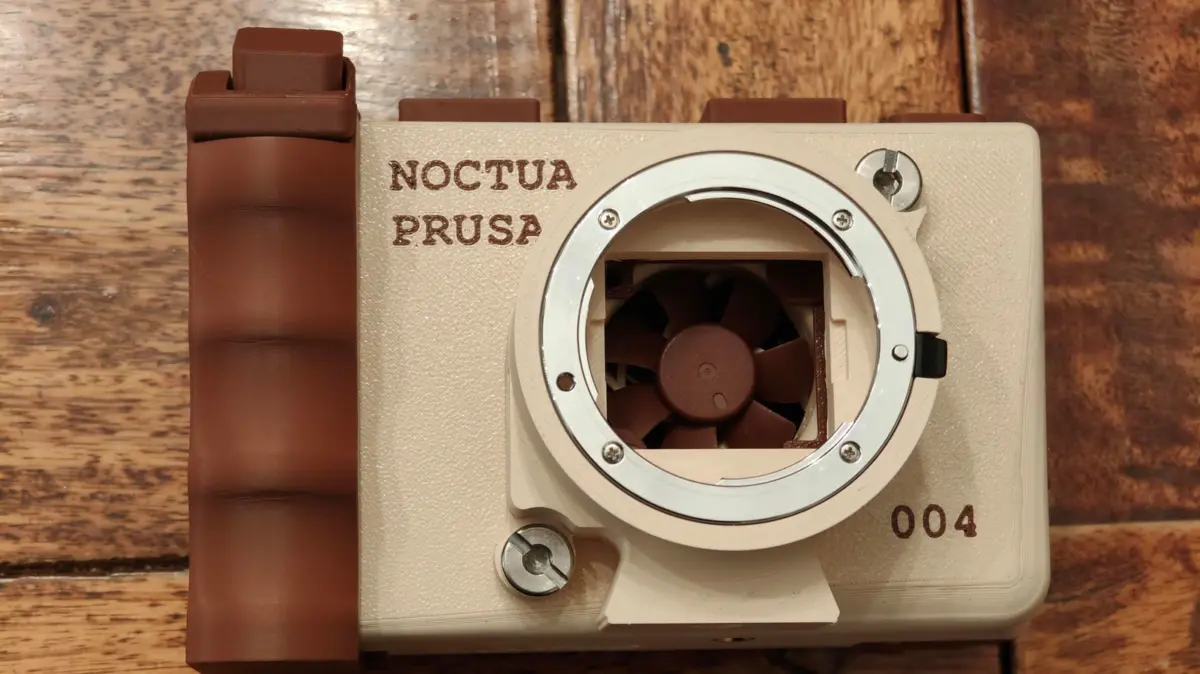
To solve this, CAIM1 partnered with renowned PC cooling manufacturer Noctua to integrate a specialized active-cooling airflow system known as the NF-A4x10. This unified single-airstream design pulls cool air efficiently across the camera’s two primary heat sources—the CPU and the sensor—while safely expelling hot air. Two advanced anti-vibration mounts isolate the cooling mechanism from the optical path, completely eliminating blur and preserving absolute picture fidelity.
5. Rugged Performance and Versatile Optics
CAIM1 is not intended to be a fragile digital novelty or an isolated cryptographic toy. Designed from the ground up for high-octane action sports and extreme, fast-paced environments, the camera features a Bring-Your-Own-Lens (BYOL) design. This allows professional videographers and photographers to mount either vintage glass or modern high-end lenses.
The startup recently tested its prototype by attaching premium glass lenses from Japanese optics company Kowa Optronics’ JC10M series, putting the camera through rigorous trials at Germany’s infamous Nürburgring racetrack. The resulting footage demonstrated that CAIM1 is a high-performance cinematic tool first, and an authentication powerhouse second.
Official Statements and Industry Comparison
The Philosophy of Open Security
While CAIM1 is not the only company exploring hardware-level photo authentication—notable competitors include Apple, which introduced hardware attestation for the iPhone 18 Pro and Pro Max’s Reference Image system, as well as a joint initiative launched by Sony, Canon, and Nikon in 2024—CAIM1 argues that its methodology offers a vital advantage: radical transparency.
In a detailed blog post hosted by Tropic Square, founder Josh
Cowell drew a sharp distinction between CAIM1’s open architecture and the closed ecosystems of tech giants:
"The traditional photograph is dead, and designing a secure camera to replace it is an exercise in healthy paranoia… CAIM1 is ultimately just the foundation of a comprehensive, verifiable infrastructure we are developing designed to aid digital truth."
Cowell further emphasized why open hardware audits matter in an age of corporate consolidation:
"Competitors require users to place blind faith in a single corporate entity’s closed ecosystem. Our use of Tropic Square’s auditable chips allows researchers and the general public alike to independently inspect and verify our internal architecture."
Future Outlook: The Road to 2027 and Beyond
As the digital landscape braces for a future where 90% or more of online media could be synthetically generated, the launch of CAIM1’s flagship camera in the first quarter of 2027 arrives as a critical line of defense.
The implications of CAIM1’s technology extend far beyond the niche worlds of action sports and professional videography. In journalism, law enforcement, legal proceedings, and insurance verification, the ability to present a mathematically proven, un-tampered photograph could restore public trust in visual evidence.
However, challenges remain. Widespread adoption will depend heavily on whether media outlets, social platforms, and verification bodies choose to integrate CAIM1’s decentralized infrastructure into their daily publishing workflows. Furthermore, scaling hardware-secured manufacturing while keeping devices accessible to independent creators will test the startup’s operational capacity.
Nevertheless, by refusing to accept the death of objective reality, CAIM1 has charted a bold course forward. In a digital world increasingly clouded by fabricated illusions, a camera that captures the unvarnished truth—backed by silicon, blockchain, and uncompromising engineering—may be exactly what society needs to see clearly once again.
For further updates on CAIM1’s ongoing prototype testing and its mission to combat the global deepfake crisis, visit the official CAIM1 Website, read their engineering logs on Medium, or follow their announcements on X (formerly Twitter).