Executive Overview
In an explosive convergence of federal law enforcement actions and international cybercrime investigations, U.S. federal authorities have trained their sights on an unsettling new frontier in cyber extortion: the alleged infiltration of the ransomware negotiation ecosystem by high-ranking industry executives. Investigators pursuing the notorious ShinyHunters hacking group—a syndicate that recently humiliated the U.S. federal government by compromising the FBI’s recruitment portal—have uncovered deep, illicit ties connecting cybercriminals to trusted figures within the cybersecurity sector.
According to sources close to the investigation, federal agents have identified executives at two separate ransomware remediation firms who maintained unusually close, cooperative relationships with the extortion collective. Most alarmingly, one U.S.-based executive is alleged to have actively assisted ShinyHunters in operating a victim-shaming portal designed to pressure breached organizations into paying exorbitant ransoms.
The sprawling probe, triggered in part by the brazen September 2026 hack of fbijobs.gov, has laid bare a murky underworld where traditional boundaries between cyber defenders and cyber attackers blur. This comprehensive report details the unraveling of the ShinyHunters network, the arrest of prominent Canadian cybersecurity executive Edward Dubrovsky, historic connections to underground aliases like "Ghostbyte," structural conflicts of interest within the ransomware negotiation market, and the profound implications this case holds for the future of global cybersecurity incident response.
Detailed Chronology: From the Netherlands to Amman and Beyond
The systematic dismantling of the modern ShinyHunters apparatus began with a series of high-stakes international raids in the fall of 2026. To understand how the syndicate operated, investigators had to track the group’s leadership evolution from its French origins to its current iteration under a teenage administrator known as "Rey."
The Fall of Pepijn van der Stap
On the evening of September 15, 2026, Dutch law enforcement executed a dramatic tactical raid in the Netherlands, deploying flash-bang grenades to stun and apprehend Pepijn van der Stap, a convicted hacker and suspected senior member of ShinyHunters. Police successfully nabbed Van der Stap while he was actively logged into his Signal instant messaging account.
This split-second tactical advantage allowed investigators to capture real-time communications between Van der Stap and his frequent contacts—notably, ransomware negotiators based in the United States and Canada. Furthermore, sources revealed that Van der Stap’s unencrypted Signal chats provided the blueprint for unraveling an alleged murder-for-hire plot. Dutch media outlet RTL reported that the plot targeted individuals abroad, with indications pointing to Van der Stap as the mastermind behind the directives (though no attacks were ultimately carried out).
The Rise and Fall of "Rey"
Van der Stap’s sudden detention created a power vacuum at the top of ShinyHunters. Control over the brand swiftly passed to "Rey," identified by researchers last year as a teenage hacker based in Amman, Jordan. According to FBI estimates, ShinyHunters has extorted more than $70 million from corporate and government victims globally over the course of 2026 alone.

However, Rey’s reign was short-lived. In late September, ShinyHunters committed what would prove to be a fatal tactical error: they breached fbijobs.gov, taunting the bureau by threatening to publish highly sensitive personnel records, including medical files, Social Security numbers, home addresses, and specialized unit assignments.
The direct assault on the FBI prompted an unprecedented, rapid-response dragnet. On October 3, Reuters reported that Rey had been detained by Jordanian authorities and was actively cooperating with the FBI.
The Arrest of Edward Dubrovsky
With Van der Stap’s Signal messages in hand, federal investigators traced digital breadcrumbs directly to the doorstep of prominent Canadian cybersecurity veteran Edward Dubrovsky. On October 9, the FBI arrested the 54-year-old executive. Dubrovsky, who had recently authored a book on cyber extortion management advocating for engagement with hackers, was formally charged in U.S. federal court with threatening to disclose hacked data and interfering with interstate commerce through extortion.
Prosecutors quickly moved to keep Dubrovsky in custody pending trial, sealing key documents related to the case. Investigators analyzing Van der Stap’s decrypted chats discovered that Dubrovsky communicated with the Dutch hacker frequently—often possessing detailed knowledge of new ShinyHunters victims before the victim organizations themselves were even aware they had been breached. Most damningly, investigators found that Dubrovsky knew ShinyHunters had infiltrated FBI servers yet failed to alert the bureau prior to the public leak threats.
Supporting Context & Metrics: The Anatomy of "Shinywire" and the Ghostbyte Legacy
The investigation into ShinyHunters has exposed specialized infrastructure built to maximize psychological pressure on victims, as well as historical ties linking modern remediation figures to classic ransomware affiliates.
The "Shinywire" Extortion Engine
According to confidential sources within the probe, federal investigators believe at least one executive at a prominent U.S.-based consulting firm played an active role in operating shinywire[.]com, a now-defunct victim extortion portal. While law enforcement has not yet publicly named the company or the specific executive—citing the absence of formal criminal charges against them—the firm is described as a prestigious enterprise with over 1,000 associates.
Active from May 3, 2026, until its seizure or decommissioning on October 16, the Shinywire website cataloged nearly 100 organizations compromised by ShinyHunters. Each entry functioned as a digital pillory:

- The Countdown: Victims were given a strict seven-day window to engage and negotiate ransom terms.
- Proof of Life: Pages featured samples of sensitive stolen files.
- The Ultimate Threat: The platform promised that if demands were ignored, all stolen proprietary data would be published on the dark web via Tor-based shaming blogs.
Cached records from monitoring services like urlscan.io highlighted high-profile targets, such as Intuitive Surgical, an American medical technology giant breached in March 2026 via targeted phishing credentials.
The "Ghostbyte" Connection
As investigators dug deeper into the backgrounds of key figures in the ransomware mediation space, they uncovered historical aliases that bridge the gap between early-generation ransomware and modern syndicates.
Interviews with former colleagues of Daniel Tobok—former CEO of cybersecurity firm Cypfer—revealed that as far back as 2018, Tobok was known to ransomware purveyors by the moniker "Ghostbyte."
During a 2018 extortion incident involving Dharma, a prolific Russian-language ransomware affiliate program, a victim company requested guarantees that their files would actually be decrypted if they paid. In response, the Dharma representative explicitly pointed them toward a Canadian IT professional, recommending they email [email protected].
"If you want guarantees, you can write to the IT company," the Dharma representative wrote. "Take the phone and negotiate with them. This IT company often solves such problems in Canada."
Threat intelligence platform Constella Intelligence subsequently linked an email address frequently used by Tobok ([email protected]) to online accounts utilizing the username "ghostbyte," including Snapchat. Furthermore, Constella tied the Dharma representative’s wallet address to cryptocurrency transactions totaling roughly $3.5 million in historical value.
While Tobok has not responded to multiple requests for comment, the historical overlap highlights the incestuous relationships that have historically plagued the incident response sector.

Official Statements and Industry Fallout
The cascading arrests have sent shockwaves through the cybersecurity insurance and incident response industries, prompting swift damage control and stark warnings from regulatory bodies.
Cypfer Distances Itself
In an official statement released on October 14, Cypfer forcefully distanced itself from the criminal proceedings surrounding Edward Dubrovsky. The firm asserted that its core business model does not involve making or facilitating ransom payments, and maintained that leadership learned of Dubrovsky’s arrest exclusively through media reports.
"We had no prior knowledge of Mr. Dubrovsky’s arrest," a Cypfer spokesperson stated via email. "CYPFER has not received any outreach from law enforcement and, to our knowledge, is not the target of any law enforcement investigation."
The statement further clarified that Cypfer and CyberSteward Inc.—another firm linked in various court filings—are completely separate entities with no overlapping officers or directors. Cypfer noted its recent acquisition by Apros Group, a holding company led by Jason Hogg, a former FBI special agent and former CEO of Aon Cyber Solutions Group.
Friction with Elite Responders
The investigation also illuminated intense animosity between ShinyHunters and top-tier incident response firms that consistently advise victims against paying ransoms. Security firms Coveware and Unit 221B have long maintained that paying groups like ShinyHunters is futile, as stolen data is rarely deleted and is frequently resold or used to secondary-extort clients and their customers.
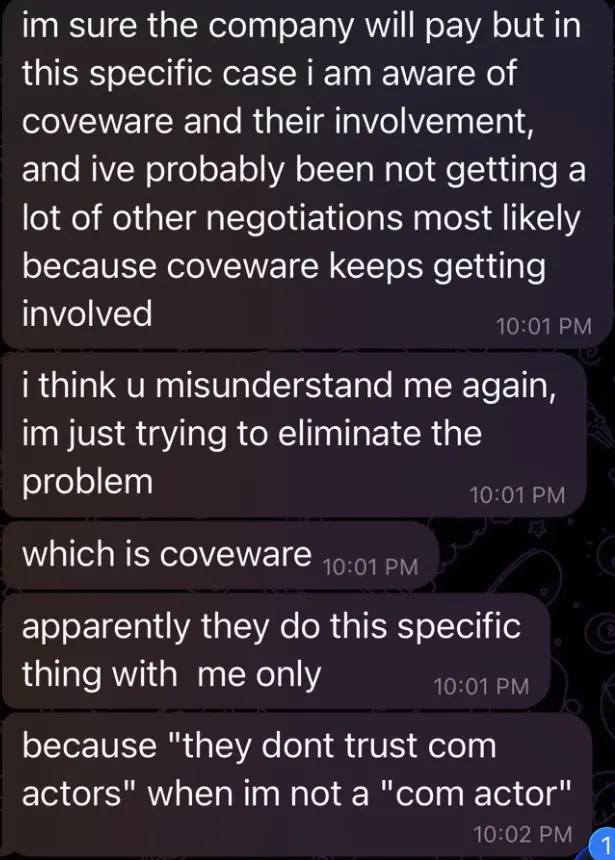
Leaked Telegram chats revealed deep frustration among ShinyHunters leadership regarding Coveware’s staunch anti-payment stance. In a May 6, 2026 chat, the primary ShinyHunters account complained to a co-conspirator:
"Go on my website, majority of those companies would’ve paid if it weren’t for Coveware giving them misinformation… Someone (100% Coveware) is going out of their way to make sure i am not paid."
Another chat from April 2026 explicitly stated the group’s desire to "eliminate the problem"—referring to Coveware’s advisory role. Coveware declined to comment on the leaked messages.

The Inherent Conflict of Interest
Industry veterans have long criticized the financial mechanics governing ransomware negotiations. Mark Camillo, Chief Executive of CyberAcuView—an industry group founded by major cyber insurance carriers—pointed out that firms charging a percentage of the final ransom payment create a toxic, misaligned incentive structure.
"It has come to the industry’s attention that many of the ransomware payers charge a percentage of the final payment which may or may not be disclosed," Camillo observed. "This makes no sense if they are also the negotiator. There needs to be more transparency in the process as no one in the ecosystem should be profiting purely on the size of the ransomware transaction or payment itself."
This conflict has increasingly drawn the ire of the U.S. Department of Justice. Beyond the Dubrovsky case, the DOJ charged MonsterCloud CEO Zohar Pinhasi with wire fraud and conspiracy for allegedly secretly paying hackers $8 million while billing clients $19 million for remediation. Similarly, in July 2026, Florida ransomware negotiator Angelo Martino was sentenced to 70 months in prison for conspiring with the BlackCat/ALPHV ransomware group to betray his own clients’ negotiation strategies to maximize payouts.
Future Outlook
The federal takedown of ShinyHunters leadership and the concurrent prosecution of executives embedded within Western cybersecurity firms mark a watershed moment for the global infosec community. For years, the boundary separating elite incident responders from the extortionists they negotiate with has operated largely in the shadows, governed by non-disclosure agreements, corporate discretion, and the desperate urgency of corporate victims.
The revelation that individuals tasked with corporate defense may have actively colluded with—or built infrastructure for—cybercrime syndicates shatters the illusion of self-regulation within the ransomware negotiation market. As the U.S. Department of Justice and federal investigators press forward with sealed indictments and ongoing probes, the industry faces an uncomfortable reckoning.
Moving forward, regulatory bodies, cyber insurers, and enterprise clients will undoubtedly demand rigorous transparency, absolute separation between remediation and payout facilitation, and strict oversight of cryptocurrency transactions. The arrest of Edward Dubrovsky and the unmasking of the Shinywire enterprise serve as a stark warning to the cyber extortion ecosystem: the veil of professional immunity protecting corrupt actors inside the defense perimeter has officially been pierced.