Executive Overview
In the high-stakes, hyper-optimized world of modern endurance sports, the prevailing narrative has long been one of absolute austerity. The cultural archetype of the marathoner is frequently depicted as an ascetic figure: someone who rises at 4:30 AM without hesitation, logs punishing mileage in sub-zero temperatures, and views physical discomfort not merely as a byproduct of training, but as a moral imperative. For decades, the unwritten rule of distance running was that if it felt easy, you simply weren’t working hard enough.
Berlin-based designer and flight attendant Hong embodies a radical, modern counter-narrative to this exhausting orthodoxy. Once firmly convinced that she was "not a runner," Hong is now training for her seventh official marathon—all while championing a philosophy that places psychological comfort, holistic recovery, and genuine enjoyment at the absolute center of her regimen. Her journey from running skeptic to seasoned endurance athlete challenges the foundational myths of the sport. By proving that consistency does not require misery, Hong offers a compelling blueprint for how busy urban professionals can integrate high-level athletic performance into chaotic, multi-faceted lives without burning out.
This in-depth feature explores Hong’s weekly training blueprint, dissecting how she marries rigorous physiological preparation with a deeply humane, pleasure-oriented approach to movement. From utilizing music as a psychological safety net and incorporating canine pacing partners to balancing international travel schedules with local running communities, Hong’s story is a masterclass in sustainable fitness. As we examine her week-long schedule, underlying training metrics, and broader implications for the running community, a clear message emerges: the future of endurance sports belongs to those who know how to push their limits while keeping a smile on their face.
Detailed Chronology: A Week in the Life of a Comfort-First Marathoner
To understand how Hong maintains her equilibrium while preparing for her seventh marathon, one must examine the mechanics of her weekly routine. Juggling a demanding career in design alongside international flight shifts requires surgical time management, yet Hong refuses to let her training schedule descend into a joyless logistical chore. Here is the chronological breakdown of how she structures her week.
Monday: The Psychology of Momentum and Musical Antidotes
The architectural integrity of Hong’s training week often hinges on Monday—a day when professional obligations threaten to drain her physical and mental reserves. Working simultaneously as a graphic designer and a flight attendant means her calendar is rarely static.
"I can’t afford to lose the sheer joy of running, or I won’t stay consistent," Hong explains.
To combat the dreaded Monday lethargy, she relies on a carefully curated running playlist featuring an eclectic mix of disco, house, and techno. While she does not listen to music on every single run, treating it as an acoustic stimulant ensures that when motivation dips, the music acts as an immediate neural reset.
Monday also highlights Hong’s capacity for spontaneous problem-solving on the road. When mid-run fatigue inevitably threatens to derail her pace, she employs a delightfully idiosyncratic technique: she starts singing.
"If I run out of breath, I shift down a gear and start singing," she notes with a laugh. "It forces me to slow down and get my breathing back under control. The run immediately becomes more fun, and I notice people smiling as I jog past them."
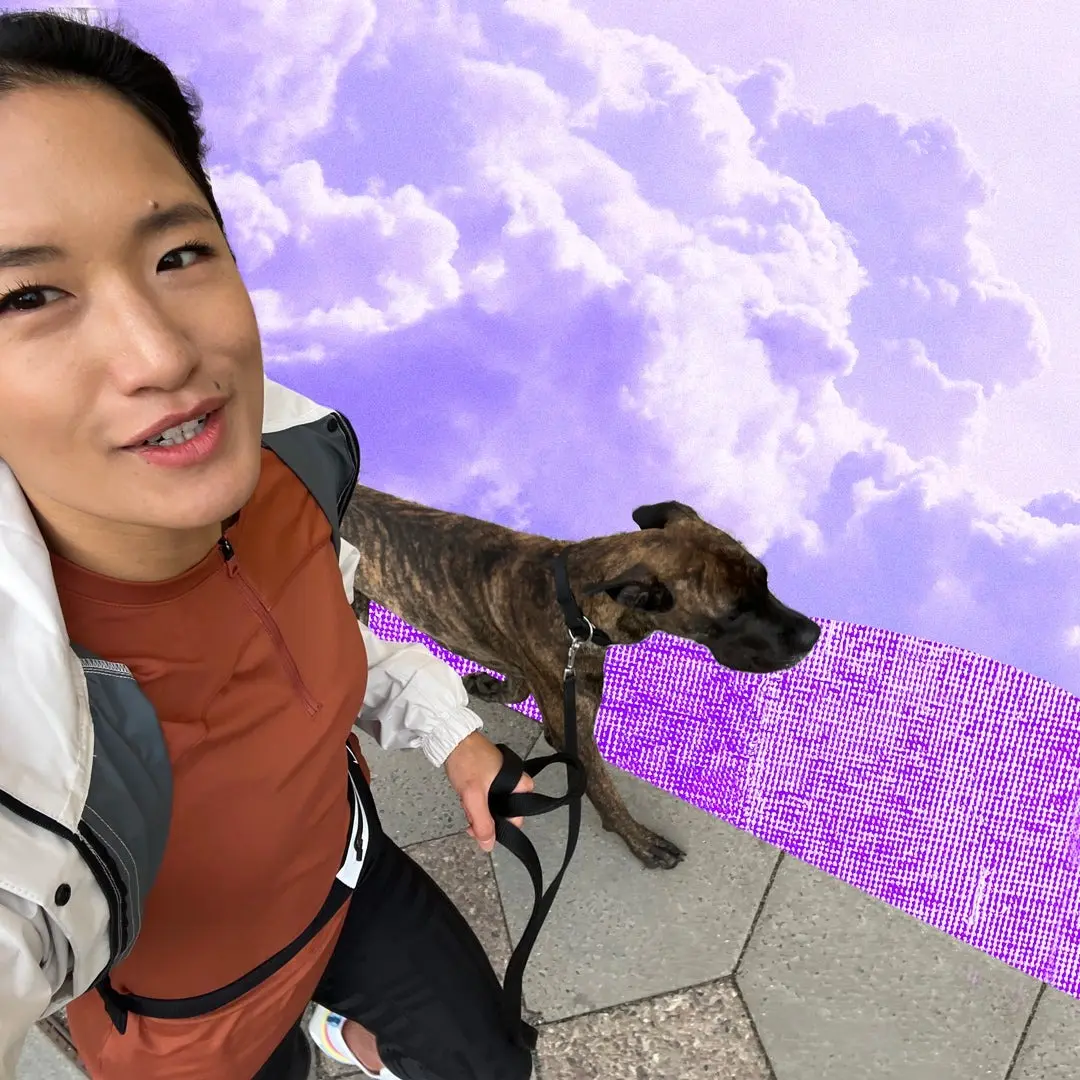
Adding an extra layer of engagement to her Monday session, Hong frequently borrows a friend’s energetic dog, Mia. The canine companion introduces a dynamic pacing element to the outing. Initially, Mia pulls Hong forward with unbridled enthusiasm; by the end of the route, Hong’s superior endurance takes over, and she pulls the dog. It is a symbiotic relationship that turns a standard aerobic recovery effort into an interactive social event.
Tuesday: Cross-Training and the Prevention Paradigm
Marathon preparation is frequently misconstrued as an exclusively linear accumulation of running miles. Hong’s Tuesday routine dismantles this fallacy entirely. On this day, running takes a back seat as she pivots toward holistic physical conditioning.
Her Tuesday regimen consists of targeted yoga sessions, structured strength training designed to bulletproof injury-prone joints, and regular physiotherapy maintenance. Far from being "junk miles" or wasted time away from the pavement, this multidisciplinary approach forms the foundational bedrock of her training block.
"This holistic program helps me when I want to step out of my comfort zone and test my limits during my runs," Hong explains. "It ensures I have a solid physiological basis."
By reinforcing her musculoskeletal system through strength work and mobility training, Hong protects her body from the high-impact stress inherent in marathon training. Consequently, she avoids the debilitating post-run exhaustion that plagues many novice endurance athletes. After a designated rest period—which she treats with the same religious devotion as her hard workouts—she wakes up fully recovered and eager to lace up her shoes once more.
Wednesday: The Art of the Urban Intermission
With international travel forming a core component of her career as a flight attendant, Hong’s weeks are defined by constant transitions between global cities and her home base in Berlin. Wednesday serves as a designated sanctuary for her social and professional life outside of athletics.
Recognizing that the psychological strain of training can be just as taxing as the physical load, Hong deliberately steps away from the stopwatch on Wednesdays. If she is in Berlin, she prioritizes face-to-face reconnections with friends, often visiting local art exhibitions or cultural spaces. This deliberate compartmentalization prevents athletic burnout, ensuring that running remains a passionate hobby rather than an oppressive second job.
Thursday: High-Performance Track Work and Footwear Engineering
If Monday and Wednesday are defined by rhythm and recovery, Thursday is where Hong confronts the raw physical demands of the marathon. Dispelling the myth that elite runners naturally leap out of bed at dawn craving twenty-kilometer speed sessions, Hong admits she frequently requires an extra psychological push.
"Some people think marathoners bounce out of bed at 5:00 AM and run 20 kilometers without a second thought," she says. "In reality, I sometimes need an extra dose of motivation."
To bridge the gap between hesitation and execution, Hong relies on meticulous gear selection. For her high-intensity track workouts—where she pushes her anaerobic threshold and tests her ability to hold aggressive splits—she deliberately chooses the Nike Invincible 3. The shoe’s signature high-stack, responsive foam provides a distinct psychological and physical advantage.
"I love running competitions and challenging myself," Hong states. "During today’s track workout, I test how fast I can run and how long I can hold my pace. I love wearing the Nike Invincible 3 because they give me a secure feeling on any terrain, and I really enjoy the bouncy sole."
Friday: Creative Recovery and Cultural Integration
Coming off the intense physiological stress of Thursday’s track session, Friday is mapped out as an intentional low-intensity recovery window. Aside from a gentle, restorative yoga flow to flush out metabolic waste from her legs, Friday is reserved for urban exploration.
As someone who spends a significant portion of her month traversing time zones, Hong treats her days in Berlin as precious opportunities to immerse herself in the local community. Meeting friends for gallery openings or quiet coffee dates allows her parasympathetic nervous system to take over, lowering cortisol levels and preparing her body for the upcoming weekend mileage block.
Saturday: The Landwehrkanal Ritual and Sensory Landscapes
Saturdays in Berlin belong to the Landwehrkanal. Hong’s standard long-run route winds along this iconic urban waterway, offering a shifting tapestry of tactile surfaces: smooth asphalt, damp grass, and occasionally slick mud.
This run is a masterclass in mindful endurance. With an engrossing podcast playing through her headphones—or sometimes, entirely switched off so she can absorb the ambient auditory backdrop of the city—Hong settles into a sustainable aerobic zone. She watches cyclists, pedestrians, and fellow runners navigate the urban landscape, turning her workout into a moving meditation.
The run culminates in a cherished post-workout ritual: stopping at a local market stall in Kreuzberg for a fresh artisanal coffee and a carefully selected carbohydrate-rich snack. It is a tangible reward system that reinforces the positive psychological loop of her training philosophy.
Sunday: Collective Endurance with the Joy Run Collective
While the midweek miles are often solitary affairs defined by personal introspection, Sunday is strictly communal. As an active member of the Joy Run Collective, Hong converges with fellow Berlin runners for the weekend long-run, typically mapping a route through the sprawling expanses of the Tiergarten.
Because Sunday runs involve extended time on feet and often expose runners to harsh seasonal weather, preparation is key. Hong deliberately layers up to combat the chill, ensuring thermal regulation doesn’t compromise her running economy.
The psychological benefits of running within a structured collective cannot be overstated. "Thanks to my running group, the Joy Run Collective, I’ve found an amazing community," Hong reflects.
The culmination of the Sunday long run is arguably the most anticipated event of her week: a communal brunch hosted by members of the collective. On this particular weekend, the post-run reward features home-cooked dumplings—a culinary carrot she eagerly anticipates throughout every preceding Wednesday and Thursday workout.
Supporting Context & Metrics: The Physiology of Comfort
Hong’s methodology is not merely a lifestyle preference; it is supported by emerging sports science regarding the intersection of psychology, recovery, and endurance performance.
The Metrics of Consistency
Sports physiologists have long noted that the single greatest predictor of marathon success is not the single longest run completed, but rather long-term consistency. In elite and sub-elite coaching circles, this is known as "cumulative volume accrued over time without interruption."
By prioritizing comfort, avoiding overtraining injuries through cross-training, and integrating psychological safety valves (such as her musical playlist and dog-pacing companions), Hong maintains a remarkably low injury incidence rate. While many runners fall into the trap of increasing their mileage too quickly—violating the classic 10% rule and leading to shin splints, plantar fasciitis, or stress fractures—Hong’s integration of yoga, physiotherapy, and planned rest days creates a resilient structural matrix.
The Role of Footwear and Biomechanical Feedback
Hong’s explicit preference for high-cushion, responsive footwear—specifically highlighting the Nike Invincible 3 during high-intensity track sessions—highlights an evolving understanding of perceived exertion. Modern footwear engineering has shifted focus toward reducing impact shock without sacrificing energy return.
For runners navigating busy urban environments with mixed-terrain routes (such as asphalt, gravel, and dirt paths along the Landwehrkanal), a shoe that offers reliable lockdown, stability, and high-energy foam cushioning significantly reduces localized muscle fatigue. When a runner feels physically secure in their equipment, proprioceptive feedback improves, allowing them to relax their upper body and maintain a fluid, economical stride even as fatigue sets in.
Official Perspectives and Expert Insights
To contextualize Hong’s approach within the broader athletic landscape, we turn to movement specialists, run coaches, and sports psychologists who evaluate the modern paradigm of marathon training.
Dr. Elena Vance, Sports Psychologist & Endurance Researcher
"For decades, the endurance sports industry marketed running through the lens of suffering—the ‘no pain, no gain’ mantra that alienated millions of potential participants. What Hong demonstrates is a sophisticated understanding of intrinsic motivation. When you reframe training around joy, comfort, and community rather than self-flagellation, your brain associates the activity with safety and reward rather than stress. This dramatically improves long-term adherence and psychological resilience on race day."
Marcus Thorne, Elite Running Coach and Biomechanist
"There is a dangerous misconception that elite training must feel miserable. In reality, roughly 80% of an elite marathoner’s volume is performed at an easy, conversational pace. Hong has intuitively stumbled upon this golden rule of polarized training, while applying it to her lifestyle. By anchoring her hard track sessions with heavy recovery protocols, strength work, and community bonding, she is building an aerobic engine that can sustain 42.2 kilometers without burning out her nervous system."
Future Outlook: The Horizon and the 7th Marathon
As Hong looks ahead to her seventh official marathon, her journey serves as a powerful proof of concept for a new generation of urban runners. Having started her running journey just four years ago at age 26, she now finds herself at age 30, physically healthier, stronger, and more self-assured than she ever was throughout her twenties.
Her trajectory proves that athletic evolution does not require sacrificing one’s professional ambitions, social life, or personal comfort. By systematically dismantling the false dichotomy between hard work and happiness, Hong has forged a sustainable path toward endurance excellence.
As she laces up her shoes for her upcoming blocks—backed by the rhythmic beats of her techno playlist, the supportive strides of the Joy Run Collective, and the comforting cushion of her running shoes—Hong’s message to the running world is unequivocal:
Consistency and comfort do not have to be mutually exclusive. You can establish rigorous new boundaries, chase ambitious athletic goals, and still enjoy every single step of the journey. Next stop: the start line of her seventh marathon.
Hong’s 3 Golden Rules for Maximum Running Enjoyment
For runners looking to inject more joy, longevity, and sustainability into their daily training routines, Hong distills her philosophy into three core takeaways:
- Prioritize Footwear and Biomechanical Security: Invest in running shoes that offer reliable grip across mixed terrains and responsive, high-cushion soles that protect your joints and boost your confidence on every stride.
- Curate Your Psychological Safety Net: Never underestimate the power of an inspiring playlist (spanning disco, house, or techno) or an engaging running partner to pull you through low-energy days.
- Connect Movement with Milieu: Pair your miles with beautiful routes, vibrant running communities, and a delicious, intentional post-run reward (whether it’s an artisanal coffee or a plate of warm dumplings) to turn training into an event you genuinely look forward to.