Executive Overview
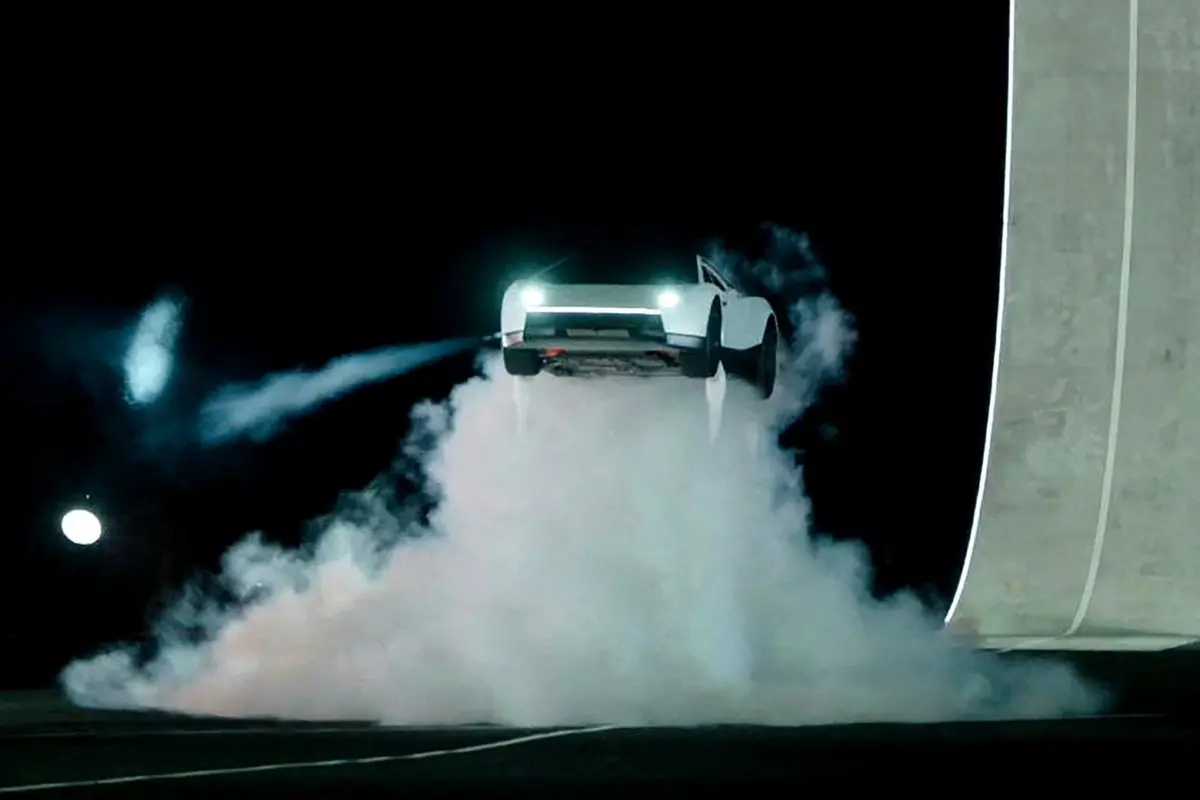
For nearly a decade, automotive enthusiasts, tech investors, and the global press have waited with bated breath for the promised follow-up to Tesla’s original Roadster. When Elon Musk finally took the stage in Texas under the flashing lights and roaring approval of a devoted crowd, he delivered a spectacle that defied conventional automotive logic. Declaring that "what you see with your eyes, you will not believe," Musk introduced a vehicle engineered not just for asphalt, but for the skies—utilizing SpaceX-designed gas thrusters to achieve jaw-dropping acceleration and momentary bursts of actual flight.
Yet, behind the blinding pyrotechnics, the nostalgic nods to the 1970s Lotus Esprit, and the science-fiction theatrics of a car that briefly elevates on a cushion of compressed air, lies a much larger strategic reality. The unveiling of the new Roadster is not the triumphant rebirth of Tesla as a traditional car company; rather, it is the ceremonial sunsetting of one era and the calculated introduction of another.
Industry analysts, financial insiders, and close watchers of Musk’s corporate empire are increasingly reading between the lines: the "flying car" is a brilliant Trojan horse designed to pave the way for the mother of all corporate maneuvers—a massive, multi-trillion-dollar megamerger between Tesla and SpaceX. As Tesla transitions away from being a pure-play electric vehicle manufacturer toward an autonomous, artificial intelligence, and humanoid robotics enterprise, absorbing SpaceX has become the ultimate financial lever to sustain Musk’s hyper-ambitious, capital-intensive vision for the future.
Detailed Chronology: From the Original Roadster to the Texas Spectacle
The path to the recent Texas reveal has been paved with broken timelines, escalating promises, and paradigm-shifting technological pivots. To understand where Tesla is going, one must examine the chronological arc of its product evolution and public relations campaigns.
The Genesis of the Roadster (2008–2017)
Tesla’s corporate journey began with the original Lotus-based Roadster, a vehicle that proved electric vehicles could be fast, sexy, and desirable. In 2017, Musk stunned the automotive world by announcing a second-generation Roadster, promising a 0-to-60 mph time of 1.9 seconds, a 620-mile range, and an optional "SpaceX package" featuring cold-gas thrusters. True believers eagerly plunked down $50,000 reservation fees—and up to $250,000 for the limited Founder Series—assuming delivery would happen by 2020.
The Great Delay and the Pivot to Autonomy (2020–2024)
As years passed, the Roadster was repeatedly pushed to the back burner while Tesla focused on scaling the mass-market Model 3 and Model Y, and later, launching the polarizing Cybertruck. During this hiatus, Musk’s ideological center of gravity shifted decisively away from passenger cars toward artificial intelligence, full self-driving (FSD) software, the Cybercab robotaxi platform, and the Optimus humanoid robot. The traditional automotive business, once seen as Tesla’s ultimate destination, was increasingly treated by Musk as a mere financial engine to fund a grander artificial intelligence enterprise.
The Texas Unveiling (Late 2025/2026)
The long-delayed vehicle finally took center stage in a meticulously choreographed production in Texas. Tesla erected a gigantic C-shaped ramp where the Roadster ascended, utilized a downforce-generating fan system to defy gravity upside down, and blasted free in a roll of compressed air before jumping over a lineup of parked Teslas. Musk announced new pricing tiers: $50,000 for the "Performance" trim, $250,000 for the "Thrust" version, and an invite-only, undisclosed sum for the "Rocket" trim equipped with SpaceX thrusters. Deliveries, naturally, were penciled in for 2028. But for seasoned market observers, the true message of the night had nothing to do with commercial sports cars. It was about corporate destiny.
Supporting Context & Metrics: The Changing Financial Landscape of Tesla
To comprehend why a merger with SpaceX is not merely possible, but increasingly logical, one must analyze the shifting financial metrics and macroeconomic pressures currently facing Tesla.
Cooling Margins and Stagnant Product Lines
For fiscal year 2025, Tesla delivered over 1.6 million manually drivable vehicles, generating roughly $95 billion in revenue—predominantly from its automotive division, supplemented by energy storage and solar initiatives. On paper, these figures sound robust. However, beneath the surface, profit margins are under severe pressure.
Tesla has not introduced a brand-new, non-commercial, consumer vehicle platform since the Cybertruck in 2019. Furthermore, the company effectively ended production of its higher-margin luxury sedan (Model S) and mid-size SUV (Model X), leaving the Model 3 and Model Y to shoulder the entire revenue burden.
Regulatory Headwinds and Global Competition
The broader operating environment has also deteriorated significantly:
- Fierce International Competition: Aggressive, low-cost Chinese automakers have captured substantial global market share, particularly in Europe.
- Political Fallout: Musk’s outspoken political alignments and support for right-wing European parties created localized consumer backlashes, further depressing foreign sales.
- Regulatory Credits: Governments have steadily phased out or modified the lucrative regulatory credits that historically provided billions in high-margin income to Tesla’s bottom line.
- U.S. Tax Policy: Fluctuations and rollbacks in federal electric vehicle tax credits have softened domestic demand across the board.
The Capital Demands of A.I. and Robotics
While its core automotive margins compress, Tesla’s capital expenditures are skyrocketing. The pivot toward artificial intelligence requires billions of dollars in specialized data-center construction to rival tech behemoths like OpenAI and Anthropic. Musk’s grand roadmap includes producing millions of Cybercabs—vehicles engineered completely without steering wheels or pedals—and manufacturing armies of Optimus humanoid robots, which he claims will eventually push Tesla’s market capitalization from $1.4 trillion to an astronomical $25 trillion.
Financing this immense technological pivot purely through traditional car sales is no longer viable. Tesla needs a financial lifeline with unmatched capital-raising power. Enter SpaceX.
Official Statements & Industry Analysis
Financial analysts and industry insiders have increasingly voiced the opinion that keeping Tesla and SpaceX as separate entities is an artificial corporate barrier in the way of Musk’s ultimate ambitions.
The Wall Street Consensus
Prominent market analysts, including Barclays analyst Dan Levy, have publicly noted that a merger between Tesla and SpaceX is no longer a wild fringe theory; in financial circles, it is viewed as a high-probability corporate restructuring.
Under a prospective acquisition framework, SpaceX would theoretically acquire Tesla, allowing current Tesla shareholders to swap their equity for shares in a combined, privately-or-publicly traded mega-entity. Such a fusion would immediately create a colossal corporate titan with an estimated valuation eclipsing $3.5 trillion.
Musk’s Long-Term Vision
While Musk has historically maintained separate corporate shells for his ventures—Tesla, SpaceX, xAI, Neuralink, and The Boring Company—the technological synergies between them have never been tighter. SpaceX provides the propulsion, materials science, and aerospace engineering prowess; Tesla provides the mass-manufacturing expertise, battery chemistry, electric powertrains, and artificial intelligence neural networks.
By integrating SpaceX’s unparalleled capital-raising prowess—bolstered by lucrative defense contracts, global satellite internet operations (Starlink), and interplanetary ambitions—with Tesla’s manufacturing infrastructure, Musk can effectively subsidize the painful, capital-heavy transition from a declining car company into a dominant robotics and space-infrastructure enterprise.
Future Outlook: The Galactic Mega-Entity
What does the horizon hold for consumers, investors, and the global technology sector as this corporate convergence approaches?
- The Twilight of the Traditional Tesla: The traditional car-manufacturing identity of Tesla is drawing to a close. Musk has explicitly stated that the new Roadster will be the last manually drivable vehicle the company ever builds. Future lines will be entirely dedicated to autonomous transport fleets (Cybercabs) and general-purpose labor (Optimus).
- The SpaceX Absorption: Expect mounting financial speculation and preparatory corporate restructuring regarding the SpaceX-Tesla merger. As the capital requirements for orbital data centers, artificial intelligence training clusters, and planetary colonization scale upward, unifying the balance sheets becomes an operational necessity.
- The Caveat Emptor Reality of Consumer Promises: For the retail customers who have placed deposits on the $250,000 "Thrust" Roadster or the invite-only "Rocket" edition, patience will be tested. Given historical precedents with Musk’s product rollouts, a 2028 delivery date should be viewed through a lens of healthy skepticism.
Ultimately, the dazzling display of thrusters, compressed air, and momentary flight in Texas was never really about selling sports cars to earthly commuters. It was a calculated theatrical flourish—a signal flare from the world’s most eccentric billionaire announcing the birth of a galactic mega-entity that will forever reshape the boundaries of technology, finance, and industrial might.