In an era dominated by instantaneous digital consumption, the lifecycle of a contemporary photograph has grown aggressively predictable. A shutter clicks; film is advanced, transported to a darkroom, meticulously developed, and transformed into contact sheets. Days are spent burning and
dodging in the darkroom, scanning negatives, and hunting for microscopic dust motes on a backlit monitor. The final image is then exported, uploaded to a social media platform, and cast into the digital ether—where its success is measured entirely by algorithmic favor and fleeting double-taps.
For many image-makers, this digital purgatory feels like a tragic end for a medium rooted in tactility, patience, and physical presence. Enter Finnegan Travers and Fergus Riley, two independent photographers and darkroom practitioners who looked at their overflowing hard drives and dusty print boxes and decided enough was enough.
Their solution is Handover, the debut publication from Pig Iron Works, the independent publishing house they founded together. Bringing together 27 photographers across the creative cultural hubs of London and Manchester, the photobook serves as a physical sanctuary for overlooked, deeply personal imagery. Rather than commissioning glossy, high-budget editorials or asking contributors to produce fresh content for the algorithm, Travers and Riley built a bridge between communities, inviting artists to unearth the "vagrant images yearning for a home" that had long been relegated to digital obscurity.
Spanning three distinct, poetically curated chapters—Even Seeing a Rainbow in the City is Rare, Lust and Laundry, and The Fable—Handover is more than just a collection of photographs. It is a rebellion against algorithmic homogeneity, a cross-city dialogue, and a masterclass in independent publishing that reminds the creative community of a fundamental truth: photography is an inherently solitary pursuit, but it doesn’t have to be a lonely one.
Detailed Chronology: From West Country Roots to a Manchester-London Axis
The genesis of Handover reads like a classic modern creative collaboration, born out of serendipity, shared geography, and a mutual reverence for traditional darkroom culture.
The story truly begins with Finnegan Travers co-running Contact, a dedicated darkroom nestled in the south-west of England. Travers had spent considerable time pondering what a physical correspondence between different darkrooms, regional communities, and urban centres might look like. He envisioned a network that could link isolated pockets of artists who were doing incredible work away from the hyper-saturated spotlights of major commercial capitals.
That vision found its missing half in 2024 at a group photography exhibition, where Travers bumped into Fergus Riley. Both men grew up in the West Country, leading to an immediate, colloquial recognition. As Riley recalls with a smile, it was a classic "’Yes mucker, I know you!’" moment—the kind of instant camaraderie that bridges past histories and shared cultural references.
Before long, the conversation turned to their mutual admiration for Manchester’s Pollard Street Photo, a revered darkroom and artist collective. Travers describes the photographers operating out of Pollard Street as "an outrageously talented crew," and the desire to build a conceptual and physical bridge between them and the London creative scene quickly took root.
However, the ambition to connect these regional hubs was fueled by a growing sense of creative exhaustion. Travers articulates a sentiment felt by countless modern image-makers:
"We spend god knows how much time thinking about ideas, what makes us tick. We put it together and photograph it. We then develop and process the film, take the negs to the darkroom, make contact sheets, spend days printing, scan the image, remove dust like a junkie looking for a vein, edit it and then what? Put it on a social media platform for our phones and hope it gets a little heart."
This frustration catalyzed their manifesto: rather than forcing contributors to generate shiny new portfolios tailored for digital feeds, the editors asked them to look backward. They dove into old print boxes and neglected hard drives to rescue neglected photographs.
Originally, the project wasn’t conceived as a single volume. It was mapped out as three separate books, functioning as a series of creative assignments sent to participating photographers two months apart. Each assignment was accompanied by a custom poem to set an evocative emotional tone. Over the course of a year, this sprawling, multi-city archive was painstakingly organized, refined, and structured in close collaboration with London-based design duo SM Studio—comprising Molly Cranston and Safiye Gray. The result is a cohesive physical object that honors the rhythm of its creation.
Supporting Context & Metrics: Inside the Three Chapters of Handover
Structured across three evocative themes, Handover curates 27 distinct artistic voices into a continuous visual conversation. The sequencing avoids conventional categorization, allowing images of raw intimacy to sit comfortably alongside mundane urban observations.
Chapter 1: Even Seeing a Rainbow in the City is Rare
The opening chapter confronts the urban landscape with a tender, almost poetic realism. It features Will Corry’s striking photograph Pigeons in the Light, which captures feral city birds congregating on a sun-dappled street, delicately picking their way between hard geometric shadows and golden illumination.
Finnegan Travers holds a deep affection for Corry’s work, comparing him to a "Yorkshire cup of tea: perfect every day, in every way." Speaking on Pigeons in the Light, Travers notes how the image elevates the mundane:
"It’s so familiar to the cities we occupy, the everyday glorified by the pigeon itself. Our very own eagle of the British Empire."
This chapter sets the pace for the book, proving that profound beauty doesn’t require exotic locales; it merely demands an attentive eye capable of finding grace in the concrete cracks of daily life.
Chapter 2: Lust and Laundry
Shifting inward, the second chapter explores the delicate threshold of domesticity, vulnerability, and private spaces. Celia Croft contributes an arresting image of her boyfriend sprawled naked across an unmade bed, with an electric fan hovering nearby to cut through the heavy air. The frame captures the visceral atmosphere of a slow, humid morning that has yet to properly begin.
Travers, who first crossed paths with Croft at London’s Assembly Darkroom, is an unreserved admirer of her unflinching artistic identity. "She genuinely is in my top five favourite photographers of all time… But she is her work, and I love that about her photography," he shares.
When asked to unpack the emotional weight of Croft’s bedroom snapshot, Travers condenses a complex emotional landscape into a brilliant, poetic micro-review:
"Heatwave, hangover, morning chorus, anxiety, depression, love. It says it all."
Chapter 3: The Fable
The final chapter delves into narrative ambiguity, memory, and surreal nocturnal passages. Travers highlights Luke Pickering’s blue-toned study of a brutalist tower block, framed carefully through a windowpane and indoor foliage. Affectionately dubbing Pickering "basically the Takashi Homma of the North; the man loves him some cyan," Travers points to the distinctive color grading that unifies Pickering’s atmospheric explorations.
Meanwhile, Fergus Riley gravitates toward the deeply personal work of Millie Noble, whose ongoing photographic documentation of her grandmother explores aging, memory, and the fascinating parallels between her grandmother’s past life as a painter and Noble’s own evolving photographic path. Riley describes these frames as "so personal and tender."
The book reaches its crescendo with Sirus Gahan’s 00:00 January 1st 2025. The image is a blurry, dreamlike tableau capturing fireworks exploding in a shadowy, smoke-filled sky while two anonymous figures embrace tightly beside a glowing streetlamp.
"I swear some of his [images] can’t be real," Riley marvels. "It asks so many more questions than it answers, just as the best photographs should."
Official Statements & Industry Impact
The release of Handover arrives at a critical juncture for independent publishing and analog photography. As major tech platforms continue to alter their algorithms, burying independent artistic content beneath reels and sponsored advertising, physical print has experienced a fierce renaissance. Yet, publishing a photobook featuring 27 distinct artists across multiple cities remains an immense logistical and financial hurdle—one that Pig Iron Works has navigated with fierce independence.
The philosophical core of Handover centers on dismantling the isolation inherent in contemporary image-making. Photography, by its very nature, often demands solitude: hours spent alone behind the camera, isolated in the darkroom, or hunched over a glowing screen editing digital files.
Reflecting on this reality, Travers notes:
"Photography is a lonely process. The least we can do is talk a bit more."
This sentiment is echoed by co-founder Fergus Riley, who views the project as an antidote to the fractured digital landscape:
"It’s been beautiful to see how keen people are to collaborate and connect as we need more of that. I hope people can get lost in the book, stringing together photographs in their own way and find connections we might not have seen ourselves."
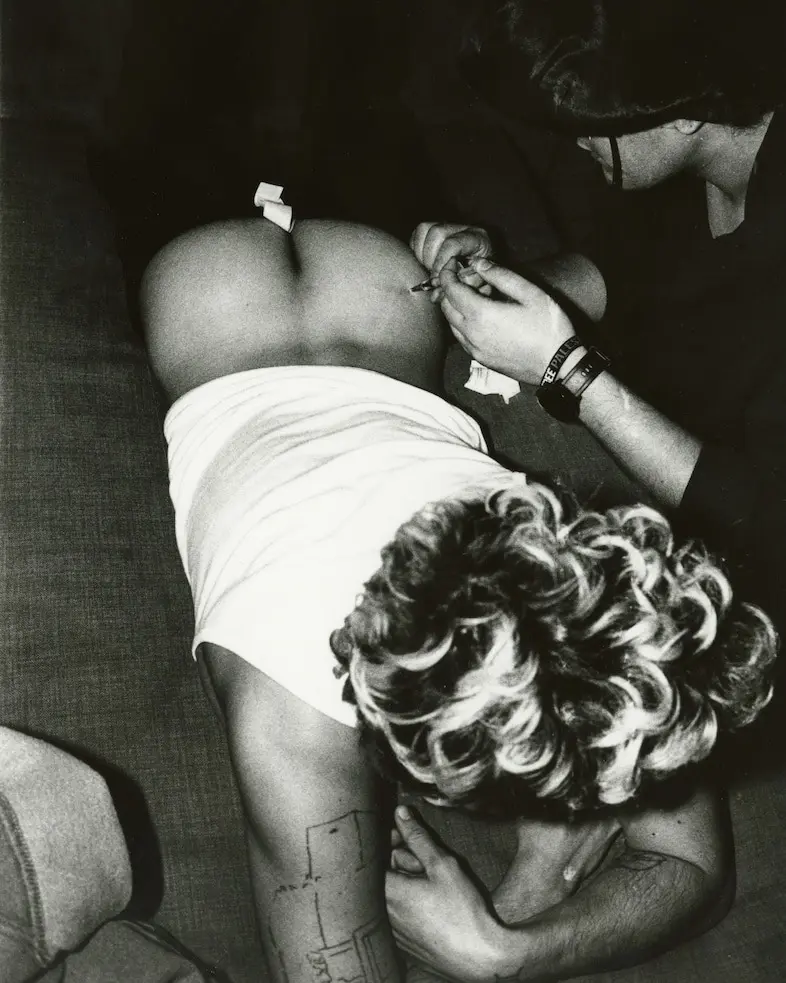
By forcing images out of the digital cloud and onto heavy, tactile paper stock, Pig Iron Works has created a physical ecosystem where artists can converse across city lines. A Jesse Glazzard capture of a stick-and-poke tattoo taking shape on a cheek now shares spatial harmony with Kaan Olcay’s grainy black-and-white framing of an empty American street. The physical proximity allows viewers to forge their own narrative threads, rescuing these visual fragments from oblivion and granting them permanent residency in the physical world.
Future Outlook: The Blueprint for Independent Publishing
As Handover makes its way into the hands of collectors, bookshops, and photography enthusiasts worldwide, it establishes a powerful precedent for how independent ventures can operate outside major commercial publishing houses. By prioritizing community over content mills and tactile permanence over fleeting digital impressions, Pig Iron Works has carved out a vital space for contemporary British photography.
The success of Handover points toward a broader cultural fatigue with the digital status quo. Creators and audiences alike are actively seeking refuge in slower, more deliberate formats. Photobooks are no longer just luxury items for coffee tables; they are functioning as community archives, manifestos, and tangible proofs of existence in an increasingly ephemeral digital age.
For Travers and Riley, the journey of Pig Iron Works has only just begun. While Handover successfully bridges the creative divides of London and Manchester through the quiet rescue of unmoored archives, it also signals an open invitation to the wider photographic community. As the art world grapples with the future of authenticity in image-making, projects like Handover offer a clear, reassuring path forward: turn off the screen, open the print box, and start talking to each other.