Executive Overview
In modern cloud-native architectures, containerization has transformed how organizations build, ship, and scale applications. Technologies like Docker and orchestration tools like Amazon Elastic Container Service (Amazon ECS) have made it trivial to spin up hundreds or thousands of microservices within minutes. However, as organizations scale their container fleets, a distinct operational bottleneck inevitably emerges at the perimeter: ingress networking.
Traditionally, configuring incoming traffic for containerized applications at scale has required platform engineering teams to perform a labyrinth of manual or semi-automated provisioning tasks. For every microservice introduced into an ECS cluster, engineers have historically had to provision, configure, and bind a distinct Application Load Balancer (ALB), generate and validate AWS Certificate Manager (ACM) SSL/TLS certificates, configure AWS WAF web access control lists (web ACLs), and establish intricate security group rules. Furthermore, maintaining these resources as services scale horizontally, undergo rolling updates, or sunset presents an ongoing maintenance burden. This per-service overhead not only throttles deployment velocity—often referred to as time-to-market—but also introduces the persistent risk of configuration drift, security gaps, and ballooning infrastructure costs.
To solve this systemic enterprise challenge, Amazon Web Services (AWS) has announced the general availability of Amazon ECS Gateway. This newly introduced, account-level resource completely reinvents how platform and application teams handle ingress networking. By abstracting the heavy lifting of load balancer provisioning, DNS assignment, certificate management, and security rule orchestration, Amazon ECS Gateway automates the entire ingress lifecycle.
Operating under a cost-optimized, multi-tenant model that allows up to 25 services to safely share a single Application Load Balancer, the feature establishes a clear demarcation line of responsibilities: platform teams define governance, networking parameters, and security policies centrally, while application teams simply connect their services via a declarative connector. Available immediately across all commercial AWS regions at no additional software charge, Amazon ECS Gateway marks a major leap forward in cloud platform engineering.
Detailed Chronology: The Evolution of ECS Ingress Management
To fully understand the significance of Amazon ECS Gateway, it is helpful to examine the historical trajectory of ingress networking on AWS and the architectural friction points that prompted this innovation.

The Era of Manual and Scripted Provisioning
In the early days of container orchestration, platform teams relied heavily on custom automation scripts—often written in Python, Bash, or embedded within Infrastructure as Code (IaC) frameworks like Terraform and AWS CloudFormation—to stitch together ECS services and Elastic Load Balancing (ELB) targets. Every time a development squad spun up a new microservice, an entire networking stack had to be provisioned alongside it.
While tools like AWS Fargate and ECS removed the undifferentiated heavy lifting of managing underlying EC2 virtual machines, the network edge remained stubbornly complex. Engineers spent significant cycles debugging target group health checks, managing ALB listener rule limits (which historically restricted the number of paths or hosts per listener), and wrestling with CloudFormation deployment ordering issues.
The Rise of Service Meshes and App Meshes
As microservices architectures grew in density, AWS and the broader tech industry introduced service meshes (such as AWS App Mesh and Istio) to handle service-to-service communication. While these tools excelled at internal east-west traffic management, north-south traffic—ingress routing from the public internet or corporate datacenters into the cluster—remained tethered to traditional load-balancing constructs. Platform teams still found themselves creating dedicated ALBs for minor services, driving up idle infrastructure costs and complicating compliance audits.
The Birth of Amazon ECS Gateway
Recognizing that ingress management had become a primary friction point for platform engineering organizations, AWS development teams embarked on creating a native, account-level solution. The goal was simple yet ambitious: decouple the lifecycle of containerized workloads from the lifecycle of the underlying load-balancing infrastructure, without sacrificing security, observability, or performance.
Development culminated in the launch of Amazon ECS Gateway, an integrated capability that provides intelligent, automated host-based routing. By allowing multiple services to share ALBs dynamically, ECS manages the infrastructure threshold automatically—provisioning the first ALB when a service connects, scaling out additional load balancers as capacity limits are approached, and gracefully tearing them down when services are decommissioned.

Architectural Deep Dive: How ECS Gateway Works
Amazon ECS Gateway introduces a robust, many-to-many relationship model between gateways and clusters, fundamentally altering how traffic flows into container environments.
Many-to-Many Architecture and Boundaries
Under the hood, a single ECS Gateway can be associated with up to 10,000 distinct ECS clusters, while a single ECS cluster can support up to five concurrent gateway associations. This architectural flexibility empowers platform teams to structure their environments precisely according to organizational and security needs. For instance, an enterprise can maintain a strict separation of concerns by deploying dedicated "Public-Facing" and "VPC-Internal" gateways, mapping them to shared clusters based on data classification and access requirements.
+-------------------------------------------------------------------+
|                        AWS Account Boundary                       |
|                                                                   |
|   +-----------------------+           +-----------------------+   |
|   |  Public ECS Gateway   |           | Internal ECS Gateway  |   |
|   +-----------------------+           +-----------------------+   |
|               |                                   |               |
|               +-----------------+-----------------+               |
|                                 |                                 |
|                                 v                                 |
|                     +-----------------------+                     |
|                     |      ECS Cluster      |                     |
|                     +-----------------------+                     |
|                      /          |                                |
|                     v           v           v                     |
|                 [Service]   [Service]   [Service]                 |
+-------------------------------------------------------------------+
Separation of Responsibilities
The architecture enforces a strict division of labor between platform engineers and developers:
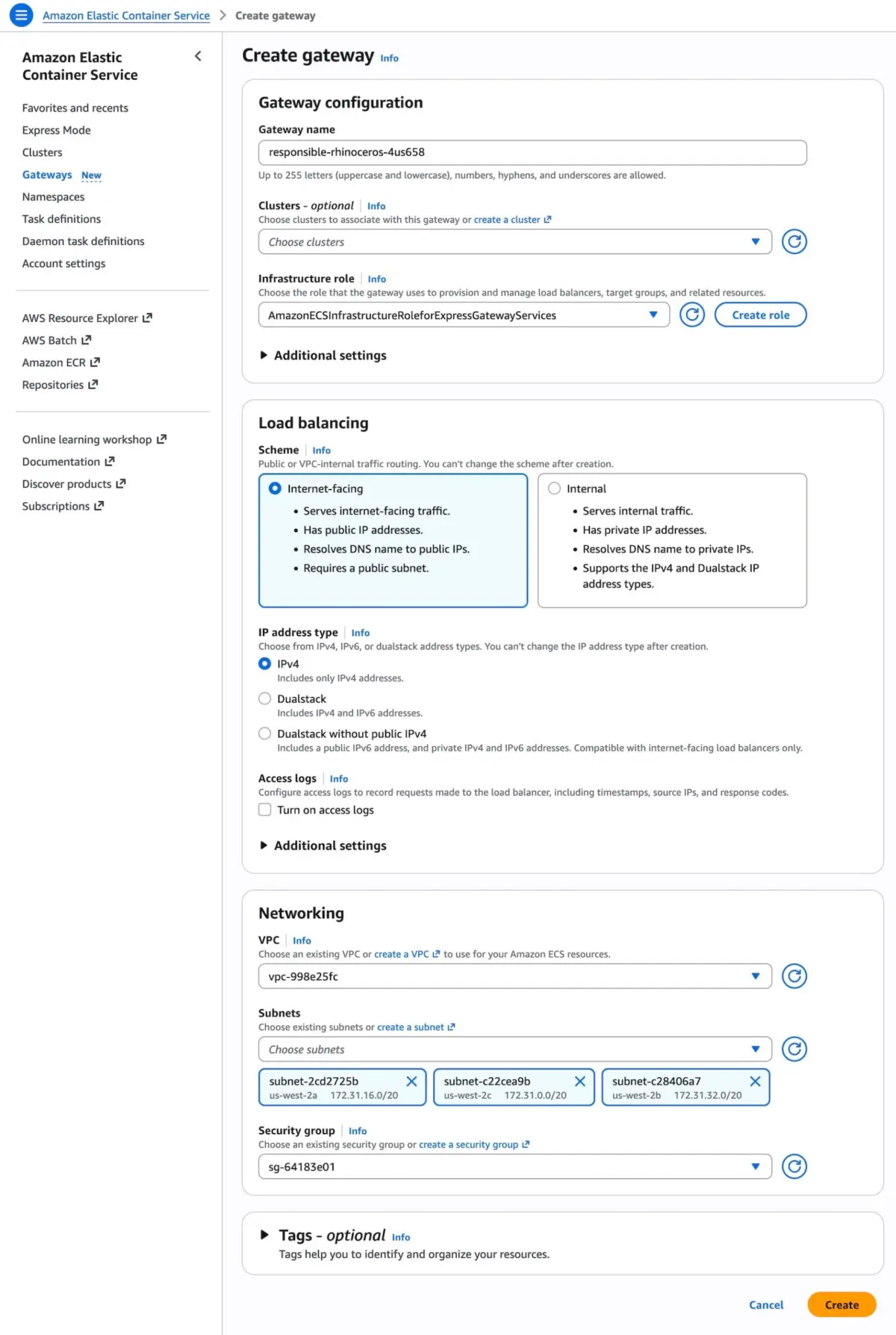
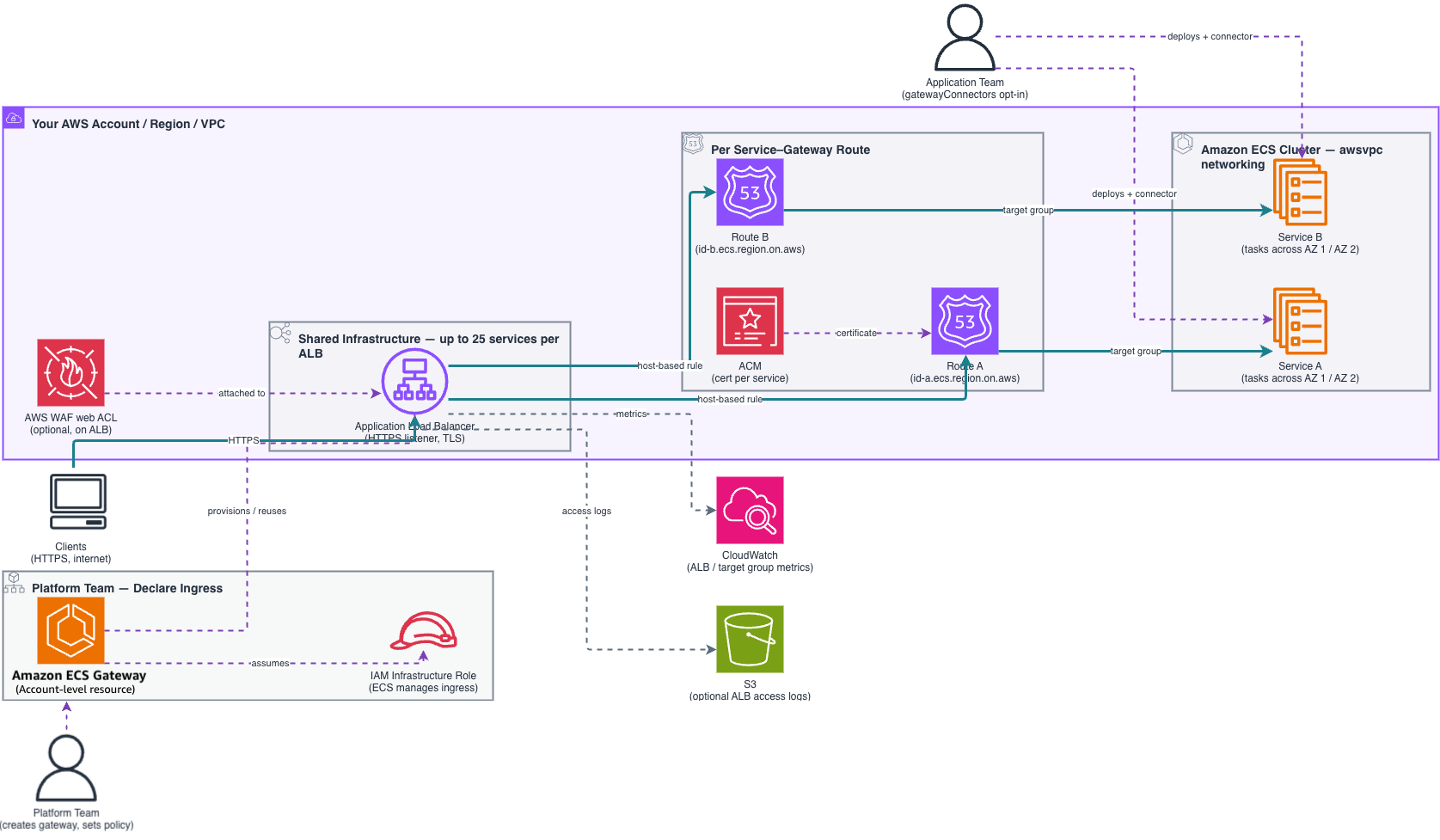
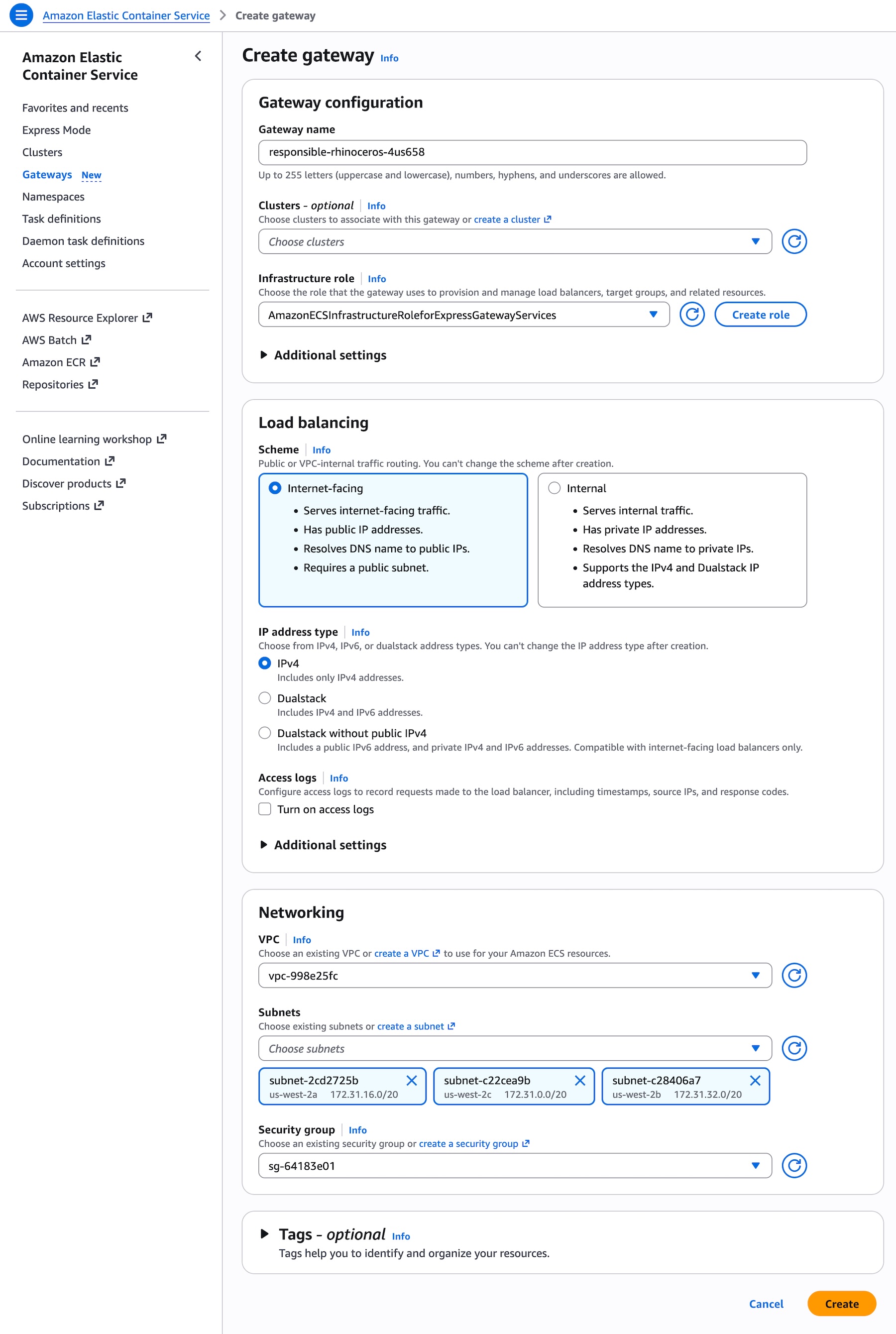
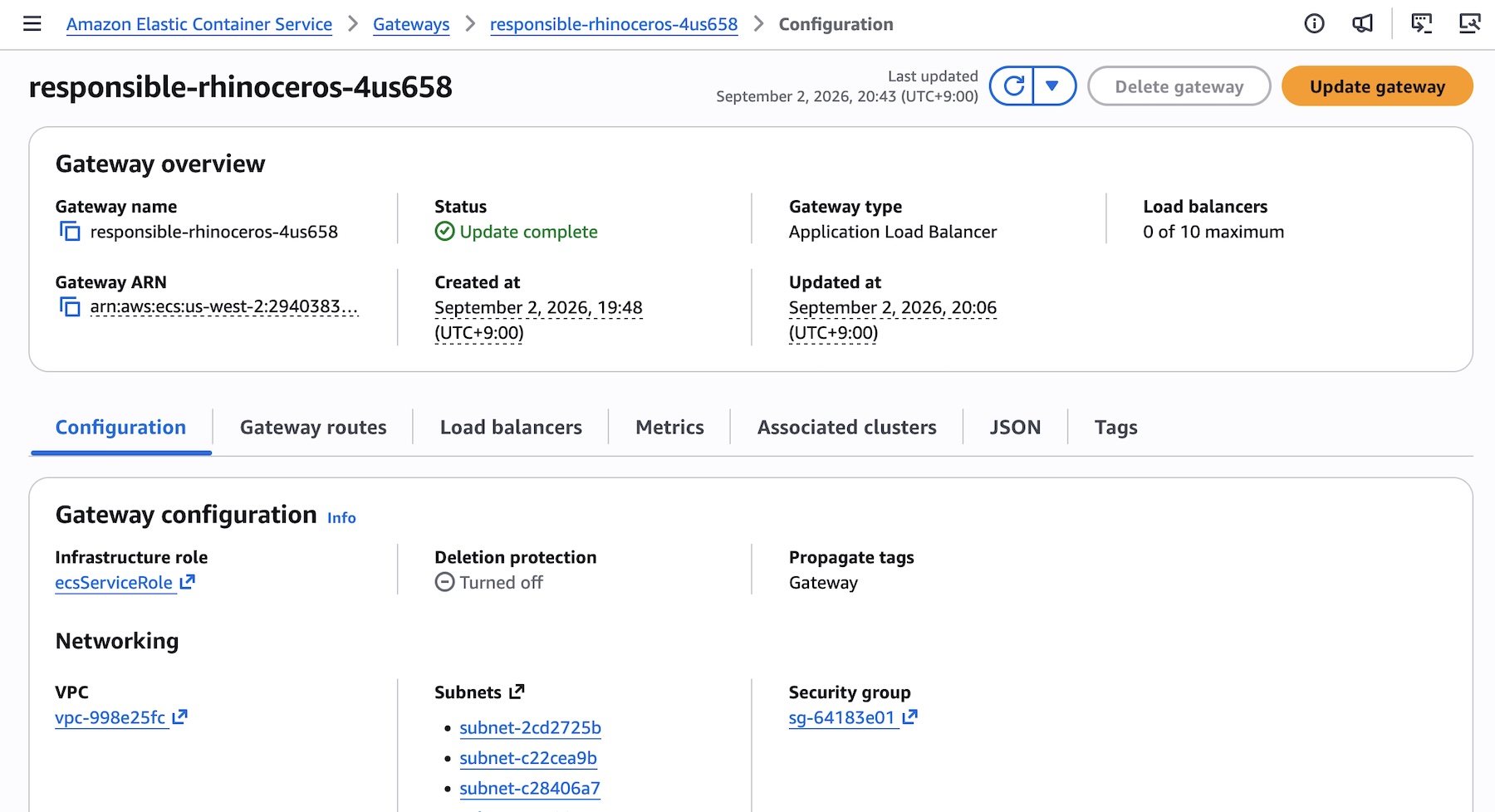
- Platform Teams (The Guardrails): Platform engineers create the gateway resource via the AWS Management Console, AWS CLI, or Infrastructure as Code tools. They define foundational parameters such as Virtual Private Cloud (VPC) subnets, security schemes (internet-facing vs. internal), IAM infrastructure roles, Web ACL associations, and listener configurations. Once established, developers cannot alter these core network parameters, ensuring strict compliance with corporate security baselines.
- Application Teams (The Agility): Developers do not need to concern themselves with load balancer ARNs, target group ports, or DNS mapping. When defining or updating an ECS service, developers simply include a gateway connector block in their service definition. Amazon ECS automatically handles the wiring, provisioning a unique DNS hostname, an ACM certificate, and listener routing rules instantly.
Behind the Scenes: Provisioning and Lifecycle Automation
When an application team connects a service to a gateway, Amazon ECS initiates a sophisticated reconciliation loop:
- Compatibility Check: ECS evaluates whether the gateway matches the service’s requirements (access type, VPC alignment, and Availability Zone coverage across configured subnets).
- Capacity Evaluation: ECS inspects existing ALBs associated with the gateway. If an ALB has available capacity (sharing up to 25 services per ALB), the service is bound to it. If capacity is exhausted, ECS automatically provisions a new ALB up to the user-defined
maxAlbCountquota limit. - Resource Orchestration: ECS provisions dedicated per-service components:
- An ACM certificate for secure HTTPS transit.
- A unique, ready-to-use DNS hostname.
- A listener rule routing traffic destined for that hostname directly to the service’s target group.
- A tightly scoped service security group permitting inbound traffic exclusively from the ALB security group.
Once initialization finishes, the gateway route transitions to an ACTIVE state, and the service endpoint begins accepting production traffic immediately.
Step-by-Step Implementation Guide
To illustrate how seamlessly platform and application teams can leverage this feature, let us walk through the creation of an ECS Gateway using the AWS Command Line Interface (CLI) and configure a service to consume it.
Step 1: Creating an ECS Gateway
First, the platform team provisions the gateway at the account level. This requires an IAM infrastructure role that grants ECS permission to manage ALBs, security groups, and certificates on your behalf.
aws ecs create-gateway
  --name enterprise-prod-gateway
  --infrastructure-role-arn arn:aws:iam::123456789012:role/ECSGatewayInfrastructureRole
  --configuration '
    "HostSharedAlb":
      "networkConfiguration":
        "subnets": [
          "subnet-080779f9bd887757a",
          "subnet-03d5b2fead6bc6258",
          "subnet-0861210a397d31252",
          "subnet-06539e194023cb77a"
        ],
        "ipAddressType": "ipv4"
      ,
      "scheme": "internet-facing"

  '
Step 2: Associating the Gateway with an ECS Cluster
Once the gateway is successfully initialized, the platform team maps it to one or more production clusters so that workloads running within those clusters can access the gateway infrastructure.
aws ecs associate-gateway-with-cluster
  --gateway enterprise-prod-gateway
  --cluster arn:aws:ecs:us-east-1:123456789012:cluster/production-core-cluster
Step 3: Connecting an Application Service
With the networking infrastructure primed and associated, application developers can attach their containerized services to the gateway. This can be executed during initial service creation or adopted incrementally on pre-existing services via the UpdateService API call.
aws ecs create-service
  --cluster production-core-cluster
  --service payment-processing-api
  --task-definition payment-api:4
  --desired-count 3
  --gateway-connectors '[
    "portName": "api-port",
    "filters":
      "accessTypes": ["PUBLIC"]
    ,
    "healthCheck":
      "enabled": true,
      "path": "/healthz",
      "intervalSeconds": 15

  ]'
By executing this single command, developers bypass the traditional multi-step dance of provisioning target groups and load balancer rules. The service automatically receives its dedicated DNS endpoint and begins serving traffic securely.
Supporting Context & Metrics: Driving Efficiency and Cost Optimization
In enterprise software engineering, architectural decisions are driven heavily by quantitative metrics regarding operational toil, cost, and time-to-market. Amazon ECS Gateway directly addresses several key pain points historically tracked by cloud operations metrics:
- Infrastructure Cost Reduction: By allowing up to 25 distinct microservices to share a single Application Load Balancer, ECS Gateway slashes baseline cloud expenditure. In traditional architectures where teams provisioned dedicated ALBs ($16+ per month base cost plus hourly data processing fees per ALB), scaling out 100 microservices meant maintaining dozens of underutilized load balancers. ECS Gateway compresses this footprint dramatically.
- Deployment Velocity: Internal developer portal metrics typically measure "Lead Time for Changes." Manual ingress provisioning often adds hours or days of queue time while tickets wait in network operations backlogs. Declarative gateway connectors reduce ingress configuration time to absolute zero, allowing CI/CD pipelines to deploy fully integrated, publicly reachable endpoints autonomously.
- Configuration Drift Mitigation: Security audits frequently uncover orphan security groups or unreferenced SSL certificates left behind after a service decommissioning. Because ECS Gateway automates the complete lifecycle—deprovisioning DNS records, certificates, and target mappings when a service terminates—it guarantees a pristine, drift-free cloud environment.
Official Statements and Industry Perspective
AWS engineering leadership emphasizes that ECS Gateway was designed in direct response to enterprise feedback regarding platform scaling friction.
"Platform engineering teams are tasked with building robust, secure internal developer platforms that abstract underlying infrastructure complexity without sacrificing governance," said a senior AWS product leader. "With Amazon ECS Gateway, we are shifting ingress management from a manual, per-service roadblock into an automated, highly scalable primitive. Organizations can now empower developers to ship services instantly while maintaining absolute, centralized control over security posture and cost efficiency."
Industry analysts have similarly lauded the release as a vital maturation milestone for AWS container services. As organizations increasingly adopt AI-assisted coding tools and autonomous deployment agents—such as the AWS MCP Server and IDE plugins that allow developers to manage ECS resources conversationally—primitives like ECS Gateway provide the clean, declarative APIs necessary for AI agents to operate safely within enterprise guardrails.
Future Outlook: The Next Wave of Platform Engineering
The release of Amazon ECS Gateway signals a broader industry shift toward intent-based networking in container ecosystems. Rather than forcing engineers to explicitly configure low-level constructs like IP subnets, target groups, and listener rules, modern cloud platforms are moving toward declarative intent: “Connect this containerized service securely to the outside world.”
Looking ahead, we can anticipate several evolutionary paths for this technology:
- Deeper Edge Security Integration: Future iterations may introduce native AWS WAF rule inheritance at the gateway level, allowing security operations teams to enforce uniform web application firewall policies across thousands of downstream microservices automatically.
- Advanced Traffic Splitting and Canary Deployments: As gateways take over host-based routing, native integration with canary analysis tools and weighted traffic distribution could become built-in capabilities of the gateway layer.
- Multi-Region Ingress Federation: Expanding gateway abstractions across multiple AWS Regions to simplify global multi-region application architectures and geo-routing failovers.
Conclusion
Amazon ECS Gateway represents a paradigm shift for organizations running containerized applications at scale on AWS. By bridging the gap between platform governance and developer agility, it eliminates the per-service ingress bottleneck that has plagued cloud architects for years. Whether an organization is managing a handful of mission-critical APIs or thousands of sprawling microservices, ECS Gateway delivers a secure, cost-optimized, and fully automated path to the cloud edge.
The feature is available today across all commercial AWS regions at no additional software charge, empowering platform teams to streamline their operations and accelerate digital innovation immediately.