Executive Overview
Managing containerized applications at cloud scale has long presented platform engineering teams with a persistent operational dilemma. While Amazon Elastic Container Service (Amazon ECS) provides robust, highly scalable orchestration for microservices, the underlying plumbing required to expose those services to the outside world—known as ingress networking—has historically been a source of heavy manual overhead.
For every new microservice deployed, platform and operations teams have had to manually provision, wire together, and continuously maintain a complex web of infrastructure: Application Load Balancers (ALBs), AWS Certificate Manager (ACM) TLS certificates, AWS WAF web access control lists (web ACLs), and granular security groups. As organizations scale from a handful of monolithic workloads to hundreds or thousands of ephemeral microservices, this per-service friction creates massive deployment bottlenecks. It slows down release velocities, introduces human error, and causes configuration drift across cloud environments.
To address this challenge head-on, Amazon Web Services (AWS) has announced the general availability of Amazon ECS Gateway, a powerful new account-level resource designed to fundamentally reinvent ingress networking for containerized workloads. By shifting the burden of infrastructure provisioning from manual scripts or declarative templates to an automated, native control plane, Amazon ECS Gateway dynamically provisions, scales, and manages required networking resources directly within the customer’s AWS account.
Offering host-based routing that allows up to 25 services to share a single Application Load Balancer, the feature dramatically optimizes infrastructure expenditures while preserving strict boundaries between platform administrators and application developers. Available immediately at no additional service charge across all commercial AWS regions where ECS operates, ECS Gateway represents a paradigm shift in how cloud-native networking is consumed, automated, and governed.
Detailed Chronology: The Evolution of ECS Ingress Management
The Traditional Overhead of Microservices Ingress
To understand the significance of the Amazon ECS Gateway release, one must examine the state of container ingress prior to this innovation. When developers build applications using container architectures, every single service that needs to accept external web traffic or communicate across internal VPC boundaries requires a dedicated entry point.

Under legacy paradigms, platform engineering teams were forced to implement intricate automation pipelines—often leveraging tools like Terraform, AWS CloudFormation, or custom scripts—to orchestrate the following workflow for every service:
- Provisioning Load Balancers: Deploying a dedicated or shared Application Load Balancer, configuring target groups, and setting up health check parameters.
- Securing Endpoints: Requesting or binding ACM certificates to ensure HTTPS/TLS encryption across client connections.
- Enforcing Security: Creating isolated security groups for the ALB and ECS tasks, ensuring that ingress traffic was strictly limited to authorized ports and IPs.
- Applying Web Firewalls: Attaching AWS WAF web ACLs to shield applications from common web exploits and DDoS vectors.
- Lifecyle Maintenance: Synchronizing these components as tasks scaled up or down, rolling out rolling updates, or retiring services entirely to avoid dangling DNS entries and orphan load balancers.
This operational burden often meant that launching a new service required days of infrastructure setup, or rigid platform team intervention, frustrating application development teams striving for continuous delivery.
The Architectural Breakthrough: Amazon ECS Gateway
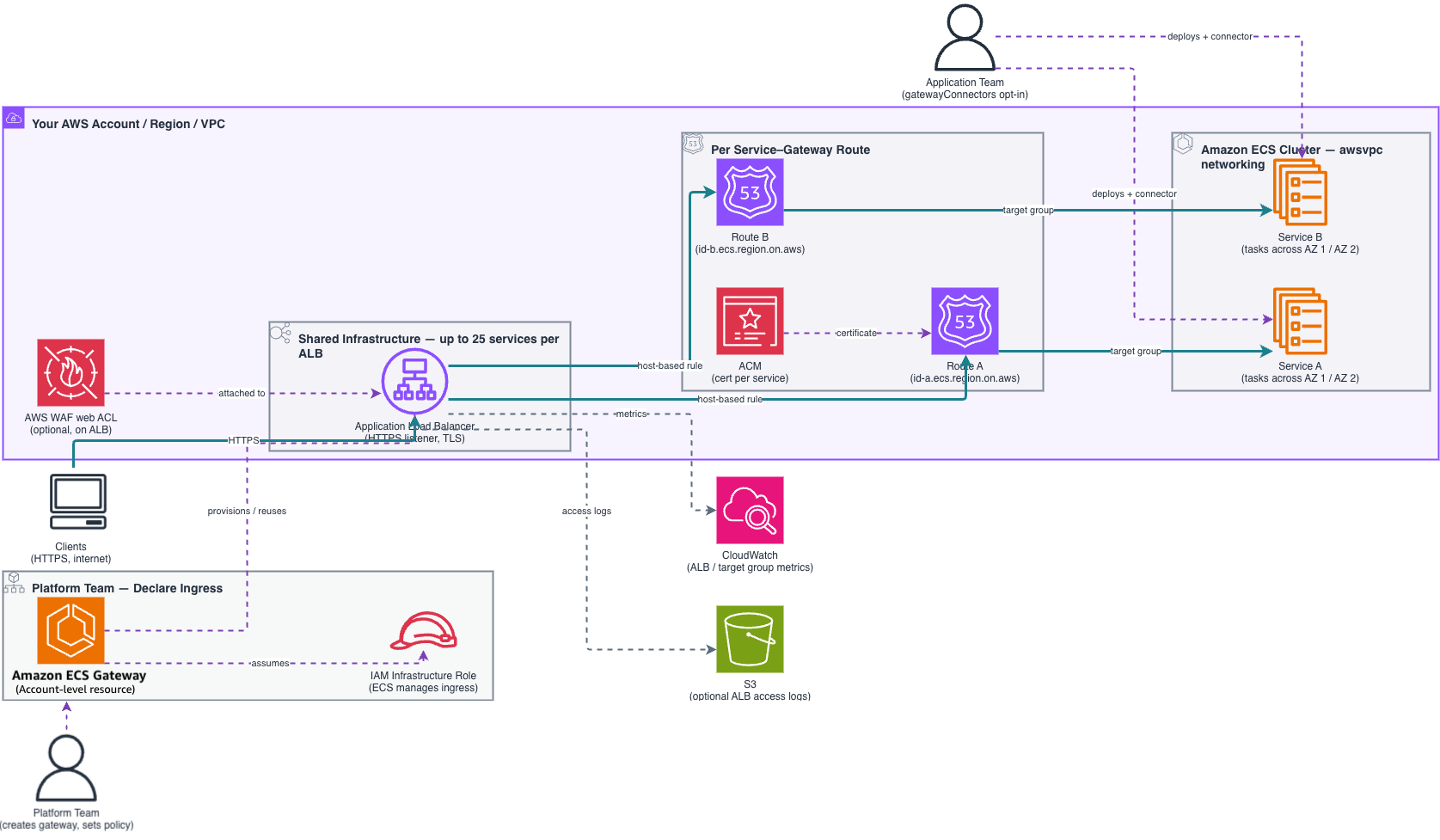
Recognizing the friction inherent in per-service ingress management, AWS architects designed Amazon ECS Gateway to act as a centralized, account-level control plane. Rather than forcing teams to wire up networking piecemeal for every container deployment, ECS Gateway acts as an intelligent intermediary that abstracts the complexity.
The architecture relies on a many-to-many relationship model between ECS clusters and gateways:
- A single ECS Gateway can be associated with up to 10,000 distinct ECS clusters.
- Conversely, a single ECS cluster can support up to 5 gateway associations (allowing environments to easily segregate public-facing traffic from internal VPC-only traffic).
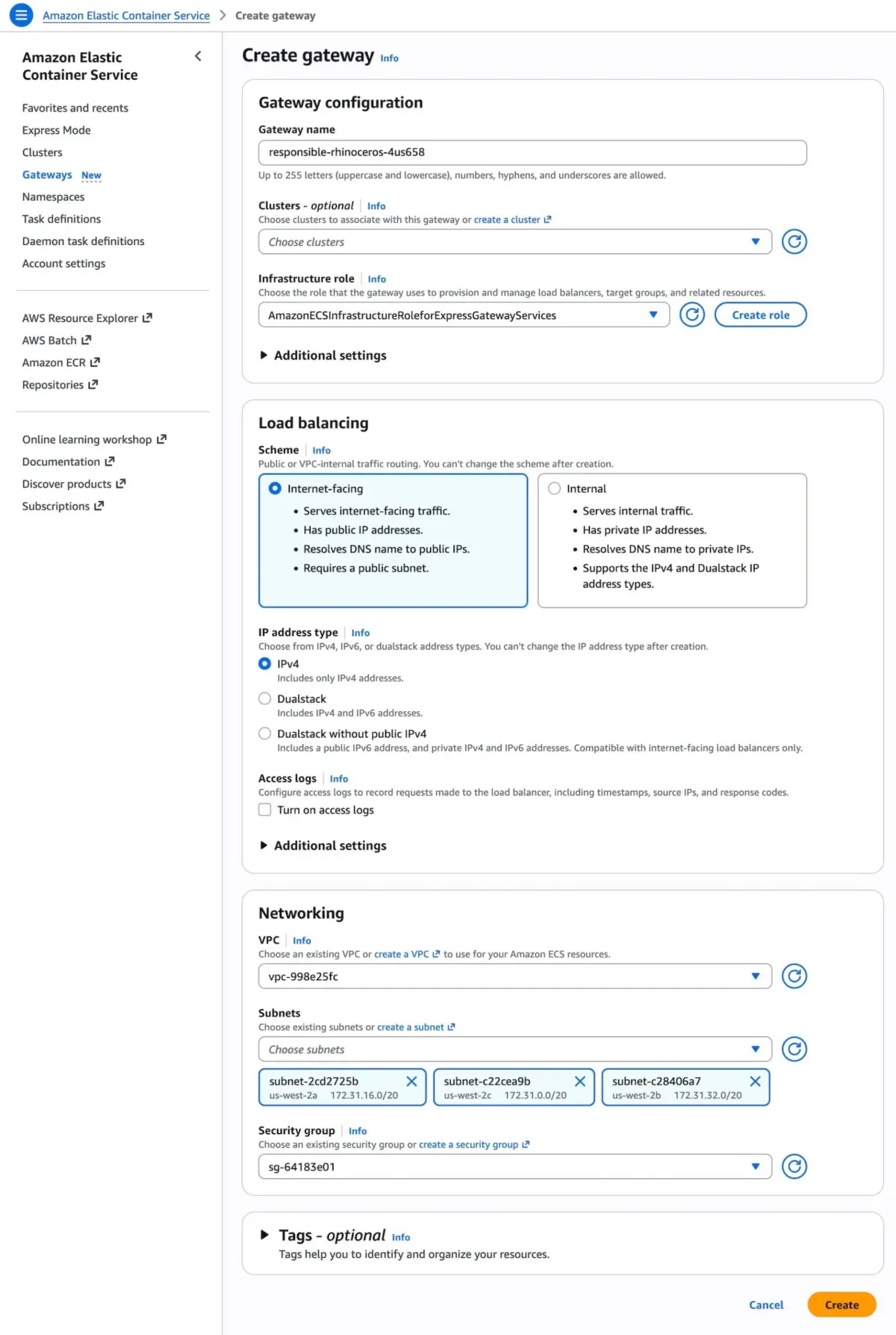
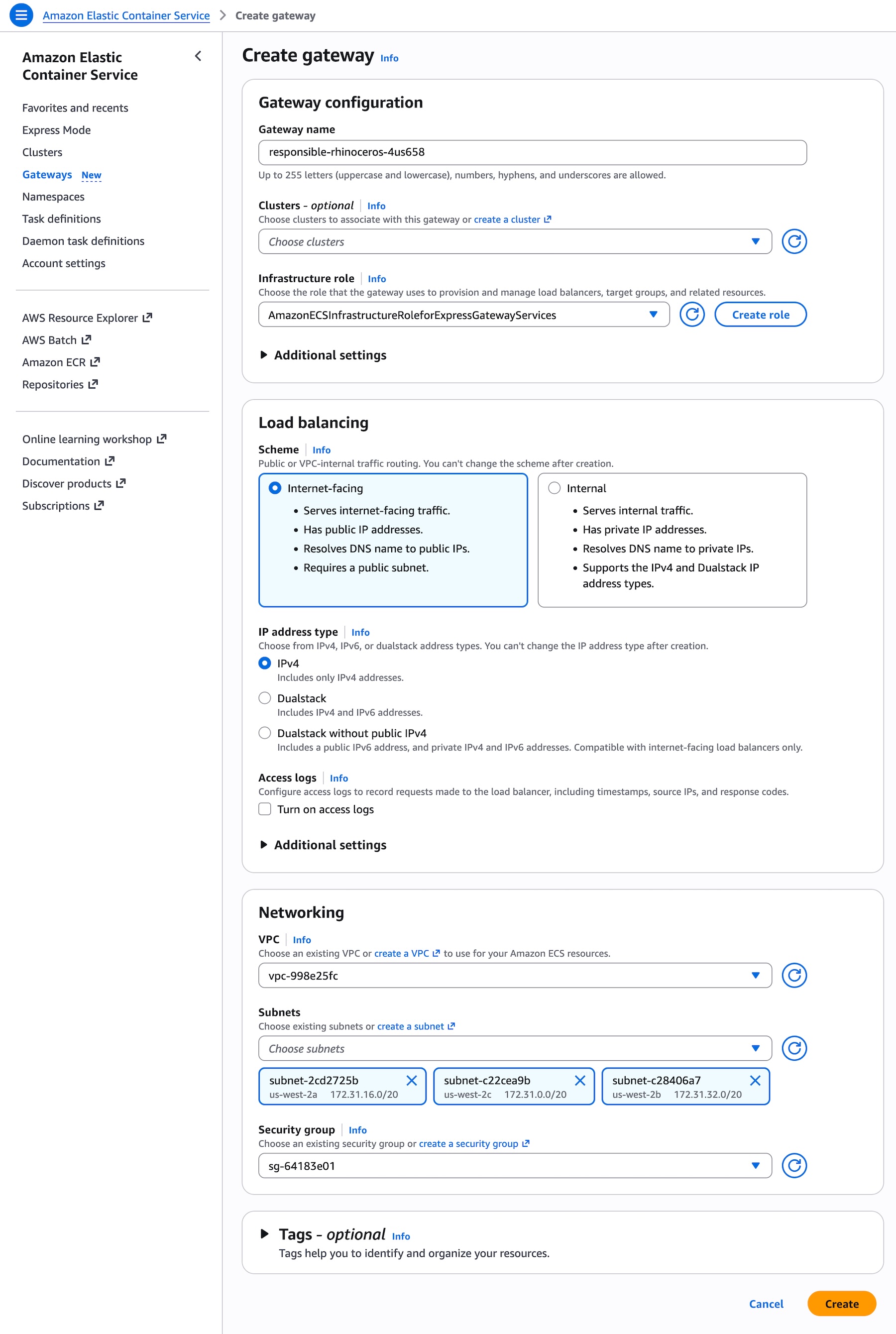
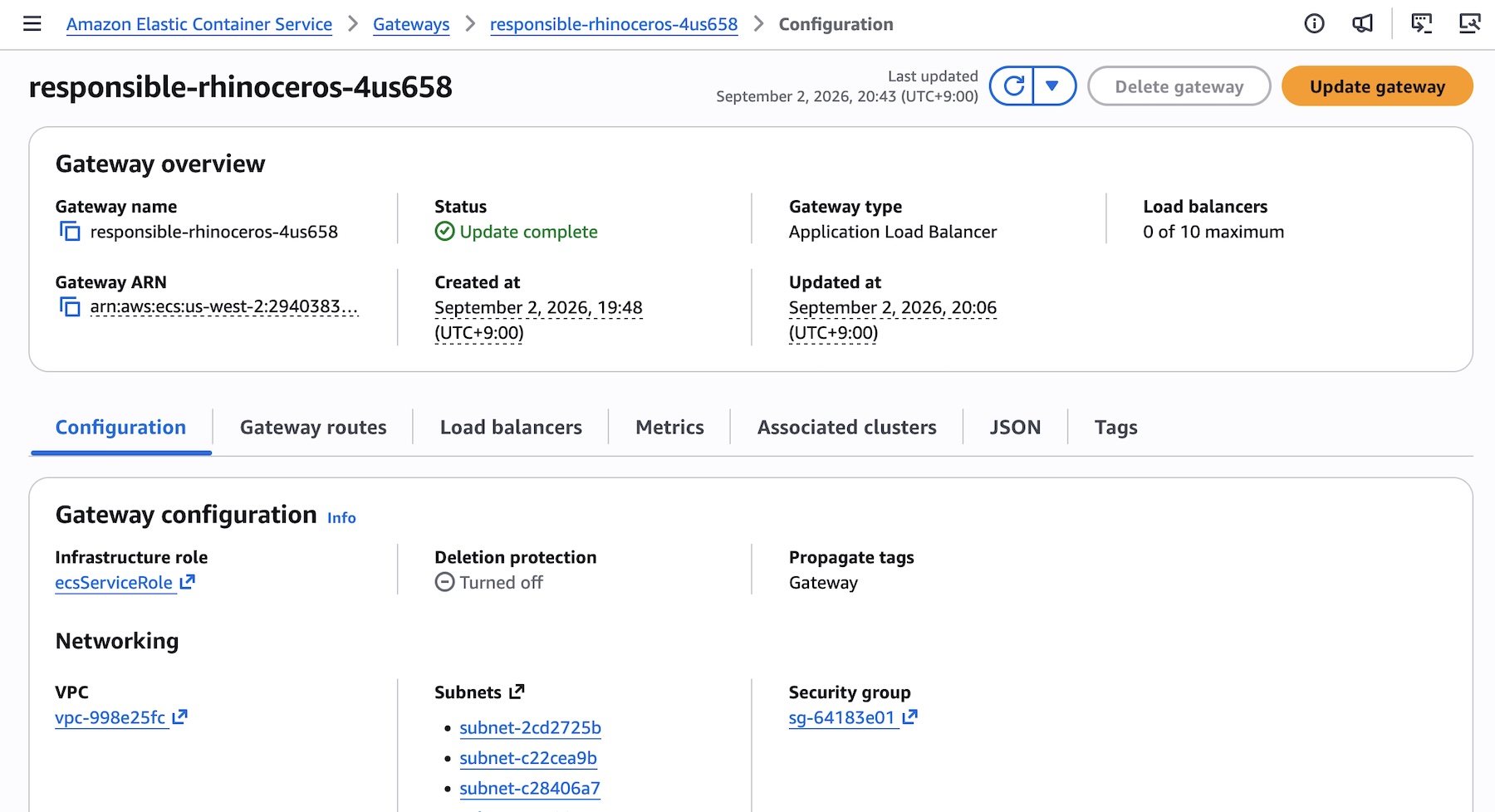
When platform teams create a gateway via the AWS Management Console or AWS Command Line Interface (AWS CLI), they establish an IAM infrastructure role that permits ECS to manage underlying resources (ALBs, security groups, certificates) autonomously within the user’s account. No active infrastructure is billed or provisioned until an application service explicitly connects to the gateway via a gateway connector.

Once connected, ECS evaluates cluster compatibility and dynamically provisions the necessary resources: an ACM certificate, a unique DNS hostname, specific listener routing rules pointing to target groups, and isolated security groups. If an existing ALB hits its capacity threshold (supporting up to 25 services per ALB via host-based routing), ECS automatically provisions a new ALB up to a user-defined maximum limit (maxAlbCount). When services are decommissioned, ECS cleans up the associated routing rules and load balancers, completely eliminating infrastructure bloat and orphan resources.
Supporting Context & Metrics: Cost Optimization and Operational Efficiency
Economic Efficiency Through Density
One of the most compelling aspects of Amazon ECS Gateway is its impact on cloud infrastructure economics. In traditional cloud architectures, provisioning a dedicated Application Load Balancer for every microservice can quickly become cost-prohibitive, especially for smaller services or development/staging environments. At roughly $16 to $20 per month base cost per ALB (plus hourly LCU—Load Balancer Capacity Unit—charges), running hundreds of microservices with individual ALBs results in significant, recurring waste.
Amazon ECS Gateway solves this economic inefficiency through intelligent host-based routing. By allowing up to 25 unique services to securely share a single Application Load Balancer, the system drastically reduces the number of active load balancers required across an enterprise footprint.
Furthermore, ECS manages the lifecycle dynamically:
- Day 0: Zero ALBs are provisioned upon initial gateway creation.
- Day 1: The first connecting service triggers the automatic provisioning of the initial ALB.
- Scaling Up: As services 2 through 25 are attached, they share the existing ALB infrastructure, maximizing LCU utilization.
- Threshold Breach: When the 26th service connects, ECS automatically provisions a second ALB in the background without manual intervention.
- Scaling Down: When services are deleted, ECS reclaims capacity and gracefully removes underutilized load balancers.
Seamless Incremental Adoption
For organizations with deeply entrenched legacy configurations, migrating to a new architectural pattern can feel daunting. AWS designed ECS Gateway with an explicit focus on backward compatibility and zero-downtime migration.
If an organization already operates an existing ECS service with a manually configured load balancer, engineers do not need to execute a risky "rip-and-replace" deployment. By utilizing the UpdateService API to add a gateway connector to an existing service definition, both ingress paths remain active concurrently. This allows platform teams to validate the new ECS Gateway DNS endpoint, test routing logic, and verify security posture before cleanly stripping away the legacy load balancer configuration.
Implementation Guide & Technical Walkthrough
For platform and DevOps engineers looking to deploy Amazon ECS Gateway, the process is streamlined across both the AWS Console and the AWS CLI.
Step 1: Creating a Gateway via AWS CLI
Platform administrators initialize a gateway at the account level by calling the CreateGateway API, passing a unique name, an authorized IAM infrastructure role ARN, and a network configuration object that specifies target VPC subnets and the traffic scheme (internet-facing or internal).
aws ecs create-gateway
  --name my-team-gateway
  --infrastructure-role-arn arn:aws:iam::123456789012:role/ECSGatewayRole
  --configuration '
    "HostSharedAlb":
      "networkConfiguration":
        "subnets": [
          "subnet-080779f9bd887757a",
          "subnet-03d5b2fead6bc6258",
          "subnet-0861210a397d31252",
          "subnet-06539e194023cb77a"
        ],
        "ipAddressType": "ipv4"
      ,
      "scheme": "internet-facing"

  '
Step 2: Associating the Gateway with ECS Clusters
Once the gateway is established, platform engineers link it to one or more ECS clusters to make the ingress infrastructure accessible to containerized workloads running within those boundaries.
aws ecs associate-gateway-with-cluster
--gateway my-team-gateway
--cluster arn:aws:ecs:us-east-1:123456789012:cluster/my-cluster
Step 3: Connecting Application Services
Application teams consume the gateway directly within their service definitions (CreateService or UpdateService) by injecting a gateway connector configuration. This tells ECS to evaluate compatible gateways and automatically wire up the necessary routing and security policies.
aws ecs create-service
  --cluster my-cluster
  --service my-api-service
  --task-definition my-api-service:1
  --gateway-connectors '[ "portName": "api", "filters": "accessTypes": ["PUBLIC"], "healthCheck": ... ]'
Additionally, organizations leveraging modern AI coding assistants can interact with and manage ECS Gateway programmatically by integrating the AWS MCP Server and associated plugins directly into their IDE workflows for seamless documentation search and API execution.
Official Statements and Industry Perspective
While AWS engineering leads have emphasized the operational relief ECS Gateway brings to enterprise platform teams, industry analysts view the release as a vital evolution in how cloud providers abstract complex infrastructure behind developer-friendly primitives.
"When platform teams manage containerized applications at scale on Amazon ECS, configuring ingress networking for each service often traditionally acted as a major velocity inhibitor," noted platform architecture representatives during the launch rollout. "Amazon ECS Gateway bridges the chasm between strict infrastructure governance and rapid application deployment, ensuring that security, cost-optimization, and automation are baked into the control plane by default."
By separating the concerns of platform engineering (defining secure, compliant gateways, subnets, and IAM roles) from application engineering (simply declaring a gateway connector on a service definition), AWS has formalized a true platform-as-a-product operating model within the container space.
Future Outlook: The Road Ahead for Container Ingress
The introduction of Amazon ECS Gateway signals a broader industry trend: the relentless abstraction of undifferentiated heavy lifting in cloud-native architectures. As microservices ecosystems continue to grow in scale and distribution, manual infrastructure wiring is rapidly becoming obsolete.
Looking forward, we can anticipate deeper integrations between automated gateways and advanced observability platforms, automated canary deployments tied directly to gateway listener rules, and enhanced multi-region traffic steering managed natively through container orchestrators. For organizations standardizing on Amazon ECS, ECS Gateway establishes a modern, resilient, and cost-effective foundation for application delivery—ensuring that engineering teams spend less time wrestling with load balancers and more time delivering business value to their end users.
Amazon ECS Gateway is available now in all commercial AWS Regions where Amazon ECS is supported, carrying no additional service markup fees. Organizations pay exclusively for the underlying AWS resources (ALBs, ACM certificates, CloudWatch logs, and data transfer) provisioned directly within their accounts.