

Executive Overview
Elon Musk has never been a stranger to theatricality, but his recent livestreamed spectacle in Texas felt different—less like a traditional product unveiling and more like a grand sleight-of-hand. Standing before an electrified crowd, Musk declared with trademark hyperbole, "What you see with your eyes, you will not believe!"
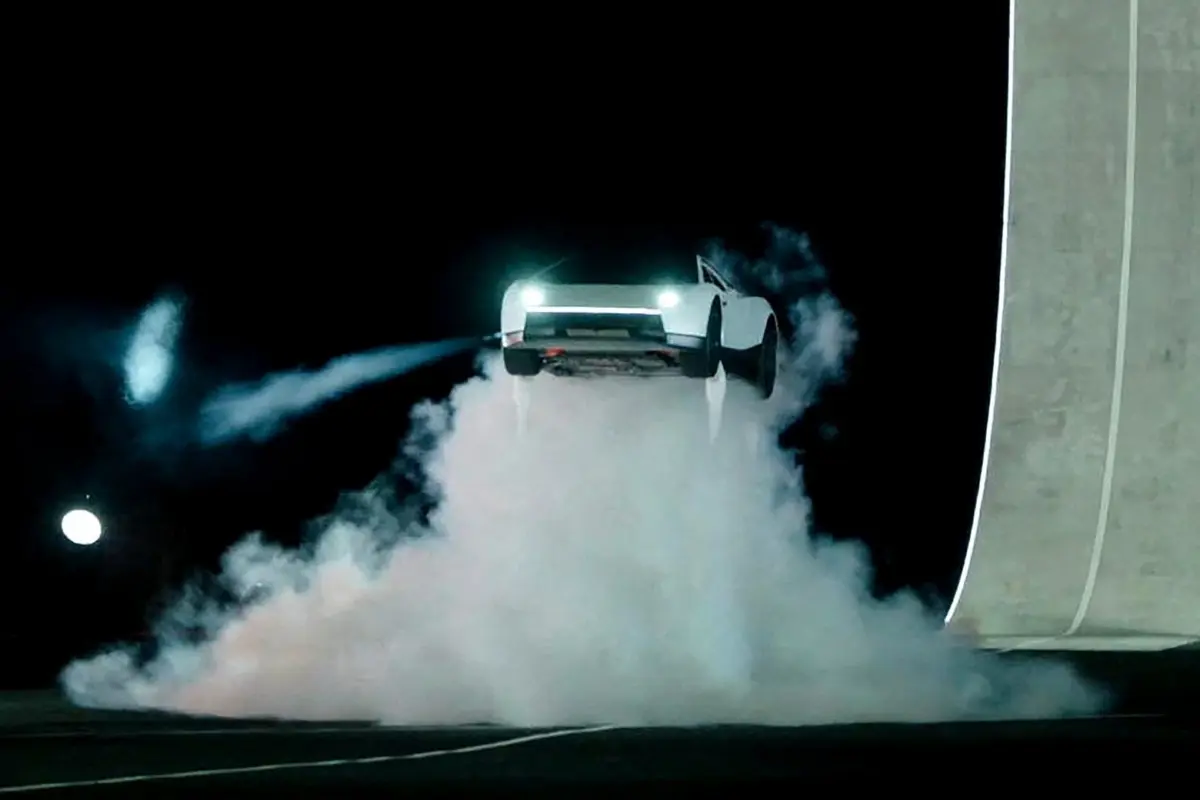
The centerpiece of his late-night evangelism was the long-awaited, nearly decade-overdue next-generation Tesla Roadster. Promoted as a bizarre hybrid between a 1970s Lotus Esprit and an SR-71 Blackbird spy plane, the vehicle boasts an absurd 0-to-60 mph acceleration time of 0.8 seconds. Yet, the real kicker—and the primary hook of the evening—was Musk’s promise that the supercar could be equipped with SpaceX-designed cold-gas thrusters capable of producing brief bursts of actual flight.
Beneath the carnival-barker fanfare of upside-down ramps, downforce fans, and compressed-air leaps, a much larger industrial strategy was quietly revealed. This was not merely the introduction of a halo car; it was a carefully calculated distraction. The theatrical display of rocket-science engineering on a car chassis signaled the twilight of Tesla as a traditional automotive manufacturer.
Industry analysts and sharp observers are reading between the lines: we are witnessing the sunsetting of Tesla’s traditional business model and the paving of the road toward a mother-of-all mergers between Tesla and SpaceX. By blending Tesla’s consumer-facing brand with SpaceX’s capital-raising juggernaut, Musk is preparing to birth a staggering, multi-trillion-dollar galactic mega-entity focused on artificial intelligence, autonomous robotaxis, humanoid robotics, and space-based infrastructure.
Detailed Chronology: From the Stage in Texas to the Drawing Board
The Texas Spectacle
The unveiling event in Texas was designed to push the boundaries of automotive PR. Tesla erected a massive C-shaped ramp, up which the new Roadster ascended. Utilizing a specialized downforce-generating fan system, the car remained pinned upside down at the apex before breaking free, executing a roll—the literal "flying" portion of the demonstration—and touching down in a billowing cloud of compressed air. It then bounded over a row of parked Tesla vehicles with another flourish.
While impressive, the stunt was reminiscent of Musk’s past promotional fireworks, most notably the 2018 launch of his personal red Roadster into deep space atop a SpaceX Falcon Heavy rocket (which remains in solar orbit today).
However, the levity of the stunt masked a sobering announcement: Musk revealed that the Roadster will be the last manually drivable consumer car Tesla ever builds.
The Shifting Roadmap
This declaration clarifies Tesla’s pivot away from consumer ownership toward autonomy and automation. The company’s immediate future rests on two pillars:
- The Cybercab: A purpose-built, autonomous vehicle lacking steering wheels or pedals, intended to anchor a global fleet of for-hire robotaxis.
- Optimus Humanoid Robots: Automated laborers that Musk claims will eventually scale Tesla’s market capitalization to an astronomical $25 trillion. Priced at a projected $30,000 per unit, these robots are slated to handle everything from manufacturing Cybercabs and mowing lawns to eldercare and, ultimately, the manual labor required for lunar and Martian colonization.
The Reservation Shell Game
For those hoping to actually purchase the new Roadster, the timeline requires a massive leap of faith. When the original Roadster concept was announced in 2017, true believers shelled out $50,000 reservations (or $250,000 for the Founder Series).
Tesla’s current pricing structure for the new iteration is similarly steep: $50,000 for the "Performance" trim, $250,000 for the "Thrust" version, and an undisclosed, invite-only sum for the "Rocket" trim—the variant equipped with SpaceX thrusters. Tesla has pointed to a tentative delivery window of 2028, testing the patience of consumers who have learned that caveat emptor is the baseline rule when dealing with Muskian timelines.
Supporting Context & Metrics: The Financial Pressures Behind the Pivot
To understand why Musk is steering Tesla away from the automotive mainstream, one must examine the cold, hard metrics of the current EV landscape.
The Core Automotive Crunch
In 2025, Tesla delivered more than 1.6 million manually drivable vehicles, pulling in roughly $95 billion in revenue, primarily from its core automotive operations (alongside solar and energy storage). On paper, this sounds like the profile of a thriving manufacturing titan. Yet, beneath the surface, the business is under severe pressure:
- Shrinking Margins: Tesla has not introduced an all-new, non-flying consumer vehicle since the Cybertruck in late 2019.
- Model Line Reductions: Production of the high-priced Model S sedan and Model X SUV has quietly wound down, leaving the aging Model 3 and Model Y to shoulder the entire revenue burden.
- Global Competition: A flood of affordable, high-quality alternatives from Chinese automakers—particularly in Europe, where political friction and Musk’s public positioning have dented brand loyalty—has eaten into Tesla’s international market share.
- Regulatory Headwinds: Governments are rolling back the lucrative regulatory carbon-credits market that once padded Tesla’s bottom line by billions, while shifting tax policies have softened overall U.S. demand for electric vehicles.
The Capital Problem
Building artificial intelligence data centers to rival tech giants like OpenAI and Anthropic requires capital expenditures of monumental proportions. At the same time, transitioning Tesla’s factories to mass-produce Cybercabs and Optimus robots demands billions in upfront reinvestment.
Selling moderately priced electric vehicles, it turns out, is a low-margin, high-stress business. Musk’s pivot acknowledges a harsh economic reality: the traditional car business cannot fund the science-fiction future he envisions.
Official Statements and Industry Analysis
The speculation surrounding a merger between Tesla and SpaceX is no longer confined to online forums; Wall Street is treating it as a near certainty.
Wall Street Weights In
Barclays analyst Dan Levy recently sent shockwaves through the financial sector by suggesting that a Tesla-SpaceX merger is "almost a done deal." Under the prevailing market theories, SpaceX—a privately held titan valued well into the hundreds of billions—would structure the acquisition, allowing Tesla public investors to swap their shares for equity in the combined entity. The resulting corporate behemoth could easily command a valuation surpassing $3.5 trillion.
Such a merger solves an acute problem for Musk: it marries Tesla’s public-market capital-raising apparatus with SpaceX’s unparalleled ability to pull off engineering miracles and absorb massive, long-term capital investments.
The Master Plan Unveiled
According to industry insiders, the traditional EV lineup was always just a bootstrap mechanism—a way to fund global manufacturing expertise, build supply chains, and master large-scale automation. As Musk sees it, if you can build a production line that spits out a vehicle every 10 seconds, you can do the same for autonomous robotaxis and legions of humanoid workers.
Furthermore, integrating SpaceX unlocks radical, sci-fi synergies. Rumors and preliminary blueprints point toward ambitious plans for SpaceX to eventually launch massive data centers into low-Earth orbit, harvesting uninterrupted, zero-latency solar power to fuel Tesla’s global AI training models.
Future Outlook: The Birth of a Galactic Mega-Entity
As the dust settles on the Texas unveiling, the true takeaway becomes clear: the era of Tesla as a standalone car company is drawing to a close.
The rocket-powered Roadster was a brilliant exercise in misdirection, designed to capture headlines, soothe nervous retail investors, and wrap a sobering corporate pivot in the nostalgic comfort of a classic Elon Musk tech circus. By injecting literal rocket science into a passenger car, Musk was telegraphing the ultimate destination of his corporate empire.
When the history of 21st-century industry is written, the transition of Tesla into SpaceX’s orbit will likely be viewed as a watershed moment. Traditional automakers spent decades trying to catch Tesla, believing they were competing in an electric vehicle race. In reality, they were watching a staging maneuver for something much grander.
Tesla is set to dissolve into a sprawling, multi-planetary conglomerate that deals in orbital infrastructure, interplanetary transport, artificial intelligence, and automated labor. As Musk builds his vision of the future—one where terrestrial cars are relics of the past and orbital data centers beam power back to Earth—the corporate entity taking shape will easily make sci-fi dystopian monopolies like the Weyland-Yutani Corporation look tame by comparison.




