Executive Overview
In the fast-evolving landscape of enterprise data architecture, the modernization of legacy data lakes has long been considered a necessary yet exceptionally burdensome engineering undertaking. Organizations holding petabytes of structured and semi-structured historical data in Apache Hive table formats have historically faced a stark operational dilemma: remain tethered to aging storage frameworks that struggle to keep pace with modern, real-time analytics demands, or dedicate months of specialized engineering capital to custom-build, test, and maintain migration pipelines to the Apache Iceberg open standard.
Today, Amazon Web Services (AWS) is fundamentally shifting that paradigm. The introduction of managed migration capabilities for Apache Hive tables directly within Amazon S3 Tables marks a watershed moment for data lake modernization. By abstracting the immense complexity of schema mapping, data type conversions, file recompression, and compaction into a streamlined, API-driven operation, AWS enables enterprises to transition petabyte-scale environments to Iceberg with zero pipeline development, minimal compute provisioning, and—critically—uninterrupted production workloads.
This newly released capability addresses the friction points that have traditionally slowed down enterprise transitions to open table formats. Apache Iceberg has rapidly solidified its position as the de facto open standard for large-scale analytical datasets, empowering organizations to execute high-performance time-travel queries, maintain complex schema evolutions, and leverage hidden partitioning. However, realizing these architectural benefits previously required organizations to construct intricate orchestration frameworks, build custom validation scripts, and handle the perilous edge cases of rollbacks and data drift.
With Amazon S3 Tables now managing the entire lifecycle of the migration workflow—from pre-flight compatibility reporting to incremental synchronization and final cutover—data engineering teams can bypass undifferentiated heavy lifting. The service empowers businesses to modernize their storage tiers cost-effectively, paying solely for the data copied without hidden conversion fees, while ensuring that existing production systems remain fully accessible online until the final, seamless transition takes place.
Detailed Chronology and Technical Execution
To fully appreciate the architectural leap represented by Amazon S3 Tables’ new migration feature, one must examine the mechanics of how data lakes have historically transitioned from Hive to Iceberg, and how AWS has systematically automated each phase of that journey.
The Legacy Challenge of Hive-to-Iceberg Transitions
Historically, upgrading an enterprise data lake registered in the AWS Glue Data Catalog from Apache Hive to Apache Iceberg demanded a multi-step, highly technical project plan. Engineering teams typically had to:

- Provision Dedicated Compute Clusters: Spin up temporary Apache Spark or Trino clusters to read, transform, and write massive datasets.
- Build Custom Translation Logic: Manually map Hive data types to their Iceberg equivalents, handling subtle discrepancies in nullability, precision, and timestamp handling.
- Handle Continuous Delta Updates: Construct complex change-data-capture (CDC) or micro-batch pipelines to ensure that records written to the source Hive table during the migration window were not lost before final cutover.
- Manage Compaction and File Optimization: Write bespoke maintenance jobs to ensure the resulting Iceberg tables did not suffer from the "small file problem," which degrades query performance.
This multi-week or multi-month endeavor introduced substantial operational risks, potential data downtime, and unpredictable cloud compute expenditures.
The Modern, Managed Workflow
Amazon S3 Tables has replaced this fragmented engineering lifecycle with a unified
, four-stage managed operation:
1. Pre-Migration Validation and Compatibility Reporting
Before a single byte of production data is altered or copied, S3 Tables evaluates the source Parquet-backed Hive tables registered in the AWS Glue Data Catalog. The system inspects the schema, data types, and underlying storage objects, subsequently generating comprehensive table and object compatibility reports. These reports highlight any potential mismatches, allowing engineers to address schema anomalies proactively rather than discovering them midway through a botched data load.
2. Incremental Synchronization via API Operations
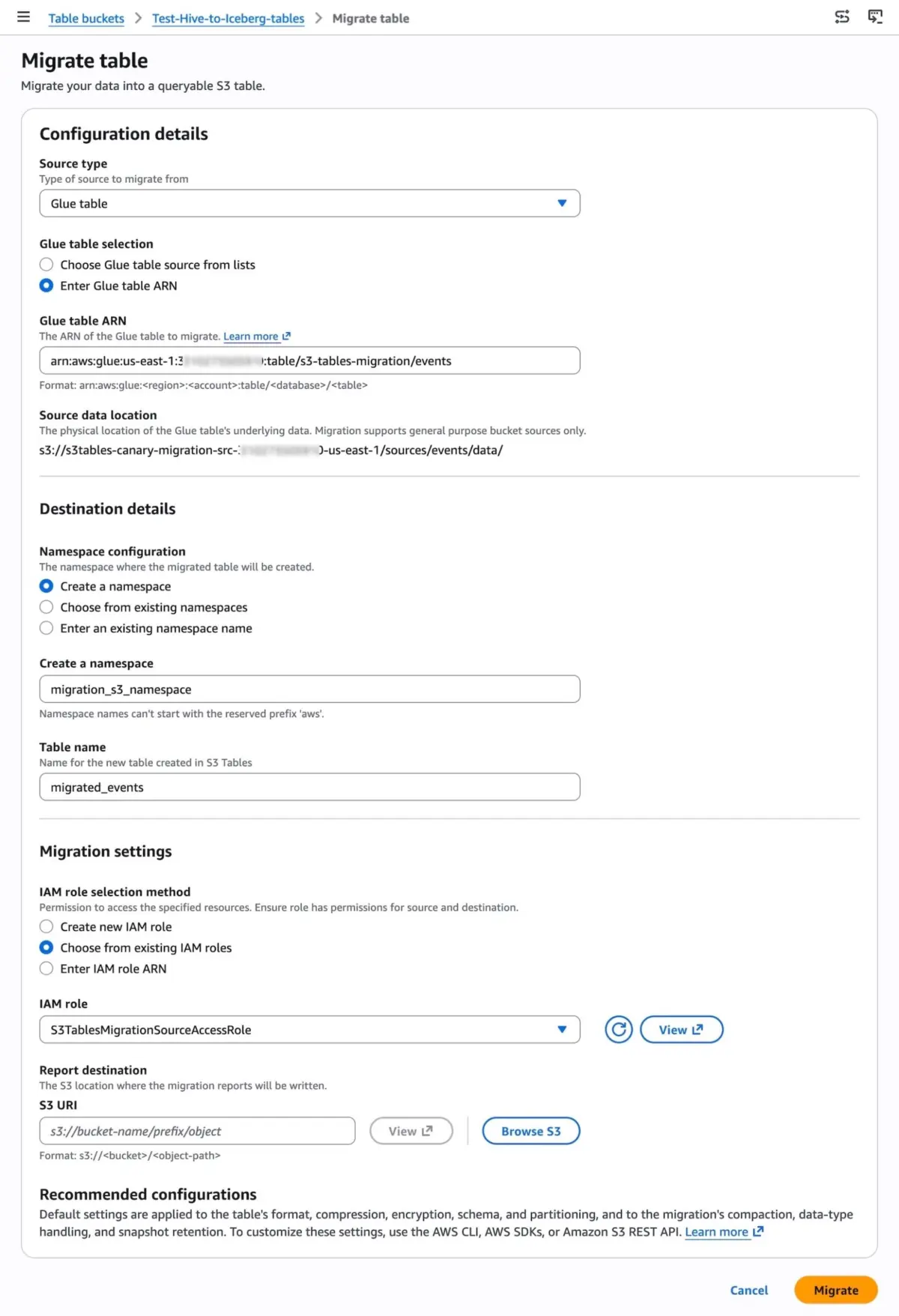
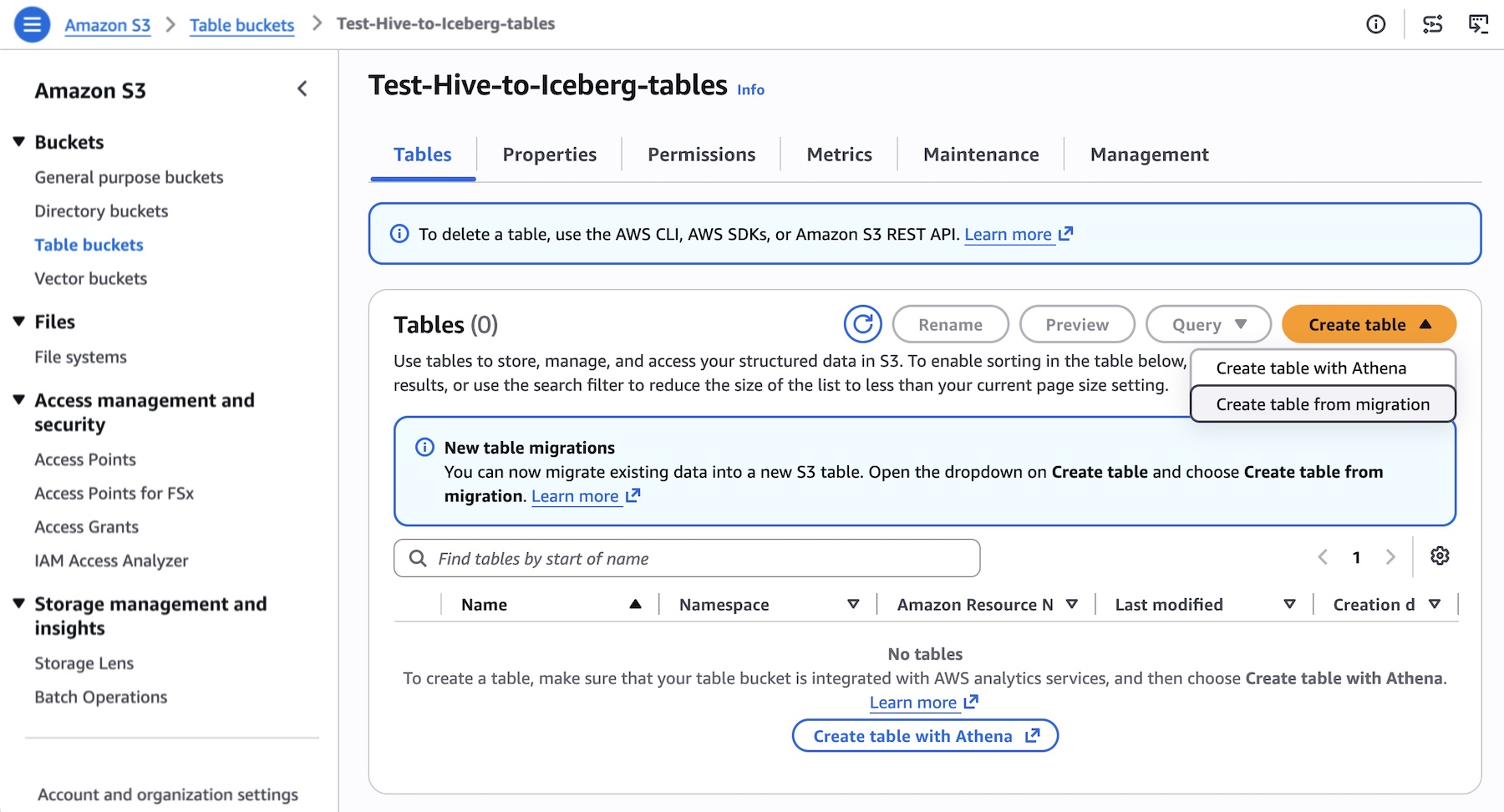
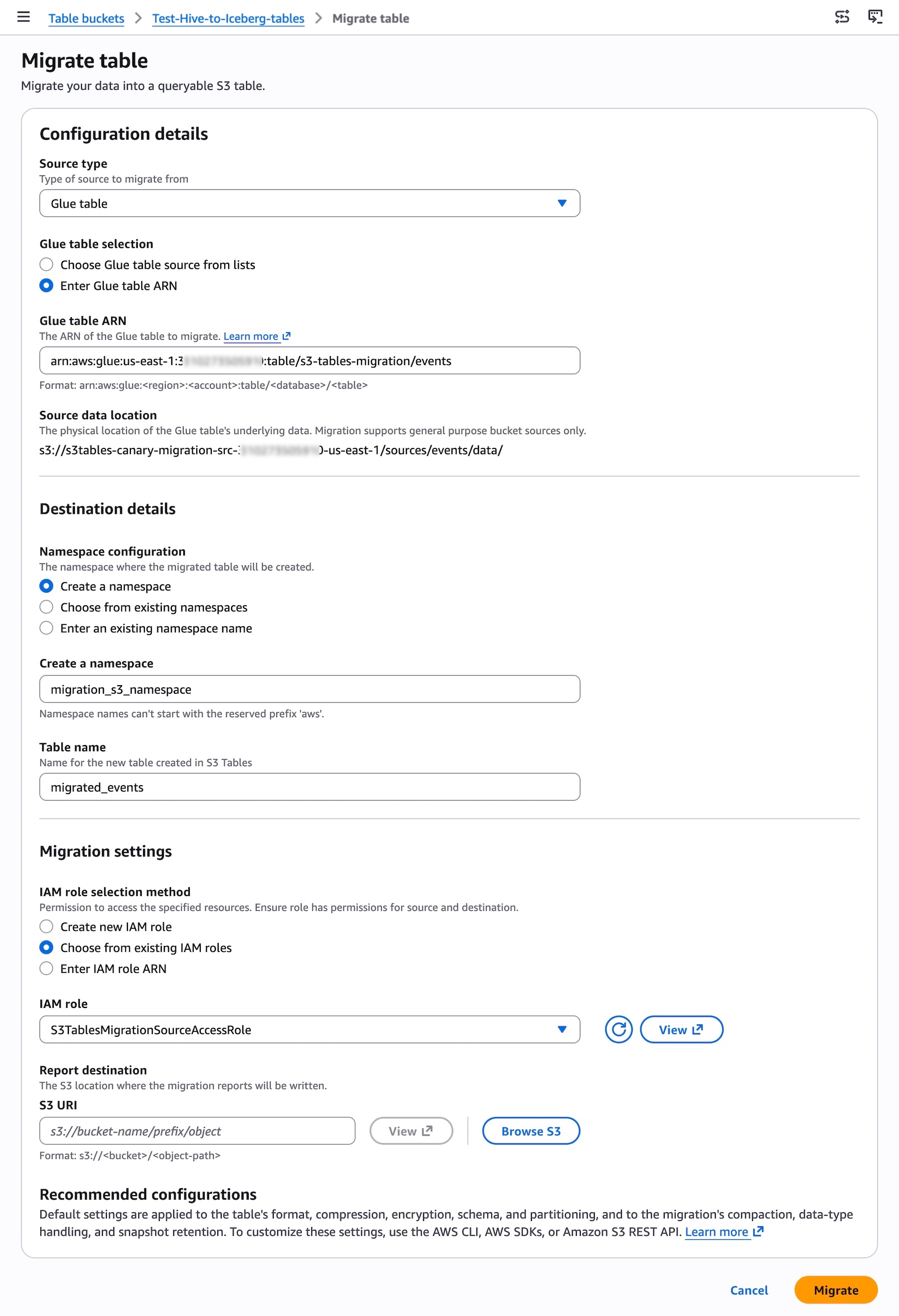
Once the destination S3 Table bucket, namespace, and performance-tuned defaults are established—either via the AWS Management Console, AWS CLI, AWS SDKs, or the specialized Agent Toolkit for AWS—the migration job commences. During this phase, the destination table remains read-only while S3 Tables safely copies, re-compresses, and compacts the data.
Crucially, production applications can continue writing to the source Hive table uninterrupted. Data engineers can invoke the sync-table-migration command iteratively to catch up the destination table with any ongoing changes in the source. Each sync operation operates incrementally, copying only the data that has changed since the last checkpoint.

3. Zero-Downtime Cutover
When the synchronization process is complete and the destination table mirrors the latest state of the source, administrators execute the final cutover. This phase requires only a brief, momentary pause in table writes, reducing potential application downtime to mere minutes. Once finalized, the destination Iceberg table is automatically promoted to read-write status.
4. Immediate Ecosystem Integration
Upon promotion, the newly minted Iceberg tables are immediately queryable via high-performance analytical engines. Direct, native integrations with Amazon Athena and Amazon SageMaker Unified Studio allow data scientists and analysts to begin querying datasets instantly. Furthermore, because the underlying storage adheres strictly to the Apache Iceberg open standard, any external engine supporting the Iceberg REST API can interact with the tables seamlessly.
Supporting Context, Architecture, and Metrics
The financial and operational implications of this release are deeply intertwined with the underlying architecture of Amazon S3 Tables and Apache Iceberg. Understanding why this feature represents a quantum leap in cost-efficiency requires a closer look at storage design, pricing models, and developer tooling.
Architectural Advantages of S3 Tables
Amazon S3 Tables are purpose-built storage tiers engineered specifically to maximize the performance and cost-efficiency of Apache Iceberg tables at petabyte scale. Traditional object storage treats data files agnostically; S3 Tables, however, understand the structural metadata of open table formats. They automatically execute critical maintenance routines—such as bin-pack compaction and snapshot management—without requiring human intervention.
By defining parameters such as target file sizes (e.g., 512 MB) and snapshot retention policies (e.g., keeping a minimum of three snapshots or bounding age to 168 hours), organizations ensure that their analytical queries execute at maximum velocity while mitigating runaway storage growth.
  "roleARN": "arn:aws:iam::123456789012:role/S3TablesMigrationRole",
  "destinationTable":
    "tableBucketARN": "arn:aws:s3tables:us-east-1:123456789012:bucket/my-destination-bucket",
    "namespace": "mynamespace",
    "name": "my_destination_table",
    "encryptionConfiguration":
      "sseAlgorithm": "aws:kms",
      "kmsKeyArn": "arn:aws:kms:us-east-1:123456789012:key/1234abcd-12ab-34cd-56ef-1234567890ab"
    ,
    "storageClassConfiguration":  "storageClass": "INTELLIGENT_TIERING" ,
    "tags":  "team": "s3tables", "purpose": "migration" ,
    "properties":
      "writeFormat": "parquet",
      "icebergFormatVersion": 2,
      "compressionCodec": "zstd",
      "dictionaryEncoding": true
    ,
    "schema":
      "type": "struct",
      "schemaId": 0,
      "identifierFieldIds": [1],
      "fields": [
         "id": 1, "name": "id",      "type": "long",   "required": true, "doc": "primary key" ,
         "id": 2, "name": "payload", "type": "string", "required": false
      ]
    ,
    "icebergSortOrder":
      "orderId": 1,
      "fields": [  "sourceId": 1, "transform": "identity", "direction": "asc", "nullOrder": "nulls-first"  ]

  ,
  "sourceType": "glueTable",
  "source":
    "glueTable":
      "catalogId": "123456789012",
      "databaseName": "my_glue_database",
      "tableName": "my_source_table"

  ,
  "dataMigration":
    "maintenanceSettings":
      "icebergCompaction":  "targetFileSizeMB": 512, "strategy": "binpack" ,
      "icebergSnapshotManagement":  "minSnapshotsToKeep": 3, "maxSnapshotAgeHours": 168
    ,
    "migrationPolicies"::
      "unmatchedSourceFieldsPolicy": "fail",
      "incompatibleValuesPolicy": "fail"

  ,
  "reviewMigrationPlan": false,
  "migrationOutput":
    "bucket": "arn:aws:s3:::my-report-bucket",
    "prefixes":
      "tableCompatibilityReport": "reports/table-compatibility/",
      "objectCompatibilityReport": "reports/object-compatibility/",
      "objectMigrationReport": "reports/object-migration/"
Cost Economics of Managed Migration
When evaluating cloud migration projects, enterprise finance and engineering leadership universally scrutinize hidden costs—such as compute cluster overhead, data transfer fees, and storage tier disruptions. AWS has structured the pricing model for S3 Tables migrations to eliminate these financial anxieties:
- Zero Conversion Charges: Customers pay exclusively for the raw data copied to the destination bucket. There are no additional surcharges or hourly compute fees associated with the Hive-to-Iceberg translation logic.
- Preservation of Storage Tiers: Source objects stored within S3 Intelligent-Tiering remain undisturbed in their current access tiers throughout the migration process, preventing accidental cost spikes associated with mass data movement or tier promotion.
- Elimination of Infrastructure Overheads: Because no dedicated Apache Spark, Presto, or custom ETL clusters need to be provisioned and managed, organizations save hundreds of engineering hours in infrastructure setup, patching, and monitoring.
Modern Developer Tooling and AI Integration
In step with the broader transformation of software engineering driven by artificial intelligence, AWS has integrated these migration capabilities directly into modern developer workflows. Through the Agent Toolkit for AWS and specialized skills such as migrating-hive-tables-to-s3-tables, coding agents and AI assistants can provide developers with step-by-step guidance, automated configuration generation, and safety guardrails.
Furthermore, by combining the AWS MCP (Model Context Protocol) Server and associated plugins with preferred AI tooling, developers can interact conversationally with AWS documentation, search regional availability metrics, troubleshoot API payloads, and execute complex AWS CLI commands with unprecedented ease.
Official Statements and Industry Impact
The release of managed Hive-to-Iceberg migrations underscores AWS’s broader strategic commitment to open table formats and decoupled data architectures. Industry analysts have long noted that while data lakes offer unmatched scalability and cost advantages compared to traditional enterprise data warehouses, the fragmentation of table formats has created unnecessary operational silos.
While AWS leadership has consistently emphasized open standards, user feedback highlighted that the velocity of adoption was being throttled by the sheer complexity of legacy table conversion. By removing this barrier, AWS is signaling that the transition to Apache Iceberg is no longer an optional, multi-quarter modernization project for elite engineering teams, but rather a streamlined, accessible administrative task available to any organization utilizing the AWS Glue Data Catalog.
Furthermore, early enterprise adopters participating in regional previews have highlighted the drastic reduction in migration timelines. Teams that previously budgeted three to six months for custom pipeline engineering, testing, and validation report completing successful table promotions in a matter of days—entirely without disrupting downstream business intelligence dashboards or machine learning training pipelines.
Future Outlook and Regional Availability
As of today, Amazon S3 Tables managed migration is generally available across a robust global footprint, spanning key strategic cloud regions:
- Americas: US East (N. Virginia, Ohio), US West (Oregon)
- Asia-Pacific: Mumbai, Singapore, Sydney, Tokyo
- Europe: Frankfurt, Ireland, Stockholm
At launch, the capability natively supports AWS Glue-registered Hive tables stored in Parquet format residing within the same AWS account and AWS Region. However, the architectural foundation laid by this release points toward an even more interconnected future.
As enterprises increasingly standardize on open table formats, the ability to effortlessly ingest, convert, and optimize legacy datasets will become a core competency of modern data platforms. By automating the plumbing of data lake modernization, AWS is enabling data engineering teams to pivot away from low-level infrastructure management and focus instead on delivering high-value business intelligence, predictive analytics, and advanced machine learning capabilities.
Organizations looking to begin their migration journey can access the new tooling directly through the Amazon S3 console, leverage the AWS CLI and SDKs for programmatic deployments, or consult the comprehensive S3 Tables migration documentation to plan their enterprise-wide data lake upgrades today.