Executive Overview
In an era dominated by hyper-connected devices, constant notifications, and the perpetual pull of digital feeds, outdoor exercise has increasingly become an extension of screen time. For everyday runners, trail joggers, and fitness enthusiasts, the smartphone—ostensibly a tool for tracking health metrics—frequently acts as a primary source of cognitive distraction.
Enter StrideCast, an innovative mobile-first Progressive Web Application (PWA) designed to fundamentally alter this dynamic. Developed by Krishna Bharadwaj for the Hacktoberfest Open-Source AI Challenge Week 1: Touch Grass, StrideCast merges generative open-source artificial intelligence with offline-first capabilities. The application creates custom, dynamically generated podcasts timed precisely to a runner’s intended duration, pace, mood, and chosen topic. Crucially, it caches the entire audio experience and tracking infrastructure directly onto the user’s device, allowing athletes to slip their phones into their pockets, engage airplane mode, and embark on their runs completely untethered from cellular networks, cloud APIs, and digital interruptions.

By prioritizing local AI processing, data privacy, and a friction-free user experience, StrideCast represents a watershed moment in open-source fitness technology. It addresses a core psychological friction point in modern fitness: the screen as an obstacle to physical immersion.
Detailed Chronology: From Concept to Hacktoberfest Submission
The genesis of StrideCast stemmed from a universally recognized modern annoyance: the friction of transitioning from a sedentary digital state to an active physical one. Pre-run rituals often involve scrolling through feeds, navigating complex fitness applications, setting up cloud-synced accounts, and managing constant alerts.

The Conceptualization Phase
Bharadwaj identified a distinct gap in the market for runners seeking auditory companionship without the invasive nature of modern fitness trackers. Existing solutions typically demand continuous cellular data connections, mandate user registration, harvest location data for third-party servers, or rely on generic, pre-recorded audio tracks that fail to adapt to individual pacing and run lengths.
The core design philosophy for StrideCast was starkly minimalist: minimize screen time to absolute zero post-setup. The development timeline concentrated on building a tool where setup takes approximately 30 seconds, culminating in a single, prominent "START" button that clears the interface and transitions the runner into the physical world.

Architectural Execution and Development
The development of StrideCast for the Hacktoberfest Open-Source AI Challenge required a rigorous engineering approach to offline processing. Because standard generative audio workflows rely heavily on continuous cloud-based API calls, the project necessitated a radical shift toward local and edge-computed pipelines.
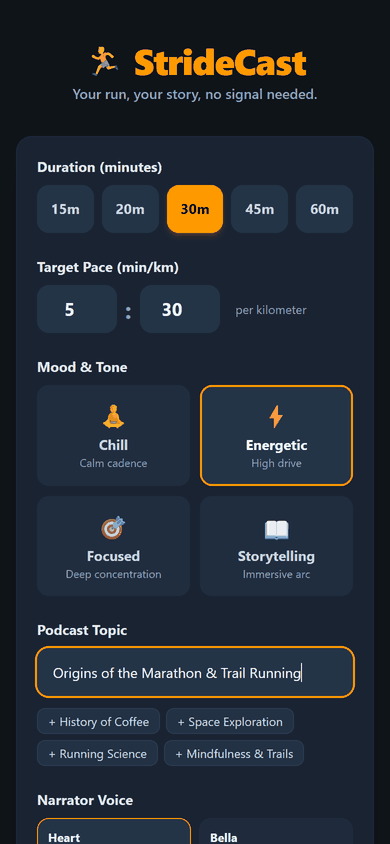
- Pre-Run Setup & Parameter Configuration: The application initiates with a streamlined user interface allowing runners to define four critical variables: duration, target pace, emotional mood, and conversational or educational topic.
- Live Generation & SSE Progress Streams: Utilizing Server-Sent Events (SSE), the application streams real-time generation progress visually to the user as the underlying open-source AI compiles and synthesizes the customized podcast script and audio narration.
- Local Caching and Offline Readiness: Once generated, the audio file and interactive map assets are immediately cached directly to the mobile device’s internal storage using modern browser storage mechanisms, indicated by a distinct "Offline-Ready" badge.
- Active Run HUD and Voice Coaching: During the run, the Progressive Web Application serves as a lightweight Head-Up Display (HUD), tracking distance, pace, and routing via device-native GPS while seamlessly playing the cached podcast offline.
- Post-Run Analytics and History: Upon completion, StrideCast compiles a comprehensive run summary featuring performance statistics, an offline SVG route visualization, and historical data logs securely stored on-device via IndexedDB.
Supporting Context & Metrics: The Philosophy of "Touching Grass"
The thematic anchor of the Hacktoberfest challenge—"Touch Grass"—speaks to a broader cultural fatigue with hyper-connectivity. Studies in environmental psychology consistently demonstrate that physical exercise performed in natural environments offers enhanced mental health benefits compared to indoor workouts. However, these benefits are frequently diluted when athletes remain tethered to devices that ping, buzz, and demand attention.

Technical Metrics and Architecture
StrideCast’s technical framework is engineered to operate under strict resource constraints without sacrificing performance:
- Platform Architecture: Mobile-first Progressive Web Application (PWA), ensuring cross-platform compatibility without requiring native app store downloads or installations.
- Data Persistence: Client-side storage managed via IndexedDB and Cache API, ensuring zero data leakage to external servers and full functionality in dead zones or airplane mode.
- Privacy Compliance: By eliminating cloud-based telemetry and mandatory user accounts, StrideCast achieves a privacy-first posture where user routes, biometric estimates, and listening preferences never leave the physical device.
- AI Integration: Leverages open-source AI models for script generation and text-to-speech synthesis, democratizing access to personalized audio content without subscription fees or proprietary API lock-ins.
Official Statements and Developer Vision
In documentation accompanying the release, the creator emphasized the ideological motivations driving the project. Open-source innovation in the AI space has frequently trended toward centralized, resource-intensive cloud models that require persistent connectivity and corporate infrastructure. StrideCast flips this paradigm inward.

"The phone is the primary device that pulls you out of a run," notes the project’s foundational documentation. "StrideCast makes the screen the shortest part of the experience. Setup takes about 30 seconds, and after that, it’s one big START button and the phone goes straight into your pocket."
By refusing to monetize user location data or demand continuous cloud connectivity, the project establishes a benchmark for ethical, community-driven software development within the fitness sector. It demonstrates that advanced generative AI tools can be successfully deployed locally, prioritizing user autonomy over continuous corporate engagement loops.

Future Outlook: The Horizon of Offline AI Fitness
As artificial intelligence hardware capabilities expand on mobile devices—driven by advancements in on-device Neural Processing Units (NPUs) and efficient open-source small language models (SLMs)—applications like StrideCast point the way toward the future of ambient computing.
Potential Trajectories for StrideCast and Open-Source Fitness
- Enhanced Local Models: Future iterations could integrate more sophisticated local LLMs running directly via WebAssembly (Wasm) or WebNN, allowing for fully dynamic, interactive audio companions that can respond contextually to unexpected changes in a runner’s pace or route mid-stride.
- Expanded Biometric Integration: Integrating with local Bluetooth Low Energy (BLE) sensors (such as heart rate monitors) entirely client-side would allow the AI-generated podcast to adapt its tone and pacing cues based on physiological stress markers, all while maintaining strict offline privacy.
- Community-Driven Extensions: As an open-source project submitted during Hacktoberfest, StrideCast invites global developer contributions to expand localization, improve offline mapping engines, and refine text-to-speech rendering pipelines for low-power mobile processors.
In summary, StrideCast transcends its origins as a hackathon submission, offering a compelling blueprint for how technology can support human physical activity rather than distract from it. By combining open-source AI, rigorous offline caching, and a deep respect for user privacy, the project successfully bridges the gap between digital innovation and the timeless simplicity of heading out the door for a run.