Executive Overview
The storied Mobile Suit Gundam franchise is once again expanding its footprint in the physical gaming landscape with the arrival of Gundam Assemble, a streamlined miniatures game designed to bridge the gap between traditional model-building hobbies and tactical tabletop wargaming. Announced alongside the Gundam Card Game as part of a dual-product visual companion release, Gundam Assemble represents a calculated effort by Bandai and its collaborators to capture a broader, more accessible slice of the tabletop market.
Miniature wargames have long suffered from high barriers to entry. Complex rulesets, exorbitant start-up costs, and the grueling, multi-step requirements of building, gluing, and painting armies often deter casual enthusiasts. Gundam Assemble directly addresses these pain points. By leveraging Bandai’s legendary expertise in Gunpla (Gundam plastic models)—specifically snap-fit assembly—while utilizing a manageable squad size of three-versus-three mobile suits, the game successfully scales down the grandiosity of interstellar warfare into a bite-sized, highly tactical skirmish experience.
Priced aggressively at roughly $35 for the standard starter set, the game undercuts heavyweights like Warhammer 40,000: Kill Team and Star Wars: Legion by a wide margin. Yet, despite its lower cost and simplified barrier to entry, early hands-on evaluations reveal a surprisingly deep strategic ecosystem driven by an innovative turn-tracking mechanic known as the "Gundam Assemble timeline." This report provides an exhaustive, multi-faceted analysis of Gundam Assemble, examining its design philosophy, mechanical intricacies, assembly and painting requirements, economic positioning, and future outlook within the competitive tabletop industry.
Detailed Chronology & Gameplay Mechanics
To understand how Gundam Assemble functions on the tabletop, one must examine its unique approach to time management, turn order, and skirmish combat. The game departs from traditional "I-go, you-go" phases or randomized card-draw activation systems, opting instead for a deterministic, consequence-driven timeline.
The Gundam Assemble Timeline
At the heart of the game’s tactical depth is the timeline. Spanning ten rounds per phase—with standard matches typically played across two phases for a total of 20 rounds—the timeline functions as a visual tracking board positioned safely to the side of the main map.
During setup, each mobile suit unit is assigned a starting timeline number based on its operational profile. For example, the agile Gundam Vidar occupies timeline slot one, granting it the initiative to act before the iconic RX-78-2 Gundam, which typically initiates at slot two.
Crucially, the timeline is dynamic. Whenever a unit executes specific actions or attacks, its unit token is physically pushed further down the timeline. A high-damage, resource-heavy maneuver like the RX-78-2’s Beam Saber attack carries a timeline cost of three, forcing the token to advance three rounds down the track. Consequently, highly aggressive plays result in extended downtime before that specific mech can activate again. This creates a rich layer of strategic resource management reminiscent of turn-based tactical video games such as XCOM or Star Wars Zero Company, where players must constantly weigh the immediate utility of an attack against the vulnerability of being sidelined for upcoming rounds.
Skirmish Structure and Victory Conditions
Matches center on small-scale engagements, typically featuring squads of three mobile suits per side. This compact scale keeps the battlefield uncluttered, allowing players to swiftly transition from deployment into active combat.
Victory points (VPs) dictate the ultimate winner. Over the course of two phases, players accumulate VPs through a variety of secondary and primary objectives, including:
- Rescuing or destroying scattered battlefield garrisons.
- Eliminating enemy mobile suit units.
- Controlling designated objective hexes at the conclusion of each phase.
Turn Economy and Unit Actions
During a mobile suit’s activation, the pilot is presented with a structured suite of choices divided into movement, primary actions, command abilities, and tactics cards:
- Advance (Movement): Units can traverse up to three hexes in any direction. Terrain navigation introduces light logistical hurdles: ascending a vertical elevation level costs two hexes of movement, whereas descending incurs no penalty. Units possessing the "Hover" keyword ignore terrain movement penalties entirely.
- Primary Actions: These actions advance the unit’s token down the timeline and include:
- Attack: Utilizing one of two attacks printed on the unit’s card, or deploying an attack via a tactics card.
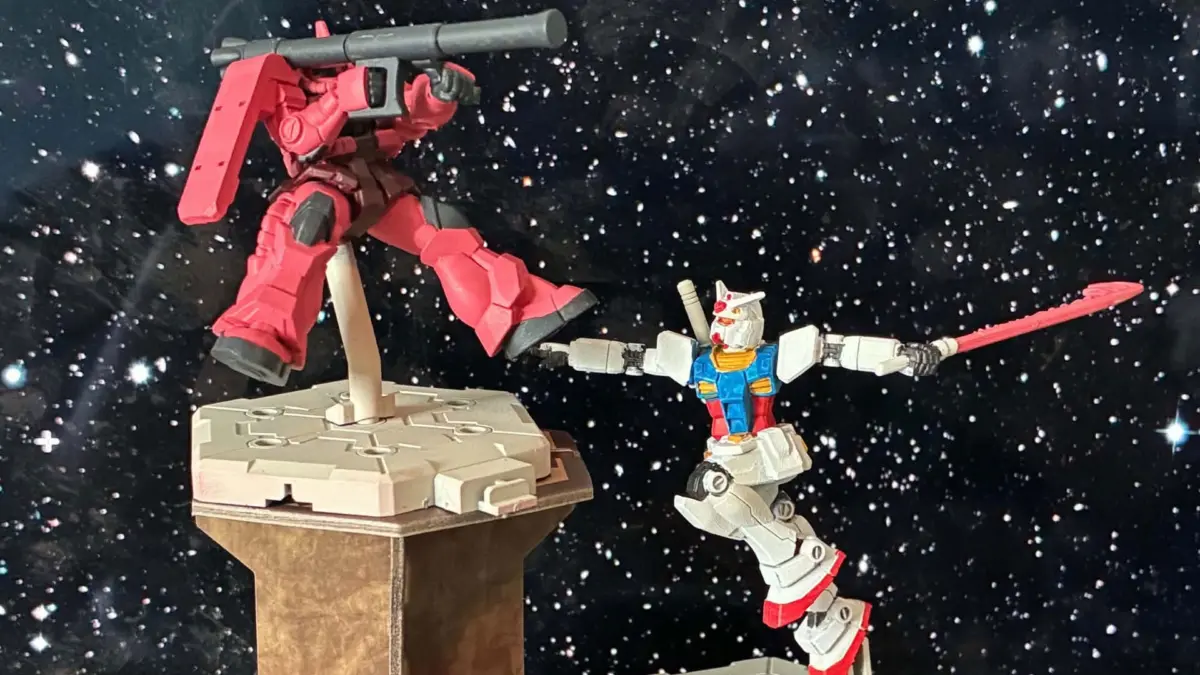
- Dash: Extending movement by an additional two hexes. Certain units—such as Char’s Zaku—can integrate offensive maneuvers into dashes, executing devastating momentum-based strikes like the "Char Kick."
- Energize: Equipping the unit with an energy token to fuel advanced abilities later in the match.
- Rescue: Securing friendly garrison tokens scattered across the map. Successfully extracting garrisons yields VPs and can trigger passive buffs; for instance, the RX-78-2 possesses a command ability that permanently increases its base strength by one for every garrison successfully rescued.
- Command Abilities: Printed directly on unit cards, these specialized maneuvers require specific prerequisites and energy expenditures, demanding careful foresight.
- Tactics Cards: One-time-use modifier cards drawn at the start of matches and replenished between phases. These range from emergency hull repairs to reactive counter-attacks and novel offensive options.
Combat Resolution and Defense
Combat in Gundam Assemble is designed for speed and clarity. When an enemy unit enters range, the attacking player resolves an attack by rolling a pool of ten-sided dice (d10s) determined by the weapon’s printed strength stat.
- Hits: Rolls of 4 or higher constitute a standard hit, translating to one point of damage.
- Critical Hits: Rolls of 9 or 10 trigger critical success effects, inflicting bonus damage or imposing debilitating negative status conditions on the target.
Notably, Gundam Assemble eliminates traditional defensive rolls, saving throws, or complex cover calculations. Instead, mitigation relies on Shield tokens. Players acquire Shields via chance pickups, command abilities, or tactics cards. Each Shield token acts as a passive safeguard that nullifies one incoming hit. Once expended, Shields become exhausted and must be reactivated at the start of the unit’s next turn.
If a mobile suit’s health drops to zero, it is destroyed, granting the victorious opponent VPs as listed on the unit card. However, permanent destruction is absent; the defeated unit’s token advances two spaces on the timeline, allowing the mech to redeploy following "repairs," retaining any accumulated upgrades or energy tokens.
Supporting Context & Metrics
The development and market positioning of Gundam Assemble reflect broader shifts in the tabletop gaming ecosystem, particularly regarding material accessibility, cost efficiency, and cross-media synergy.
The Gunpla Heritage: Snap-Fit Simplicity
The primary obstacle for newcomers entering the wargaming hobby is the labor-intensive trinity of cutting, gluing, and painting. Gundam Assemble circumvents much of this friction by adopting Bandai’s proprietary snap-fit methodology.
Drawing directly from the engineering principles of Gunpla, the miniatures arrive on sprues with components designed to be cleanly excised and locked securely into place without chemical adhesives. While these parts are significantly reduced in scale compared to standard High Grade (HG) or Master Grade (MG) model kits—necessitating precision hobby nippers to minimize error—the resulting figures retain a surprising degree of mechanical fidelity and panel detail.
However, this streamlined assembly trades away individualized customization. Rather than offering interchangeable limbs, weapons, or modular parts that players can mix and match, Gundam Assemble relies on pre-posed variants across different product releases. For example, while the starter set features the RX-78-2 Gundam mid-beam-saber strike, a separate Paint Pack variant depicts the same mobile suit brandishing a beam rifle. While purists who enjoy deep kit-bashing might find this restrictive, it drastically lowers the learning curve for hobby novices.
Painting: Demystifying the Miniature Palette
Painting miniatures remains an intimidating threshold for many enthusiasts, but Gundam Assemble benefits inherently from the aesthetic conventions of the Gundam universe. Mobile suits generally feature clean, monochrome color blockings accented by distinct chromatic highlights. Crucially, painters do not have to struggle with organic flesh tones, eyes, or complex organic textures.
To assist beginners, the starter set includes an explicit painting guide within its instruction manual. While dedicated product lines like the Gundam Assemble Paint Pack are available, standard water-based acrylic model paints—and custom color-mixing—yield professional-looking results with minimal effort, provided the miniatures are properly primed beforehand.
Comparative Market Metrics
From an economic perspective, Gundam Assemble occupies a highly competitive tier within the skirmish wargaming market:
| Game System | Starter Set Price Point | Average Miniature Count / Scope | Assembly Requirements |
|---|---|---|---|
| Gundam Assemble (Standard) | ~$35 | ~6 Mobile Suits (3v3 Skirmish) | Snap-fit (No glue required) |
| Gundam Assemble (Deluxe) | ~$100 | ~12 Mobile Suits | Snap-fit (No glue required) |
| Warhammer 40K: Kill Team | ~$118+ | Full specialized squad + terrain | Glue, clippers, extensive prep |
| Star Wars: Legion | ~$99+ | Armies / large squad setups | Glue, advanced hobby tools |
| HeroClix / X-Wing | Variable | Pre-painted miniatures | None (Ready to play) |
By offering a standard starter tier at $35—comparable to the price of a single mid-tier HG Gunpla kit—Bandai has effectively positioned Gundam Assemble as an impulse-buy entry point for both anime fans and curious tabletop gamers. For dedicated collectors seeking immediate expansion, a Deluxe Starter Set is available for approximately $100, doubling the miniature count, while specialized expansion packs featuring fan-favorite units retail around $40.
Future Outlook
Gundam Assemble is slated for its initial retail rollout this fall, with an aggressive pipeline of expansion packs and modular sets already scheduled for release into early next year. This steady cadence of product deployment is vital for maintaining momentum in the collectible miniatures market.
The game’s dual announcement alongside the Gundam Card Game underscores Bandai Namco’s coordinated strategy to saturate physical gaming spaces with interconnected intellectual property. By utilizing the card game and miniatures game as visual and thematic companions, the company is cultivating an interconnected ecosystem where fans of the animation timeline can explore tactical tabletop engagement from multiple angles.
Going forward, the success of Gundam Assemble will likely hinge on the breadth of its mobile suit roster and the frequency of faction expansions. The Gundam metaseries spans decades of alternate timelines and Universal Century lore—from Mobile Suit Zeta Gundam and Mobile Suit Gundam Wing to Iron-Blooded Orphans—providing an inexhaustible reservoir of mechanical designs ready for adaptation into the game’s streamlined hex-based framework.
For veterans exhausted by the prohibitive time investments of traditional wargames, and for newcomers intimidated by complex rulebooks and painting requirements, Gundam Assemble offers a refreshing, highly strategic, and economically viable alternative. It successfully translates the aesthetic thrill of piloting giant robotic weaponry into a brisk, accessible tabletop format that is well-positioned to make a lasting impact upon its release.